
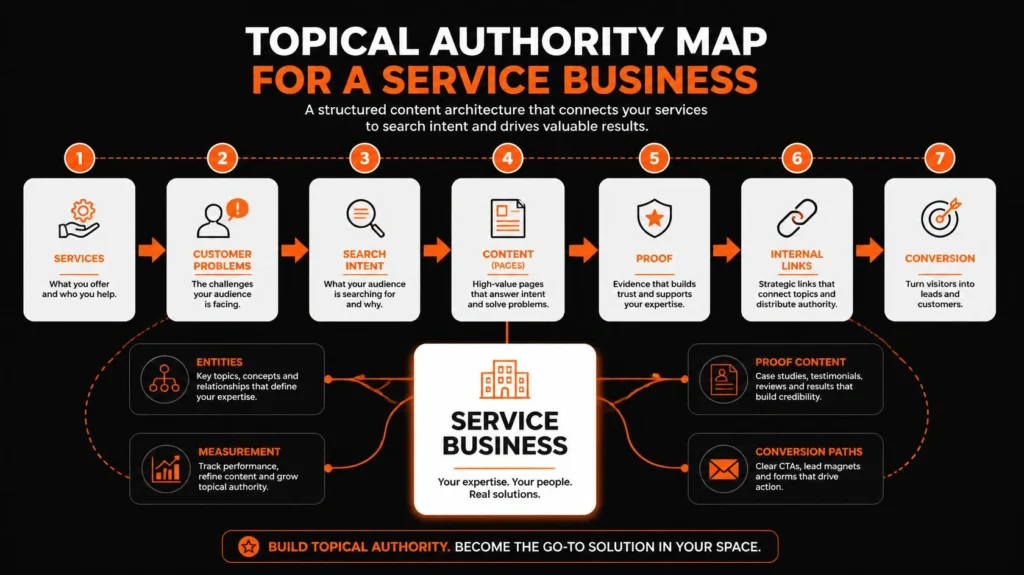
A topical authority map is a strategic plan that connects your services, customer problems, search intent, website pages, supporting content, entities, internal links, and business goals.
For a service business, the objective is not to publish as many articles as possible. The objective is to make sure important customer questions have the right home on your website, while related pages support each other and lead naturally toward your services.
A practical model is:
Service → Problem → Intent → Page → Proof → Link → Action
This guide explains how to build that map, how to decide whether a topic needs its own URL, how to avoid content overlap, how to prioritize what to publish, and how to connect informational content with commercial pages.
What Is a Topical Authority Map?
A topical authority map is a structured content architecture that organizes a website around a focused subject, its related entities, customer questions, search intents, pages, and relationships between those pages.
A keyword list answers:
What do people search for?
A keyword map answers:
Which keyword belongs to which URL?
A topical authority map answers a broader question:
What should the website cover, which page should own each important search need, and how should those pages work together?
That difference becomes important as a service website grows.
Consider a roofing company targeting:
- roof repair
- roof replacement
- leaking roof
- roof repair cost
- roof replacement cost
- storm damage
- roof inspection
- repair or replace roof
That does not automatically mean eight pages are needed.
Some searches may represent the same intent. Others may require genuinely different answers.
The topical map helps you make that decision before creating URLs.
Topical Map vs Keyword Map
These are related but different tools.
| Keyword Map | Topical Authority Map |
|---|---|
| Assigns keywords to URLs | Defines the broader content architecture |
| Mainly page-focused | Business, topic, intent and relationship-focused |
| Helps organize keyword targeting | Helps decide what pages should exist |
| Useful for preventing targeting conflicts | Useful for planning coverage and hierarchy |
| Usually tactical | Strategic and tactical |
For example:
Keyword map:
“roof repair” → /roof-repair/
Topical map:
Roof repair → leaking roof → repair cost → repair vs replacement → service page → case study → internal links → enquiry path
The keyword map is one component of the larger system.
Topical Map vs Content Cluster vs Sitemap
These terms are often confused.
| Structure | Purpose |
|---|---|
| Topical map | Plans the subject architecture |
| Content cluster | Groups related pages around a narrower topic |
| Keyword map | Assigns keyword themes to URLs |
| XML sitemap | Helps search engines discover existing URLs |
A content cluster might contain one commercial service page and several supporting articles.
A topical map can contain several content clusters.
A sitemap does something different. It lists URLs that exist. It does not determine whether those URLs are strategically useful.
Why Service Businesses Need a Topical Authority Map
A service customer rarely starts and finishes with one query.
Someone looking for an HVAC company might search:
“Why is my AC not cooling?”
Then:
“Can an AC be repaired?”
Then:
“How much does AC repair cost?”
Then:
“AC repair near me.”
The search intent changes as the customer gets closer to a decision.
The first query is problem-solving.
The second is diagnostic and educational.
The third is commercial investigation.
The fourth is local and commercial.
A useful website can support that entire journey without forcing every query onto one service page.
The service page can own the main commercial intent.
A problem-solving article can answer the earlier question.
A cost guide can address pricing factors.
A comparison page can help someone decide between repair and replacement.
A legitimate local page can address genuine service-area intent.
Internal links then connect those resources.
This is the foundation of a service-business content architecture.
My Content Strategy & SEO Content Writing Service is built around the same principle: content should support search intent, topical coverage, service pages, internal links, and business goals rather than exist as isolated articles.
The Service-Business Topical Map Framework
Use this model when building your map:
Service → Problem → Intent → Page → Proof → Link → Action
Service
What does the business actually sell?
Problem
What situation causes the customer to need that service?
Intent
What is the person trying to understand, compare, solve, or buy?
Page
Which URL should provide the best answer?
Proof
What evidence, expertise, examples, research, or business information can support the answer?
Link
Which related pages should connect to it?
Action
What is the logical next step after the visitor has the information they need?
This framework makes the map useful for both SEO and business planning.
Step 1: Define the Business Context
Start with the business, not the keyword tool.
Document:
- Core services
- Primary customers
- Markets or genuine service areas
- Customer problems
- Commercial priorities
- Existing service pages
- Existing articles
- Existing case studies
- Available evidence
- Main conversion actions
Imagine a bookkeeping company.
Its services may include:
Bookkeeping
Payroll
Tax Preparation
Business Accounting
Financial Reporting
Now identify the problems connected with those services.
For bookkeeping, customers might struggle with:
- overdue records
- unreconciled transactions
- poor visibility into cash flow
- financial administration consuming too much time
- difficulty maintaining accurate books
Those problems create real search questions.
That is the beginning of the topical map.
Google’s current people-first content guidance also emphasizes having a clear site purpose and creating content primarily to help people rather than producing pages mainly to attract search-engine traffic.
Step 2: Map Services, Problems, Entities and Attributes
Take each major service and expand its subject area.
Suppose the service is:
AC Repair
Possible attributes include:
- system type
- problem type
- urgency
- repair complexity
- cost factors
- repair time
- maintenance history
- warranty considerations
Possible customer problems include:
- AC not cooling
- warm air
- unusual noises
- water leaks
- frozen components
- repeated breakdowns
Related entities may include:
- HVAC system
- thermostat
- air filter
- refrigerant
- compressor
- ductwork
- maintenance
- replacement
- installation
The goal is not to repeat these terms throughout the page.
The goal is to understand the relationships.
For example:
AC Repair → solves → cooling problem
Cooling problem → creates → troubleshooting search
Troubleshooting search → leads to → repair decision
Repair decision → may lead to → service enquiry
That is semantic planning in practical terms.
Step 3: Expand Real Customer Searches
After defining the business and its subject relationships, research how customers actually search.
Useful sources include:
- Google Search
- Google Search Console
- autocomplete suggestions
- People Also Ask
- related searches
- customer enquiries
- sales calls
- reviews
- customer support questions
- competitors
- keyword research platforms
My Keyword Research Service can support this stage by connecting search demand with intent, business relevance, competitors, customer problems, content opportunities, and page mapping.
Do not aim to collect hundreds of keywords simply because a tool can export them.
The real objective is to identify meaningful search needs.
Use Query Fan-Out Thinking
Google’s current documentation for AI search describes query fan-out, where related searches can be used to gather information needed to answer a broader user question.
That gives topical mapping an important practical implication.
A broad question can contain several connected information needs.
For example:
“Should I repair or replace my roof?”
may require an explanation of:
- roof age
- damage severity
- repair cost
- replacement cost
- remaining lifespan
- material
- warranty
- inspection
Those concepts all belong in the map.
They do not automatically require separate pages.
Step 4: Cluster by Search Intent
Do not cluster keywords just because the wording looks similar.
Cluster them according to the problem and intent they represent.
Consider:
AC repair
air conditioner repair
AC repair service
Those may all represent the same commercial intent.
Now compare:
why is my AC not cooling?
That search is different.
The searcher is trying to diagnose a problem.
A troubleshooting guide may therefore be a better page type.
A useful test is:
Could one page satisfy both searches properly without becoming too broad, repetitive, or confusing?
If yes, one page may be enough.
If no, inspect the SERP and consider distinct page ownership.
Search intent is one of the strongest tools available for preventing unnecessary page creation.
Step 5: Assign One Clear Owner to Each Important Intent
Now build a page ownership matrix.
| Search Need | Intent | Best Page Type | Page Owner |
|---|---|---|---|
| Main service | Commercial | Service page | AC Repair |
| Problem | Informational | Guide | AC Not Cooling |
| Cost | Commercial investigation | Cost guide | AC Repair Cost |
| Comparison | Commercial investigation | Comparison article | Repair vs Replacement |
| Local service | Local/commercial | Local service page | AC Repair in Austin |
| Proof | Trust | Case study | HVAC Case Study |
Every row has a job.
That is what makes the map operational.
Your On-Page SEO Service is closely related to this stage because page purpose, search intent, structure, headings, internal links, and conversion objectives need to work together.
Step 6: Decide Whether a Topic Needs a New Page
Not every topic deserves a URL.
Create a separate page when:
- the search intent is materially different
- the question needs meaningful depth
- the audience or use case changes
- the topic has clear business relevance
- the SERP consistently indicates a distinct result type
- the existing page would become weaker if the topic were forced into it
Keep the topic on the existing page when:
- it has the same intent
- the answer is short
- it would mostly duplicate existing information
- the topic has little independent value
- the only reason for the page is a keyword variation
This is a much better rule than:
One keyword = one page.
Step 7: Prioritize What to Publish First
Your map will almost certainly contain more ideas than the business can publish immediately.
That is fine.
Do not prioritize only by search volume.
A practical editorial score is:
Priority = Business Relevance + Intent Value + Coverage Gap + Evidence Potential + Conversion Proximity
Score each factor from 0 to 3.
Example:
| Topic | Business | Intent | Gap | Evidence | Conversion | Total |
|---|---|---|---|---|---|---|
| Main service | 3 | 3 | 3 | 2 | 3 | 14 |
| Cost guide | 3 | 3 | 2 | 2 | 3 | 13 |
| Repair vs replacement | 3 | 3 | 3 | 2 | 3 | 14 |
| Industry history | 0 | 1 | 1 | 1 | 0 | 3 |
This is not a Google ranking formula.
It is a planning tool.
It helps the business decide what deserves attention first.
Your SEO Audit Service can also be useful here because an audit can reveal which existing pages should be improved, consolidated, repositioned, or supported before creating more content.
Step 8: Build the Internal-Link Architecture
Internal links should make the site’s relationships easier to understand.
A common service-business structure is:
Problem article → Service page → Conversion page
For example:
Why Is My AC Not Cooling?
↓
AC Repair
↓
Request Service
Another path:
Repair vs Replacement
↓
AC Repair
↓
AC Installation
A broader guide can connect several supporting topics to the same service.
Use descriptive anchors.
Avoid vague links such as “click here” when a more meaningful anchor would explain the destination.
My Technical SEO Service covers technical areas such as site architecture, crawlability, indexation, XML sitemaps, internal linking, redirects, structured data, and other technical foundations.
Step 9: Publish in Dependency Order
A practical publishing sequence is:
Core commercial pages
then
Foundational supporting guides
then
Problem-solving content
then
Comparison and cost content
then
Proof and case studies
then
Long-tail supporting topics
The reason is simple.
Your supporting content needs somewhere useful to lead.
At the same time, a business does not need dozens of blog posts before creating the service page it actually wants customers to visit.
The map should function as an implementation roadmap.
Practical Example: An HVAC Topical Authority Map
Imagine an HVAC business with a priority service:
AC Repair
The map could include:
Core Commercial Page
AC Repair
Owns the main commercial service intent.
Problem Cluster
Why Is My AC Not Cooling?
Why Is My AC Blowing Warm Air?
Why Is My AC Leaking Water?
Why Is My AC Freezing Up?
Why Is My AC Making Strange Noises?
These pages address troubleshooting intent.
Decision Cluster
Should I Repair or Replace My AC?
How Long Does AC Repair Take?
How Do I Choose an AC Repair Company?
These pages help customers evaluate options.
Cost Cluster
How Much Does AC Repair Cost?
What Affects AC Repair Pricing?
These pages address pricing questions without pretending there is one universal price.
Local Cluster
AC Repair in Austin
Emergency AC Repair in Austin
Those pages should only exist where the business genuinely serves those markets and there is useful location-specific information to provide.
The architecture is useful because the pages have different jobs.
How Many Supporting Articles Should One Service Have?
There is no universal number.
One service might need four strong supporting resources.
Another might legitimately need fifteen or more.
The right question is:
What important and distinct customer questions still need a useful answer?
A new article is justified when the topic provides:
- distinct intent
- real customer value
- meaningful depth
- business relevance
- useful evidence or explanation
- a clear relationship with the service
A new article is probably unnecessary when it would simply repeat an existing page using different wording.
The stronger principle is:
Create a page because the searcher needs a different answer, not because the keyword is different.
Should Every Keyword Get Its Own Page?
No.
Imagine these searches:
- bookkeeping service
- bookkeeping services
- bookkeeping company
- outsourced bookkeeping
They may represent one commercial need.
One well-structured page may serve them better than four thin pages.
By contrast:
How does bookkeeping work?
has a different informational purpose.
That could justify a separate guide.
The topical map helps identify that difference before publishing.
How to Avoid Keyword Cannibalisation
Cannibalisation becomes a concern when multiple pages target essentially the same search need without a strong reason for both to exist.
Use this sequence:
Problem → Diagnose → Differentiate or Consolidate → Re-link
First, identify pages with overlapping search themes.
Then compare:
- intent
- page purpose
- search queries
- SERP result types
- content overlap
- internal-link relationships
Then decide whether the pages should:
Remain separate
Be differentiated
Be consolidated
Be repositioned
Do not assume two pages are competing simply because they share one keyword.
Look at the actual user need.
Common Topical Authority Map Mistakes
Starting With Keywords Instead of the Business
Keyword tools can produce enormous lists.
They cannot decide what your business should be known for.
Start with the business.
Then research the language customers use.
Giving Every Keyword a URL
This creates unnecessary pages and can make the website harder to maintain.
Cluster by intent instead.
Ignoring Existing Content
Always inspect the current website before adding a new URL.
An existing page might already own the topic.
The better solution may be improving it.
Publishing Information With No Service Relationship
A service business can publish genuinely useful content that never contributes to its actual customer journey.
Each important supporting topic should have a clear relationship with the wider site.
Making the Pillar Page Huge
A pillar page should provide breadth and orientation.
It should not reproduce every supporting article in full.
Keep the main page useful and focused, then send deeper questions to dedicated resources.
Treating Internal Links as an Afterthought
If links are added only after all content is written, useful relationships can be missed.
Plan major links during the mapping stage.
Publishing for Volume
A larger page count is not automatically stronger topical coverage.
Google’s people-first guidance warns against creating content primarily to attract search traffic, and its spam policies address scaled content abuse where large volumes of low-value content are produced for ranking manipulation.
Quality and usefulness should control expansion.
How to Measure a Topical Authority Map
Do not judge the map only by the position of one keyword.
Measure the topic and business outcomes.
Visibility Metrics
Track:
- impressions
- clicks
- search-query growth
- ranking distribution
- branded versus non-branded visibility
Architecture Metrics
Track:
- important pages with internal links
- orphan pages
- pages with weak relationships
- service pages supported by relevant content
- overlapping page intent
Business Metrics
Track:
- qualified leads
- calls
- form submissions
- consultations
- bookings
- sales opportunities
Traffic is useful, but it is not the only outcome that matters.
A lower-volume commercial page can be more valuable to a business than a high-traffic informational article.
My Conversion Rate Optimization Service can help connect the SEO journey with landing pages, messaging, forms, calls to action, user experience, and measurable business actions.
How AI Search Fits Into a Topical Map
AI search does not mean you need a separate collection of pages called “AI SEO content.”
Google’s current guidance for AI features states that foundational SEO practices remain important for AI Overviews and AI Mode. Google also explains query fan-out as a way related searches can be used to gather information for a broader question.
The practical lesson is straightforward:
Build useful coverage around real questions and relationships.
Suppose someone asks:
“Is it worth repairing my old roof?”
A useful answer may need information about:
- age
- damage
- materials
- repair cost
- replacement cost
- remaining life
- warranty
- inspection
A topical map helps you decide which information belongs together and which deeper questions deserve their own page.
My AEO and GEO Consulting Service focuses on clear answers, entity relationships, useful content structure, evidence, and search visibility across traditional and AI-driven search environments.
Local Service Businesses Need Extra Care
Local service businesses often add another branch:
Service → Location
For example:
Plumbing
Plumbing in Boston
Emergency Plumbing in Boston
However, changing the city name does not automatically create a legitimate new page.
A location page should represent a genuine market or service relationship and contain useful information specific to that location.
That may include:
- real service availability
- local context
- relevant services
- legitimate business details
- useful FAQs
- appropriate internal links
- genuine local proof
Avoid producing large numbers of pages where only the city name changes.
My Local SEO Service is relevant for businesses that need to structure service-area content around genuine local intent.
For businesses relying heavily on Google Maps and local discovery, Google Business Profile Optimization can also support the broader relationship between the website, local business identity, and local search visibility.
Use Case Studies as Evidence
A topical map should identify where authentic proof can strengthen the content.
Useful evidence can include:
- original research
- customer questions
- legitimate case studies
- screenshots
- business data
- documented processes
- expert analysis
- transparent methodology
The rule is important:
Never manufacture evidence.
Do not create fake statistics, fake customers, invented results, or first-hand experience that did not happen.
Your own published mental health practice Local SEO case study provides a real example of connecting search intent, local relevance, service content, internal linking, trust, and business outcomes.
Your accounting firm SEO case study provides another example of building search visibility around a real service business rather than treating keyword research as an isolated exercise.
These examples demonstrate a process. They should not be treated as guarantees that another business will achieve the same outcome.
A Topical Map Should Also Tell You What Not to Publish
This is one of its most valuable uses.
Every proposed topic can be placed into one of four actions:
Keep
The existing page already satisfies the search intent.
Improve
The topic is valuable, but the current page needs stronger coverage.
Consolidate
Two pages overlap enough that a stronger combined resource makes more sense.
Expand
A genuinely new search need exists and deserves a dedicated page.
This creates discipline.
Your map becomes a filter for content ideas instead of an excuse to publish more URLs.
How to Maintain a Topical Authority Map
Your map should evolve with the website.
Review it when:
- services change
- products change
- customer questions change
- Search Console reveals new search patterns
- competitors publish stronger resources
- pages start attracting overlapping queries
- important information becomes outdated
- a new market is entered
A practical maintenance cycle is:
Review → Measure → Improve → Consolidate → Expand
For WordPress websites, the map should also be reviewed alongside technical structure as content grows. My WordPress SEO Service addresses issues such as page structure, indexing, canonicalization, sitemaps, content architecture, and internal links.
And when building or redesigning a website, SEO-Friendly Web Design can help establish a strong page hierarchy and content structure before the site becomes difficult to reorganize.
Topical Authority Map Checklist
Business
- Core services are defined
- Audience is defined
- Customer problems are documented
- Genuine service areas are documented
- Commercial priorities are clear
Research
- Existing pages are inventoried
- Customer questions are collected
- Search intent is reviewed
- Keyword research is completed
- Competitors are analyzed
- PAA and related questions are reviewed
Architecture
- Important intents have clear owners
- Similar searches are clustered
- Different intents receive separate pages where justified
- Pillar and cluster relationships are clear
- Internal links are planned
- Cannibalisation risks are reviewed
Content
- The primary answer appears early
- Important entities are explained
- Examples are specific and useful
- Claims are supported where necessary
- Content provides information gain
- Keywords are used naturally
Conversion
- Supporting content connects to relevant services
- Service pages have a clear next step
- Trust information is easy to find
- Calls to action match the searcher’s stage
- Important pages support a business objective
Maintenance
- Search performance is reviewed
- Outdated content is updated
- Overlapping pages are consolidated when appropriate
- New topics are added only when justified
- Internal links are updated as clusters expand
Frequently Asked Questions
What is a topical authority map?
A topical authority map is a structured plan that organizes a website around its services, customer problems, search intents, entities, pages, supporting content, and internal relationships. It helps determine what the website should cover, which page should own each important search need, and how the pages should connect.
How do you build a topical map?
Start with the business and its services. Map customer problems and entities, collect real search questions, group them by search intent, assign page ownership, prioritize the most valuable gaps, design internal links, and publish in a logical sequence.
What is the difference between a topical map and a keyword map?
A keyword map assigns keyword groups to individual URLs. A topical map is broader and includes services, customer problems, entities, search intent, page types, supporting topics, internal relationships, and business priorities.
Is a topical map the same as a content cluster?
No. A content cluster is a connected group of pages around a narrower subject. A topical map is the larger strategic architecture that can contain several clusters, service pages, case studies, supporting guides, and commercial relationships.
Is a topical map the same as a sitemap?
No. A sitemap is a technical file representing URLs that exist on a website. A topical map is a strategic plan for deciding what should exist and how the subjects and pages should relate.
Should every keyword get its own page?
No. Multiple keywords can belong to one page when they represent the same search intent. A separate page should be created when the searcher needs a materially different answer, use case, audience, or content format.
How many supporting articles should one service have?
There is no fixed number. Create supporting articles for important and genuinely distinct search needs. A smaller service might need only a few strong resources, while a broad service can require many more.
How do you avoid keyword cannibalisation?
Give every important search intent a clear primary page owner. Compare overlapping pages by intent, SERP behaviour, query patterns, content purpose, and internal links. Then differentiate, consolidate, reposition, or keep the pages separate based on what users actually need.
Does a topical map help with AI search?
A useful topical map can make relationships between services, questions, entities, and pages clearer. Google says AI Overviews and AI Mode use core Search systems and that foundational SEO practices remain important. The practical focus should therefore be clear, useful, trustworthy information rather than artificial AI-search tactics.
Can a small service business benefit from a topical map?
Yes. A focused map is especially useful when resources are limited because it helps the business decide which service pages and supporting questions deserve investment first.
How often should a topical authority map be updated?
There is no universal schedule. Review it whenever services, customer needs, search behaviour, competitors, or important website content changes. For an active website, a quarterly strategic review can be a useful starting point.
Related SEO Resources
Continue exploring related SEO resources on this website:
- Content Strategy & SEO Content Writing Service
- Keyword Research Service
- SEO Audit Service
- On-Page SEO Service
- Technical SEO Service
- Local SEO Service
- Google Business Profile Optimization Service
- AEO and GEO Consulting Service
- Conversion Rate Optimization Service
- WordPress SEO Service
- SEO-Friendly Web Design Service
- Pain-Point AEO Content Strategy
- Mental Health Practice SEO Case Study
- Regional Accounting Firm SEO Case Study
Work With Md Mynul Hassan
A topical authority map is useful when it becomes an implementation plan.
I work across SEO, Local SEO, AEO, GEO, content strategy, keyword research, on-page SEO, technical SEO, and search visibility.
You can learn more about my Content Strategy & SEO Content Writing Service or explore my AEO and GEO Consulting Service.
For freelance projects, you can view my Upwork profile or Freelancer.com profile.
You can also connect with me on LinkedIn, YouTube, and Facebook.
Final Takeaway
A topical authority map is not a page-count target.
It is a decision system.
Start with the services.
Map the problems those services solve.
Research the questions customers actually ask.
Group searches by intent.
Give important intents clear page ownership.
Prioritize the strongest opportunities.
Connect the pages with useful internal links.
Then review real performance data to decide what should be improved, consolidated, or expanded.
The strongest topical map is not the one with the most URLs.
It is the one where every important page has a clear reason to exist, every major search need has an appropriate home, and the relationship between useful information and the business’s services is easy to understand.