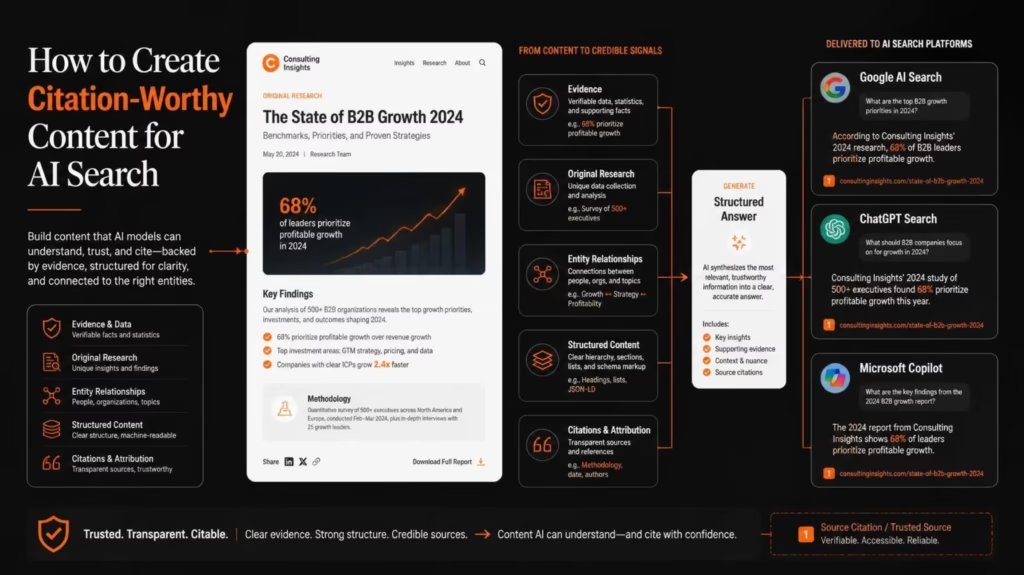
Citation-worthy content is content that gives readers and search systems a clear, useful, well-supported source they can rely on for a specific question, claim, explanation, or decision.
It is not simply content with more keywords, more words, more headings, or more references.
A strong citation-worthy page combines clear answers, relevant evidence, original information, entity clarity, useful context, logical structure, trustworthy sources, and strong technical accessibility.
Google’s current guidance makes an important point: there is no separate technical optimization requirement for appearing in AI Overviews or AI Mode. Pages still need to be accessible to Google Search, indexed, and eligible to appear in traditional Search. Google also emphasizes useful, unique, people-first content rather than special “AI ranking tricks.”
That changes how content should be created.
Instead of asking:
“How do I make AI cite my article?”
A better question is:
“How do I make my article useful enough, clear enough, and trustworthy enough to become a strong source for the answer?”
This guide explains how to do that.
What Is Citation-Worthy Content?
Citation-worthy content is information that can credibly support an answer because it is relevant, understandable, sufficiently original, and supported by appropriate evidence.
A page can rank for a keyword and still be a weak citation source.
For example:
“SEO is important for businesses because it improves visibility and helps companies get more traffic.”
This statement is broad, generic, and difficult to use as meaningful evidence.
A stronger version explains the relationship:
“SEO helps a business make its important pages easier for search engines to discover, understand, and associate with relevant search intent. The quality of the result depends on factors such as technical accessibility, content relevance, website structure, competition, and the searcher’s intent.”
The second explanation contains more useful context.
That is the standard to aim for throughout a citation-worthy article.
For a broader content strategy, see Content Strategy & SEO Content Writing Service.
How Does AI Search Decide What to Cite?
There is no single public citation algorithm used by Google, ChatGPT, Microsoft Copilot, and every other AI search system.
Different platforms have different retrieval, ranking, grounding, and generation systems.
A useful practical model is:
Discovery → Retrieval → Selection → Attribution → Answer
Discovery and indexing
A page cannot become a useful web source if a search system cannot access or understand it.
For Google Search, this means basic technical foundations still matter.
Important areas include:
- Crawlability
- Indexability
- Internal links
- Accessible text
- Canonical URLs
- Site architecture
- Mobile usability
- Page performance
- Appropriate structured data
A technically inaccessible article cannot compensate for excellent writing.
See Technical SEO Service for the technical foundation behind crawling, indexing, sitemaps, canonicals, redirects, internal linking, structured data, and website performance.
Retrieval and query expansion
AI search does not necessarily depend only on the exact words in a user’s question.
Modern systems can interpret a broader information need and retrieve information from related sources.
Google describes this through concepts such as retrieval-augmented generation and query fan-out.
For example, someone may ask:
“How can I make my business more visible in AI search?”
Answering that question may require information about:
- AI search visibility
- traditional SEO
- crawlability
- content quality
- entity information
- source attribution
- customer questions
- internal linking
- structured data
- brand mentions
- measurement
This is why modern keyword research should not stop at finding an exact phrase.
Your Keyword Research Service can connect search intent, topic clustering, semantic concepts, questions, commercial intent, and supporting content opportunities.
Selection and attribution
Being retrieved does not automatically mean being cited.
A system may retrieve several pages and select only some of them for the final answer.
This makes content clarity especially important.
Consider these two sentences:
“It has several advantages.”
and:
“Original research can strengthen an article’s information value because it gives readers findings that may not exist in competing summaries.”
The second statement is much easier to understand without surrounding context.
A useful test is:
Could this paragraph still make sense if it were extracted from the page and shown independently?
When the answer is yes, the passage is more useful for both humans and information-retrieval systems.
What Makes Content Citation-Worthy?
Strong citation-worthy content usually has several characteristics working together.
1. It answers the question directly
Answer-first writing is one of the simplest improvements you can make.
Do not begin a question-based section with three paragraphs about why the topic matters.
Answer it.
Then explain the answer.
For example:
How can you make content easier for AI search systems to understand?
Use clear headings, direct answers, complete explanations, strong entity references, appropriate evidence, descriptive internal links, and accessible text. Then explain why each element matters.
This approach also improves readability for people who scan long articles.
2. It supports important claims with evidence
Not every sentence requires a citation.
A major factual claim does.
A statistic does.
A statement about a search platform’s current behavior usually does.
A legal or regulatory statement does.
A research finding does.
The strongest source depends on the claim.
| Claim | Preferred Source |
|---|---|
| Search-engine feature | Official documentation |
| Platform behavior | Official documentation |
| Statistic | Original dataset or primary research |
| Research result | Original academic paper |
| Regulation | Government source |
| Business result | Documented case study |
| First-hand observation | Clearly identified experience |
| Recommendation | Expert analysis with appropriate qualification |
The goal is not to add references everywhere.
The goal is to connect important claims with the strongest available evidence.
3. It adds information that competitors do not provide
A citation-worthy article needs information gain.
Information gain can come from:
- Original research
- First-hand observations
- A unique framework
- Practical examples
- Original calculations
- A documented workflow
- Decision criteria
- Comparison tables
- Troubleshooting
- Case studies
- Limitations
- Fresh platform information
A useful question to ask before publication is:
What will the reader learn here that they probably would not learn from three generic articles about the same topic?
If the answer is “nothing,” the article needs more value.
4. It clearly identifies entities
A strong article does not repeatedly use vague references such as:
“the platform”
“the system”
“they”
“the tool”
Name the entity.
Instead of:
“They introduced AI search reporting.”
write:
“Bing Webmaster Tools introduced AI Performance reporting for supported Microsoft AI experiences.”
Entity clarity matters because extracted content can lose the surrounding context.
Clearly named entities also make relationships easier to understand.
For example:
Google Search → provides → Search Console
Bing Webmaster Tools → reports → AI citation activity
AI search → retrieves → web sources
Original research → provides → unique evidence
This is semantic SEO in practical form.
5. It provides enough context
A statistic without context is often weaker than a smaller but properly explained finding.
Weak:
“AI visibility increased by 40%.”
Better:
“The researchers reported an improvement within their experimental evaluation, using their defined visibility metric and tested content conditions.”
The second statement prevents the reader from assuming that the number represents every website, query, platform, and business.
Never turn an experiment into a universal promise.
6. It makes source relationships obvious
A reference list at the end of an article is useful, but important claims should still be connected naturally to their sources.
For example:
Google states that AI Overviews and AI Mode use core Search systems and that pages need to meet normal Search eligibility requirements.
The relationship is obvious:
Claim → Source → Context
That is much stronger than adding ten unrelated links under a heading called “Sources.”
7. It uses structure for understanding
Use:
- Clear H2s
- Useful H3s
- Short paragraphs
- Numbered steps
- Lists
- Comparison tables
- Examples
- Checklists
But do not turn every paragraph into a two-sentence “AI block.”
Structure should make the page easier to use.
Google does not require a special writing format or a particular word count for AI Search.
8. It stays accurate and current
Citation-worthy content can lose value when its facts become outdated.
This is particularly important for:
- SEO
- AI Search
- Search features
- Software
- Statistics
- Pricing
- Regulations
- Platform policies
- Marketing technology
When something changes, update the underlying information.
Do not add a new date to an article while leaving outdated information untouched.
How to Create Citation-Worthy Content Step by Step
Step 1: Start With the Searcher’s Problem
Do not begin with keywords.
Begin with the problem.
For this topic:
Problem: A business wants its content to become a useful source in AI-powered search results.
From there, identify what the reader needs to understand.
Step 2: Identify the Main Search Intent
For “citation-worthy content,” the dominant intent is informational.
The reader wants to understand:
- What citation-worthy content means
- Why it matters
- What makes a source useful
- How to create it
- What evidence should be included
- How to structure the page
- How to measure AI visibility
Once the intent is clear, unnecessary sections become easier to remove.
Step 3: Expand the Query Into Related Questions
Build a query fan-out before drafting.
Questions may include:
- What makes content citation-worthy?
- How does AI search select sources?
- Does original research help?
- How should statistics be cited?
- Does structured data matter?
- Do internal links matter?
- Does
llms.txthelp Google? - How can AI citations be measured?
- How often should content be updated?
Do not create a separate page for every question.
Some belong on the pillar page.
Others deserve deeper cluster articles.
Step 4: Build an Evidence Inventory
Before writing, list the important claims.
Then assign an evidence type.
Use this structure:
Claim → Source → Date → Evidence Type → Confidence
For example:
| Claim | Evidence Type |
|---|---|
| Google AI search uses query fan-out | Official Google documentation |
| ChatGPT Search provides web sources | Official OpenAI documentation |
| Bing reports AI citation activity | Official Bing documentation |
| GEO can affect generative-search visibility | Academic research |
This makes fact checking much easier.
Step 5: Write the Direct Answer First
For every important question, write the answer first.
Then add:
Explanation → Evidence → Example → Limitation → Action
This structure works especially well for AEO content.
Step 6: Add Original Information
This is where you move beyond generic SEO writing.
Create something useful that reflects your analysis.
For example:
The Claim-to-Source Framework
Use six stages:
Claim → Context → Evidence → Attribution → Interpretation → Action
Claim
What exactly are you saying?
Context
What conditions make the claim true?
Evidence
What supports it?
Attribution
Who produced the evidence?
Interpretation
What does it actually mean?
Action
What should the reader do with the information?
This framework prevents a common content problem: presenting a fact without enough information to interpret it correctly.
Step 7: Improve Entity Clarity
Name important entities consistently.
For example:
Use Google AI Overviews rather than repeatedly writing “Google’s AI thing.”
Use Bing Webmaster Tools instead of “Bing’s tool.”
Use the full organization or platform name the first time, then use a shorter form when the meaning remains clear.
Step 8: Strengthen Internal Links
Internal links should connect related concepts.
They should answer the reader’s next question.
For example:
Someone reading about technical accessibility may need Technical SEO Service.
Someone researching content production may need Content Strategy & SEO Content Writing Service.
Someone looking for AI search strategy may need AEO and GEO Consulting.
Someone researching measurement can continue to Best AEO Tools for Businesses to Track AI Visibility.
Every link should have a reason.
Step 9: Make the Author and Business Clear
For professional content, make it obvious:
- Who wrote the article
- What the author specializes in
- What organization or brand publishes it
- When it was published
- When it was updated
- Which sources support important factual claims
Do not invent qualifications.
Do not manufacture experience.
Do not add fake case studies.
Authenticity is more valuable than artificial EEAT signals.
Step 10: Review the Page After Publication
Publishing is not the final step.
Review:
- Organic impressions
- Clicks
- Search queries
- Indexed status
- Internal links
- AI visibility
- Cited pages
- Relevant prompts or grounding queries where available
- Leads and conversions
Your SEO Audit Service can be used when a broader website diagnosis is necessary.
The Claim-to-Source Framework in Practice
Consider this statement:
“Original research is good for SEO.”
That is too broad.
A better structure is:
Claim: Original research can make content more distinctive.
Context: The research should be relevant to the audience and topic.
Evidence: Document the method, source, sample, date, calculations, and findings.
Attribution: Identify who conducted the research.
Interpretation: Explain what the result does and does not demonstrate.
Action: Show readers how they can use the finding.
That gives the reader something much more valuable than the original sentence.
What Does Not Make Content Citation-Worthy?
Keyword stuffing
Repeating a phrase twenty times does not create evidence.
Keywords should help define the subject and align the page with search intent.
Writing longer than necessary
A 3,500-word article is not automatically better than a 1,800-word article.
Length should follow topic complexity.
Adding fake references
A source should genuinely support the statement being made.
Never add a citation because an article “looks more authoritative” with references.
Publishing generic AI rewrites
Changing wording without adding information is not information gain.
A rewritten competitor article is still a generic article.
Artificial mentions
Trying to manipulate references, mentions, or links simply to create the appearance of authority is not a reliable content strategy.
Creating llms.txt solely for Google rankings
Do not treat llms.txt as a required Google AI ranking mechanism.
Google’s current documentation does not require it for AI Overviews or AI Mode.
Excessive content chunking
There is no reason to turn every paragraph into an isolated sentence block just because someone claims AI systems prefer “chunks.”
Write naturally.
Use sections when they improve comprehension.
Creating hundreds of near-duplicate pages
Publishing many pages targeting tiny variations of the same intent can create duplication and cannibalization.
Each page should have a distinct purpose.
Does Original Research Help Make Content Citation-Worthy?
Yes, when it is genuinely useful and properly documented.
Original research can provide information that does not already exist in thousands of competing articles.
Examples include:
- Original surveys
- First-party datasets
- Website audits
- Experiments
- Benchmarks
- Comparisons
- Calculations
- Case-study findings
- Documented implementation results
But original research is not automatically authoritative.
The methodology matters.
Suppose you analyze 100 pages and report that 78 contain a particular issue.
A credible research section should tell the reader:
- What pages were analyzed
- When the analysis occurred
- How pages were selected
- What was measured
- How the result was calculated
- What limitations exist
That creates a research asset.
The number alone does not.
For trust-focused content, see Reviews, Testimonials & Case Studies for AEO and SEO.
Can First-Hand Experience Improve Citation-Worthy Content?
It can, provided the experience is real and clearly presented.
For example:
“During a website audit, I found that several important service pages were difficult to reach through the site’s internal navigation.”
This is an observation.
It should not become:
“All websites have this problem.”
The first statement is a documented experience.
The second is an unsupported generalization.
First-hand experience is most useful when you explain:
Situation → Problem → Diagnosis → Action → Result → Limitation
This turns experience into useful evidence.
Your AEO for Service Businesses content also provides a natural example of connecting customer questions, business information, and answer-focused content.
How Important Are Internal Links for Citation-Worthy Content?
Internal links do not magically make an article more citable.
Their value is contextual.
A good internal link helps search engines and readers understand how one page relates to another.
For example:
Citation-worthy content → content strategy
Citation-worthy content → AEO/GEO consulting
Citation-worthy content → technical SEO
Citation-worthy content → keyword research
Citation-worthy content → AEO measurement
This creates a more understandable topical architecture.
Your On-Page SEO Service also covers internal linking, page structure, relevance, search intent, metadata, and content organization.
Does Structured Data Make Content Citation-Worthy?
Not by itself.
Structured data can help search engines understand what a page represents.
It does not transform weak content into credible evidence.
For this type of article, appropriate structured data may include:
- Article or BlogPosting
- Person
- BreadcrumbList
The structured data should accurately represent visible information.
Do not use it to invent:
- Reviews
- Ratings
- Authors
- Locations
- Organizations
- Credentials
- Services
- Dates
Structured data supports understanding.
It does not replace quality.
Does llms.txt Help Google AI Search?
No special llms.txt file is required for Google AI Search.
Google’s current documentation says websites do not need special AI text files or special AI markup to appear in AI features.
The foundation remains:
- Crawlable pages
- Indexable content
- Useful information
- Clear site structure
- Strong internal links
- Accessible text
- Appropriate structured data
That is a much better investment than chasing unverified AI-search shortcuts.
How Can You Measure AI Search Citation Visibility?
AI visibility should not be treated as identical to traditional rankings.
A website can rank in Google and receive little AI citation visibility.
A page can also appear as a cited source without producing the same traffic pattern as a traditional blue-link result.
This is why measurement needs several layers.
| Layer | What to Measure |
|---|---|
| Technical | Indexing and crawlability |
| Organic Search | Impressions, clicks, queries |
| AI Visibility | Cited pages and AI appearances |
| Citation Quality | Relevance of source attribution |
| Business | Leads, enquiries, sales, qualified visits |
Google has introduced generative AI performance reporting through Search Console, while Bing Webmaster Tools provides AI Performance reporting for supported Microsoft AI experiences.
Your Best AEO Tools for Businesses to Track AI Visibility article can be used as a deeper resource for the measurement layer.
Can a Page Be Good for SEO but Weak for AI Citation?
Yes.
Traditional SEO quality and AI citation usefulness overlap, but they are not identical.
A page might have:
- A good title
- Strong technical SEO
- Good rankings
- Correct metadata
and still provide little useful evidence.
For example, an article may summarize information that exists everywhere else without adding original analysis or clear sourcing.
The page can be optimized.
The information can still be ordinary.
Citation-worthy content needs both:
Discoverability + Source Value
A Practical Before-and-After Example
Before
AI search is becoming more important for businesses. Companies should optimize their content with keywords, FAQs, schema and backlinks to increase their chances of appearing in AI results.
After
AI search systems depend on accessible information and relevant sources, but there is no single “AI optimization” tactic that guarantees citation. A stronger strategy is to make important information easy to discover, understand, verify and connect with the user’s question. That means combining strong SEO foundations with clear answers, relevant entities, evidence, useful internal links, and original information.
The second version is better because it:
- Avoids an unsupported guarantee
- Explains the relationship between SEO and AI search
- Uses explicit concepts
- Answers the problem directly
- Gives a practical direction
- Avoids keyword stuffing
How to Build a Citation-Worthy Content Workflow
A repeatable workflow can look like this:
Research
Study the search intent, current SERP, related questions, authoritative sources, competitors, entities, and information gaps.
Plan
Map the primary question, secondary questions, entities, evidence requirements, internal links, and conversion path.
Draft
Write the direct answer first.
Then add explanation, evidence, examples, limitations, and actions.
Verify
Check factual claims, statistics, dates, source quality, links, author information, and structured data.
Improve
Remove filler, repeated definitions, weak claims, generic transitions, unsupported statements, and unnecessary keyword repetition.
Publish
Make sure the page is crawlable, indexable, internally linked, technically sound, and connected to relevant supporting content.
Measure
Review Search Console, AI visibility data, cited pages, relevant queries, conversions, and user behavior.
Update
Change the page when its underlying information changes.
Citation-Worthy Content Checklist
Before publishing, use this checklist.
Search Intent
- Does the article answer the primary search question?
- Does the introduction provide the answer quickly?
- Are major secondary intents covered?
- Are useful follow-up questions answered?
Evidence
- Are important factual claims supported?
- Are statistics sourced and dated?
- Are primary sources preferred where available?
- Are research findings represented accurately?
- Are limitations explained?
Originality
- Does the article add information gain?
- Is there a framework, example, calculation, observation, or process?
- Is the content independently organized?
- Has competitor wording been avoided?
Entity SEO
- Are important entities named clearly?
- Are relationships between entities understandable?
- Is the author identifiable?
- Is the business information consistent?
AEO
- Are important questions answered directly?
- Can important passages stand alone?
- Are headings descriptive?
- Are concise answer blocks used where appropriate?
Technical SEO
- Is the page indexable?
- Is the canonical correct?
- Is the URL clean?
- Are important pages internally linked?
- Is the page usable on mobile?
- Does structured data match visible content?
For WordPress sites, WordPress SEO Service can support platform-specific technical and on-page implementation.
Performance
- Are images optimized?
- Is unnecessary JavaScript minimized?
- Are important pages responsive?
- Are Core Web Vitals issues addressed where relevant?
See Website Speed Optimization Service for a deeper performance workflow.
Maintenance
- Are current platform claims still accurate?
- Are outdated statistics removed?
- Are old references still valid?
- Are new supporting pages linked?
- Does the article still satisfy the searcher’s intent?
Frequently Asked Questions
What makes content citation-worthy?
Citation-worthy content gives a clear and useful answer while providing enough evidence, context, originality, and entity clarity to make important information understandable and verifiable.
How do I make my content easier for AI search systems to cite?
Use clear headings, direct answers, complete explanations, relevant entities, credible evidence, descriptive internal links, accessible text, and genuinely useful information. Avoid unsupported claims, keyword stuffing, artificial mentions, and generic rewrites.
Does original research help AI citations?
Original research can make content more distinctive and useful because it contributes information that may not already exist elsewhere. Its value depends on relevance, methodology, documentation, quality, and discoverability. It is not a guaranteed AI citation method.
Do citations and references improve AI search visibility?
Good source attribution can make factual information easier for readers to verify and understand. References should support actual claims rather than being added simply to make a page appear authoritative.
Does schema help AI citations?
Structured data can help search engines understand page entities and content types, but it is not a guaranteed AI citation signal. The markup must accurately represent the visible content.
Does llms.txt help Google AI Search?
Google does not require llms.txt for AI Overviews or AI Mode. Websites should prioritize crawlability, indexability, useful content, clear structure, internal links, and other established Search fundamentals.
Can a page rank well but still not be cited by AI?
Yes. Ranking and citation are different outcomes. A page can rank for a query while offering little unique information or evidence that would make it a strong source for an AI-generated answer.
How do I measure AI citations?
Use available platform reporting such as Google Search Console’s generative AI performance reporting and Bing Webmaster Tools’ AI Performance reporting. Also track organic visibility and business outcomes so AI visibility is interpreted in context.
How often should citation-worthy content be updated?
Update it whenever important underlying information changes. Freshness should be based on the subject’s rate of change rather than an arbitrary schedule.
Does longer content have a better chance of being cited?
Not necessarily. Content should be as long as required to satisfy the topic properly. Additional words do not create value when they simply repeat information.
Build Content That Deserves to Be Used
Citation-worthy content is not created by chasing one hidden AI ranking factor.
It comes from building a stronger source.
Start with the searcher’s actual problem.
Give the answer directly.
Explain the subject clearly.
Support important claims with appropriate evidence.
Name important entities.
Add original information where you genuinely have it.
Connect related pages through useful internal links.
Keep the technical foundation accessible.
Measure what happens after publication.
Then improve the page based on evidence.
For businesses that need help connecting content strategy with AEO, GEO, semantic SEO, entities, internal linking, and search visibility, see AEO and GEO Consulting.
You can also continue researching through the AEO FAQ Hub and How to Use Customer Pain Points to Create AEO Content.
For professional work and collaboration:
Upwork
Freelancer.com
LinkedIn
YouTube
Facebook
The most useful standard to remember is:
Be relevant enough to retrieve, clear enough to understand, useful enough to select, and trustworthy enough to cite.
That is the foundation of citation-worthy content for AI search.