For years, service businesses have focused on one primary SEO goal: ranking higher on Google.
That still matters.
But search is changing.
People are no longer using search engines only to find websites. They are also asking AI-powered search and answer systems questions such as:
“Who should I hire for SEO?”
“Which lawyer is best for my business?”
“Who is a reliable contractor near me?”
“Which accounting firm should I choose?”
“What is the best agency for this type of project?”
This creates a new challenge for service businesses.
It is no longer enough to simply have a website with keywords.
Your business needs to be easy to understand, relevant to the search, supported by useful information, and trustworthy enough to become a strong candidate for recommendation.
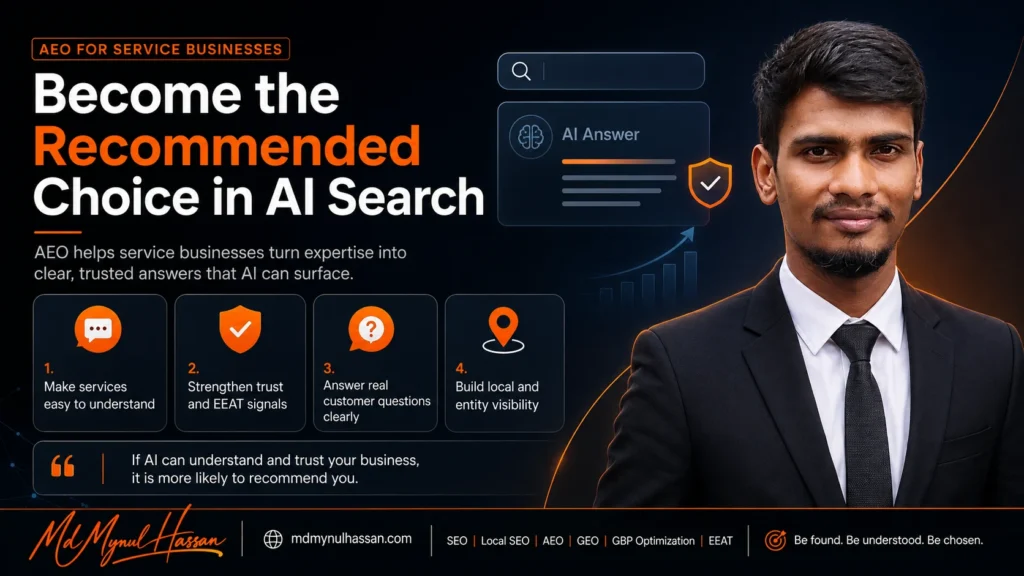
This is where Answer Engine Optimization (AEO) becomes increasingly important.
From my experience working on practical SEO strategies over the last 2 years, I have noticed that many businesses already have websites, service pages, Google Business Profiles, and content.
Yet they still struggle with visibility, qualified traffic, calls, leads, and trust.
In many cases, the problem is not simply rankings.
The bigger problem is clarity.
Does your online presence clearly explain what your business does, who you help, what problems you solve, where you operate, what makes you qualified, and why a customer should choose you?
That is the foundation of modern search visibility.
What Is AEO for Service Businesses?
Answer Engine Optimization is the practice of creating and structuring information so that answer engines and AI-driven search systems can better understand a topic, business, service, and its relevance to a user’s question.
For a service business, this means creating content that answers the questions people ask before they contact or hire a provider.
Traditional SEO might focus heavily on a keyword such as:
“local SEO consultant”
A broader AEO approach also considers questions such as:
- What does a local SEO consultant do?
- When should a business hire a local SEO consultant?
- How much does local SEO cost?
- What should I look for when choosing an SEO consultant?
- Can local SEO improve Google Maps visibility?
- What is the difference between Local SEO and traditional SEO?
These questions reveal search intent.
They also give your business opportunities to demonstrate expertise.
That is why I don’t treat AEO as simply another keyword strategy.
I see it as part of a broader search visibility system.
Why AEO Matters for Service Businesses
A service business usually has a longer decision-making process than a simple product purchase.
Someone may compare several providers before contacting one.
They may search Google.
They may check Google Maps.
They may read reviews.
They may visit your website.
They may compare your services.
They may search questions about your industry.
They may ask an AI system for recommendations.
Every one of those interactions can influence the final decision.
This means your digital presence needs to answer more than:
“What service do you provide?”
It should also answer:
“Why should I trust you with this problem?”
That distinction is important.
Service buyers are looking for confidence
Imagine someone needs a lawyer.
They are unlikely to choose a provider simply because the website contains the phrase “lawyer.”
They may want to know:
- What type of cases does the lawyer handle?
- Where do they operate?
- What experience do they have?
- What should someone expect during the process?
- What questions should a client ask before hiring?
- What are common mistakes?
- What makes one provider different from another?
The same principle applies to consultants, agencies, accountants, contractors, clinics, home-service businesses, and other professional services.
AEO gives you a framework for answering these questions clearly.
AEO Does Not Replace SEO
One of the biggest misconceptions I see is treating AEO as something completely separate from SEO.
I don’t see it that way.
AEO should work together with traditional SEO.
A strong service-business search strategy can connect:
SEO + Search Intent + Local SEO + Google Business Profile + Google Maps SEO + Content + Topical Authority + Internal Linking + EEAT + AEO + GEO
Traditional SEO still provides the foundation.
Technical SEO helps search engines crawl and understand your website.
Keyword research helps identify how your audience searches.
On-page SEO helps align individual pages with search intent.
Content strategy builds topical depth.
Local SEO strengthens geographic relevance.
Google Business Profile optimization supports local visibility.
Internal linking connects related pages.
EEAT helps demonstrate experience, expertise, authoritativeness, and trustworthiness.
AEO focuses on making information useful and understandable for answer-driven searches.
GEO can extend this thinking toward generative search environments.
These areas work better as a system than as isolated SEO tasks.
Start With Search Intent
Before creating content for AEO, understand what the person is actually trying to accomplish.
A person searching:
“SEO”
has very different intent from someone searching:
“SEO consultant for small business”
And that is different again from:
“How much does SEO consulting cost?”
And different again from:
“Who is the best SEO consultant for a service business?”
The keywords may overlap.
The intent does not.
This is why I put significant emphasis on search intent and buyer intent when planning content.
My keyword research service focuses on identifying search terms based on intent, competition, and conversion potential rather than simply collecting large keyword lists.
Think about the questions behind the keyword
Instead of asking only:
What keyword should this page target?
Ask:
What does the person want to know, compare, solve, or decide?
That question often produces much better content.
Build Strong Service Pages
A service page is one of the most important assets for a service business.
Yet I often see service pages that are extremely thin.
For example:
Local SEO Services
followed by two short paragraphs and a contact button.
That does not give a potential customer enough information.
A stronger service page should explain:
- What the service is
- Who it is for
- What problems it solves
- What is included
- How the process works
- What makes the provider qualified
- Common questions
- Important considerations
- Relevant supporting information
- A clear next step
The page should satisfy both the user’s immediate question and the questions they are likely to ask next.
This is one reason I treat SEO as more than keyword placement.
Create Expert-Led Content
Service businesses have an advantage that many generic websites do not have:
real-world experience.
Use it.
If you are a contractor, explain the problems you regularly see.
If you are a lawyer, explain common questions clients ask.
If you are an accountant, explain confusing financial processes in simple language.
If you are an SEO consultant, explain the SEO problems you actually encounter.
This is much stronger than producing generic content simply because a keyword has search volume.
From my own SEO work, one thing I often notice is that businesses have knowledge inside their team but fail to turn that knowledge into useful content.
That is a missed opportunity.
Your experience can become:
- FAQs
- Guides
- Service explanations
- Comparison articles
- Checklists
- Case-study content
- Expert opinions
- Process explanations
- Troubleshooting articles
- Buyer guides
The goal is not to publish everything.
The goal is to publish the information that helps your audience make better decisions.
Use Comparison and Decision-Making Content
Service buyers often compare options before making contact.
That means comparison and decision-stage content can be valuable.
Examples include:
- SEO consultant vs SEO agency
- Local SEO vs traditional SEO
- DIY SEO vs professional SEO
- Google Business Profile management vs one-time optimization
- Freelancer vs agency
- Different service packages
- Questions to ask before hiring a provider
This type of content can demonstrate expertise while helping potential customers understand their options.
It also gives your website more opportunities to address commercial search intent.
Build Topical Authority
Publishing one article about a subject does not necessarily demonstrate deep expertise.
A stronger approach is to build a connected group of useful content around the subject.
For example, a website targeting local SEO could cover:
- Local SEO basics
- Google Maps SEO
- Google Business Profile optimization
- Local keyword research
- Local citations
- Reviews
- Local landing pages
- Local content
- NAP consistency
- Local ranking factors
- Local SEO audits
- AEO for local businesses
These topics are related.
When they are organized properly and connected through internal links, they create a stronger topical structure.
This is where many businesses miss opportunities.
They publish individual articles but do not connect them into a meaningful information architecture.
Internal Linking Is Part of the Strategy
Internal linking is not simply a technical SEO task.
It also helps users move from one question to another.
For example, someone reading about AEO for service businesses may naturally want to learn about:
Google Business Profile optimization
Your internal links should appear where they are genuinely useful.
For example:
Before creating an AEO strategy, I recommend understanding where your current website stands. A detailed SEO audit can identify technical, indexing, content, internal linking, and AI-search visibility issues.
Another example:
AEO content should begin with understanding what your customers actually search for. That is why keyword research and search-intent analysis are important parts of the planning process.
For local service businesses:
If your business depends on local customers, your website should work together with your Google Business Profile optimization strategy.
These are useful internal links because they take the reader to the next logical step.
Local SEO and AEO Should Work Together
For local service businesses, AEO becomes even more interesting.
Consider a search such as:
“Who is the best plumber near me?”
The user is not simply looking for information.
They may be looking for someone to hire.
That means your local search presence matters.
Your website, Google Business Profile, reviews, business information, service pages, local content, and other trust signals should communicate a consistent picture of the business.
My Google Business Profile optimization service focuses on improving how businesses present themselves across Google Maps and local search while strengthening relevant local trust signals.
A well-optimized profile should clearly communicate:
- Business name
- Primary category
- Services
- Location or service area
- Business description
- Hours
- Photos and media
- Reviews
- Q&A information
- Consistent business information
The objective is not simply to add keywords.
The objective is to make the business easier to understand and easier for customers to evaluate.
Reviews Are Important Trust Signals
When people choose a service provider, trust can be a deciding factor.
Reviews can help potential customers understand other people’s experiences.
But reviews should be genuine.
I do not believe in creating fake testimonials, manufacturing customer experiences, or making unsupported claims.
Real reviews, clear business information, authentic experience, and transparent communication are much more valuable in the long term.
For service businesses, trust should not be an SEO costume.
It should reflect the actual business.
Demonstrate EEAT Naturally
EEAT—Experience, Expertise, Authoritativeness, and Trustworthiness—is particularly relevant for service businesses.
Your website should make it easier for people to understand:
Who is behind this business?
What experience do they have?
What do they actually know?
Can I trust their recommendations?
Why should I choose them?
For me, this means being honest about my own work.
I have been working on practical SEO strategies for the last 2 years, focusing on areas such as Local SEO, Google Business Profile optimization, keyword research, on-page SEO, SEO audits, content optimization, topical authority, internal linking, competitor analysis, AEO, GEO, and EEAT-focused search visibility.
I also believe trust means being honest about limitations.
I don’t promise guaranteed rankings.
I don’t invent client results.
I don’t create fake case studies.
I don’t claim revenue increases or ranking percentages unless there is real evidence to support them.
I believe good SEO should be practical, clear, and honest.
Answer Real Customer Questions
One of the simplest ways to improve AEO readiness is to document the questions your customers already ask.
Start with:
Before the customer contacts you
What do they want to know?
Before they compare providers
What information do they need?
Before they buy
What objections or concerns do they have?
After they become a customer
What questions do they usually ask?
These questions can become content opportunities.
For example, a contractor could answer:
- How long does the project normally take?
- What should I prepare before work begins?
- What affects project pricing?
- What questions should I ask a contractor?
- What are common mistakes homeowners make?
A law firm could explain:
- When should someone speak with a lawyer?
- What documents should a client prepare?
- What happens during the initial consultation?
- What common mistakes should clients avoid?
An SEO consultant could explain:
- How long does SEO take?
- What does an SEO audit include?
- What is Local SEO?
- How does Google Maps SEO work?
- What is AEO?
- How should a business prepare for AI search?
These answers demonstrate knowledge while helping potential customers.
Create Content Around the Entire Buyer Journey
AEO should not focus only on informational questions.
A service business should create content for different stages of the decision-making process.
Awareness
The customer is trying to understand a problem.
Examples:
What is Local SEO?
Why is my business not showing on Google Maps?
Consideration
The customer is evaluating solutions.
Examples:
Should I hire an SEO consultant?
How much does Local SEO cost?
Decision
The customer is ready to choose a provider.
Examples:
How do I choose a Local SEO consultant?
What should an SEO service include?
Trust
The customer wants evidence.
Examples:
Who is behind the service?
What experience does the consultant have?
What do previous customers say?
This gives your website a much stronger role in the buying process.
Don’t Forget Technical SEO
AEO does not remove the need for a technically healthy website.
If important pages cannot be crawled, indexed, rendered, or understood properly, excellent content may not achieve its potential.
This is why I still pay attention to:
- Indexing
- Crawlability
- Site architecture
- Canonicals
- XML sitemaps
- Robots directives
- Page speed
- Core Web Vitals
- Mobile usability
- Structured data
- Duplicate content
- Internal linking
- Redirects
My SEO audit service covers technical and indexing issues alongside on-page, content, internal linking, authority, and modern search visibility considerations.
Modern search visibility still needs a strong technical foundation.
What Traditional SEO Gets Right
I don’t think traditional SEO is outdated.
Far from it.
Search engines still need to crawl, understand, evaluate, and rank content.
- Keyword research still matters.
- Technical SEO still matters.
- On-page optimization still matters.
- Links still matter.
- Content quality still matters.
- Search intent still matters.
- What has changed is the environment around search.
- We now have more ways for people to discover information.
- Google Search.
- Google Maps.
- Featured snippets.
- People Also Ask.
- Voice search.
- AI-powered search experiences.
- Answer engines.
- Generative search.
The SEO foundation remains important.
But businesses should think beyond the traditional:
keyword → ranking → click
They should also consider:
question → answer → understanding → trust → decision
Common AEO Mistakes Service Businesses Make
1. Writing only for keywords
A page can contain the target keyword and still fail to answer the customer’s real questions.
2. Creating thin service pages
A service page should explain the service, not simply announce that the service exists.
3. Publishing generic AI-generated content
Content should reflect real expertise and useful business knowledge.
4. Ignoring local signals
Local service businesses need more than website content.
5. Forgetting internal links
Important pages should be connected logically.
6. Making unsupported claims
Trust disappears when businesses exaggerate experience or results.
7. Creating content without search intent
Traffic is not useful if it comes from people who will never need your service.
8. Treating AEO as a shortcut
There is no reliable shortcut that guarantees an AI system will recommend your business.
The stronger approach is to build a genuinely useful and trustworthy online presence.
How I Approach AEO for Service Businesses
When I work on a search visibility strategy, I don’t begin with a checklist.
I begin by understanding the business.
I want to know:
- What does the business actually sell?
- Who is the ideal customer?
- Where does the business operate?
- What problems do customers have?
- What questions do customers ask before buying?
- What competitors are already visible?
- Which pages are currently performing?
- Which pages are missing?
- Is the website technically healthy?
- Are the service pages strong enough?
- Is the Google Business Profile properly optimized?
- Does the content demonstrate genuine expertise?
- Are the important topics connected through internal links?
- Are the trust signals clear?
This is why I look at SEO as a complete visibility system rather than a collection of isolated tasks.
AEO Is Not About Manipulating AI
This is probably the most important point I want to make.
I don’t believe AEO should be about trying to trick AI systems into mentioning your business.
It should be about making your business genuinely easier to understand.
If your website clearly explains:
- What you do
- Who you help
- Where you operate
- What problems you solve
- What you know
- Why customers can trust you
- What your services include
- How people can contact you
then you are building something much more valuable than a temporary optimization trick.
You are building a stronger digital representation of the business.
What Service Businesses Should Do Now
If you are a service business and want to prepare for modern search, I would start with the foundation.
Step 1: Audit your current visibility
Find out what is working and what is not.
Step 2: Understand your customers’ questions
Don’t rely only on keyword volume.
Understand the questions behind the searches.
Step 3: Improve your core service pages
Make them genuinely useful.
Step 4: Build supporting topical content
Answer related questions and cover the subject comprehensively.
Step 5: Strengthen internal linking
Connect related service pages and informational content.
Step 6: Improve local signals
For local businesses, optimize your Google Business Profile and local presence.
Step 7: Strengthen trust
Show real experience, real reviews, clear business information, and transparent expertise.
Step 8: Continue measuring and improving
AEO is not a one-time setup.
Search behavior changes.
Businesses change.
Competitors change.
Your content should evolve too.
Final Thoughts
Many businesses think their SEO problem is simply:
“We are not ranking high enough.”
Sometimes that is true.
But from my experience, the deeper problem is often that the business is not communicating its value clearly enough online.
A website may have the right keywords but still fail to explain the business.
A Google Business Profile may exist but not communicate strong local relevance.
A blog may contain dozens of articles but lack topical structure.
A service page may exist but not answer the questions customers actually have.
And a business may have genuine expertise but fail to demonstrate it online.
That is why I believe modern SEO needs to move beyond rankings alone.
Your business should be:
Easy to find.
Easy to understand.
Easy to trust.
Easy to choose.
AEO is one part of that larger system.
The goal is not simply to appear in search.
The goal is to become a credible answer when the right customer is looking for a solution.
Be found. Be understood. Be chosen.
— Md Mynul Hassan
SEO | Local SEO | AEO | GEO | Google Business Profile Optimization
Frequently Asked Questions About AEO for Service Businesses
What is AEO for service businesses?
AEO, or Answer Engine Optimization, focuses on creating clear, useful, trustworthy information that helps answer engines and AI-driven search systems understand and respond to questions about a service, business, or topic.
Is AEO replacing traditional SEO?
No. AEO should complement traditional SEO. Technical SEO, keyword research, search intent, content quality, internal linking, authority, and local SEO still provide important foundations for search visibility.
How can a service business prepare for AI search?
Start by improving your core service pages, answering real customer questions, demonstrating genuine expertise, strengthening internal links, improving trust signals, and making your business information clear and consistent.
Does Google Business Profile matter for AEO?
For local service businesses, it can be an important part of the overall search visibility system. A well-maintained Google Business Profile can help communicate business category, services, location, reviews, and other relevant information across Google’s local search ecosystem.
How many internal links should an AEO article have?
There is no universal number that guarantees better rankings. I prefer using internal links where they genuinely help the reader discover the next relevant resource. For an article of this depth, around 6–8 highly relevant internal links is a reasonable starting point.
Can AEO guarantee that AI will recommend my business?
No.
No honest SEO professional should guarantee that an AI system will recommend a particular business.
AEO should focus on improving the quality, clarity, relevance, expertise, and trustworthiness of your online presence so that your business has a stronger foundation for modern search visibility.
Work With Me
If your service business already has a website or Google Business Profile but you are not getting the visibility, calls, leads, or trust you expect, the first step is understanding what is actually holding the business back.
I work across SEO, Local SEO, Google Business Profile optimization, keyword research, SEO audits, content strategy, AEO, GEO, and search visibility to build a connected strategy rather than treating every SEO task separately.
You can explore my SEO services or start with an SEO audit to identify the highest-priority opportunities.