Many businesses do not have a content shortage. They have a customer-understanding problem.
They already receive useful questions through sales calls, contact forms, customer support, Google Business Profile reviews, product reviews, consultations, emails, and conversations with prospects. But when I review websites, I often see that very little of this real customer language appears in the content.
Instead, businesses publish articles around broad keywords, generic topics, or subjects competitors are already covering.
Over the last two years of working with practical SEO strategies, I have noticed that some of the strongest content opportunities start somewhere else: with the problem the customer is actually trying to solve.
A prospect may wonder whether a service is worth paying for. A SaaS user may be tired of doing the same manual task every week. A local customer may want to know whether a business serves their area. An ecommerce shopper may be unable to decide which product is right for them.
Those are not just marketing observations. They can become search-intent signals, keyword opportunities, AEO questions, service-page improvements, internal-linking opportunities, topical clusters, and trust-building content.
My approach is simple:
Start with the customer’s problem. Understand how that problem appears in search. Then create the clearest, most useful, and most trustworthy answer you can.
That is what I mean by a pain-point SEO and AEO content strategy.
What Is Pain-Point AEO Content?
Pain-point AEO content is content built around a real problem, concern, frustration, objection, uncertainty, or decision faced by your target customer.
Traditional keyword research often begins with:
“What keywords should we target?”
Pain-point research adds a more important question:
“What happened in this person’s business or life that made them search in the first place?”
For example, a SaaS company may target the keyword:
automated reporting software
But the customer’s real problem may be:
“My team wastes several hours rebuilding the same reports every week.”
That pain point can lead to questions such as:
- Why does weekly client reporting take so long?
- Which reporting tasks can be automated?
- How can an agency reduce manual reporting work?
- When should a team move from spreadsheets to reporting software?
- What should still be reviewed manually after reporting is automated?
The keyword tells me how people describe the topic.
The pain point tells me why they care.
That difference can completely change the quality of a content strategy.
For this reason, I connect customer pain-point research with keyword research, search intent, SEO content strategy, AEO, GEO, EEAT, internal linking, and conversion paths rather than treating them as separate activities.
The Quick Answer: How Do You Turn Customer Pain Points Into AEO Content?
The process I use can be summarized as:
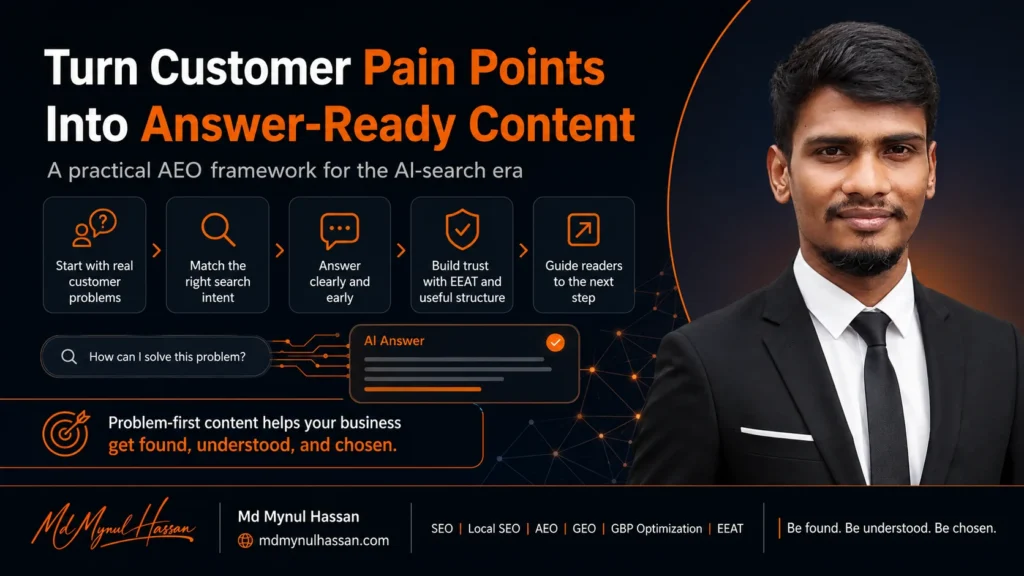
Pain Point → Search Intent → Question → Direct Answer → Supporting Detail → Trust → Next Step
First, identify a problem customers genuinely experience. Then research how people express that problem in search. Understand whether they want information, comparison, reassurance, a local provider, a product, or direct help. Create the right type of page, answer the important question early, support the answer with experience and useful detail, and connect the reader to the next relevant resource.
The goal is not simply to rank an article.
The goal is to make your business easier to find, understand, trust, and choose.
Why Customer Pain Points Matter More in Modern Search
Search is becoming more conversational.
People do not always search with two- or three-word phrases anymore. They describe situations. They ask follow-up questions. They compare options. They include conditions, locations, budgets, symptoms, goals, and concerns.
That matters for traditional Google Search, but it also matters for answer engines and AI-driven search experiences.
Google’s own guidance for AI features in Search continues to emphasize the same foundations that matter in normal SEO: useful content, crawlability, page experience, clear site structure, internal links, accurate information, and content that provides genuine value.
Google does not recommend creating a separate page for every possible conversational query or inventing special content solely for AI systems. Its guidance still points back to producing useful content for people and making that information easy for search systems to understand.
You can review Google’s official guidance on AI features and your website and its broader guidance on creating helpful, reliable, people-first content.
This is one reason I do not treat AEO or GEO as replacements for SEO.
I see them as part of a wider search visibility strategy.
Traditional SEO still creates the foundation. AEO pushes us to make important answers clearer. GEO makes us think more carefully about how brands, entities, expertise, and information may be interpreted in generative search environments.
But the foundation remains useful content and strong SEO.
Pain Point vs Keyword vs Search Intent
These concepts are closely related, but they are not interchangeable.
| Element | What It Tells Me | Example |
|---|---|---|
| Customer pain point | What the customer is struggling with | “Reporting takes too long every week.” |
| Keyword | How the topic may appear in search | automated client reporting |
| Search intent | What the searcher wants to accomplish | Find a faster reporting process |
| Content angle | What we should help them understand | How to reduce manual reporting work |
| Commercial connection | Where the business can genuinely help | Reporting automation software |
When these elements align, content usually becomes much more useful.
When they do not, businesses may attract traffic without attracting the right customers.
This is why I do not treat SEO content strategy as simply choosing keywords and publishing articles. I want to understand what each page is supposed to solve, who it is for, and where it fits within the wider website.
My Pain-Point SEO and AEO Framework
Step 1: Start With Problems Customers Actually Have
I prefer to start with real customer information before brainstorming dozens of article titles.
Useful sources can include:
- sales conversations
- enquiry forms
- support tickets
- customer emails
- consultation questions
- Google Business Profile reviews
- product reviews
- website search data
- Search Console queries
- social media comments
- competitor reviews
- frequently raised objections
- questions people ask before buying
These sources help me understand the language people use when they are not trying to “write an SEO keyword.”
That language is valuable.
Where I Usually Look First
First-Party Customer Sources
The strongest sources are often information the business already owns: sales conversations, customer support, forms, reviews, consultation notes, and actual enquiries.
What I Want to Capture
I pay particular attention to repeated questions, repeated frustrations, objections before purchase, confusion between services, urgency, price concerns, location concerns, comparison questions, and the reasons customers hesitate before taking action.
These patterns can reveal content opportunities that a keyword tool alone may not show clearly.
Step 2: Translate the Pain Point Into Search Language
Customers do not always use the language businesses use internally.
A SaaS company may talk about:
workflow automation
while a customer says:
“How do I stop doing this task manually every Friday?”
A lawyer may use a formal legal term while a potential client describes the situation in everyday language.
An SEO professional may say:
keyword cannibalization
while a business owner says:
“Why are two of my pages competing with each other?”
Both forms of language can matter.
This is where keyword research becomes useful.
I want to understand:
- how customers describe the problem
- how people search for it
- which related questions appear
- what terminology Google associates with the topic
- what type of content currently satisfies the intent
- whether the search is informational, commercial, transactional, or local
- whether an existing page already deserves improvement
The important point is that keyword research should validate and expand customer understanding, not replace it.
Step 3: Identify the Real Search Intent
The same customer problem can create several different searches.
Consider someone whose air conditioner is running but not cooling.
| Search Query | Likely Intent | Better Destination |
|---|---|---|
| Why is my AC running but not cooling? | Informational | Troubleshooting guide |
| Can low refrigerant stop an AC from cooling? | Informational | Supporting article or section |
| Should I repair or replace my AC? | Commercial investigation | Comparison/decision guide |
| AC repair near me | Local transactional | Local service page |
| Emergency AC repair in Dallas | Local transactional | Relevant service/location page |
All of these searches can originate from the same underlying pain.
But I would not try to force them all onto one page.
This is where search-intent thinking becomes important.
Instead of asking:
“Where can I add this keyword?”
I ask:
“Which page would best help this person accomplish what they are trying to do?”
That principle is also central to how I approach on-page SEO.
Step 4: Decide Whether You Actually Need a New Page
Not every pain point deserves a new blog post.
This is an important part of content strategy that is often ignored.
Sometimes the better solution is improving an existing service page.
A pricing question may belong on a service page.
A delivery question may belong on an ecommerce product, category, or shipping page.
A short purchasing objection may belong inside an FAQ section.
A broad educational problem may justify a full article.
A location-specific service need may belong on a properly developed local landing page.
A recurring collection of related customer questions may be suitable for an FAQ hub.
Before creating a new URL, I ask:
Does an existing page already have the right purpose and intent to answer this question?
If the answer is yes, I would usually strengthen that page rather than create unnecessary overlap.
I explore this question-based approach further in my article on what customers are asking before they buy and my guide to building an AEO-focused FAQ hub.
Step 5: Turn the Pain Point Into a Clear, Answerable Question
Compare these two headings:
Reporting Automation Tips
and
Why Is Weekly Client Reporting Taking So Long?
The second version reveals a specific problem.
Compare:
SEO Content Strategy
with:
Should You Publish More SEO Content or Improve Your Existing Pages First?
Again, the second version gives the reader a decision to solve.
This does not mean every heading should be written as a question.
I do not want to force a formula onto every page.
But the page should make it obvious what problem it is solving.
Step 6: Answer the Important Question Early
One thing I often see in content is an unnecessarily long path to the answer.
The article introduces the industry.
Then defines basic terminology.
Then explains why the topic is important.
Then provides more context.
Eventually, the user reaches the information they searched for.
I prefer to give the core answer much earlier.
For example:
Should You Publish More Content or Improve Existing Pages First?
If your website already contains pages targeting important searches but those pages have weak intent alignment, thin information, unclear structure, outdated content, poor internal linking, or technical problems, improving the existing pages may deserve priority before creating more content. New content becomes more useful when there is a genuine search-intent or topical gap your current pages cannot satisfy.
The article can then explain the details.
A direct answer does not mean shallow content.
It gives the reader orientation before asking them to invest time in the deeper explanation.
This approach is also useful for AEO because a clear section can be understood independently while still belonging to a more comprehensive resource.
Step 7: Add Information Generic Content Usually Misses
A large amount of online content can define a topic.
That does not necessarily make it useful.
The stronger opportunity is often found in details such as:
- when advice applies
- when it does not apply
- trade-offs
- decision criteria
- mistakes
- exceptions
- practical examples
- first-hand observations
- risks
- what should happen next
This is where experience becomes important.
For example, saying:
“Google Business Profile optimization is important for Local SEO.”
does not show much expertise.
When I work on a Google Business Profile, I look at whether categories, services, business information, the website, reviews, location relevance, and the way customers describe the company create a consistent picture of the real business.
That tells the reader more about how I think.
It is also why I connect Google Business Profile optimization with Local SEO rather than treating them as completely separate tasks.
Step 8: Demonstrate EEAT Instead of Repeating That You Have It
I do not believe EEAT should be treated like a box added at the bottom of an article.
Experience should appear in what you have observed.
Expertise should appear in how accurately you explain the problem.
Authoritativeness should develop through consistent, useful coverage of topics genuinely connected to your work.
Trust should come from accuracy, transparency, clear authorship, real business information, reliable sources, and reasonable claims.
For example, I would not write:
“This AEO strategy will guarantee your business appears in AI answers.”
I cannot honestly guarantee that.
A more responsible statement would be:
Creating clear, useful, well-structured content around genuine customer problems can strengthen the information search and AI systems have available to understand your topics, expertise, services, and relevance.
That is the type of recommendation I am comfortable making.
Google’s people-first content guidance also encourages creators to make authorship clear and demonstrate first-hand expertise where it is relevant.
Four Practical Pain-Point AEO Examples
Local Business Example
Imagine a plumber repeatedly receives this question:
“Why does my drain keep clogging even after I clear it?”
The business could publish a broad article called:
10 Drain Cleaning Tips
But I would rather investigate the customer’s actual problem.
A stronger article might be:
Why Does My Drain Keep Clogging After I Clear It?
The content could explain possible reasons recurring blockages happen, what the homeowner can reasonably check, when a temporary solution may not address the underlying problem, and when professional inspection may be appropriate.
The purpose is not to scare the reader into calling.
The purpose is to help them understand the situation.
If professional drain cleaning is genuinely relevant, the article can then link naturally to the appropriate service page.
How This Connects With Local SEO
The same service should also be represented clearly across the website and Google Business Profile.
The business should not artificially repeat city names throughout the article.
Instead, local relevance should come from accurate business information, real services, legitimate service areas, reviews, local landing pages where appropriate, and consistency between the website and the profile.
That is a stronger Local SEO foundation.
SaaS Example
Suppose a SaaS company’s customers frequently say:
“Our weekly reporting process takes too much time.”
The company may initially think its SEO topic is:
reporting automation software
But the pain point creates more useful content possibilities:
- Why Does Weekly Client Reporting Take So Long?
- Which Reporting Tasks Should Agencies Automate?
- Manual vs Automated Client Reporting
- When Should a Growing Team Automate Its Reporting Workflow?
- How to Reduce Repetitive Reporting Without Losing Quality Control
The content should first explain the workflow problem.
Where does time get wasted?
Which tasks are repetitive?
What should be standardized?
Which steps can reasonably be automated?
Where is human review still necessary?
Only then does the software need to enter the conversation.
That makes the product relevant because the reader understands why it solves the problem.
Ecommerce Example
Ecommerce shoppers frequently experience decision uncertainty.
The business already has products.
The customer already has buying intent.
But they do not know which option fits their situation.
That pain point can create content such as:
- product comparison guides
- buying guides
- compatibility guides
- size guides
- use-case articles
- product-selection FAQs
- “best for” explanations
- care guides
For example:
Which Coffee Grinder Is Better for Espresso vs Filter Coffee?
or:
What Size Travel Backpack Do I Need for a Weekend Trip?
These pages can answer informational questions while guiding customers naturally toward the relevant categories and products.
This is one reason my ecommerce SEO approach connects informational content with category pages, product pages, internal linking, site structure, and commercial search intent.
Professional Services Example
Professional-service prospects often have a different type of pain point:
uncertainty before contacting someone.
They may ask:
- Do I really need professional help?
- Can I solve this myself?
- What should I prepare first?
- What does the process involve?
- How do I compare providers?
- How much help do I actually need?
These questions can create excellent informational-commercial content.
For example:
Should You Publish More SEO Content or Fix Your Existing Pages First?
My answer would depend on the website.
If a business already has useful pages but they suffer from poor search intent, overlapping targeting, weak internal linking, indexing problems, unclear headings, outdated information, or other structural issues, publishing another twenty articles may not be the best first step.
An SEO audit may identify more important problems that deserve attention first.
That kind of recommendation builds trust because the answer changes according to the situation instead of automatically recommending more work.
How Pain-Point Research Improves Service Pages
Pain-point research is not only useful for blog content.
It can make service pages much clearer.
One thing I often see on business websites is that service pages describe what the company offers without explaining why someone would need it.
For example:
Generic Version
SEO Audit Service
“We provide comprehensive SEO audits to improve your website.”
That tells the reader very little.
Pain-Point Version
You May Need an SEO Audit If:
- your important pages are indexed but receive very little qualified traffic
- visibility has dropped and you do not understand why
- several pages appear to target the same search intent
- you publish content but cannot identify what is actually contributing to growth
- your website receives impressions but few meaningful clicks
- internal linking is weak or inconsistent
- you do not know whether the problem is technical SEO, content, search intent, or authority
Now the service is connected to recognizable problems.
The page becomes easier for a potential client to understand.
How Pain Points Build Topical Authority
A strong customer problem can become the foundation of a useful topic cluster.
Imagine a SaaS company helps businesses improve employee onboarding.
The main pain point is:
“Our onboarding process is too slow and inconsistent.”
That problem could create the following content structure:
| Search Need | Content Opportunity |
|---|---|
| Understand the problem | Why Is Employee Onboarding Taking So Long? |
| Fix the workflow | How to Build a Repeatable Employee Onboarding Process |
| Compare approaches | Manual vs Automated Employee Onboarding |
| Make a decision | When Should a Growing Company Automate Onboarding? |
| Resolve objections | Employee Onboarding Automation FAQs |
| Evaluate a solution | Employee Onboarding Software Page |
Now the content is connected.
Each page has a purpose.
Supporting resources can link naturally to the commercial page.
Related articles can reinforce one another.
The website begins to build meaningful depth around a subject directly connected to the business.
That is much stronger than publishing unrelated articles because individual keywords happen to have search volume.
Internal Linking Should Follow the Customer Journey
I do not see internal linking as simply an SEO checkbox.
Good internal linking helps the reader continue solving the problem.
Imagine someone arrives on an article called:
Why Does My Website Get Traffic but Very Few Enquiries?
The article may explain:
- irrelevant keyword targeting
- search-intent mismatch
- unclear service positioning
- weak calls to action
- thin trust signals
- confusing navigation
- poor mobile experience
- weak commercial pages
A reader who realizes the problem may be structural could naturally continue to an SEO audit service.
Someone who has an intent and page-structure problem may benefit from on-page SEO.
A business that lacks useful supporting content may need a stronger SEO content strategy.
Those internal links are useful because they match what the reader is trying to do next.
That is very different from adding random links simply to increase the number of internal links on a page.
How Pain Points Can Strengthen Google Business Profile Strategy
For local businesses, customer reviews can be particularly useful research.
Reviews reveal the language real customers use to describe what mattered to them.
They may repeatedly mention:
- response time
- communication
- a specific service
- convenience
- availability
- staff helpfulness
- a particular problem that was solved
I do not recommend copying review phrases into website pages purely to target keywords.
I use them to better understand customer priorities.
If customers repeatedly value fast scheduling, the website may need to explain the booking process more clearly.
If people frequently praise help choosing the right service, the business may need better decision-support content.
If customers repeatedly mention one service, that service may deserve stronger representation across the website and Google Business Profile.
This is how Local SEO, Google Maps visibility, website content, reviews, and Google Business Profile optimization can support the same real business rather than functioning as disconnected tactics.
How Pain-Point AEO Connects With GEO and AI Search
AEO and GEO attract a lot of attention because businesses want to understand how AI-driven discovery changes search visibility.
I think the useful approach is to avoid treating AI search as a completely separate world.
A strong page still needs to make its subject clear.
It still needs accurate information.
It still benefits from logical headings.
It still benefits from useful internal links.
Search engines still need to access the page.
Users still need to trust what they read.
The company still needs clear business and brand information.
That is why my AEO and GEO consulting approach starts from SEO fundamentals rather than promising special AI-search shortcuts.
For pain-point content, I focus on making important sections understandable on their own while ensuring they remain part of a comprehensive article.
A useful section often has:
A clear question or heading
followed by:
A direct answer
then:
Explanation, evidence, conditions, examples, and next steps
This structure helps users scan the page and helps search systems understand the purpose of individual sections.
Do You Need Special Schema for AEO?
I would not build an AEO strategy around schema alone.
Structured data can be useful when an appropriate Google-supported type accurately describes visible page content.
But there is no special piece of markup that turns weak content into a strong answer.
I prioritize the following order:
Real question → useful answer → clear structure → expertise → trust → internal relationships → technical accessibility
Then I consider structured data where it genuinely fits.
The content should make sense even without the markup.
Common Pain-Point Content Mistakes
Starting With the Keyword and Inventing the Problem Later
This often produces content that technically includes the topic but does not reflect how customers actually think.
Start with genuine customer needs whenever possible.
Creating a Separate Article for Every Small Query Variation
“Best CRM reporting software,” “CRM software for reporting,” and “best reporting CRM tool” do not automatically need separate pages.
Look for the underlying intent.
Writing a Great Question but Giving a Generic Answer
A pain-point headline creates an expectation.
If the article underneath contains the same generic information as every other page, the stronger title does not solve the content problem.
Hiding the Main Answer
Do not force readers through hundreds of words before providing the information they came for.
Turning Every Informational Article Into a Sales Pitch
Help first.
Create the commercial connection where it naturally makes sense.
Publishing AI-Generated Content Without Adding Business Knowledge
AI can support research, organization, drafting, and content workflows.
But publishing large amounts of generic material that adds little value is not a sustainable strategy.
Google’s guidance on generative AI content still comes back to quality, originality, accuracy, and usefulness.
Forgetting Internal Links
Useful content should not become an isolated island.
Connect it to related guides, services, categories, products, or other relevant pages.
Creating More Content When the Existing Website Needs Repair
Sometimes the correct recommendation is not another blog post.
Poor crawlability, weak site architecture, indexing problems, duplicate targeting, slow performance, or other technical issues may deserve attention first.
That is where technical SEO and auditing become part of content strategy.
Old SEO Thinking vs Modern Search Visibility Thinking
Traditional SEO fundamentals still matter.
What has changed is the context in which I apply them.
| Narrow SEO Question | Broader Search Visibility Question |
|---|---|
| What keyword can we rank for? | What customer problem does this query represent? |
| How many times should we use the keyword? | Does the page clearly satisfy the search intent? |
| How many articles should we publish? | Which information is actually missing? |
| Can we add more FAQs? | Which questions genuinely help customers decide or act? |
| How do we rank this article? | How does this page support the wider topic and business? |
| How do we get mentioned by AI? | How do we become a clear, trustworthy source worth understanding? |
| How do we increase traffic? | How do we attract relevant visibility and create a useful next step? |
I still care about rankings.
I still care about keywords.
I still care about technical SEO.
But I do not see any of them as the complete strategy.
SEO works better when the important pieces support one another.
How I Measure Pain-Point Content
I would not judge a pain-point article only by whether one keyword moves from position nine to position six.
I would look at a wider set of signals.
Search Visibility
Is the page earning impressions for relevant customer questions?
Is it appearing for useful long-tail searches?
Is visibility increasing across the broader topic?
User Behavior
Are readers moving to related pages?
Are they interacting with important internal links?
Does the content appear to help them continue their journey?
Commercial Relevance
Is the article supporting visibility for related service, category, or product pages?
Are relevant enquiries coming through the content journey?
Search Console Learning
Which queries are actually generating impressions?
Are unexpected customer questions appearing?
Do those queries reveal additional useful content opportunities?
Business Learning
Are sales and support teams hearing new questions that should be added to existing pages?
This last point is important.
Content strategy should not end after publication.
Customer conversations can continuously improve the website.
A Practical Pain-Point Content Workflow
If I were building this strategy from the beginning, I would use the following process:
| Step | Action |
|---|---|
| 1 | Collect recurring customer problems |
| 2 | Group similar problems into themes |
| 3 | Research how people express those problems in search |
| 4 | Determine the search intent |
| 5 | Review existing pages before creating new URLs |
| 6 | Choose the correct content type |
| 7 | Write a clear direct answer |
| 8 | Add experience, examples, conditions, and useful depth |
| 9 | Include evidence where important |
| 10 | Add contextual internal links |
| 11 | Connect the content to a logical next step |
| 12 | Optimize title, headings, metadata, images, and on-page signals |
| 13 | Review technical accessibility |
| 14 | Publish and measure real search behavior |
| 15 | Update the page when customer questions or information change |
This approach helps me avoid publishing content simply because a calendar says another article is due.
My Pain-Point AEO Content Checklist
Before publishing a page, I would ask:
- Is the topic based on a genuine customer problem?
- Do I understand why someone would search for this?
- Is the search intent clear?
- Does this really need a new page?
- Does the title accurately describe the problem?
- Can readers find the core answer quickly?
- Does the article go beyond common definitions?
- Have I included useful examples or decision criteria?
- Are important claims accurate?
- Does my experience or expertise appear naturally?
- Are external sources used where evidence is helpful?
- Are internal links contextual and useful?
- Does the page support a wider topic?
- Is there a logical next action?
- Have I avoided unsupported ranking or AI-visibility claims?
- Can search engines access and understand the page?
- Would this content still be valuable if search engines did not exist?
That last question is one of my favorites.
If the content would have almost no value without the possibility of ranking, it probably needs more work.
Frequently Asked Questions About Pain-Point AEO Content
What Is Pain-Point Content?
Pain-point content is content built around a real customer problem, concern, frustration, objection, uncertainty, or decision. Instead of starting only with a search keyword, it starts with what the person is actually trying to solve.
What Is Pain-Point SEO?
Pain-point SEO connects customer problems with search behavior. It uses keyword research, search intent, page structure, useful answers, internal linking, and relevant commercial pages to help businesses become visible for problems they genuinely understand or solve.
How Does Pain-Point Content Help AEO?
Many answer-engine searches are questions or descriptions of problems. Content that clearly identifies the issue, gives a direct answer, explains the situation accurately, and adds real expertise is easier for both people and search systems to understand.
Is AEO Different From SEO?
AEO places more emphasis on producing clear answers for question-based and answer-oriented search experiences. I do not treat it as a replacement for SEO. Strong AEO usually depends on the same fundamentals as strong SEO: accessibility, relevance, useful content, authority, internal linking, site structure, and trust.
What Is GEO?
Generative Engine Optimization, or GEO, is commonly used to describe efforts to improve how a brand and its information are understood and potentially surfaced in generative search and AI-driven discovery experiences. I treat GEO as an extension of broader search visibility rather than a reason to abandon traditional SEO fundamentals.
Should Every Customer Question Become a Blog Post?
No.
Some questions belong on service pages, product pages, category pages, location pages, FAQ sections, comparison pages, or existing articles.
Creating a new URL for every customer question can produce thin and overlapping content.
How Do I Find Customer Pain Points for SEO?
Start with the language customers already use. Review sales questions, customer support, enquiries, consultations, Google Business Profile reviews, product reviews, Search Console queries, website search data, objections, and common pre-purchase questions.
Then use SEO research to validate how those problems appear in search.
Can AI Help Create Pain-Point Content?
Yes, AI can help with research support, brainstorming, organization, outlining, and drafting.
But I would still add human expertise, business-specific knowledge, accurate information, useful examples, proper review, and original reasoning before publishing.
The value should come from the finished resource, not from how quickly it was generated.
Does Pain-Point Content Work for Local SEO?
Yes.
Local customers frequently search around urgent problems, specific services, prices, service areas, availability, reviews, and decisions.
Pain-point content works particularly well when it connects naturally with accurate local information, service pages, Google Business Profile data, and genuine customer needs.
Does Pain-Point Content Work for SaaS and B2B?
Yes.
SaaS and B2B customers frequently search around inefficiency, workflow problems, costs, risks, implementation, integrations, comparisons, alternatives, and buying decisions.
Those are naturally strong pain-point topics.
Final Thoughts: Solve the Problem Before Chasing the Keyword
Over the last two years of working with websites, SEO, Local SEO, Google Business Profiles, keyword research, content structure, and search visibility problems, one lesson has become increasingly clear to me:
Businesses often already possess much of the useful information their customers need.
The information is simply not organized properly online.
It lives inside sales conversations.
It lives inside support emails.
It lives inside reviews.
It lives inside product explanations.
It lives inside consultation calls.
It lives inside the experience of the people running the business.
The opportunity is to turn that knowledge into useful search content.
Customer pain points provide a strong starting point because they connect four important things:
what the customer needs, what people search for, what the business genuinely understands, and what the business can actually help solve.
Then keyword research helps validate the opportunity.
Search intent tells us what page is needed.
SEO helps make the page discoverable and understandable.
AEO encourages clear answers.
GEO expands the visibility conversation into AI-driven discovery.
EEAT strengthens the role of experience, expertise, authority, and trust.
Internal linking connects individual answers into a wider information system.
And a sensible next step helps turn visibility into business opportunity.
This is why I do not look at SEO as simply adding keywords to pages.
I look at it as a complete visibility system.
Good SEO should help search engines, AI systems, and most importantly- potential customers understand:
what your business does, who you help, where you are relevant, what problems you solve, why your information deserves trust, and why someone should consider choosing you.
If your website already has pages and content but those pages are not generating enough relevant visibility, calls, enquiries, traffic, or trust, publishing more content is not always the first answer.
Sometimes the better starting point is understanding the customer’s problem and fixing the visibility foundation around it.
That is the kind of work I focus on through SEO, Local SEO, Google Business Profile optimization, AEO and GEO, keyword research, content optimization, topical authority, internal linking, and EEAT-focused search strategy.
Be found. Be understood. Be chosen.
Md Mynul Hassan
SEO | Local SEO | AEO | GEO | Google Business Profile Optimization
mdmynulhassan.com