One thing I often notice when reviewing business websites is that the business is already answering valuable customer questions every day, but the website is not.
The sales team explains pricing on calls. A founder explains the process during consultations. Customer support answers the same questions by email. A local business receives questions about service areas, availability and timing. An ecommerce brand repeatedly explains product compatibility, delivery, warranties or returns.
Then I visit the website and many of those answers are missing.
Instead, I often find service pages that explain the business in general terms, product pages with basic descriptions, or blog articles created around keywords without fully addressing the questions customers ask before they make a decision.
Over the last 2 years of working with practical SEO strategies, I have started paying much more attention to these buyer questions.
I do not see them as simple FAQ ideas.
I see them as customer-intent data.
They can reveal what people are uncertain about, what is stopping them from taking action, what they compare before buying, what they need to trust, and what information a website should make easier to find.
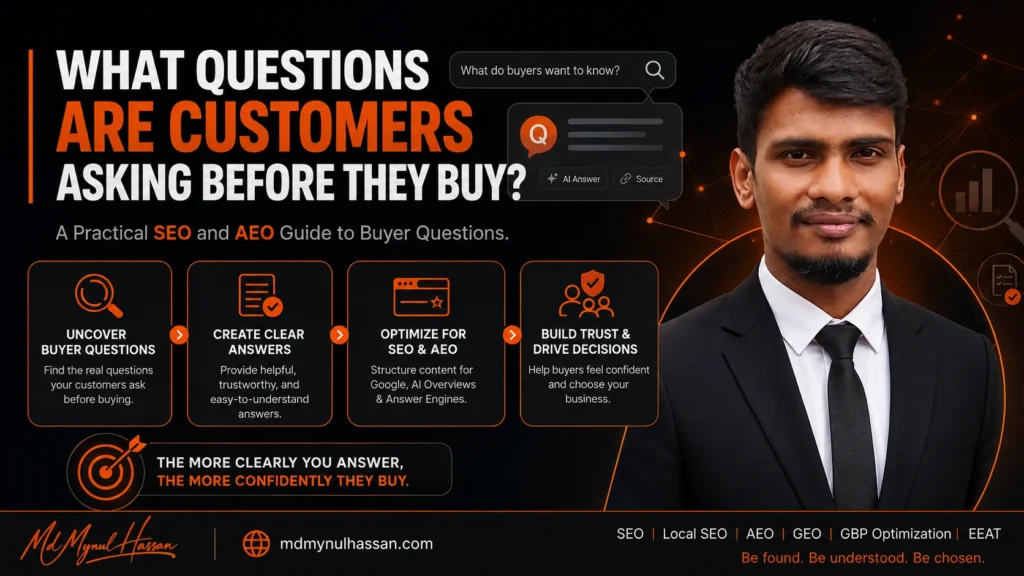
That makes customer questions useful across SEO, Local SEO, Google Business Profile optimization, content strategy, AEO, GEO, topical authority, internal linking, conversion paths and sales enablement.
The goal is not to create content for every possible question.
The goal is to identify the questions that actually matter and answer them in the right place.
What Are Customer Questions Before Buying?
Customer questions before buying are the questions, concerns, comparisons and objections people have while deciding whether a product, service or business is right for them.
They can appear at different stages of the buying journey.
A potential customer may ask:
- What exactly is included?
- How much does it cost?
- What affects the price?
- Is this suitable for my situation?
- How long does the process take?
- Do you serve my location?
- What happens after I contact you?
- What makes this option different?
- Is there a warranty or guarantee?
- Can I trust this company?
- Which option should I choose?
- What are the possible limitations?
- Do I need this service now?
- What should I prepare before getting started?
These questions matter because they often sit between visibility and conversion.
A person may already know your business exists.
They may already be on your website.
They may even be interested in your service.
But they still have unanswered questions.
If your website cannot resolve that uncertainty, the visitor may continue searching somewhere else.
Why Buyer Questions Matter for SEO
Many businesses still think about SEO mainly in terms of keywords and rankings.
Keywords matter, but they do not always tell the full story.
A keyword can tell me what someone searched.
A question can reveal why they searched.
That distinction is important.
Someone searching for:
local SEO service
may be looking for a provider.
Someone asking:
How long does Local SEO take for a small business?
is trying to understand expectations.
Someone asking:
Why does my Google Business Profile get views but not calls?
has a specific problem.
Someone searching:
Local SEO consultant vs agency
may already be evaluating providers.
The more clearly I understand the question behind the search, the easier it becomes to decide what the page should explain.
That is why my approach to keyword research goes beyond collecting keywords. I also look at search intent, customer language, question patterns, related topics, commercial relevance and how individual searches fit into the wider decision journey.
Buyer Questions Reveal Search Intent
Search intent is not always perfectly represented by a keyword label such as informational, commercial or transactional.
Real customer intent can be more specific.
The searcher may be trying to:
- reduce risk
- understand a process
- compare providers
- justify a purchase
- confirm compatibility
- understand cost
- verify expertise
- check location
- understand limitations
- decide whether to contact the company
These details help me create more useful content.
Instead of asking only, “What keyword should this page rank for?”
I also ask, “What does the customer need to understand before moving forward?”
That produces a better content brief.
Why Customer Questions Matter More in Modern Search
Search behavior is expanding beyond traditional keyword searches.
People can now ask complete questions through Google Search, AI Overviews, AI Mode, ChatGPT, Gemini, Perplexity and other answer-driven interfaces.
That does not mean traditional SEO has stopped mattering.
Google’s current guidance for generative AI search specifically says that established SEO best practices remain foundational. It recommends technically accessible websites and useful, original, non-commodity content rather than chasing separate AEO or GEO tricks.
This fits closely with how I approach AEO and GEO consulting.
I do not treat AEO or GEO as replacements for SEO.
I see them as another reason to make business information clearer, more useful, easier to retrieve and better aligned with real customer questions.
Google also continues to emphasize helpful, reliable, people-first content that demonstrates real knowledge or experience rather than content created primarily to manipulate search visibility.
That makes genuine customer-question research especially useful.
It gives you something better than another generic keyword list.
It gives you topics your real customers already care about.
Where Do I Find Questions Customers Ask Before Buying?
When I research customer questions, I prefer starting with the business itself.
SEO tools are useful, but the strongest question research often combines first-party business information with search data and public discussions.
First-Party Sources of Buyer Questions
First-party sources are valuable because they reflect actual conversations between the business and its customers.
These questions may never show meaningful keyword volume, but they can still influence buying decisions.
Sales Calls and Discovery Calls
Sales calls are one of the first places I would look.
A salesperson often answers the same objections repeatedly without realizing those objections could become useful website content.
Questions might include:
“Why does your service cost more?”
“How long will this take?”
“Can I cancel?”
“What is included?”
“Do I need to sign a contract?”
“How is this different from another service?”
“Can you work with my existing system?”
These questions can reveal gaps in service pages, pricing pages, comparison content, onboarding information and FAQs.
What I Would Capture From Sales Conversations
I would not only collect the exact question.
I would also capture:
- what the customer was trying to understand
- which stage of the sales conversation the question appeared
- whether the question was asked repeatedly
- whether it delayed the decision
- what answer usually helped
- which page should logically explain it
- whether supporting proof or evidence is needed
That context helps turn a sales objection into useful search content.
Example: Turning a Sales Objection Into Search Content
Imagine several prospects ask:
“Why does professional SEO take time?”
I would not simply create a 2,000-word article repeating that exact phrase.
I would consider what the customer actually needs to understand.
They may need information about crawling, indexing, competition, content improvements, technical changes, Local SEO signals, authority, measurement and realistic expectations.
The question becomes the starting point, not the entire strategy.
Customer Support Tickets and Emails
Support conversations can reveal unclear information on the website.
Some support questions happen after purchase, but they can still expose information that future buyers would benefit from seeing earlier.
For example, customers may repeatedly ask:
- how something works
- what is included
- how to activate a service
- whether something is compatible
- what happens after payment
- how delivery works
- how returns are handled
- when they will receive an update
If people regularly misunderstand the same thing, I look at whether the website explains it clearly enough.
Contact Forms, WhatsApp and Live Chat
For many small and service businesses, customer research is sitting inside WhatsApp messages, contact-form submissions and live-chat history.
Those conversations often use much more natural language than keyword tools.
That language can help improve headings, FAQs, service explanations and content ideas.
Customer Reviews
Reviews are useful for more than reputation.
They can reveal what customers valued during the buying process.
For example, several customers may independently mention:
- fast response
- transparent pricing
- clear communication
- easy booking
- professional explanation
- reliable delivery
- local availability
- product quality
- after-sales support
I can use these patterns to understand what future customers may also care about.
For local businesses, customer reviews can also help identify language around services, locations and decision factors.
Search and Community Sources
After reviewing business data, I expand the research using search behavior and public discussions.
Google Search and People Also Ask
Google’s search results can reveal related questions and search patterns around a topic.
I use these as discovery signals rather than copying every question into an FAQ.
If several related searches focus on pricing, comparison, timing, location or suitability, that pattern tells me what people may need before making a decision.
Google Search Console
Search Console can show the queries already generating impressions and clicks for your website.
Sometimes a page appears for questions it does not answer very well.
That can reveal an optimization opportunity.
For example, if a service page receives impressions for several “how much,” “how long,” or “is it worth it” queries, I would review whether those questions deserve clearer coverage.
Reddit can be useful for understanding natural customer language.
People often describe frustrations, comparisons and objections in detail.
I am not treating every Reddit comment as fact.
I am looking for recurring themes.
If the same concern appears across Google searches, customer calls, competitor content and Reddit discussions, it deserves more attention.
Quora
Quora can help identify explanatory questions around complicated products and services.
As with Reddit, the value is not copying answers.
The value is identifying how people frame their problems.
Competitor Websites
Competitor research can reveal questions other businesses answer well and questions they ignore.
I look at:
- service pages
- FAQs
- buying guides
- comparison pages
- product pages
- pricing information
- review themes
- resource hubs
Competitor research should not become copying.
The objective is to identify information gaps and then produce something more useful from your own business knowledge.
My SEO audit service also looks at search intent, content gaps, competing pages, internal links and page structure when those areas are relevant to a project’s visibility problems.
How to Organize Buyer Questions by Intent
Collecting questions is only the beginning.
A spreadsheet with 200 questions does not automatically create a content strategy.
The questions need to be organized.
Informational Questions
These help someone understand the topic.
Examples:
- What is Local SEO?
- How does this service work?
- Why does this problem happen?
- What is included?
These may belong in educational articles, service-page sections or resource pages.
Commercial Investigation Questions
These appear when people are comparing options.
Examples:
- Which option is better?
- What is the difference between A and B?
- How much does the service cost?
- Is this service worth it?
- Should I hire a consultant or agency?
These questions can work well in comparison guides, service pages and decision-support content.
Transactional Questions
These often appear close to action.
Examples:
- How can I book?
- Do you serve my location?
- Can I get a quote?
- Is this product available?
- What happens after payment?
These answers usually need to be close to the conversion point.
Trust Questions
These deserve special attention.
Examples:
- Who will do the work?
- What experience do you have?
- How do you protect customer information?
- What happens if there is a problem?
- Can I see your process?
- What does the service actually include?
These questions connect directly with EEAT, brand trust and conversion confidence.
A trustworthy answer is better than a promotional answer.
Do Not Put Every Buyer Question on One FAQ Page
One mistake I often see is collecting dozens of questions and placing all of them on one huge FAQ page.
Sometimes a dedicated FAQ resource is useful.
But the more important question is:
Where would this answer help the customer most?
A question about a specific service may belong on the service page.
A pricing question may belong near the service’s decision section.
A product compatibility question should usually be answered on the product or category page.
A location question may belong on a local service page.
A comparison question may deserve its own article.
A detailed educational question may belong in the blog.
A broader group of related questions could justify an FAQ hub.
I have written separately about creating an AEO FAQ hub for business websites and using FAQ pages for AEO and AI visibility.
The point is not to create more FAQ blocks.
The point is to put useful answers where people actually need them.
How I Turn Buyer Questions Into SEO Content
My approach is to move from question collection to content decisions.
Step 1: Identify the Real Question Behind the Question
A customer might ask:
“How much does Local SEO cost?”
The surface-level question is about price.
The deeper questions may be:
- What am I paying for?
- Why do prices vary?
- What should a package include?
- How do I compare providers?
- How long will I need the service?
- How can I avoid wasting money?
The better content addresses those underlying concerns.
Step 2: Check Search Intent and Business Relevance
Not every customer question deserves a new page.
Before creating content, I would review:
- whether people search for the topic
- whether it relates to the business
- whether an existing page should answer it
- whether competitors have useful coverage
- whether the question supports a service or product
- whether there is enough unique information to create something valuable
This is where keyword research and search-intent analysis become important.
Step 3: Map the Question to the Right Page
I decide whether the answer belongs on:
- a service page
- product page
- category page
- location page
- blog post
- comparison guide
- FAQ hub
- pricing page
- policy page
- case study
- contact or onboarding page
The correct destination matters as much as the question.
Step 4: Give the Direct Answer Early
If someone asks a clear question, I prefer giving them a clear answer.
I do not want to make readers scroll through 800 words before understanding the basic point.
For example:
What is customer-question research?
Customer-question research is the process of collecting and analyzing the questions, objections and information needs customers express before, during and after a buying decision, then using those insights to improve website content, SEO, AEO and the customer journey.
Then I can expand.
This direct-answer structure is useful for readers and fits naturally into my wider approach to AEO.
Step 5: Add Useful Context
A direct answer should not mean a shallow answer.
After answering the question, I can explain:
- why it matters
- how it works
- what affects the answer
- examples
- mistakes
- alternatives
- limitations
- what the reader should do next
This produces content that satisfies the question instead of simply matching its wording.
Step 6: Improve the Page Around the Question
Question research can improve more than body copy.
It may affect:
- SEO title
- H1
- H2 and H3 structure
- service descriptions
- internal links
- FAQs
- calls to action
- comparison tables
- screenshots
- images
- product information
- location information
- trust content
My On-Page SEO service focuses on this wider connection between search intent, page relevance, headings, content, internal links and conversion objectives.
Internal Linking Should Follow the Customer Journey
Internal links should help people continue answering related questions.
I do not like adding links simply because two pages contain similar keywords.
I prefer asking:
What will this person probably need next?
Someone reading about customer-question research may next need help with SEO content strategy.
A reader struggling with local customer questions may benefit from my Local SEO service.
A business whose Google Maps presence does not reflect its website may need Google Business Profile optimization.
Someone trying to understand AI-driven visibility may continue to my guide on building an AI-search-friendly business website or my guide to appearing in Google AI Overviews.
That creates a useful path through the website.
The link exists because it helps the reader move forward, not because I want to force another keyword into the page.
How Buyer Questions Support Local SEO and Google Maps Visibility
Customer questions can be especially useful for local and service businesses.
People may ask:
- Do you serve my area?
- How far do you travel?
- Are you open today?
- Do I need an appointment?
- Can you visit my home?
- Do you charge extra outside the city?
- Which neighborhoods do you cover?
- Is same-day service available?
- Where are you located?
- What should I prepare before the visit?
These questions can reveal gaps between the website, Google Business Profile, service pages and actual customer expectations.
Google explains that local results are mainly influenced by relevance, distance and prominence. It also recommends complete and accurate Business Profile information to help Google better understand a business and match it with relevant searches.
That does not mean adding every city name to every paragraph.
It means making genuine service information and location relevance clear.
When I work on Local SEO, I connect search intent, services, locations, website content, Google Maps visibility, reviews, internal links and Google Business Profile information rather than treating them as separate tasks.
A business should not only appear locally.
Potential customers should understand whether the business is relevant to their location and need.
How Buyer Questions Improve Google Business Profile Strategy
Google Business Profile is another place where customer questions can reveal useful optimization opportunities.
If customers repeatedly ask:
“Do you provide this service?”
“Are you open on weekends?”
“Do you serve this location?”
“Where is your office?”
then I would check whether the profile and website communicate those details clearly and consistently.
Google notes that Business Profile and local-search information can come from the business itself, the official website, user contributions and other sources.
That makes consistency important.
When I work on Google Business Profile optimization, I do not see the profile as an isolated listing.
I look at how it connects with the website, business information, services, categories, local relevance, reviews and customer expectations.
Customer Questions for Service Businesses
Service businesses can turn repeated questions into some of their strongest content.
Imagine a home-service business.
Potential customers might ask:
- How quickly can someone arrive?
- What areas do you cover?
- Do you provide emergency service?
- What affects the price?
- Should I repair or replace the system?
- What should I check before calling?
- What information do you need from me?
- Is the work guaranteed?
Some of those questions belong directly on service pages.
Others could become articles.
Comparison questions may become dedicated guides.
Location-related questions may improve local pages.
The strongest structure depends on the business.
I discuss this wider approach in my guide to AEO for service businesses.
Customer Questions for Ecommerce Brands
Ecommerce businesses also have valuable pre-purchase questions.
Customers may want to know:
- Which size should I choose?
- Will this work with my device?
- What material is it made from?
- What is the difference between these models?
- How long does delivery take?
- Can I return the product?
- What happens if it arrives damaged?
- Does it include a warranty?
- How should I maintain it?
- Which product is best for my use case?
These questions can improve:
- product descriptions
- category pages
- buying guides
- comparison pages
- support content
- internal links
- product FAQs
- conversion confidence
My Ecommerce SEO service connects product visibility with category architecture, content, internal links, technical SEO and commercial search intent.
The goal is not simply more ecommerce traffic.
The right shopper should understand what the product is, whether it fits their needs and what to do next.
Buyer Questions and Topical Authority
Customer-question research can also help develop topical authority.
Suppose a business offers Google Business Profile optimization.
One article about “Google Business Profile optimization” is not the entire topic.
Customers may also ask:
- Why is my profile not appearing?
- Which category should I use?
- Can I change my business address?
- Why do competitors rank above me?
- How do reviews affect local visibility?
- What should I add to services?
- How does my website affect Google Maps?
- Why was my profile suspended?
- Should I create more than one profile?
- How should service-area businesses set up their profile?
Those questions can reveal supporting topics.
The next step is not publishing all of them immediately.
I would group them, validate the intent, review existing pages and decide which questions deserve dedicated content.
Then internal links can connect related topics back to the main commercial page.
That creates a more useful topic ecosystem than publishing disconnected blog articles.
How Customer Questions Support AEO and GEO
Answer Engine Optimization becomes easier to understand when we think about real questions.
AEO is not about turning every heading into a question.
It is about making useful information easier to find, interpret and answer.
A strong answer often has several parts:
- a clear question
- a direct answer
- useful context
- evidence or experience
- relevant entities and terminology
- supporting internal links
- a logical next step
Google’s 2026 guidance reinforces the importance of unique, useful content and specifically warns publishers not to focus on unnecessary “AEO/GEO hacks” for Google Search.
HubSpot’s current AEO resources also reflect the growing role of prompt tracking, citations and brand visibility across answer engines, showing how search visibility is being measured beyond traditional keyword positions.
For additional industry context, see HubSpot’s guide to Answer Engine Optimization tools.
My approach stays simple.
First make the business and content genuinely useful.
Then make the information clear.
Then make it technically accessible.
Then connect related information.
Then improve authority and trust.
That creates a stronger foundation for traditional search and AI-driven discovery.
Buyer Questions Are Also EEAT Opportunities
Many questions people ask before buying are actually trust questions.
They may ask:
“Who will handle my project?”
“How much experience do you have?”
“What happens if something goes wrong?”
“What is included in the service?”
“What does your process look like?”
“Can you explain the limitations?”
A generic marketing answer will not always build trust.
A useful answer may include:
- real process information
- author or expert identity
- limitations
- qualifications where relevant
- clear policies
- genuine examples
- supporting sources
- transparent business information
- realistic expectations
Google’s people-first content guidance specifically encourages clear authorship, first-hand expertise, original value and information that gives readers a reason to trust the content.
That aligns with how I prefer to work.
I do not guarantee rankings.
I do not invent client results.
I do not recommend publishing fake statistics because they make an article look authoritative.
If evidence is needed, I prefer using real evidence.
If a result cannot be guaranteed, I say that clearly.
You can read more about my working principles and SEO process on my Why Choose Md Mynul Hassan page.
Old SEO Thinking vs Modern Search Visibility Thinking
Older SEO workflows often looked something like this:
Find a keyword.
Check search volume.
Create a page.
Use the keyword in the title.
Add related terms.
Build links.
Monitor rankings.
Those steps are not automatically wrong.
But today I think the process needs more context.
I also ask:
What is the customer trying to achieve?
What are they uncertain about?
What questions appear before they contact the business?
What objections appear during sales?
Does the existing page answer those questions?
Does the content demonstrate genuine experience?
Does another page already satisfy the intent?
Where should this answer live?
What should the visitor read next?
Does the website support the same information as the Google Business Profile?
Could an AI-driven search system clearly identify the answer?
Does the content help the business become easier to understand and trust?
This is what I mean when I say I look at SEO as a visibility system rather than a keyword checklist.
Common Mistakes Businesses Make With Buyer-Question Content
Mistake 1: Copying People Also Ask Questions
People Also Ask can provide useful ideas.
It should not become your entire content strategy.
The question still needs to matter to your customers and business.
Mistake 2: Generating Hundreds of AI Questions
It is easy to ask an AI tool for 500 questions.
That does not mean 500 useful pages should be created.
Mass-producing repetitive question content can lead to thin information and poor site structure.
Mistake 3: Looking Only at Search Volume
A question with low measured volume can still remove a major sales objection.
SEO value and business value are not always identical.
Mistake 4: Creating a Separate Article for Every Question
Some questions deserve one sentence.
Some belong inside a service page.
Some deserve a detailed article.
The format should match the importance and intent.
Mistake 5: Giving Vague Marketing Answers
If someone asks about cost, do not answer:
“We provide affordable solutions tailored to your needs.”
That does not answer the question.
Explain what affects the price, what is included and what information is needed to provide an accurate quote.
Mistake 6: Ignoring Sales and Support Teams
Your sales team may know more about buyer uncertainty than your SEO tool.
Your support team may know where your website creates confusion.
Use that information.
Mistake 7: Forgetting Internal Links
An informational article should not become a dead end.
Connect the reader to the next useful resource.
Mistake 8: Forgetting Conversion Intent
Content can rank and still fail the business.
If the page attracts the right visitor but does not clearly explain what they should do next, an opportunity is being lost.
Mistake 9: Adding FAQ Schema Only for Rich Results
FAQ content can still help users and support question coverage.
However, Google retired FAQ rich results in May 2026 and removed its FAQ rich-result documentation in June 2026.
I would therefore create FAQ content because the answers are useful, not because I expect an FAQ SERP feature.
My Practical Customer-Question Research Process
When I approach this type of work, I use a simple sequence.
1. Understand the Business
I first want to know:
What does the business sell?
Who buys it?
Which services or products matter most?
Which locations matter?
What does a successful enquiry or purchase look like?
2. Collect First-Party Questions
I review available:
- sales calls
- contact forms
- support emails
- WhatsApp messages
- live chat
- reviews
- consultation notes
- objections
- common misunderstandings
3. Expand With Search Research
Then I look at:
- keyword research
- Google Search
- People Also Ask
- Search Console
- competitors
- Quora
- relevant industry communities
4. Group Questions by Intent
I separate:
- informational questions
- comparison questions
- pricing questions
- local questions
- trust questions
- objections
- transactional questions
- post-purchase questions
5. Score the Opportunity
I consider:
- customer frequency
- search relevance
- business relevance
- commercial importance
- content gap
- existing-page suitability
- trust requirement
- conversion value
6. Map Questions to Pages
I decide whether to improve an existing page or create something new.
This can prevent unnecessary content creation and keyword cannibalization.
7. Write the Direct Answer
I answer the real question first.
Then I expand with context, examples and limitations.
8. Add EEAT and Supporting Evidence
Where necessary, I add credible external sources, author experience, business process information, proof, policies or supporting examples.
9. Build Internal Links
I connect informational pages with relevant services and related resources.
10. Review Performance and New Questions
Customer questions change.
Search behavior changes.
Products change.
Services change.
Sales teams discover new objections.
The question library should be updated over time.
A Simple Buyer-Question Content Framework
For each important question, I recommend documenting:
Question: What is the customer asking?
Intent: Why are they asking?
Journey stage: Awareness, consideration, comparison or decision?
Business value: Does the question affect a sale, lead or qualification?
Current answer: Does the website already answer it?
Best page: Where should the answer live?
Direct answer: What is the shortest accurate answer?
Supporting context: What else does the person need to understand?
Evidence: What proof or source supports the answer?
Internal link: What should the reader explore next?
CTA: What is the logical next action?
This creates a much more useful content system than a spreadsheet containing only keywords and search volume.
How to Audit Your Website for Missing Buyer Questions
Here is a simple exercise.
Take your last 20 to 50 sales enquiries, support messages, customer calls or contact-form submissions.
Write down every question that appears repeatedly.
Then review your website.
Ask:
- Can a potential customer find the answer?
- Is the answer on the correct page?
- Is it clear?
- Is it specific?
- Is it accurate?
- Does it remove uncertainty?
- Does it support the buying decision?
- Does it contain enough proof?
- Is local information clear where relevant?
- Does it link to the next useful page?
- Does the call to action match the reader’s stage?
If several important questions fail this test, you already have a useful content roadmap.
You may not need another 50 blog posts.
You may need better answers on the pages you already have.
If your website contains many unclear or underperforming pages, an SEO audit can help identify where search intent, content depth, internal linking and page targeting need improvement.
Frequently Asked Questions About Customer Questions Before Buying
What questions do customers ask before buying?
Customers often ask about pricing, suitability, process, timing, comparisons, location, availability, guarantees, returns, risk, support and what happens after they buy or contact the business.
The exact questions depend on the business and buying decision.
How do I find questions my customers are asking?
Start with real customer interactions such as sales calls, emails, contact forms, support tickets, live chat, reviews and Google Business Profile interactions. Then expand the research with keyword tools, Google Search, People Also Ask, Search Console, Reddit, Quora and competitor research.
Are buyer questions useful for SEO?
Yes, when the questions reflect genuine search intent and customer needs.
They can help improve service pages, product pages, blog content, FAQs, internal links, topical coverage and conversion clarity.
Are customer questions useful for AEO?
Yes.
Customer questions provide natural topics for clear, direct answers.
However, AEO should not become a strategy of adding artificial question headings everywhere.
The answer still needs to be useful, trustworthy and supported by a strong SEO foundation.
Should every customer question become a blog post?
No.
Some questions belong inside existing service or product pages.
Others may need a short FAQ answer.
Only questions with enough depth, search relevance or business value should normally become standalone articles.
Should businesses still create FAQ content in 2026?
Yes, when the questions genuinely help customers.
However, Google retired FAQ rich results in 2026, so I would not create FAQ content simply to chase that SERP feature.
Can customer questions help sales teams?
Yes.
A useful article, comparison guide, pricing explanation or service-page section can give a sales team something useful to send when a prospect asks a common question.
This connects SEO and content with sales enablement.
Final Thoughts
Over the last 2 years of working with websites, Local SEO, Google Business Profiles, keyword research, content, search intent and visibility problems, one thing has become increasingly clear to me.
Many businesses already know what their customers need to hear.
The knowledge is inside sales conversations, support tickets, founder experience, reviews, emails, consultations and everyday enquiries.
The problem is that the website often does not reflect that knowledge.
That creates a gap between what the business knows and what search engines, AI systems and potential customers can actually access.
Good customer-question research helps close that gap.
It can strengthen traditional SEO by improving search-intent coverage.
It can support Local SEO by answering location and service questions.
It can improve Google Business Profile alignment.
It can support AEO and GEO by making useful answers clearer.
It can strengthen topical authority by identifying related information needs.
It can improve internal linking by connecting questions with the next relevant resource.
It can strengthen EEAT by giving businesses opportunities to explain real processes, experience and limitations.
It can also make the website more useful to the people who are actually deciding whether to contact or buy from the business.
That is why I do not look at SEO as only rankings or keywords.
I look at it as a complete visibility system.
The business should be easier to find.
The information should be easier to understand.
The expertise should be easier to trust.
The next step should be easier to choose.
If your website already has traffic or a Google Business Profile but still struggles to turn visibility into qualified calls, leads, enquiries or sales, you can explore my practical SEO services and search visibility approach through mdmynulhassan.com.
Be found. Be understood. Be chosen.
About the Author
Md Mynul Hassan works with businesses on practical SEO, Local SEO, Google Business Profile optimization, Google Maps SEO, keyword research, on-page SEO, SEO audits, content optimization, topical authority, internal linking, competitor analysis, AEO, GEO and EEAT-focused search visibility.
Over the last 2 years, my focus has been helping businesses understand why an existing website or Google Business Profile may still struggle to generate the visibility, trust, traffic, calls, enquiries or business opportunities expected from search.
I believe useful SEO should connect search intent, content, technical foundations, local relevance, Google Business Profile strength, internal linking, authority and trust into one practical system.
Learn more about my SEO approach and services.