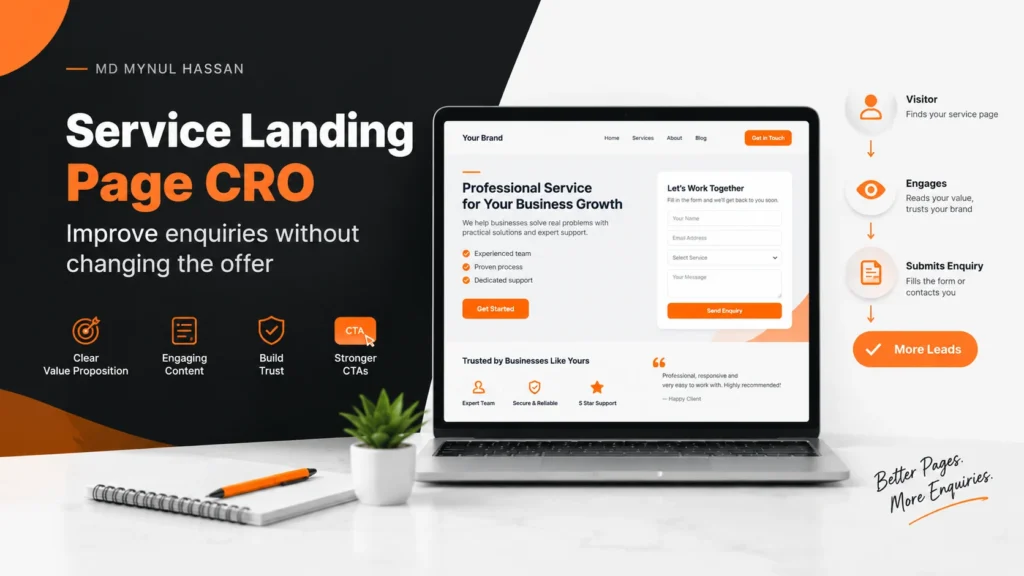
A service landing page does not need a different offer to generate more enquiries. Often, the bigger problem is that the existing offer is difficult to understand, evaluate, trust, or act on.
Service landing page CRO is the process of improving the page and its conversion path so relevant visitors can understand the service, decide whether it fits, see credible reasons to trust the business, and take the next step with less friction.
The work can involve messaging, page structure, proof, CTAs, forms, mobile usability, internal links, measurement, and testing.
The key is to improve the decision path rather than randomly change buttons, colors, or headlines.
That distinction matters because a service page usually serves several jobs at once. It may need to satisfy a search query, explain a service, answer objections, establish credibility, and generate an enquiry.
A useful conversion rate optimization service should therefore examine the entire path from visitor intent to business outcome rather than treating one button as the entire CRO strategy.
What Is Service Landing Page CRO?
Service landing page CRO is the structured process of improving a service-focused webpage so a higher proportion of relevant visitors complete the intended business action, such as submitting an enquiry, calling, booking a consultation, requesting a quote, or starting a sales conversation.
CRO does not automatically mean redesigning a website.
It may mean rewriting the first paragraph, clarifying who the service is for, moving proof closer to a claim, reducing unnecessary form fields, improving mobile layout, making the CTA more specific, or fixing measurement.
The practical objective is simple:
Help the right visitor make a confident decision with less unnecessary effort.
That also means CRO is not the same as chasing the highest possible conversion percentage. A page that produces a large number of poor-fit enquiries may look better in analytics while becoming harder for the sales team to handle.
A healthier model is:
Relevant traffic → clear service understanding → trust → appropriate action → qualified enquiry
What Should a Service Page Make Clear First?
The visitor should quickly understand five things:
- Fit: Is this service for someone like me?
- Problem: What problem does it address?
- Outcome: What useful result or improvement is the service intended to provide?
- Proof: Why should I believe this business can deliver it?
- Next step: What happens if I contact the business?
This is the First-Screen Decision Stack.
It is useful because many service pages start with branding language instead of decision-making information.
A headline such as “Digital Solutions for Modern Businesses” may sound polished, but it gives a searcher very little information.
A clearer headline might say:
SEO Strategy for Service Businesses That Need More Qualified Enquiries
That version establishes the subject, audience, and commercial problem more directly.
Google’s SEO guidance emphasizes useful, people-first content and making it easier for users and search engines to understand what a page is about. Google for Developers
The First-Screen Decision Stack
Fit → Problem → Outcome → Proof → Next Step
It does not mean every element has to appear in five separate boxes.
The information can be compressed into a strong hero section:
H1: What the service is and who it helps
Supporting copy: The problem and useful outcome
Proof cue: Relevant evidence or credibility
Primary CTA: The next action
Microcopy: What the visitor should expect after clicking
The first screen should not try to tell the entire story. It should make the next decision easier.
8 Areas That Commonly Reduce Service-Page Enquiries
1. Message Match and Value Proposition
A service page performs poorly when the visitor has to translate vague marketing language into a concrete understanding of the offer.
The page should connect the visitor’s reason for arriving with what the business actually provides.
For search traffic, that begins with intent.
Someone searching “SEO audit service” expects an explanation of an audit, what it reviews, what the output looks like, and why it would be useful.
They should not land on a generic homepage-style introduction.
That is why keyword research supports CRO as well as SEO. Search data helps reveal the language and problems associated with a commercial query, while CRO determines whether the resulting page makes the next decision easy.
Practical test: Read only the title, H1, first paragraph, and primary CTA. Can a new visitor explain the service correctly without asking for clarification?
If not, improve the message before changing the visual design.
2. Service Scope and Fit
A buyer needs to know what they are actually getting.
This can include:
- services or deliverables included
- who the service is designed for
- common use cases
- what the process looks like
- what information the business needs
- what happens after contact
- important limitations or exclusions
- pricing context where appropriate
This is especially useful for professional services where the word “consulting” or “strategy” can describe very different things.
A page should not hide scope in the hope that uncertainty creates more leads.
It usually creates more questions.
Your SEO audit service is a useful example of how scope can be explained through what is reviewed, how findings are prioritized, and what happens afterward rather than presenting a generic promise.
3. Proof and Trust
Trust signals work best when they support a specific decision.
Relevant proof could include:
- verified testimonials
- case studies
- named examples
- screenshots
- project methodology
- clear process documentation
- relevant credentials where genuine
- transparent limitations
- independent references
Do not place every trust signal in one isolated “Why Choose Us” block near the bottom.
If a page makes a claim, the supporting evidence should appear close enough to help the reader evaluate that claim.
A useful case study on this site documents a personal injury law firm’s lead volume moving from 0 per month to 105 leads per month after six months. The case study attributes the work to a broader connected strategy involving Local SEO, service-page optimization, technical SEO, content, internal linking, and conversion-focused search visibility. It does not claim that CRO alone caused the result. That distinction makes the example more trustworthy. mdmynulhassan.com
You can review the methodology in the Brisbane personal injury SEO case study.
4. CTA Hierarchy
A CTA should describe an action that matches the visitor’s readiness.
“Submit” tells the visitor almost nothing.
“Request an SEO Review” gives more context.
“Book a Consultation” works when the visitor already knows what they are booking.
“Get a Quote” makes sense when pricing or quoting is the natural next step.
The surrounding content matters as much as the button.
A CTA is stronger when the visitor already knows:
- what the service is
- why it may fit
- what happens next
- what information is required
Changing a button from blue to orange may improve visibility, but it does not solve uncertainty about the offer.
5. Form Friction
Forms are often treated as implementation details when they are actually part of the conversion path.
Ask for information the business genuinely needs at that stage.
For a simple consultation request, a form might need:
Name
Email
Website
Main challenge
A longer form can be appropriate when qualification requires additional information, but each field should earn its place.
Nielsen Norman Group’s usability research emphasizes reducing hesitation and making forms easier to understand, including clear grouping and relationships between labels and inputs. Nielsen Norman Group
Good form CRO also includes:
- clear labels
- helpful field descriptions
- understandable error messages
- mobile-friendly inputs
- visible confirmation
- clear expectations after submission
A form that technically works but makes people wonder whether their submission succeeded is still creating friction.
6. Objection Handling
Visitors often leave because the page has not answered a question that matters to their decision.
Common objections include:
How much does it cost?
How long does it take?
Is this suitable for my business?
What exactly do you do?
Will I need to change my current website?
What happens after I submit the form?
Do you work with businesses like mine?
Not every page needs a full pricing table.
But it should provide enough context to prevent avoidable uncertainty.
One helpful technique is a short “good fit” section.
For example:
This service is a good fit when your website already receives relevant traffic but important commercial pages are not producing enough enquiries.
Then state when it is not the right starting point:
It may not be the first priority when the website has almost no relevant traffic or when the offer itself has not been validated.
That kind of qualification can reduce poor-fit enquiries while improving trust.
7. Mobile UX and Speed
A service page can have excellent copy and still lose visitors because the page is difficult to use.
Check:
- hero height
- CTA visibility
- font size
- form usability
- tap targets
- image sizes
- menu behavior
- layout shifts
- slow scripts
- excessive pop-ups
- intrusive overlays
Google’s Core Web Vitals guidance currently identifies LCP, INP, and CLS as key measures of loading performance, responsiveness, and visual stability. Google’s recommended good thresholds are LCP of 2.5 seconds or less, INP under 200 milliseconds, and CLS of 0.1 or less. Google for Developers
That does not mean a Core Web Vitals score is a guaranteed conversion lever.
It means performance and usability should be diagnosed as part of the actual experience.
For pages where performance is a concern, website speed optimization is a logical supporting resource.
8. Internal Paths and Supporting Content
A service page should not become a dead end.
Someone researching your service may want deeper information before contacting you.
A contextual link can send that visitor to:
- a supporting guide
- a case study
- a related service
- an audit page
- an industry page
- an explanation of the process
Your on-page SEO service explains why content structure, internal linking, search intent, and page-level relevance need to work together.
Your SEO content strategy service provides the broader relationship between supporting content and important commercial pages.
The goal is not to add links for their own sake.
Each link should answer the visitor’s likely next question.
How to Audit a Service Page Before Changing It
Do not start by redesigning the page.
Start by diagnosing the conversion path.
Step 1: Define the page’s job
Write one sentence:
This page exists to help [audience] understand [service] and take [action].
If that sentence is unclear, the page itself may be trying to do too much.
Step 2: Identify the dominant traffic intent
Check:
- organic queries
- paid keywords
- referral sources
- internal links
- landing URLs
- branded vs non-branded traffic
- device mix
A visitor arriving from a high-intent service query should see a different first experience from someone arriving from a general informational article.
Step 3: Inspect the first screen
Look at the page as a stranger.
Within a few seconds, can you answer:
What is this?
Is it relevant to me?
Why should I trust it?
What do I do next?
Step 4: Check the proof
Match proof to the claims.
A testimonial about communication does not necessarily support a technical performance claim.
A case study about SEO traffic does not automatically prove CRO effectiveness.
Evidence should support the exact decision the reader is making.
Step 5: Inspect friction
Look at:
- unnecessary form fields
- unclear buttons
- repeated pop-ups
- distracting navigation
- slow-loading elements
- difficult mobile interactions
- unclear success messages
- broken links
- confusing pricing information
Step 6: Verify tracking
GA4 can use events to record interactions such as clicks, form-related actions, and other meaningful website behavior. Google for Developers
Track the actual journey instead of relying on one number.
For example:
Page visit → CTA click → form start → form completion → qualified enquiry → booked consultation
That sequence provides much more information than “conversion rate increased.”
CRO vs SEO: Which Should You Fix First?
SEO and CRO answer different questions.
| Area | SEO | CRO |
|---|---|---|
| Main question | Can the right people find the page? | Can relevant visitors understand and act? |
| Focus | Search visibility and relevance | Decision-making and action |
| Main inputs | Search intent, content, technical SEO, authority | UX, messaging, proof, CTA, forms |
| Typical problem | Not enough qualified traffic | Enough traffic but too few enquiries |
| Useful metrics | Impressions, clicks, CTR, position | CTA clicks, form completion, qualified enquiries |
| Best relationship | Bring relevant visitors | Help those visitors take the right next step |
The two should work together.
A service page with excellent CRO but no relevant traffic has limited opportunity.
A page with strong search visibility but a weak conversion path can waste that opportunity.
This is one reason technical SEO and CRO should sometimes be reviewed together. A page that cannot be crawled, loads poorly, has a broken form, or suffers from technical errors has a problem larger than copywriting.
When Should You Rewrite, Redesign, or Test?
These three decisions are often mixed together.
Rewrite when:
- the offer is sound
- the structure is usable
- the page lacks clarity
- the audience is unclear
- objections are unanswered
- proof is weak or poorly positioned
- CTA language is vague
Redesign when:
- layout itself creates friction
- mobile usability is poor
- important elements cannot be presented clearly
- navigation competes with the page goal
- the existing template restricts useful content structure
- performance problems are tied to implementation
A redesign should solve a diagnosed problem.
Test when:
- you have a clear hypothesis
- the element is important enough to matter
- tracking is reliable
- you can collect enough useful evidence
- the test has a defined primary metric
A useful hypothesis looks like this:
If we replace a generic CTA with one that describes the next action and add one sentence explaining what happens after submission, qualified CTA engagement should improve because the visitor has less uncertainty about the next step.
That is much stronger than:
Let’s test a new button color.
Nielsen Norman Group’s usability heuristics reinforce principles such as consistency, error prevention, recognition rather than recall, and keeping interfaces focused and understandable. Nielsen Norman Group
How to Measure Service-Page CRO Properly
Start with the formula.
Conversion rate = desired conversions ÷ eligible visitors × 100
The important word is desired.
If you count every tiny interaction as a conversion, the number becomes less useful.
For a service business, useful metrics can include:
Page conversion rate
Measures how often eligible page visitors complete the primary action.
CTA click rate
Shows whether visitors engage with the next-step action.
Form start rate
Helps reveal whether people are willing to begin the enquiry process.
Form completion rate
Shows where friction may exist between starting and completing a form.
Qualified enquiry rate
Qualified enquiries ÷ total enquiries × 100
This is often more valuable than raw submission volume.
Booked consultation rate
Shows how many enquiries progress to the next commercial stage.
Lead-to-opportunity rate
This brings CRM data into the CRO process.
A page can generate more enquiries and still become less commercially useful if lead quality falls.
That is why a proper CRO measurement framework should connect website actions with the business’s actual sales process.
Practical Service Page Example
Consider a fictional SEO consultancy.
Before
H1:
Digital Marketing Services
Supporting copy:
We help businesses grow online with strategic digital solutions.
CTA:
Submit
The page may look professional, but the visitor still has to ask:
What service?
For whom?
Which problem?
Why this business?
What happens after clicking?
After
H1:
SEO Strategy for Service Businesses That Need More Qualified Enquiries
Supporting copy:
Get a clearer search strategy for your service pages, content, technical foundation, and commercial search opportunities.
Proof cue:
Relevant case study or specific methodology
CTA:
Request an SEO Review
Microcopy:
Share your website and main search challenge. The first review focuses on priorities, not a generic list of tasks.
Nothing about the underlying SEO offer had to change.
The difference is the information architecture.
The second version helps the visitor make a decision sooner.
For implementation, SEO-friendly web design can help connect design, SEO structure, mobile experience, internal links, and conversion-focused layouts.
Common Service-Page CRO Mistakes
Mistake 1: Changing the CTA before fixing the message
Problem: The page asks for action before explaining enough.
Better approach: Improve the information surrounding the CTA first.
Mistake 2: Treating every visitor as equally valuable
Problem: Raw lead volume becomes the main objective.
Better approach: Measure qualified enquiries and downstream outcomes.
Mistake 3: Copying another business’s landing page
Problem: The structure may suit a different audience, offer, market, or traffic source.
Better approach: Borrow principles, not wording or assumptions.
Mistake 4: Adding more sections instead of removing friction
Problem: The page becomes longer without becoming clearer.
Better approach: Ask what each section helps the buyer decide.
Mistake 5: Hiding important proof
Problem: Evidence appears after the visitor has already made a decision.
Better approach: Put relevant proof beside the claims it supports.
Mistake 6: Asking for too much information
Problem: The business tries to qualify everything before starting a conversation.
Better approach: Ask only for information justified by the stage of the journey.
Mistake 7: Assuming SEO traffic is automatically qualified
Problem: The page receives organic visits but they may come from informational searches.
Better approach: Analyze the query and landing-page intent.
Mistake 8: Redesigning before diagnosing
Problem: A new design can reproduce the same structural problem.
Better approach: Audit first, prioritize second, redesign only when evidence supports it.
Mistake 9: Tracking only form submissions
Problem: You cannot see where people abandon.
Better approach: Track CTA clicks, form starts, errors, completions, and qualified outcomes.
Mistake 10: Using unverified performance claims
Problem: The page tries to build trust with statistics that have no clear source.
Better approach: Use verified case studies, transparent methodology, and specific evidence.
Service Landing Page CRO Checklist
Before publishing or optimizing a service page, check:
Positioning
- The H1 identifies the actual service.
- The target audience is clear.
- The problem or use case is obvious.
- The expected outcome is explained without exaggerated promises.
First screen
- The page is understandable without scrolling.
- The primary CTA is visible.
- The CTA language describes a meaningful action.
- Supporting copy explains what happens next.
Service clarity
- Scope is explained.
- Major deliverables are understandable.
- Good-fit situations are clear.
- Important limitations or exclusions are not hidden.
Trust
- Proof is genuine.
- Testimonials are attributable where appropriate.
- Case studies do not exaggerate results.
- Claims have supporting evidence.
Forms
- Every field has a purpose.
- Labels are clear.
- Errors are understandable.
- Mobile completion is easy.
- Successful submission is obvious.
UX
- The page works on mobile.
- Important content is easy to find.
- No unnecessary overlays interrupt the decision.
- Navigation does not overpower the primary action.
- Images and scripts do not create avoidable performance problems.
For WordPress sites, a WordPress SEO service can also be relevant when page-builder configuration, indexing, internal links, schema, plugins, or performance affect the page.
SEO
- Search intent matches the page type.
- Title and H1 are aligned.
- The primary topic is naturally covered.
- Related concepts are explained.
- Internal links support the next question.
- Canonical URL is correct.
- Images have descriptive filenames and useful alt text.
Measurement
- CTA clicks are tracked.
- Form starts and completions can be distinguished.
- Qualified enquiries can be identified.
- CRM outcomes can be connected where possible.
- The primary conversion has a clear definition.
Supporting search visibility
A service page often benefits from relationships with Local SEO, technical SEO, content, and answer-oriented search resources.
For local businesses, Local SEO services can connect service relevance, local search intent, business information, and conversion paths.
Where Google Business Profile is part of the customer journey, Google Business Profile optimization can support the connection between local discovery and the website experience.
For businesses focused on modern answer-oriented search, AEO and GEO consulting can support clearer entities, answers, content structure, and brand information.
Connect With Md Mynul Hassan
Conversion optimization often sits between SEO, content, website structure, UX, and business strategy. That is why I approach CRO as part of the wider search and conversion system rather than as isolated button testing.
You can explore my work or contact me through my professional profiles:
Work with Md Mynul Hassan on Upwork
Hire Md Mynul Hassan on Freelancer
Connect with Md Mynul Hassan on LinkedIn
Watch Md Mynul Hassan on YouTube
Follow Md Mynul Hassan on Facebook
For a website that receives relevant visitors but does not turn enough of them into useful conversations, the natural next step is a focused Conversion Rate Optimization Service review.
The purpose is to identify where the decision path becomes unclear, where friction appears, what evidence is missing, and which improvements deserve priority.
The Practical Takeaway
A service page does not need a new offer to become more useful.
Start by asking what a qualified visitor needs to know before taking action.
Is the service relevant?
Does it solve my problem?
What exactly do I get?
Why should I trust this business?
What happens next?
Once those questions are answered clearly, then look at the next layer: forms, CTAs, mobile UX, speed, internal links, analytics, and testing.
That sequence keeps CRO grounded in the real customer decision rather than a collection of isolated design changes.
The strongest service landing page CRO strategy is therefore:
Clarify → reduce uncertainty → remove friction → measure the right outcome → improve what the evidence supports.
FAQ
What should be fixed first on a service page that gets traffic but few enquiries?
Start with the first-screen decision path. Check whether the page clearly explains the service, intended customer, problem, useful outcome, proof, and next action. Before changing the design, confirm that the visitor can understand the offer quickly.
Should I redesign or rewrite my service page first?
Rewrite first when the existing layout can communicate the service but the message, proof, objections, CTA, or page structure are weak. Redesign when layout, mobile usability, performance, or template limitations prevent the content from being presented clearly.
Should a service page include pricing?
Often, some pricing context is useful, but a universal rule does not exist. If prices are standardized, showing them may reduce uncertainty. For customized services, explaining pricing factors, scope, or how quoting works can be more appropriate.
How many form fields should a service page have?
Use the fewest fields that still allow the business to handle the enquiry properly. Additional fields should have a clear qualification or operational purpose. Clear labels, grouping, validation, and mobile usability matter as much as field count.
How many CTAs should a service page have?
There is no universal ideal number. The primary CTA should remain clear while the page provides natural opportunities to act after important decision points, such as understanding the service, reviewing proof, or resolving objections.
Can SEO improve service-page conversions?
Yes, when SEO improves the relevance of the traffic reaching the page and aligns the page with the actual search intent. SEO and CRO solve different parts of the journey, so a page can need both better traffic quality and better conversion structure.
Does page speed matter for service-page CRO?
Yes. Slow loading, delayed interactions, and layout instability can make a page harder to use. Google currently recommends good Core Web Vitals for a better user experience, with LCP at 2.5 seconds or less, INP under 200 milliseconds, and CLS at 0.1 or less.
What should I track on a service page?
Track the primary conversion plus diagnostic steps such as CTA clicks, form starts, form completions, errors, calls, booked consultations, and qualified enquiries. Where possible, connect website activity with CRM outcomes rather than judging the page on raw submission volume alone. Google Analytics supports event-based measurement of website interactions. Google for Developers
Can CRO improve lead quality?
Yes. CRO can improve qualification by explaining fit, scope, pricing context, service boundaries, and expectations before the visitor contacts the business. This can reduce some poor-fit enquiries while helping suitable prospects understand the next step.