Industry: Personal Injury Law
Location: Brisbane, Queensland, Australia
Project Duration: 6 Months
Client: Withheld under NDA
My Role: SEO Consultant, Local SEO Consultant, Google Business Profile Optimization Consultant, SEO Content Strategist
Primary Focus: Local SEO, Google Business Profile, local search intent, service-page optimization, technical SEO, content, internal linking, authority, conversion-focused search visibility
Starting Lead Volume: 0 leads per month
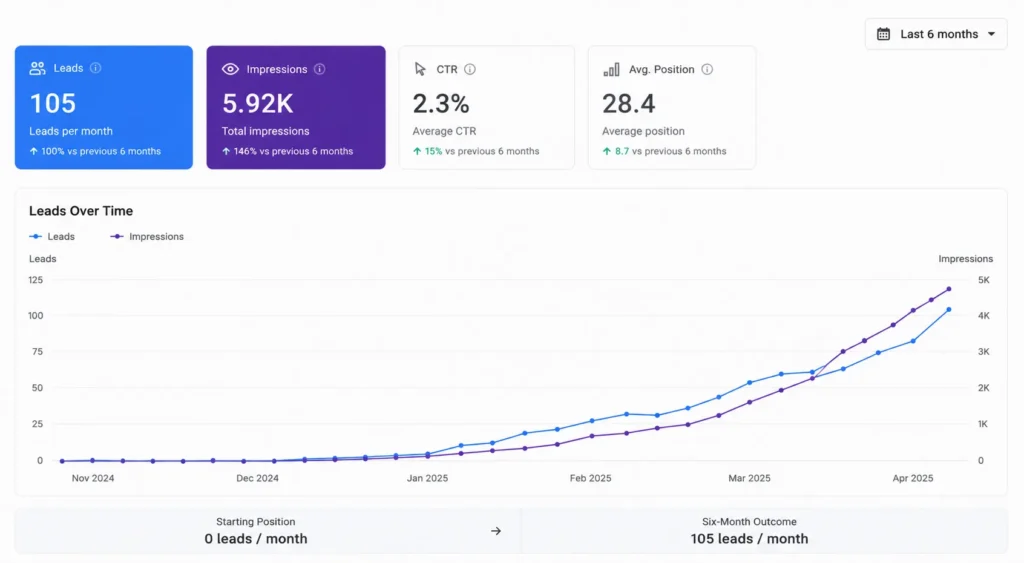
Lead Volume After 6 Months: 105 leads per month
Executive Summary
I worked on a personal injury law firm project in Brisbane where the starting point was straightforward: the business was generating 0 leads per month from the search visibility system I was working to improve.
Personal injury law is a difficult local SEO market because searchers are often looking for legal help at a stressful and time-sensitive moment. At the same time, Brisbane is a competitive metropolitan market, and legal searches can have strong commercial value.
I did not treat the project as a simple keyword-ranking exercise.
My focus was to build a stronger connection between the firm’s services, local search intent, website content, Google Business Profile, technical foundations, authority signals, and the actions a potential client needed to take after finding the business.
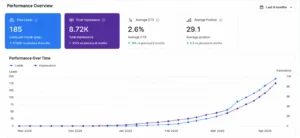
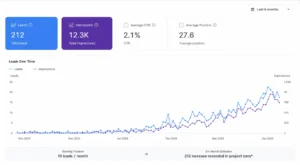
Over the six-month engagement, the recorded lead outcome moved from 0 leads per month to 105 leads per month.
That is the result I use as the central business outcome of this case study. I have not added unsupported traffic, ranking, call, GBP, or revenue figures that were not provided as part of the project data.
For the strategic foundation, I also followed Google’s current guidance around local relevance and Business Profile quality. Google states that local results are primarily influenced by relevance, distance, and prominence, which is one reason I approached the project as a connected local search system instead of trying to force rankings through keyword repetition.
About the Project
The client was a personal injury law firm operating in Brisbane, Queensland.
The market required a strong local presence because potential clients can search using different combinations of:
- Personal injury lawyer
- Personal injury solicitor
- Compensation lawyer
- Workplace injury lawyer
- Motor vehicle accident lawyer
- Car accident lawyer
- Injury compensation
- Specific service + Brisbane
- Lawyer near me
- Urgent legal-help queries
The important point was that these searches do not all represent the same intent.
Someone searching for information about a compensation process may still be researching. Someone searching for a personal injury lawyer in Brisbane may already be evaluating providers. A person searching for a lawyer after an accident may be much closer to contacting a firm.
That distinction shaped how I approached the campaign.
My broader Local SEO methodology is centered on connecting search intent, website relevance, Google Business Profile signals, local authority, and conversion opportunities rather than treating each part independently.
The Challenge
The starting position was 0 leads per month.
That made the actual business objective more important than vanity metrics.
I was not trying to produce a report that simply showed more impressions. The real question was whether the business could become more visible for commercially relevant searches and whether that visibility could create more opportunities for prospective clients to make contact.
Personal injury SEO also requires a different approach from many ordinary local businesses.
A local restaurant, for example, can often win customers from relatively simple discovery searches. Legal clients may compare firms, look at service-specific information, examine credibility signals, and then decide whether they are comfortable making contact.
So the challenge was not simply:
“How do I rank this law firm?”
The better question was:
“How do I make this business easier to find, understand, trust, and contact when someone in Brisbane is looking for personal injury legal help?”
That became the basis of the project.
Starting Position
The most important baseline number was clear:
| Metric | Starting Position | Month 6 |
|---|---|---|
| Leads per month | 0 | 105 |
I am deliberately not adding invented baseline figures for organic sessions, GBP calls, Maps positions, clicks, or keyword rankings. Those would make the case study look more detailed, but they would not make it more trustworthy.
The lead result is the business outcome supplied for this project.
Project Goals
My objectives were built around improving the complete search journey rather than chasing individual positions.
Build stronger local visibility
I wanted the firm to have a clearer relationship between its services, Brisbane market, website, and Google Business Profile.
Improve service relevance
Personal injury is a broad topic. I needed the website structure and content to communicate the actual legal services clearly enough for both search engines and potential clients.
Match content to search intent
I mapped the work around informational, commercial-investigation, transactional, and local intent rather than choosing keywords based only on search volume.
Strengthen conversion opportunities
Visibility only becomes commercially useful when people can understand the service and take the next step.
That meant paying attention to contact paths, service clarity, calls to action, trust elements, and the transition from search result to enquiry.
Create a stronger foundation for long-term visibility
I wanted the project to improve the underlying search system rather than depend on short-term tactics.
Strategy Overview
I structured the campaign around five connected areas:
Search demand and intent → Website and technical foundation → Local SEO and GBP → Content and authority → Conversion and measurement
That approach reflects how I normally work with local service businesses. My Local SEO process includes website analysis, local search research, competitor analysis, service-page work, GBP alignment, internal linking, technical review, citations, and measurement.
The strategy also had to stay within Google’s guidelines.
I did not use fake business names, fake locations, fake reviews, misleading service areas, or other manipulative local tactics. Google’s own guidance makes clear that businesses cannot simply pay for a better local ranking, and that relevance, distance, and prominence remain important parts of local search.
Month 1: Research, Audit and Search Intent
I started with research rather than immediately publishing content.
The first step was to understand the firm’s services, target market, existing search presence, website structure, Google Business Profile, competing firms, and the types of searches that could realistically lead to a legal enquiry.
I separated search opportunities by intent.
For example, a query around “personal injury compensation” can have an informational component, while “personal injury lawyer Brisbane” carries much stronger commercial and local intent.
That distinction matters because the same page should not necessarily try to answer every type of query.
I also reviewed the site from a technical and structural perspective.
My technical SEO process includes areas such as crawling, indexing, canonicals, redirects, XML sitemaps, site architecture, internal links, JavaScript considerations, structured data, Search Console issues, and website performance.
At the same time, I assessed how the website communicated the firm’s services and how easily a prospective client could move from a search result to a useful service page and then to contact.
The objective of Month 1 was to establish the priorities before making larger changes.
Month 2: Local and Technical Foundation
Once the research was complete, I moved into the foundational work.
I focused on making the website and local presence communicate the same business clearly.
For Local SEO, I looked at the relationship between:
- The firm’s services
- Brisbane relevance
- Website pages
- Google Business Profile
- Business information
- Local signals
- Competitor positioning
- Customer trust
- Conversion paths
Google explains that Business Profile information is one of the sources used in local search and that public information from a business’s official website can also contribute to how Google understands a local business.
That made website-to-profile consistency important.
I also kept the implementation focused on genuine information. I did not attempt to create artificial local signals simply to reach more suburbs or locations.
Month 3: Service-Page and On-Page Optimization
The next stage focused more heavily on the commercial side of the website.
A law firm’s service architecture needs to make sense to both the prospective client and the search engine.
I reviewed the way service information was structured, including page targeting, headings, titles, content relevance, internal links, calls to action, and the relationship between different legal services.
I treated each important page as a destination for a particular search intent rather than a container for every possible keyword.
This is where my on-page SEO methodology becomes particularly important.
I do not approach on-page optimization as adding more instances of a phrase.
Instead, I look at whether the page clearly answers:
What service is offered?
Who is it for?
Where is it relevant?
What questions will the searcher have?
Why should the business be trusted?
What should the visitor do next?
That approach also helped support conversion.
The same principle appears in my current Local SEO methodology, where I focus on service relevance, profile accuracy, trust signals, mobile usability, contact information, service clarity, and strong calls to action rather than rankings alone.
Month 4: Content and Topical Authority
By Month 4, the focus expanded from individual commercial pages to broader topic coverage.
Personal injury law creates a large group of related questions.
People may want to understand:
- What type of injury qualifies for a claim
- What happens after an accident
- What compensation may involve
- How the legal process works
- What evidence may matter
- When to seek legal advice
- How different injury situations are handled
I used this relationship between core services and supporting questions to strengthen topical coverage.
I did not build pages simply because a keyword existed in a keyword tool.
A topic needed a reason to exist.
The page needed to satisfy a real question, support the firm’s service architecture, or contribute to a useful internal-linking relationship.
This also created an AEO benefit.
Clear question-and-answer structures, direct explanations, useful headings, and well-defined entities make content easier for people to understand and easier for search systems to interpret.
My current AEO/GEO methodology follows the same principle: strong AI-search visibility starts with useful content, clear entities, accessible technical foundations, structured information, authority, and consistency rather than so-called AI ranking tricks.
Month 5: Authority, Local Signals and Trust
At this stage I focused more strongly on the external signals supporting the website and local presence.
For a professional service business such as a personal injury law firm, trust matters.
I considered the relationship between the firm’s website, local presence, business information, relevant citations, reviews, authority signals, and third-party references.
I did not treat citations as a numbers game.
The goal was accuracy and relevance.
That is consistent with Google’s explanation that prominence can be influenced by information across the web, including links and reviews.
I also kept the review strategy within legitimate boundaries. The objective was to strengthen the firm’s genuine reputation, not manufacture one.
For a legal business, that distinction protects both the client and the consultant.
Month 6: Consolidation and Conversion Focus
The final month was about improving what had already been built.
I looked at the search journey as a whole.
A visitor may discover the firm through a search result, arrive on a service page, compare the firm with another provider, look for evidence of credibility, and then decide whether to make contact.
So I focused on the parts of the journey that could reduce friction.
That included improving clarity around services, strengthening internal connections between relevant pages, refining calls to action, and making the website easier to use as a next step after search discovery.
I also measured progress against the business outcome rather than judging the project entirely through rankings.
Google Search Console provides separate metrics for clicks, impressions, CTR and average position, which makes it useful for understanding search visibility at a page and query level.
For this particular case study, the verified business result supplied for publication is the lead outcome.
Results
The clearest result from the six-month engagement was the change in lead generation.
| Business Outcome | Before | After 6 Months |
|---|---|---|
| Leads per month | 0 | 105 |
The business moved from 0 leads per month to 105 leads per month after six months.
That is the figure I consider the central result of the project.
I am not adding a fabricated percentage growth calculation because percentage growth from a zero baseline is mathematically undefined.
I am also not inventing organic-session, keyword-position, GBP-call, direction-request, or website-click figures that were not supplied with the project data.
Where Search Console, GBP, GA4, CRM, and call-tracking exports are available, I normally use those datasets to connect search visibility with real business outcomes. Google’s Search Console documentation confirms that clicks, impressions, CTR, and average position are distinct measurements and should be interpreted accordingly.
What Made the Biggest Difference
The biggest lesson from this project was that I did not try to solve the firm’s lead-generation problem with one SEO tactic.
The result came from connecting multiple parts of the search journey.
1. I focused on intent, not keyword volume
A high-volume phrase is not automatically the best target.
For a law firm, the difference between someone looking for general information and someone actively searching for legal representation can be commercially significant.
I therefore prioritized intent and page purpose before deciding what the site needed.
2. I connected website SEO with Local SEO
I did not treat the website and Google Business Profile as separate marketing assets.
The firm’s services, location relevance, website content, business information, and local presence needed to make sense together.
Google itself describes local ranking around relevance, distance and prominence, which reinforces why a connected local foundation is more useful than isolated optimization tricks.
3. I built around the customer journey
A ranking can create an opportunity.
It does not automatically create a lead.
Once someone lands on the website, the business still needs to explain the service clearly, establish trust, reduce friction, and make the next action obvious.
That is why conversion thinking was part of the SEO strategy rather than something I left until the end.
4. I treated content as a system
I did not want a website full of disconnected articles.
The important service pages needed supporting topics, and those topics needed logical connections back to the core commercial pages.
That helped create a clearer topical structure and gave internal links a genuine purpose.
5. I kept the strategy within real Local SEO constraints
I did not try to manipulate the business name, create fake locations, fabricate reviews, or promise Maps positions.
Google explicitly states that there is no way to request or pay for a better local ranking.
That matters to me because a strategy is only useful if the business can stand behind it.
Business Impact
The move from 0 to 105 leads per month changed the way I evaluated the project.
The objective was never to create a prettier SEO report.
The objective was to create a stronger path from search demand to potential client contact.
For a personal injury law firm, this is especially relevant because the value of visibility is closely connected to the ability to reach people who are actively looking for legal assistance.
That is why I place greater weight on qualified enquiries and business actions than on ranking screenshots alone.
Measurement and Evidence
I use different tools for different questions.
Google Search Console helps me understand search visibility through impressions, clicks, CTR, average position, queries, and pages.
Google Business Profile helps evaluate local-search activity and how the firm’s local presence supports discovery.
GA4 can help connect organic visitors with meaningful site actions.
CRM or call-tracking data is valuable when the goal is to understand whether search visibility is producing actual business opportunities.
For this published case study, the confirmed numerical outcome I am presenting is the lead change from 0 per month to 105 per month.
That distinction is intentional. I would rather publish one defensible business result than create a longer list of numbers that I cannot substantiate.
AEO and GEO Considerations
Although the project was fundamentally a Local SEO campaign, I also considered how stronger content structure can support newer search experiences.
I did not treat GEO as a replacement for SEO.
The same fundamentals still matter:
- Clear business identity
- Clear services
- Strong topical coverage
- Useful answers
- Consistent business information
- Accessible technical structure
- Relevant authority
- Evidence that supports trust
This is also consistent with current Bing guidance, which says that the traditional SEO foundations supporting crawling, indexing, content clarity, authority, and trust also support visibility in AI-powered search and grounding experiences.
My current AEO/GEO service philosophy follows the same direction. I focus on making a business easier for search systems to understand, retrieve, summarize, and connect with relevant queries rather than trying to exploit supposed AI-search shortcuts.
Key Takeaways
The first lesson was simple: 0 leads is not solved by chasing rankings alone.
The second was that a competitive legal market needs a search strategy built around commercial intent, trust, local relevance, content structure, and conversion.
The third was that Local SEO works better when the website, Business Profile, services, content, authority, and customer journey reinforce one another.
The fourth was measurement.
A ranking report can show movement, but the business ultimately cares about calls, enquiries, consultations, cases, bookings, or revenue.
In this project, the lead outcome gave me the clearest measure available:
0 leads per month → 105 leads per month in six months.
My Approach
This project reflects how I approach Local SEO more broadly.
I start with the business rather than a generic SEO checklist.
I want to understand the services, market, customers, competitors, website, local presence, search demand, and business objective first.
Then I identify what is actually limiting visibility.
From there, I prioritize the work.
That can mean technical SEO, keyword research, service-page optimization, Local SEO, Google Business Profile work, content, internal linking, authority, AEO, GEO, or conversion improvements.
Not every client needs all of them.
The work should follow the problem.
You can see the same principle in my current Local SEO service approach, where I connect search intent, website relevance, Business Profile signals, local authority, and conversion opportunities rather than treating Local SEO as a rankings-only service.
For businesses that need a deeper diagnosis before implementation, I also provide an SEO audit service, covering issues such as technical SEO, search intent, local relevance, service pages, internal linking, competitors, and conversion paths.
And where the local presence itself needs more attention, my Google Business Profile optimization service focuses on accurate profile information, categories, services, website alignment, reviews, competitors, and local visibility opportunities.
Conclusion
This Brisbane personal injury law firm project started at 0 leads per month.
After six months, the lead outcome reached 105 leads per month.
The important part for me was not a single keyword or one optimization task.
I approached the project as a connected search-visibility system.
I worked around search intent, local relevance, website structure, service clarity, Google Business Profile alignment, content, authority, internal linking, trust, and conversion.
That is how I prefer to approach SEO.
Not as a list of isolated tasks.
Not as a promise of a specific ranking.
And not as a collection of vanity metrics.
The goal is to make a business easier to find, easier to understand, easier to trust, and easier to choose.
Be found. Be understood. Be chosen.
About Md Mynul Hassan
I’m Md Mynul Hassan, an SEO Consultant, Local SEO Consultant, Google Business Profile Optimization Consultant, AEO Strategist, GEO Strategist, and SEO Content Strategist.
I work with local and service businesses, professional firms, startups, agencies, ecommerce businesses, and other companies that need search visibility connected to real business outcomes.
I have more than two years of practical SEO experience, supported by a web-development background, and I work with businesses in Bangladesh and international English-speaking markets. My website currently positions my work around Local SEO, Google Business Profile optimization, technical SEO, content strategy, AEO, GEO, and search visibility.
You can also view my professional work through my Upwork profile, which currently identifies me as a Local SEO Specialist focused on GBP, AEO and GEO.
My Freelancer profile is another place to review my professional background and portfolio.
For more case studies, my SEO case studies section contains additional project work.
For project discussions, you can contact me directly