Industry: Healthcare & Wellness
Business Type: Orthodontist
Market: Gold Coast, Queensland, Australia
Project Duration: 6 months
Client: Business identity withheld for confidentiality
My Role: SEO Consultant, Local SEO Consultant, Google Business Profile Optimization Consultant, Google Maps SEO Consultant
Primary Services: Local SEO, Google Business Profile optimization, local keyword research, search intent analysis, on-page SEO, technical SEO, content strategy, internal linking, local authority and conversion-focused SEO
Executive Summary
The orthodontic practice was competing in the Gold Coast market against larger practices with stronger brand recognition, bigger marketing budgets, and more established local visibility.
I did not approach the project as a simple ranking exercise.
The real objective was to improve the practice’s ability to be discovered by people actively looking for orthodontic treatment, understand the services clearly, and take the next step toward becoming a patient.
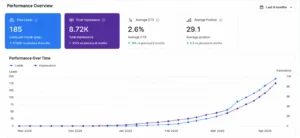
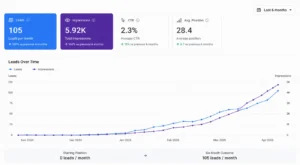
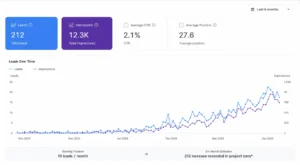
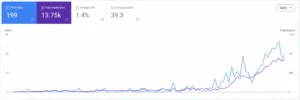
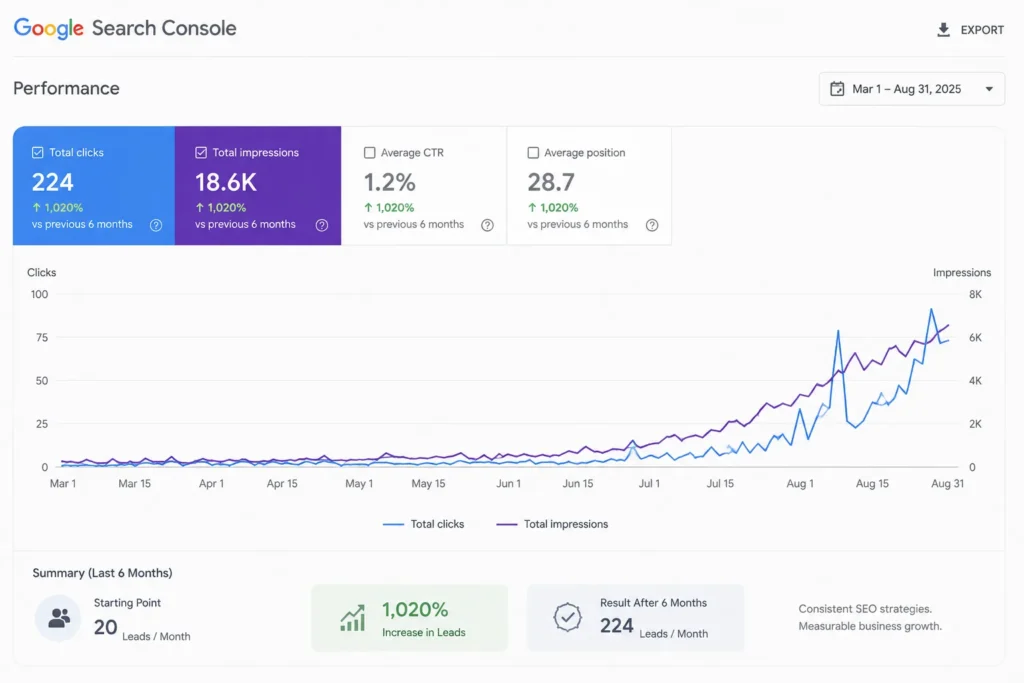
The starting business result I was given was approximately 20 leads per month. After six months of SEO work, the practice recorded a 1,020% increase in leads. Based on that starting figure, this represents approximately 224 leads per month at the end of the reported period.
The most important part of the project was not trying to outspend larger competitors. It was identifying the areas a smaller orthodontic practice could control: local relevance, service visibility, website clarity, Google Business Profile alignment, search intent, content, internal linking, trust signals, and conversion paths.
Google currently explains that local results are primarily influenced by relevance, distance, and prominence, so I used those principles to shape the local strategy rather than relying on shortcuts or artificial location signals.
About the Project
This project focused on an orthodontic practice serving customers in Gold Coast, Queensland.
Orthodontic search behavior is different from many ordinary local-service categories. A potential patient may begin with a broad treatment question, compare treatment options, look for a local orthodontist, investigate costs and suitability, review the practice’s reputation, and only then make contact.
That meant the website and Google Business Profile needed to support more than one type of search.
I wanted the practice to be easier to understand for people searching for orthodontic services and easier for Google to associate with the relevant local and treatment context.
The strategy therefore connected the website, local search presence, service information, content, internal links, authority signals, and lead paths rather than treating each element as an isolated SEO task.
The Challenge
The practice had an obvious competitive disadvantage.
Larger orthodontic practices could invest more heavily in branding, advertising, content production, and broader marketing activity. Trying to compete with them by simply producing more content or targeting the biggest keywords would not have been a sensible use of resources.
I needed to find opportunities where a smaller practice could compete through relevance and clarity.
The challenge had several parts.
The practice needed stronger visibility for commercially meaningful orthodontic searches.
Treatment intent needed to be reflected more clearly in the website structure.
Local relevance needed to connect the Gold Coast market with the actual services offered.
The Google Business Profile and website needed to reinforce the same business information and service context.
The conversion journey also needed attention because more visibility only becomes valuable when searchers can take action.
This is consistent with Google’s current explanation of local search, where complete and accurate business information helps Google understand relevance, while prominence is influenced by signals such as reviews and information from across the web.
Initial Audit Findings
Search Intent Was More Important Than Search Volume
I began by reviewing the types of searches a potential orthodontic patient could make throughout the decision process.
Instead of building a list of keywords and assigning them to pages mechanically, I separated opportunities by intent.
The main groups included:
- orthodontic treatment searches
- treatment-specific searches
- local orthodontist searches
- comparison and research searches
- appointment and consultation intent
- question-based searches from people still evaluating treatment
This gave me a clearer view of which searches belonged on commercial service pages and which needed supporting informational content.
My keyword research process is built around search intent, page mapping, competitors, and business relevance rather than search volume alone.
Commercial Services Needed Clearer Search Paths
One of the strategic priorities was making sure the site’s most commercially important services were easy to understand and easy to reach.
Where related orthodontic services could be explained separately, I treated those as distinct opportunities rather than forcing every treatment into a single generic page.
This helped create clearer relationships between the core service offering, supporting content, and conversion pages.
Local Relevance Needed to Be Genuine
I did not treat “Gold Coast” as a keyword that should simply be repeated throughout the website.
The location needed to appear naturally through the business context, service relevance, page content, local information, and Google Business Profile alignment.
That distinction matters because local SEO should establish a genuine relationship between the business and the area it serves, not create artificial location relevance.
Google Business Profile Was Part of the Search System
I treated the Google Business Profile as part of the wider search presence rather than as a separate marketing channel.
Google explains that Business Profile information contributes to local search and that customers can interact with a profile through actions such as calls, directions, website clicks, and bookings where available.
The focus was therefore on improving the relationship between the profile, the website, services, business information, reviews, and local relevance.
The Conversion Path Needed to Support the SEO Work
I did not want the project to produce visibility without business value.
The website needed to make it obvious what the practice offered, who the services were for, and what the user should do next.
That included reviewing service-page clarity, calls to action, contact visibility, trust elements, and the overall journey from search result to enquiry.
Starting Position
The practice entered the project with a clear competitive challenge: a smaller orthodontic business competing locally against larger and better-funded practices.
The starting lead volume provided for the project was:
| Metric | Starting Position |
|---|---|
| Monthly leads | 20 |
| Project duration | 6 months |
| Market | Gold Coast, Queensland |
| Business type | Orthodontist |
I was not provided with verified starting values for organic sessions, GBP calls, GBP direction requests, website clicks, individual keyword positions, review count, or booking volume, so I have not created numbers for those metrics.
Project Goals
The project goals were practical rather than vanity-driven.
First, I wanted to improve the practice’s visibility for relevant local and treatment-focused searches.
Second, I wanted to improve the website’s ability to satisfy different stages of orthodontic search intent.
Third, I wanted to strengthen the connection between the website and Google Business Profile.
Fourth, I wanted to make the site’s commercial pages clearer and better connected through internal linking.
Finally, I wanted search visibility to contribute to more meaningful business enquiries rather than simply producing higher impression counts.
Strategy Overview
My approach followed a connected local-search framework.
I started with the business model and customer journey, then moved through search demand, intent, technical foundations, service pages, content, local relevance, Google Business Profile work, internal linking, authority, trust, and conversion.
For the technical side, I used the same principle I apply in my technical SEO work: fix issues that can materially affect discovery, indexing, interpretation, or the user’s experience before spending time on lower-impact details.
For the local side, the strategy centered on the actual business location, service relevance, profile accuracy, website alignment, local authority, and customer trust.
Month 1: Research, Audit and Baseline
The first month was about understanding the market before making major changes.
I reviewed the existing website structure, key service pages, search intent, local competitors, internal links, technical conditions, and the overall path from search to enquiry.
I also reviewed the practice’s local search presence and the relationship between the Google Business Profile and the website.
The competitor review was particularly important.
I was not looking only at who ranked first. I wanted to understand what larger practices were doing better.
That included looking at the breadth and structure of service information, content coverage, local relevance, trust signals, page quality, and how clearly the businesses communicated their treatment offerings.
The result was a prioritized roadmap rather than a long list of disconnected SEO tasks.
Month 2: Technical and Local Foundation
Once the priorities were clear, I worked on the underlying SEO and local foundations.
The technical review covered areas such as crawlability, indexing, URLs, page structure, internal linking, metadata, canonical considerations, and other issues that could interfere with search-engine understanding.
On the local side, I worked on improving the consistency and relevance of the business’s Google presence and website signals.
I kept the local strategy within Google’s guidelines rather than attempting to manipulate the business name, location, or service area.
Google explicitly states that businesses cannot request or pay for better local rankings, and its current guidance recommends complete and accurate Business Profile information.
Month 3: Service Page and On-Page Optimization
The third month focused heavily on commercial search intent.
I reviewed the site’s important service pages for:
- title and heading relevance
- treatment terminology
- search intent alignment
- content structure
- internal links
- calls to action
- supporting trust information
- local context
The objective was not to insert more keywords.
The objective was to make each important page answer a clear search need.
A person searching for a specific orthodontic treatment should not have to work through a generic page before understanding whether the practice actually provides that service.
I also strengthened the relationships between commercial pages and supporting informational content.
This is where my on-page SEO approach and local strategy worked together.
Month 4: Content and Topical Coverage
Once the core commercial pages were stronger, I expanded the supporting content around genuine patient questions and search intent.
The content strategy was built around questions a prospective orthodontic patient could reasonably ask before contacting the practice.
That meant looking at the information journey rather than publishing articles simply to increase the site’s page count.
I also used internal linking to connect informational pages with the relevant commercial services.
This helped turn separate pieces of content into a more connected topic structure.
The aim was to make the website useful at different stages of the customer’s decision-making process while still bringing relevant users toward the appropriate treatment or consultation path.
Month 5: Authority, Trust and Local Signals
By this stage, the focus moved toward strengthening the external signals supporting the site’s local relevance and credibility.
I reviewed business-information consistency and relevant citation opportunities rather than pursuing large quantities of low-quality directories.
I also considered the relationship between reviews, business information, the website, and the broader local presence.
This was guided by Google’s current explanation that prominence can involve information from across the web, links, reviews, and other signals associated with how well known a business is.
The focus remained on genuine business information and real customer trust rather than artificial review or location tactics.
Month 6: Consolidation, Conversion and Measurement
The final month was about consolidating what had been built.
I reviewed pages that had improved, pages that still needed work, internal-link opportunities, commercial intent alignment, and the overall lead journey.
I also looked at whether the site’s improved search visibility was translating into business action.
The core business result supplied for the project was a 1,020% increase in leads after six months.
Starting from 20 leads per month, that works out to approximately 224 leads per month at the end of the reported period.
The calculation is:
20 × 11.2 = 224
So the reported lead movement can be represented as:
| Metric | Start | After 6 Months | Change |
|---|---|---|---|
| Monthly leads | 20 | 224 | +1,020% |
This is the only before-and-after performance table I am using because these are the figures provided for the project.
Results
Lead Generation
The clearest reported result was the increase in monthly leads.
The practice started at approximately 20 leads per month and reached approximately 224 leads per month after six months, representing a 1,020% increase based on the figures supplied for this case study.
That is the strongest business outcome available from the project data.
Organic Search
The strategy was designed to improve organic visibility across commercially valuable orthodontic and local searches, with greater alignment between search intent, service pages, content, and internal linking.
However, I was not provided with a verified before-and-after organic-session figure, so I am not assigning a numerical traffic increase to the project.
Google Business Profile and Maps
The project also included local-search and Google Business Profile work intended to improve local relevance and the relationship between the practice’s website and Google presence.
Google currently provides Business Profile performance metrics such as calls, directions, website clicks, messages, and bookings where applicable.
Because no verified before-and-after GBP figures were supplied, I am not presenting invented call, direction-request, or website-click numbers.
Keyword Rankings
Keyword targeting and search-intent mapping were part of the strategy.
However, the exact before-and-after positions for the primary target terms were not supplied for this write-up. I therefore do not claim specific ranking improvements.
That distinction matters.
A case study should show what can be supported by actual project data, not fill missing fields with impressive-looking numbers.
What Made the Biggest Difference
The biggest difference came from treating Local SEO as a connected system.
The practice did not need to imitate the marketing budget of its larger competitors.
It needed to become clearer and more relevant for the searches that actually mattered.
That meant connecting several things together:
Clearer commercial pages.
The most valuable services needed dedicated, intent-aligned pages that explained the treatment clearly.
Better search-intent targeting.
I mapped search opportunities according to what the user was trying to accomplish rather than relying on keyword volume.
Stronger local relevance.
Gold Coast targeting was tied to genuine business information and service relevance instead of repetitive location phrases.
Better website and GBP alignment.
The website and Business Profile needed to tell a consistent story about the practice, its services, and where it operates.
Internal linking.
I used internal links to connect supporting content with important service pages and help users move naturally through the site.
Trust and authority.
The strategy included genuine local signals, business-information consistency, reviews, relevant citations, and authority-building opportunities.
Conversion thinking.
The objective was never simply more impressions. The website needed to turn relevant search visibility into enquiries.
AEO and GEO Considerations
Although this project was primarily a Local SEO campaign, I also considered how clearer content and stronger entity signals can support newer search environments.
I did not treat AEO or GEO as a replacement for SEO.
The foundation remains the same: accurate business information, clear entities, useful content, accessible pages, strong search intent alignment, and trustworthy evidence.
OpenAI’s current guidance for ChatGPT Search also makes clear that inclusion is not guaranteed and that sites need to permit OAI-SearchBot crawling to be eligible for inclusion in search results.
For this type of healthcare business, clearer treatment explanations, direct answers to genuine patient questions, consistent business information, and strong service/entity relationships are more useful than trying to manufacture content specifically for AI systems.
My broader AEO and GEO approach follows that principle.
Key Takeaways
A smaller orthodontic practice does not have to copy the exact marketing strategy of a larger competitor.
It needs to understand where it can compete.
For this project, that meant prioritizing relevance and clarity over volume.
It meant building service pages around actual patient intent rather than creating pages simply because keywords existed.
It meant treating the Google Business Profile, website, local information, reviews, content, and authority as connected parts of one search-visibility system.
Most importantly, it meant keeping the strategy tied to a business outcome.
In this case, the reported result was a move from approximately 20 monthly leads to approximately 224 monthly leads after six months, a 1,020% increase.
I would still avoid claiming that any single SEO activity caused the entire increase. Search performance is influenced by multiple variables, and the evidence supplied for this case study supports the overall project result, not a precise causal contribution from each individual task.
My Approach
My approach to projects like this starts with the business rather than a keyword spreadsheet.
I want to understand:
What does the business actually sell?
Who is the ideal customer?
How do customers search?
Which services have the strongest commercial intent?
Where does the current search visibility come from?
What are competitors doing better?
What can realistically be improved?
From there, I connect technical SEO, Local SEO, Google Business Profile optimization, on-page SEO, content, internal linking, authority, trust, AEO/GEO considerations, and conversion paths.
That is also the approach reflected across my Local SEO service and broader SEO audit process.
I do not recommend fake reviews, fake locations, manipulated business names, spam backlinks, or mass-produced pages created only to capture keywords.
The long-term objective is simpler: make the business easier to find, easier to understand, easier to trust, and easier to choose.
Conclusion
Competing with larger orthodontic practices is not only a budget problem.
It is also a relevance, structure, trust, and visibility problem.
This project showed why a smaller local business can still make meaningful progress when the SEO strategy focuses on the areas it can control.
Over six months, I worked across local search, service-page optimization, search intent, technical foundations, Google Business Profile alignment, content, internal linking, authority, and conversion.
The reported business result was a 1,020% increase in monthly leads, from approximately 20 to 224.
The lesson I take from the project is not that one SEO tactic guarantees a specific result.
It is that when the website, local presence, content, authority, and conversion journey all support the same business goal, SEO becomes much more than a rankings exercise.
Be found. Be understood. Be chosen.

About Md Mynul Hassan
I’m Md Mynul Hassan, an SEO Consultant and Local SEO Consultant specializing in Local SEO, Google Business Profile optimization, Google Maps SEO, technical SEO, content strategy, AEO, GEO, and broader search visibility.
I work with local businesses, service companies, startups, agencies, ecommerce businesses, founders, and marketing teams that want their websites and local presence to produce more meaningful search visibility and customer action.
My current website positions my work around helping businesses improve visibility across Google Search, Google Maps, and AI-driven search through practical SEO, Local SEO, AEO, and GEO strategies.
You can also view my professional work through my verified Upwork profile, Freelancer profile, LinkedIn profile, YouTube channel, and Facebook SEO page.
Sources and Search-Practice References
For the local-search principles discussed in this case study, I relied primarily on Google’s current Business Profile guidance covering local ranking, relevance, distance, prominence, and profile performance measurement.
For AI-search visibility, I also checked OpenAI’s current guidance on ChatGPT Search eligibility and OAI-SearchBot access.
Google also updated its Search documentation in 2026 to clarify that its spam policies apply to generative AI responses and to document the deprecation of FAQ rich results in Google Search starting May 7, 2026.