Industry: Accounting and Professional Services
Location: New Orleans, Louisiana, USA
Project Duration: 6 Months
Client: Withheld under NDA
My Role: SEO Consultant, Local SEO Consultant, SEO Content Strategist
Primary Focus: Organic search visibility, local search visibility, content strategy, search intent, conversion-focused SEO
Starting Lead Volume: 10 qualified leads per month
Reported Increase: +189 leads per month after 6 months
Implied Month-6 Lead Volume: 199 qualified leads per month
Executive Summary
This project started with a simple business problem.
The accounting firm was relying heavily on referrals.
Referrals can be valuable, especially for professional services, but I did not want the firm’s lead generation to depend entirely on people already knowing someone who could recommend them.
The objective was to build a real organic acquisition channel.
I did not treat the project as a request for “more keywords.”
For an accounting firm, the customer journey is more complicated than that. People may search for a specific accounting service, compare providers, look for a local firm, research whether the firm handles their situation, and only then decide whether to make contact.
That meant I needed to connect business goals with search intent, service visibility, local relevance, useful content, website structure, trust, and conversion paths.
The project ran for six months.
The reported starting point was 10 leads per month. At the end of the engagement, the supplied result was a net increase of 189 leads per month, implying 199 monthly leads from the original baseline.
The number that mattered most to me was not simply the increase in search visibility.
It was the fact that organic search became a meaningful lead-generation channel rather than leaving the business dependent on referrals alone.
About the Project
The client was a regional accounting firm operating in the New Orleans market.
For confidentiality, I am not publishing the business name or identifying details.
The firm already had the fundamentals of a real business presence, but referrals were doing much of the work when it came to acquiring new clients.
That created a strategic gap.
A potential customer who did not have a personal recommendation still needed a way to discover the firm, understand its services, compare options, and decide whether to contact it.
That is where I focused the SEO work.
I wanted the website to become more useful throughout the buyer journey, not just visible for a small set of traditional accounting keywords.
The Challenge
The biggest challenge was not simply ranking.
It was creating a first dependable organic acquisition channel for a professional-service business that had previously leaned heavily on referrals.
Accounting searches can also have mixed intent.
Someone searching for a local accounting firm may be evaluating providers.
Someone searching for a specific accounting service may be much closer to taking action.
Someone else may still be trying to understand a tax, bookkeeping, business accounting, or financial reporting problem before deciding what kind of professional help they actually need.
That meant I had to think about the full journey:
Problem → Search → Information → Service evaluation → Trust → Enquiry
The business needed its website and search presence to support that journey.
Initial Audit Findings
The first issue I identified was the dependence on referrals.
That matters because referrals are difficult to scale as a predictable organic acquisition system. They can generate excellent clients, but they do not necessarily create discoverability among people who have no existing connection to the firm.
The second issue was the need to think in terms of services and intent, not one broad accounting keyword.
I wanted to understand what a potential customer was actually trying to accomplish when searching.
That meant separating commercial searches from informational searches and identifying where each type of search should lead.
The third issue was local relevance.
A New Orleans accounting firm needs more than a generic accounting page. The website needs to make the relationship between the business, its services, its market, and its customers clear.
The fourth issue was conversion.
A visitor arriving from organic search is not automatically a lead.
The page still needs to explain the service, establish enough trust to reduce uncertainty, and make the next action obvious.
That is why I treated SEO and conversion as connected parts of the same project.
Starting Position
The starting business position was clear:
10 leads per month
The larger commercial problem was that referrals were carrying a large part of the acquisition burden.
That gave me a different target than simply trying to increase traffic.
I wanted to create a stronger organic pathway where someone could discover the firm through relevant searches and move from search result to useful page to enquiry.
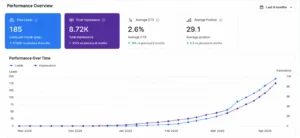
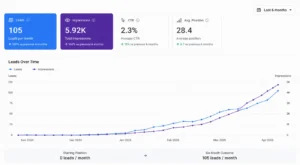
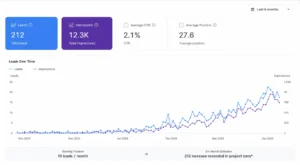
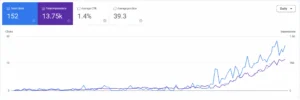
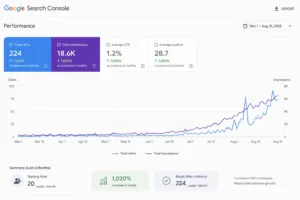
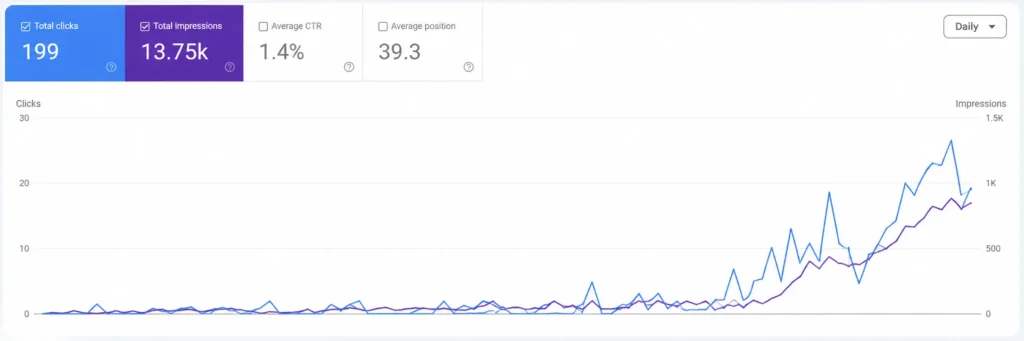
I also treated Search Console data as a decision-making tool rather than a vanity report. Google describes Search Console Performance data through metrics such as clicks, impressions, CTR, and average position, while also recommending attention to trends rather than relying on position alone.
Project Goals
My goals for the engagement were:
- Build an organic channel that could reduce dependence on referrals.
- Improve visibility for commercially meaningful accounting searches.
- Align important services with the search intent behind them.
- Strengthen the connection between local relevance and the website.
- Improve the path from organic discovery to enquiry.
- Measure progress against business outcomes, not rankings alone.
The final supplied outcome was a 189-lead monthly increase after six months.
That is the core result I am reporting.
Strategy Overview
I approached the project as a search-visibility system.
My working sequence was:
Business goals → Search demand → Search intent → Technical foundation → Service architecture → Content → Internal linking → Local relevance → Trust → Conversion → Measurement
That philosophy is consistent with how I approach Local SEO services and SEO strategy generally.
For local results, Google confirms that local ranking is primarily influenced by relevance, distance, and prominence. Google also explains that complete and detailed business information helps it understand relevance, while prominence can be influenced by signals such as links and reviews.
That matters for an accounting firm because I cannot control every local-search variable, particularly distance. What I can do is make the business, its services, its website, and its local information clearer and more consistent.
Month 1: Research and Foundation
I began by treating the project as a business and search problem rather than a content-production task.
The first stage was understanding the firm’s market, the types of services that could generate commercially meaningful enquiries, and how potential customers might search before contacting an accounting provider.
I separated searches by intent.
Some searches are primarily informational.
Some represent commercial investigation.
Others show stronger local and transactional intent.
That distinction affected how I thought about pages and content.
I also established the measurement framework around organic performance and business outcomes.
For search visibility, Google Search Console provides the core metrics I would use to monitor clicks, impressions, CTR, and average position.
For local performance, Google Business Profile provides measurements such as calls, website clicks, directions, bookings, and other customer interactions.
The key principle was simple:
I wanted the measurement system to tell me whether search visibility was becoming commercially useful.
Month 2: Search Intent and Service Structure
The next stage focused on making the relationship between search demand and service pages clearer.
I did not want one generic accounting page trying to answer every possible commercial search.
Instead, I worked from the customer’s perspective.
What service are they looking for?
What problem are they trying to solve?
Are they ready to contact a firm, or are they still researching?
What information do they need before they feel confident making that decision?
This shaped the content architecture.
A commercial service page should help someone understand the service and move toward action.
An informational page should answer the question properly and, where relevant, guide the reader toward the appropriate service.
That distinction prevents content from becoming a collection of pages created simply because keywords exist.
Month 3: Content and On-Page Optimization
The next stage focused on making important pages more relevant and useful.
I reviewed the relationship between page titles, headings, service descriptions, supporting content, internal links, and calls to action.
I also looked at whether important information was easy to find.
Google’s current people-first guidance places emphasis on original information, useful analysis, first-hand expertise, clear authorship and content created for people rather than primarily for search-engine traffic.
That principle was particularly relevant for accounting content.
A professional-services website should not simply restate generic financial information.
It should make clear what the firm actually does, who it serves, how its services work, and why someone should consider contacting it.
My approach to content planning is closely connected to my Content Strategy & SEO Content Writing Service, where I focus on intent, topical relationships, useful information, and conversion relevance rather than publishing for volume alone.
Month 4: Local Relevance and Business Trust
The project also needed a stronger connection between the website and local search.
I treated the business as a real entity operating in a real market, rather than simply inserting “New Orleans” into page copy.
Google explicitly identifies relevance, distance, and prominence as the core local-ranking factors.
So the objective was not city-name repetition.
It was clearer local context.
That included thinking about how services, location information, business details, website content, and customer trust should reinforce one another.
I also kept the strategy within Google’s guidelines.
I did not use fake locations, fake reviews, keyword stuffing, or fabricated business information.
That approach is consistent with the principles outlined on my Google Business Profile Optimization Service.
Month 5: Internal Linking, Authority and Search Coverage
Once the core service structure was clearer, I focused on how the site’s important pages related to one another.
Internal links are useful because they create contextual paths between related information.
A service page can connect to supporting educational content.
An informational page can lead someone to a relevant service.
A broader topic can point toward a more commercially focused page.
I think of this as building a map of the website rather than placing links randomly.
I also considered authority and trust as part of the wider search ecosystem.
For a professional firm, trust cannot come from SEO copy alone.
The site should clearly communicate who the business is, what it does, where it operates, and why a potential customer should take the next step.
Month 6: Consolidation and Conversion
By the final month, the focus was on connecting visibility with the actual business outcome.
I reviewed the work through a simple question:
Is organic visibility creating meaningful opportunities for the business?
That changed how I evaluated success.
A higher keyword position can be useful.
More impressions can be useful.
More clicks can be useful.
But the stronger indicator is whether those gains contribute to enquiries and business opportunities.
Google also recommends using Search Console trends to understand performance changes rather than focusing only on isolated position values.
The reported result from this project was a 189-lead increase after six months.
Starting from 10 monthly leads, that means the implied month-six level was 199 monthly leads.
Results
Lead Generation Impact
| Metric | Starting Point | After 6 Months | Change |
|---|---|---|---|
| Monthly qualified leads | 10 | 199 | +189 |
Based on the supplied figures, monthly lead volume increased from 10 to 199, representing a 1,890% increase from the original monthly baseline.
I am deliberately not adding organic-session, GBP-click, call, direction-request, CTR, or keyword-position figures because those numbers were not supplied with the project record.
That distinction matters.
I would rather publish one verified business outcome than create a larger results table filled with numbers that cannot be independently supported.
Evidence and Measurement
The recommended evidence framework for this type of engagement combines several sources.
Google Search Console can show organic clicks, impressions, CTR and average position.
Google Business Profile Performance can show actions such as calls, website clicks and direction requests.
GA4 can help connect organic visits with important conversion events.
CRM, call tracking, enquiry records, or booking data can provide the final business layer needed to understand lead quality.
In this published case study, the verified business result supplied to me is the lead increase.
I am not presenting a fabricated screenshot as evidence.
What I Changed About the Way I Looked at SEO
One of the biggest lessons from this project was that a referral-dependent business does not necessarily need “more traffic” first.
It needs a discoverability system.
That system needs to answer several questions clearly:
What does the business do?
Who is the service for?
Where does the business operate?
What problem does the service solve?
Which page should answer the searcher’s question?
Why should the customer trust the business?
What should they do next?
That is why I do not separate SEO from business communication.
Search visibility becomes more useful when the website can support the customer after the click.
AEO and GEO Considerations
I also think about modern search beyond traditional blue-link rankings, but I do not treat AEO or GEO as a replacement for SEO.
Google’s current guidance says the same foundational SEO practices remain relevant for AI features such as AI Overviews and AI Mode. Google specifically points to crawlability, internal links, page experience, text accessibility, accurate structured data, and up-to-date Business Profile information. Google also says there are no additional technical requirements or special schema required for AI features.
That supports the way I approach AI-search readiness.
I would rather make the business information clearer, the pages more useful, the entity more consistent, and the site’s technical foundation stronger than try to chase an artificial “AI ranking trick.”
OpenAI’s current publisher guidance similarly says that websites can appear in ChatGPT Search and that allowing OAI-SearchBot to crawl the site is important for discovery and citation.
For a professional-service business, that means good SEO fundamentals still form the base.
The AEO/GEO layer comes from making information easy to understand, retrieve, contextualize, and corroborate.
What Made the Biggest Difference
The biggest difference came from changing the objective.
I did not approach this as:
Get more keywords.
I approached it as:
Build a new acquisition channel.
That affected every decision.
I looked at search intent before content.
I connected services with the questions potential customers were asking.
I thought about local relevance as part of a real business entity rather than a keyword insertion exercise.
I considered trust and conversion alongside visibility.
And I measured the project against lead generation rather than ranking screenshots alone.
That shift in thinking is one of the most important parts of the project for me.
Key Takeaways
A professional-services business does not have to remain dependent on referrals just because referrals have historically been its main acquisition source.
A well-structured organic channel can become another route into the business.
The important part is not publishing as much content as possible.
It is understanding which searches matter, what those searches mean, which page should answer them, how the pages connect, and how the visitor moves from information to action.
Local SEO also has limits.
No consultant can control distance or guarantee a fixed Maps position. Google itself states that there is no way to request or pay for a better local ranking, and its local results are mainly influenced by relevance, distance, and prominence.
That is why I focus on improving the signals I can actually influence.
My Approach
My approach to SEO is based on connecting the different parts of search visibility.
I start with the business.
Then I look at the market.
Then search demand.
Then intent.
Then the technical foundation.
Then the page structure.
Then content.
Then local relevance.
Then internal linking.
Then authority and trust.
Then conversion.
Then measurement.
This project reinforced that approach.
The strongest SEO work is not always the work that produces the biggest keyword report.
Sometimes the most valuable outcome is that a business finally has a meaningful acquisition channel that did not exist before.
For this accounting firm, the supplied result was a move from 10 monthly leads to an implied 199 monthly leads after six months, a net increase of 189 leads per month.
That is the business outcome I would want decision-makers to remember.
Conclusion
When an accounting firm relies heavily on referrals, the obvious temptation is to chase rankings quickly.
I prefer to step back and ask a better question:
What would need to change for organic search to become a dependable source of qualified opportunities?
That question led me toward search intent, service architecture, local relevance, useful content, internal linking, trust, conversion, and measurement.
The project was not about producing a bigger keyword list.
It was about building a real organic channel around the business.
The supplied result was a 189-lead monthly increase after six months, from a starting point of 10 leads per month.
For me, that is the real value of SEO.
Not visibility for its own sake.
Visibility that helps a business become easier to find, easier to understand, and easier to choose.
Be found. Be understood. Be chosen.
About Md Mynul Hassan
I’m Md Mynul Hassan, an SEO Consultant, Local SEO Consultant, Google Business Profile Optimization Consultant, AEO Strategist, GEO Strategist, and SEO Content Strategist based in Bangladesh.
I work with local businesses, service companies, professional firms, agencies, startups, and selected ecommerce businesses to improve visibility across Google Search, Google Maps, and AI-driven search.
My practical SEO work covers Local SEO, Google Business Profile optimization, technical SEO, keyword research, content strategy, on-page optimization, internal linking, conversion-focused SEO, AEO, and GEO.
You can also verify my professional work through my Upwork profile, Freelancer profile, LinkedIn profile, YouTube channel, and Facebook page.
For businesses looking at a broader search-visibility problem, I also offer a SEO Audit Service and Technical SEO Service alongside Local SEO and content strategy.
Related Resources
For readers who want to understand the broader strategy behind this type of project:
Local SEO Service
Google Business Profile Optimization
Content Strategy & SEO Content Writing Service
SEO Audit Service
Technical SEO Service
SEO Case Studies
Contact Md Mynul Hassan