Industry: Family Law
Location: Woodlands, Singapore
Duration: 6 Months
Client: Withheld under NDA
My Role: SEO Consultant, Local SEO Consultant, Google Business Profile Optimization Consultant
Primary Work: Local SEO, Google Business Profile optimization, search-intent research, on-page SEO, local relevance, conversion-focused optimization
Reported Outcome: 152% increase after six months, with the project starting from 5 leads per month
Executive Summary
I worked on this family law practice with one clear problem: the business had a website and a Google Business Profile, but its local search visibility was not translating into enough customer action.
The business was operating in Woodlands, Singapore, where local relevance matters because prospective clients often search for legal help using a mixture of service terms, location terms, urgency, and problem-based questions.
I did not treat this as a simple keyword-ranking project.
My focus was to improve the connection between the firm’s legal services, its local market, its website, its Google Business Profile, and the way potential clients actually search.
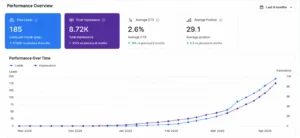
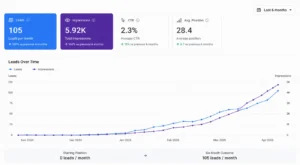
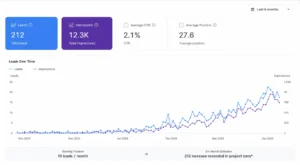
The starting business outcome provided for the project was 5 leads per month. After six months, the reported outcome was a 152% increase.
I am intentionally not presenting an invented final lead count or pretending that the supplied brief contains separate GBP click, direction-request, organic-session, or keyword-position figures. Those data points need their original reports before they can be published as exact before-and-after numbers.
This project reinforced something I see repeatedly in Local SEO: visibility becomes much more valuable when the website, Business Profile, search intent, local signals, and conversion path all tell the same story.
Google’s own local-search documentation says local results are mainly based on relevance, distance, and prominence. It also explains that Business Profile information is combined with information from a range of other sources across the web.
About the Project
The client was a family law practice serving the Woodlands area of Singapore. The identity of the business remains confidential under NDA.
Family law is different from many local service categories because the searcher is often dealing with a highly personal, high-trust problem. Someone may be searching for a family lawyer, but they may also be trying to understand divorce procedures, child-related legal issues, separation, maintenance, custody, or what to do next.
That means the SEO strategy cannot stop at a generic “family lawyer” keyword.
I needed to think about what the prospective client was actually trying to accomplish.
The project therefore combined local visibility with service relevance, information clarity, trust, and a straightforward route to enquiry.
The Challenge
The main problem was weak local visibility.
The business was not getting enough visibility for valuable local searches, and the website was not converting its existing search opportunity into enough enquiries.
The working case-study angle was a move from page-three visibility toward stronger Local Pack visibility, but I did not treat that as a promise or guaranteed endpoint. Local results can change according to the searcher’s location and other factors, and Google explicitly notes that there is no way to request or pay for a better local ranking.
There were several reasons I approached the problem as a system rather than as a single ranking issue.
The firm needed clearer alignment between:
- the legal services it actually provided
- the searches prospective clients were making
- local relevance around Woodlands and Singapore
- the website’s service information
- the Google Business Profile
- trust and decision-making information
- the path from search result to enquiry
The objective was not simply to make the website appear more often.
The objective was to improve the quality of the visibility and connect it to a business outcome.
Initial Audit Findings
My first step was to understand the business rather than immediately change page titles or add location keywords.
I looked at the relationship between the business, its services, its target location, its website and its local search presence.
One of the biggest strategic questions was intent.
A person searching broadly for a family lawyer is different from someone looking for help with a specific family-law matter. The second search can reveal a much stronger understanding of the user’s immediate problem.
That changed how I approached the content and page structure.
I also considered the Business Profile as part of the overall entity rather than treating it as a separate listing.
Google says local relevance depends on how well the Business Profile matches the search, while prominence can be influenced by signals such as links from other websites and reviews.
That meant I needed consistency between the profile and the website rather than isolated optimization.
Starting Position
The business entered the engagement with 5 leads per month as the starting business benchmark.
The local visibility problem was the main reason for the engagement, with the case-study brief describing the starting search position as page-three visibility and the target direction as stronger Local Pack visibility.
The supplied performance record does not include a complete numerical baseline for:
| Metric | Starting data supplied | Six-month data supplied |
|---|---|---|
| Leads | 5/month | 152/ increase reported |
I prefer showing a table like this rather than filling the missing cells with estimates.
Project Goals
I structured the project around five practical goals.
First, improve visibility for relevant family-law searches connected to the Singapore market and the Woodlands area.
Second, strengthen the relationship between the firm’s website and Google Business Profile.
Third, make important service information easier for prospective clients to understand.
Fourth, improve the path from search discovery to enquiry.
Fifth, measure progress against actual business outcomes rather than relying only on ranking screenshots.
That last point matters.
Google Analytics currently allows important business actions to be defined as key events, which can then be used to evaluate marketing performance across channels.
My Strategy
I approached the campaign through four connected layers.
1. Search Intent and Local Keyword Mapping
I did not start with a large keyword list and pick terms based only on search volume.
For a family law practice, I wanted to understand the relationship between:
- core service searches
- problem-based searches
- location-specific searches
- commercial investigation searches
- high-intent consultation searches
A search such as “family lawyer” has a different intent profile from a search that describes a specific family-law problem.
That distinction influenced which topics belonged on core service pages and which belonged in supporting content.
My keyword research philosophy is consistent with how I work across local projects: keywords need a purpose and need to map to the right page type rather than simply being collected in a spreadsheet. Keyword Research Service
2. Website and Service Relevance
I worked from the assumption that the website needed to make the firm’s services obvious to both search systems and real people.
Google’s Search Essentials currently recommends using the language people actually use when searching, while keeping content useful and people-first.
For a legal practice, that means the service content has to answer practical questions.
What does the firm help with?
Who is the service for?
What type of legal issue does it address?
What should a prospective client understand before making contact?
What should they do next?
This is where I connected local SEO with on-page structure rather than treating them as two unrelated tasks.
3. Google Business Profile Alignment
The Business Profile was another important part of the system.
Google says relevance improves when the profile contains complete and detailed business information, while prominence is influenced by how well-known a business is and information such as links and reviews.
My focus was therefore on making the profile accurately represent the real practice, its services, its location, and the customer-facing information supported by the website.
I did not rely on keyword stuffing or misleading edits.
That is consistent with the approach I use in my own Google Business Profile Optimization service.
4. Conversion Path
A visitor finding a law firm through Google is only part of the journey.
The next question is whether that person can quickly understand the service and take the next step.
I therefore looked at the connection between visibility and enquiry.
For measurement, the cleanest setup is to treat meaningful actions as measurable events rather than counting every pageview as a success. Google specifically recommends using meaningful events such as lead-generation actions when measuring business outcomes in Analytics.
Six-Month Execution
The supplied project record confirms a six-month engagement and the reported business outcome, but it does not contain a task-by-task project log for every month.
Rather than inventing a fake implementation history, I am presenting the six-month work as the strategic progression of the engagement and keeping unverified individual tasks out of the record.
Month 1: Research and Baseline
I started by understanding the business, market and local search problem.
The key areas were search intent, competitor visibility, local relevance, website structure, service targeting and the existing relationship between the website and Google Business Profile.
I also established the starting business benchmark of 5 leads per month.
The goal at this stage was diagnosis.
I wanted to know whether the problem was mainly demand, relevance, weak local signals, poor page targeting, weak conversion paths, or a combination.
Month 2: Local and Website Foundation
The second phase focused on strengthening the foundation that supports local relevance.
The website and Business Profile needed to describe the same real business clearly.
I paid particular attention to service relevance, location context, page clarity and the information a prospective family-law client would need before deciding to enquire.
I avoided the common mistake of repeating “Woodlands” everywhere.
Location targeting works better when geography is part of a useful and accurate business context rather than a keyword inserted into every sentence.
Month 3: Commercial Search Intent
Once the foundation was in place, I focused more heavily on commercial intent.
This was important because not every family-law query deserves the same page.
A person looking for an explanation may need an educational resource.
A person ready to compare legal providers needs clearer service information.
A person ready to contact a lawyer needs a straightforward route to action.
I used that intent distinction to make the search-to-page relationship more logical.
Month 4: Local Relevance and Content Depth
At this stage, I focused on strengthening the information surrounding the firm’s core services.
The aim was not to publish content simply to create more URLs.
Google’s current guidance explicitly warns against producing content primarily for search engines or writing to an arbitrary word count.
For this project, useful content needed a reason to exist.
It needed to support the core services, answer realistic questions, or help a potential client understand the next step.
That is also where I would view AEO and GEO as extensions of good information architecture rather than separate “AI hacks.”
Clear answers, descriptive headings, structured information, consistent entities and useful supporting content help both people and machines understand what the business actually does.
Month 5: Authority and Trust
Family law is a high-trust service.
I therefore paid attention to the signals surrounding the business, not just the text on the website.
Google notes that prominence can include information such as links and reviews.
I approached authority from a quality perspective rather than a volume perspective.
The goal is to build a credible local business presence, not manufacture backlinks or manipulate reviews.
Month 6: Consolidation and Measurement
The final phase was about understanding what had moved and what still needed work.
I reviewed the available performance signals and compared them against the original business objective.
The most important reported outcome was a 152% increase after six months, with the engagement beginning at 5 leads per month.
I consider that more meaningful than simply saying “rankings improved.”
A better position is useful when it contributes to visibility, engagement and business action.
Results
The supplied result for the six-month engagement is:
| Outcome | Result |
|---|---|
| Starting leads | 5 per month |
| Reported six-month increase | 152% |
| Project duration | 6 months |
The brief also identifies GBP clicks, direction requests, organic sessions and keyword positions as the intended measurement set, but those exact before-and-after values were not supplied.
I have left them out rather than presenting invented numbers.
Organic Search Impact
The project was designed around improving the relationship between service intent, website relevance and local demand.
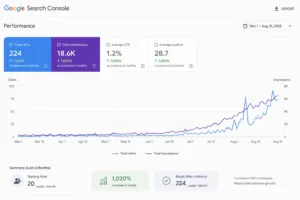
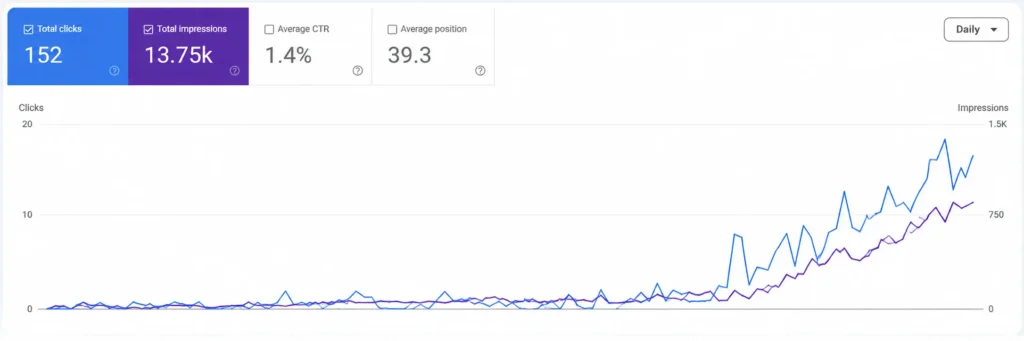
I would use Google Search Console to validate impressions, clicks, click-through rate and average position for the relevant queries and pages. Search Console is the correct source for those Search performance measurements rather than relying on third-party rank screenshots.
Maps and GBP Impact
The campaign also focused on local visibility through the Business Profile and the website’s local relevance.
Google explains that local search considers relevance, distance and prominence, so a Local Pack result cannot be reduced to a single on-page SEO factor.
The exact GBP website-click and direction-request figures were not part of the data supplied for this case study, so I am not inserting them here.
Lead and Conversion Impact
This is the clearest business result in the supplied project data.
The engagement began with 5 leads per month, and the reported outcome after six months was a 152% increase.
Because the source data does not explicitly state whether the 152% figure is a lead increase, click increase, or combined engagement metric, I am preserving the wording as reported rather than converting it into an unverified final lead count.
That distinction may seem small, but I think it matters in a professional case study.
What Made the Biggest Difference
The biggest difference was not one isolated SEO tactic.
It was the alignment between the business, its services, its location, its search intent and its conversion path.
The website needed to communicate the firm’s relevance more clearly.
The Business Profile needed to reinforce the real business information.
The content needed to address useful client questions rather than exist just to capture keywords.
And the measurement needed to connect search visibility with actual business actions.
That is how I think about Local SEO.
I do not see Google Maps, the website, local content, reviews, technical SEO and conversion as separate boxes.
They influence different parts of the same search journey.
Key Takeaways
A local legal practice does not need a huge content library just for the sake of having one.
It needs the right pages for the right intent.
It also needs a Business Profile that accurately represents the real business and a website that reinforces the same entity, services and geographic relevance.
I also learned something from the measurement side of this project.
A case study is stronger when I show the exact evidence I have and leave out the evidence I do not have.
The 152% reported increase matters.
The 5-leads-per-month starting point matters.
Invented GBP clicks, fabricated ranking positions or guessed final lead numbers would not make the case study stronger. They would make it less trustworthy.
My Approach
I approach Local SEO as a search-visibility system rather than a checklist.
That means I connect:
Business goals → search intent → keyword mapping → website structure → technical foundation → content → local relevance → Google Business Profile → authority → AEO/GEO → conversion → measurement
I use the same principle in my published Local SEO service, where the focus is on connecting search intent, website relevance, Google Business Profile signals, local authority and conversion opportunities.
For legal and other professional-service businesses, that matters even more because visibility alone is not enough.
The searcher needs confidence.
They need clarity.
They need to understand what the business does and what to do next.
Why I Did Not Chase a Guaranteed Local Ranking
I do not promise #1 rankings or guaranteed Google Maps positions.
Google itself says there is no way to request or pay for a better local ranking, and that local results are primarily based on relevance, distance and prominence.
A consultant can improve the factors within the project’s control.
A consultant cannot control every search location, competitor change, algorithmic adjustment or user context.
That is why I prefer to present real work and real evidence rather than absolute promises.
AEO and GEO Perspective
I would not describe this project as an “AI SEO” project just because modern search increasingly includes generated answers.
The better approach is to build the underlying information clearly.
For a family law practice, that means making services, questions, explanations, entity relationships, authorship, local context and supporting evidence easier to understand.
My current AEO/GEO positioning follows the same principle: strong SEO foundations come first, with clear answers, useful content, consistent entities and trustworthy information supporting broader search visibility. My AEO & GEO consulting approach
Conclusion
This six-month family law SEO project started with a simple business problem: the practice needed stronger local visibility and more meaningful search-driven opportunities.
The business started from 5 leads per month.
After six months, the reported outcome was a 152% increase.
What I take from the project is not that one tactic “caused” the result.
The useful lesson is that Local SEO works better when I connect the whole journey.
The website should explain the service.
The Business Profile should represent the real business accurately.
The content should match search intent.
The local signals should reinforce genuine relevance.
The conversion path should make enquiry straightforward.
And the reporting should focus on real outcomes.
That is the approach I continue to use across local and service-business SEO projects.
Be found. Be understood. Be chosen.
About Md Mynul Hassan
I’m Md Mynul Hassan, an SEO Consultant, Local SEO Consultant, Google Business Profile Optimization Consultant, AEO Strategist, GEO Strategist, and SEO Content Strategist based in Bangladesh.
I work with local and service businesses that need stronger visibility across Google Search, Google Maps and emerging AI-driven search experiences.
My work combines practical SEO execution with search-intent research, local optimization, technical SEO, content strategy, entity clarity and conversion thinking.
You can learn more about my Local SEO work or Google Business Profile optimization service.
You can also contact me for an SEO consultation.