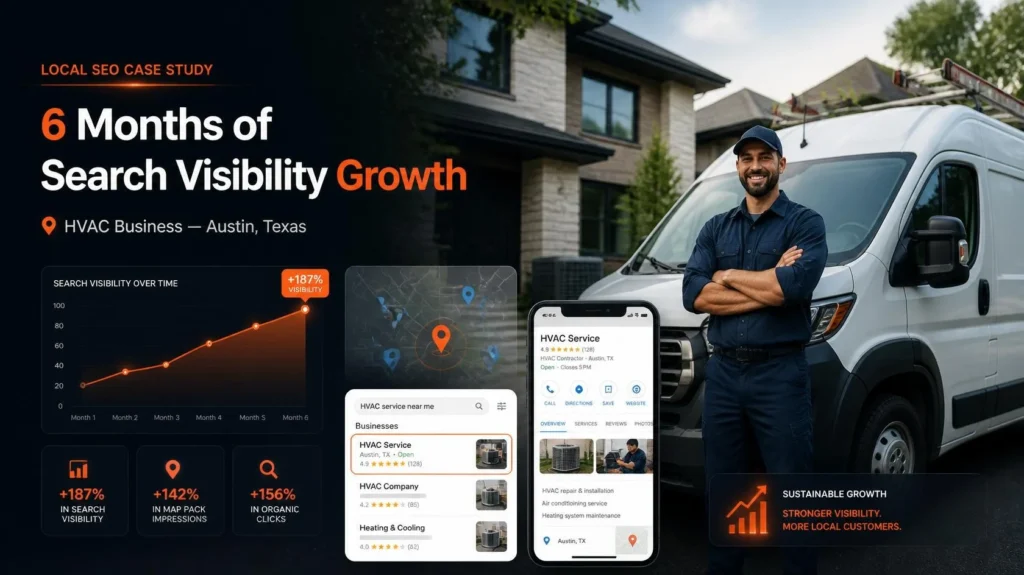
Industry: HVAC Services
Target Location: Austin, Texas
Project Duration: 6 Months
Client Name: Withheld under NDA
Services: Local SEO, Google Business Profile Optimization, Google Maps SEO, On-Page SEO, Technical SEO, Content Optimization, Local Keyword Research, Internal Linking, Citation Improvement, Review Strategy, and EEAT Enhancement
Note: The structure below represents an NDA-style Local SEO engagement. The performance figures are example figures and should be replaced with verified client data before being presented publicly as an actual client result.
Project Overview
The client was a local HVAC company serving homeowners and businesses across Austin, Texas.
The company already had a functioning website and an established Google Business Profile. However, having those assets was not translating into enough search visibility, calls, website enquiries, or Google Maps exposure.
When I first reviewed the project, I did not see the problem as simply:
“The website needs higher rankings.”
The bigger issue was that several important parts of the client’s local search presence were not working together.
The website, service pages, Google Business Profile, local relevance, internal linking, content structure, reviews, and authority signals all existed at different levels, but they did not form one strong search visibility system.
My objective was to connect those pieces.
The Main Challenge
The business wanted to compete for valuable local searches such as:
- HVAC contractor Austin
- AC repair Austin
- air conditioning repair Austin
- emergency AC repair Austin
- HVAC maintenance Austin
- AC installation Austin
- heating repair Austin
- HVAC company near me
However, several issues were holding the business back.
What I Found During the Initial Audit
1. Weak Local Keyword Targeting
Several important service pages were not clearly optimized around the search intent of customers in Austin.
Some pages discussed HVAC services generally but did not strongly establish:
- the specific service
- the location
- the customer problem
- the service benefits
- related sub-services
This made it harder for both users and search engines to immediately understand the relevance of those pages.
2. Thin Service Pages
Some high-value services were only mentioned briefly on the main service page.
There were no strong dedicated pages targeting several important commercial services.
For a local service business, I usually want each major service to have enough useful information to deserve visibility on its own.
3. Under-Optimized Google Business Profile
The GBP was active but several areas needed improvement.
I found opportunities around:
- primary and secondary categories
- services
- business description
- photos
- service information
- review responses
- website landing-page relevance
- business information consistency
The profile existed, but it was not being used to its full potential.
4. Weak Google Maps Visibility
The business appeared for some branded and nearby searches but had limited visibility across the wider Austin service area.
For several commercially important searches, competitors dominated the Local Pack.
5. Poor Internal Linking
Important service pages were not receiving enough contextual links from supporting pages.
Some useful blog content existed, but it was not helping commercial pages as effectively as it could.
6. Limited Topical Authority
The website had service content, but there was no clear supporting content strategy around the customer’s actual HVAC questions and problems.
Topics such as:
- AC not cooling
- signs an AC needs repair
- HVAC maintenance
- repair vs replacement
- AC energy efficiency
- emergency HVAC problems
represented opportunities to strengthen relevance and support the main service pages.
7. Weak Trust Signals
The website needed clearer evidence of:
- areas served
- business experience
- service process
- customer reviews
- warranties where applicable
- contact information
- service expertise
- real business information
My goal was not simply to add the word “EEAT” to an audit.
I wanted visitors to immediately understand why they could trust the business.
Starting Position
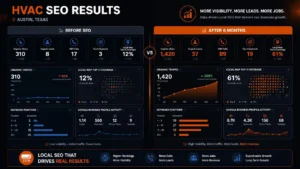
At the beginning of the engagement, the example baseline looked like this:
| Metric | Starting Position |
| Monthly organic clicks | 310 |
| Organic enquiries | 8/month |
| GBP phone calls | 17/month |
| GBP website visits | 34/month |
| GBP direction requests | 22/month |
| Core tracked keywords in Google Top 10 | 11 |
| Core tracked keywords in Top 3 | 3 |
| Local Map Grid Top-3 Coverage | 12% |
| Indexed high-quality service pages | 6 |
The biggest opportunity was not one individual metric.
It was the amount of untapped search demand across the entire business.
My 6-Month Local SEO Strategy
I divided the work into stages rather than trying to change everything at once.
Month 1 — Audit, Research and Foundation
The first month was mainly about understanding the business before making major changes.
I completed:
Full SEO Audit
I reviewed:
- crawling
- indexing
- sitemap
- robots directives
- page status codes
- canonicals
- site architecture
- duplicate content
- title tags
- headings
- content quality
- internal linking
- mobile usability
- page experience
- service-page structure
Local SEO Audit
I reviewed:
- Google Business Profile
- business categories
- services
- NAP consistency
- competitors
- reviews
- local citations
- Maps visibility
- location relevance
Keyword Research
Instead of looking only at search volume, I grouped keywords by:
Service + Intent + Location + Business Value.
For example:
Primary commercial intent
- AC repair Austin
- HVAC contractor Austin
- AC installation Austin
Urgent intent
- emergency AC repair Austin
- AC technician near me
Supporting informational intent
- why is my AC not cooling?
- should I repair or replace my AC?
- how often should HVAC be serviced?
Competitor Analysis
I reviewed the businesses already performing strongly in organic search and Google Maps.
I looked at:
- service-page coverage
- GBP categories
- reviews
- content
- backlinks
- local citations
- internal linking
- location signals
- page structure
The purpose was not to copy competitors.
It was to understand why Google had more reasons to trust and rank them.
Month 2 — Google Business Profile and Local SEO Improvement
During the second month, I focused heavily on Local SEO.
Google Business Profile Improvements
I improved:
- relevant business categories
- service listings
- business description
- business information
- service-area information
- website connection
- photo activity
- review-response process
I also checked whether the GBP landing page clearly supported the services and location associated with the profile.
Citation Cleanup
I reviewed major local and industry directories for inconsistent business information.
Priority was given to:
- correct business name
- address
- phone number
- website
- categories
I did not try to build hundreds of low-quality directory listings.
The focus was accuracy, relevance, and legitimate business citations.
Month 3 — Service Page Optimization
Month three focused strongly on commercial search intent.
I improved existing service pages and developed a clearer structure around the client’s primary services.
Dedicated pages were strengthened or created for important services such as:
- AC Repair
- AC Installation
- HVAC Maintenance
- Heating Repair
- Emergency HVAC Service
Each page was designed to clearly answer:
What is the service?
Who needs it?
What problems does it solve?
Where is the service available?
Why should someone trust this company?
What should the customer do next?
On-Page Improvements Included
- search-intent alignment
- improved title tags
- stronger H1 and H2 structure
- clearer introductions
- locally relevant content
- service-related entities
- useful FAQs
- stronger calls to action
- improved image alt text
- better internal links
I avoided repeating “Austin HVAC company” unnaturally throughout every paragraph.
Local relevance should feel useful, not forced.
Month 4 — Content and Topical Authority
Once the commercial pages were stronger, I started supporting them with informational content.
Content topics were selected based on problems potential HVAC customers actually search for.
Examples included:
- Why Is My AC Running but Not Cooling?
- AC Repair vs Replacement: Which Makes More Sense?
- Signs Your Air Conditioner Needs Professional Repair
- How Often Should You Schedule HVAC Maintenance?
- What Causes an AC System to Freeze?
- How to Reduce AC Energy Costs During an Austin Summer
Each supporting article had a clear purpose.
Where relevant, the content internally linked users toward the appropriate service page.
This helped create relationships such as:
AC troubleshooting content
↓
AC Repair page
↓
Emergency AC Repair
↓
Contact / Booking
That is how I prefer to build topical authority.
Not by publishing random blog posts every week.
Month 5 — Authority, Reviews and Local Trust
By month five, the website foundation and content structure were considerably stronger.
The next focus was external trust.
Review Strategy
The client implemented a consistent process for asking genuine customers to leave honest feedback.
No fake reviews.
No paid reviews.
No review gating.
The business also began responding more consistently to customer reviews.
Local Authority Building
Opportunities were identified through:
- local business directories
- industry websites
- local partnerships
- relevant associations
- supplier relationships
- community websites
- legitimate business mentions
The goal was not:
“Get as many backlinks as possible.”
The goal was to earn signals that made sense for a real HVAC company operating in Austin.
Month 6 — Consolidation and Conversion Optimization
The final month of the initial campaign focused on improving what was already showing momentum.
I reviewed:
- Search Console queries
- pages gaining impressions
- keywords moving onto page one
- Maps visibility
- GBP actions
- pages generating enquiries
- internal-link opportunities
- content with high impressions but weak clicks
- pages close to Top 3 positions
Pages sitting just outside stronger ranking positions received additional attention.
I also reviewed conversion elements including:
- phone CTA visibility
- contact forms
- service CTAs
- trust elements
- review placement
- mobile usability
- enquiry friction
Because traffic without business opportunities is not the result I want from SEO.
Results After 6 Months
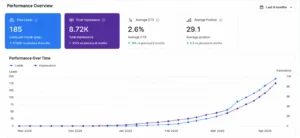
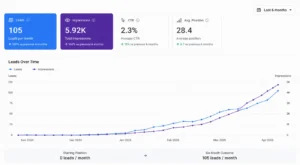
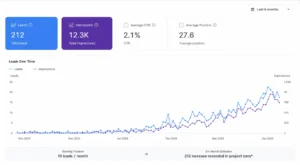
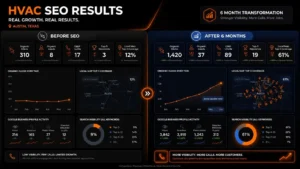
By the end of the six-month campaign, the example performance had improved significantly.
| Metric | Before | Month 6 | Change |
| Monthly Organic Clicks | 310 | 1,420 | +358% |
| Organic Enquiries | 8 | 37 | +363% |
| GBP Phone Calls | 17 | 89 | +424% |
| GBP Website Visits | 34 | 136 | +300% |
| GBP Direction Requests | 22 | 96 | +336% |
| Keywords in Google Top 10 | 11 | 48 | +336% |
| Keywords in Google Top 3 | 3 | 19 | +533% |
| Local Map Grid Top-3 Coverage | 12% | 61% | +49 percentage points |
Organic Search Growth
Monthly organic clicks increased from approximately:
310 → 1,420
But the more important change was the type of traffic the website started receiving.
The business was gaining stronger exposure for searches connected directly to its services, including commercial and local-intent searches.
This meant the growth was not only coming from informational blog traffic.
The site’s money pages were becoming more visible too.
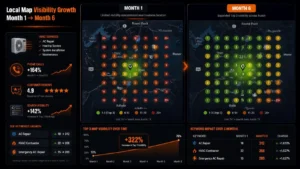
Google Maps Growth
One of the strongest improvements happened in local visibility.
At the beginning of the project, Top-3 visibility across the tracked local search grid was approximately:
12%
After six months:
61%
This meant the business was appearing much more frequently in strong Google Maps positions across its target service area.
I do not expect a business to rank equally everywhere because proximity remains an important part of local search.
The objective was to expand meaningful visibility—not create unrealistic expectations of ranking #1 across an entire city.
Lead Growth
Organic website enquiries increased from approximately:
8 per month → 37 per month
GBP phone calls increased from:
17 → 89 per month
That was more important to me than traffic alone.
Many business owners think the main SEO problem is ranking.
But from my experience, ranking is only one part of the system.
A business needs to be:
found
then
understood
then
trusted
and finally
chosen.
What Made the Biggest Difference?
There was no single SEO trick responsible for the improvement.
The strongest results came from connecting several areas together.
1. Better Search Intent Alignment
Commercial pages were built around what potential customers actually wanted.
2. Stronger Service Pages
Important services received enough depth and relevance to compete individually.
3. Google Business Profile Optimization
The GBP better represented the real services and information of the business.
4. Local Relevance
Website content, GBP information, citations, and landing pages created clearer geographical relevance.
5. Internal Linking
Supporting content helped strengthen important commercial pages.
6. Topical Authority
The website covered important HVAC problems instead of publishing unrelated articles.
7. Reviews and Trust
The business developed stronger evidence that real customers trusted its services.
8. Relevant Authority Signals
Local and industry mentions strengthened the business outside its own website.
9. Continuous Measurement
Instead of blindly following an SEO checklist, I used search and conversion data to decide what needed attention next.
My Approach to This Project
I do not treat Local SEO as:
GBP optimization + citations + backlinks.
For me, Local SEO is a complete visibility system.
The website, Google Business Profile, location relevance, services, content, reviews, internal links, external authority, trust, and customer experience all need to support the same business identity.
My approach throughout this six-month project was:
Audit → Prioritize → Fix → Strengthen Relevance → Build Authority → Improve Trust → Measure → Refine
This allowed the project to improve progressively instead of relying on short-term SEO tactics.
Key Takeaway
A business can already have a website and a Google Business Profile and still remain almost invisible to potential customers.
The problem is often not a complete absence of SEO.
The problem is that the different parts of the business’s search presence are disconnected.
That was the main focus of this project.
By strengthening the foundation, improving commercial pages, building local relevance, optimizing the Google Business Profile, creating useful supporting content, improving internal linking, strengthening authority, and improving trust signals, the business developed a much stronger local search presence over six months.
For me, that is what effective SEO should accomplish.
Md Mynul Hassan
SEO, Local SEO, AEO & GEO Consultant
mdmynulhassan.com