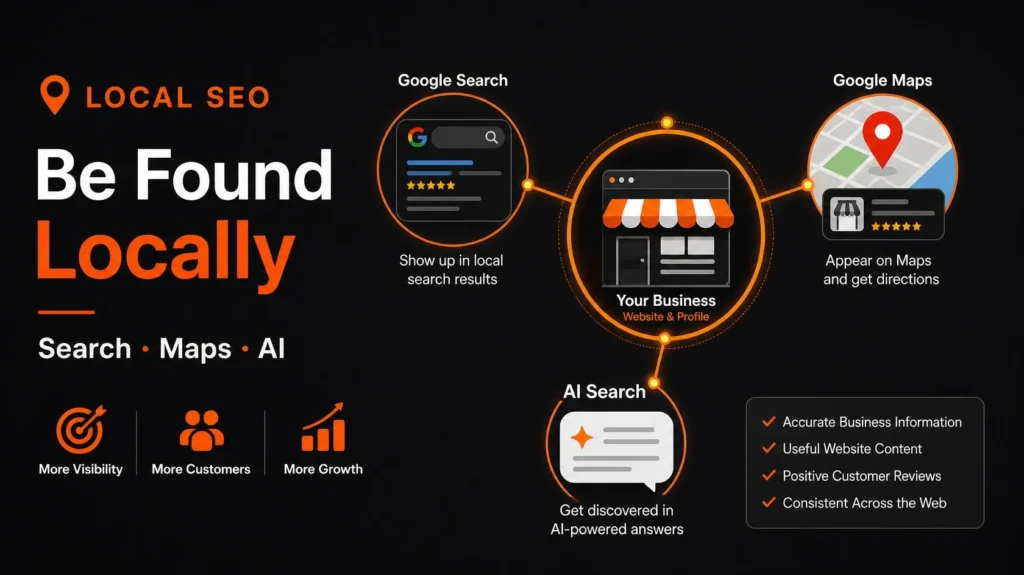
Local SEO helps a small business become easier to find when people search for relevant products or services in a specific area. It combines accurate business information, a useful website, relevant service pages, customer reputation, technical accessibility, and a clear path to contact or purchase. The best starting point is to identify what customers search for, find the gaps in your current presence, and fix the issues most closely connected to business goals.
A business does not need to publish hundreds of pages or chase every SEO trend. It needs to help potential customers understand what it offers, where it operates, why it is a relevant choice, and how to take the next step.
This guide explains how to plan local SEO for a small business, improve Google Search and Google Maps visibility, avoid common mistakes, and measure progress without relying on ranking promises.
What Is Local SEO?
Local SEO is the process of improving a business’s online presence so it can appear for relevant searches with geographic intent. These searches might name a city or neighborhood, include wording such as “near me,” or imply that the searcher wants a nearby provider.
For example, a customer might search for a plumber in a particular city, a dentist near a neighborhood, or an accountant who serves local businesses. Local SEO helps search engines understand the connection between the search, the business, its services, and its location.
Local SEO typically involves:
- Google Business Profile accuracy and optimization.
- Website service pages that clearly explain the business’s offerings.
- Local keyword and search-intent research.
- Relevant location pages when a separate page is justified.
- Reviews, reputation, and meaningful local references.
- Technical SEO, internal links, and accessible content.
- Measurement of relevant searches, enquiries, and other business outcomes.
These activities work together. A complete business profile cannot fix a website that does not explain the service. Likewise, a well-written service page does not guarantee visibility in Google Maps.
A practical Local SEO strategy connects these elements rather than treating them as separate tasks.
How Does Google Rank Local Businesses?
Google says local search results are mainly influenced by relevance, distance, and prominence. These factors help Google match the searcher’s need with suitable businesses. No business can directly control every factor, and there is no reliable method for guaranteeing a specific position.
Relevance describes how well the business matches the search. Accurate categories, service information, useful website content, and clearly explained offerings help establish that relationship.
Distance relates to the physical distance between the searcher and a business. The searcher’s location matters, so a business may appear differently across neighborhoods even when its website and profile have not changed.
Prominence reflects how well-known a business is. Information such as reviews and links from other websites can contribute to Google’s understanding of prominence.
Google’s official guidance on improving local rankings explains these factors and recommends maintaining complete, accurate business information.
What can a small business control?
A business can improve the accuracy of its profile, clarify its services, create useful website pages, earn genuine customer feedback, build relevant relationships, and remove technical barriers that affect important content.
It cannot control the searcher’s location, competitors’ actions, or Google’s entire ranking system. This is why a single ranking check is not a complete picture of local search performance.
How to Improve Local SEO: A Step-by-Step Strategy
The following workflow prioritizes decisions before volume. Begin with the search opportunities that matter most to the business, then improve the pages and information intended to satisfy those searches.
1. Identify the services and searches that matter most
Start with the services that generate meaningful revenue or qualified enquiries. Record the main service, the target audience, the places genuinely served, and the action you want a potential customer to take.
Next, organize relevant queries into groups:
- Service queries: what customers want to buy or book.
- Geographic queries: searches that mention a city, neighborhood, or service area.
- Problem queries: searches describing a problem a customer needs to solve.
- Comparison queries: searches used to compare providers, options, or costs.
- Brand queries: searches that include the business name.
Do not assume every keyword needs its own page. Several closely related queries may express the same intent and belong on one useful page.
A structured keyword research process helps determine which searches deserve a dedicated page, which can be answered within existing content, and which are too weak or unrelated to prioritize.
2. Make Google Business Profile accurate and useful
An eligible business should claim and verify its Google Business Profile and check that the information accurately represents its real-world operations.
Review the following details:
- Business name, using the genuine name rather than added keywords.
- The most appropriate primary and additional categories.
- Address or service-area information, as applicable.
- Current business hours and special hours.
- Services and relevant business attributes.
- Telephone number and the correct website URL.
- Current photographs that represent the business.
- A process for monitoring and responding to customer reviews.
Only select details that are true and applicable. A service-area business should represent its actual service model rather than presenting an unstaffed address as a customer-facing office.
Your profile should answer basic questions quickly: What does the business do? Where does it operate? Is it relevant to this search? How can a customer contact it?
The Google Business Profile optimization service is the relevant next step for businesses that need help reviewing their profile and website alignment.
Avoid keyword stuffing in business information
Adding a list of services or cities to a business name does not make the business more legitimate or automatically improve relevance. Use the actual business name and the dedicated profile fields for their intended purposes.
Similarly, do not create profiles for locations that do not meet Google’s eligibility requirements. Incorrect information can confuse customers and put the profile at risk.
3. Improve the pages customers need before contacting you
Your website should provide a clear answer to the searcher’s commercial question.
A useful service page explains what the business offers, who the service is for, how the service works, where it is available, and what the visitor should do next. It should also make supporting evidence accessible when that evidence exists.
Review each important page for:
- A descriptive title and one clear H1.
- A direct explanation near the beginning.
- Specific service information rather than generic marketing language.
- Appropriate geographic context.
- Relevant evidence, qualifications, photographs, or examples where available.
- Internal links to related resources and services.
- Clear contact, booking, or enquiry options.
A page should not repeat the same keyword in every heading. Search engines need to understand the page’s topic and usefulness, not encounter the same phrase as often as possible.
An on-page SEO review can help identify issues with headings, relevance, metadata, internal links, and conversion paths.
4. Create location pages only when they serve a real need
A location page can be useful when people in a particular geographic market need information that an existing page does not adequately provide.
Before publishing another city or neighborhood page, ask:
- Does the business genuinely serve this location?
- Is there a distinct customer or search need?
- Can the page provide useful information beyond replacing the city name?
- Does it explain relevant service availability and the next step?
- Would the page still help a visitor if the search-engine benefit did not exist?
If several proposed pages would contain nearly identical information, improve the strongest existing page instead of multiplying URLs.
A service-area page is not the same as a page representing a physical office. The website should describe that distinction accurately.
For more detailed guidance, see how to build local landing pages without doorway pages. The goal is useful, differentiated geographic content, not the largest possible collection of city pages.
5. Build a credible reputation and relevant local references
Reviews help potential customers assess their options. Relevant local references, partnerships, and links may also support discovery and provide context about the business.
Build reputation through genuine customer experiences. Ask customers for honest feedback, respond professionally, and address recurring service problems. Do not fabricate reviews or treat a positive rating as something to purchase.
For local links and citations, prioritize relevance and legitimacy. A mention from a genuinely relevant trade association, community organization, supplier, or local publication can be more useful than adding a business to unrelated directories simply to increase a count.
Keep the business name, address, and phone number consistent where those details apply. Correct important inconsistencies rather than assuming that every small difference across the internet requires an expensive cleanup campaign.
6. Publish content that helps local customers make decisions
Supporting content should answer questions connected to your services. Useful topics include choosing a provider, understanding service options, identifying common problems, preparing for an appointment, or determining when professional help is appropriate.
For example, a plumbing company might create a clear service page and supporting guides about common plumbing problems. A dental practice might explain appointment preparation or the differences between relevant treatments. These examples illustrate content structure, not claims about real client results.
The content should be accurate and useful outside the narrow context of its target keyword.
Build links between supporting guides and the main service pages so the relationship between informational and commercial content is clear. A connected SEO content strategy can help organize these topics and avoid publishing articles that compete for the same intent.
7. Fix technical problems that interfere with important pages
A search strategy can fail if important pages cannot be discovered, crawled, rendered, or indexed correctly.
Review whether:
- Important URLs return the correct status codes.
- Canonical tags identify the intended preferred URLs.
- Internal links point to current destinations.
- Sitemaps include the relevant canonical pages.
- Robots directives do not accidentally block important content.
- Redirects lead to relevant destinations.
- Mobile visitors can read and use the pages.
- Page performance and layout do not create avoidable usability problems.
Prioritize technical findings by their effect on important pages. A critical indexing issue affecting a core service page deserves more attention than a minor warning on an unimportant URL.
A targeted technical SEO review can help distinguish issues that require immediate correction from those that can wait.
8. Make business information easy to understand across search formats
Local customers may discover a business through a standard organic result, Google Maps, an AI-generated search experience, or a question-based query.
The useful response is to make the business information clearer, more accurate, and easier to verify. Explain the service directly, identify the intended audience, use descriptive page headings, provide relevant evidence, and maintain consistency between the website and the business profile.
Google’s guidance on AI features and your website states that existing SEO best practices remain relevant to AI Overviews and AI Mode. It does not require a separate set of special optimizations to appear in those features.
For a local business, this means the website should continue to answer genuine customer questions and provide credible service information. There is no guaranteed technique for inclusion in an AI-generated response.
Further reading on AEO for local businesses and AEO/GEO consulting can help readers explore that subject in greater depth.
A Practical Local SEO Example
Consider a hypothetical plumbing company that serves one city and several nearby communities. It has a verified business profile and a basic website, but its service pages are vague and enquiries are inconsistent.
The first action should not automatically be creating a page for every nearby town.
Instead, the company could:
- Identify its highest-priority services and the searches that indicate a need for them.
- Check that the Google Business Profile accurately represents the business.
- Improve its main service pages so they explain the actual work offered.
- Create a separate location page only where there is a genuine, distinct need and enough useful information.
- Address important indexing and internal-link problems.
- Establish a reliable way to record calls and enquiries from relevant marketing channels.
- Review the results and use the findings to decide what should happen next.
This approach gives the business a way to connect each action to an identifiable problem. It also prevents the team from confusing a growing page count with meaningful improvements in visibility or lead quality.
For a related industry-specific example, read the local SEO and Google Maps guide for plumbing companies.
Common Local SEO Mistakes to Avoid
Creating too many similar location pages
Problem: Pages differ mainly in the city name and provide little unique value.
Better approach: Evaluate whether each page addresses a distinct need. Improve or consolidate overlapping content when the differences are not meaningful.
Adding keywords to the Google Business Profile name
Problem: The profile no longer accurately represents the real-world business.
Better approach: Use the genuine business name and place relevant service information in the correct profile fields. See the guide to Google Business Profile services without keyword stuffing.
Tracking rankings from one location only
Problem: A position recorded in one place may not represent visibility across the wider service area.
Better approach: Review important queries from relevant locations, use consistent tracking methods, and combine visibility data with enquiries and other business outcomes.
Publishing content without a page strategy
Problem: New articles overlap with each other or fail to support an important service.
Better approach: Assign each page a distinct purpose, connect it to relevant service pages, and use a topical authority map to plan supporting resources.
Treating every SEO issue as equally urgent
Problem: Teams spend time on low-impact warnings while important commercial pages or indexing problems remain unresolved.
Better approach: Identify the affected page, the business consequence, the effort required, and the evidence that will show whether a fix worked. Use a prioritized SEO audit when the work needs a structured diagnosis.
How to Measure Local SEO Results
Measure progress at two levels: search visibility and business outcomes.
| Measurement area | What to review | Why it matters |
|---|---|---|
| Organic search | Queries, clicks, impressions, click-through rates, and landing pages | Shows how the website performs in organic search |
| Google Business Profile | Available performance measures, customer interactions, and relevant actions | Helps evaluate discovery and activity on the profile |
| Geographic visibility | Performance for priority service and location combinations | Reveals whether visibility is relevant to the markets served |
| Conversions | Qualified forms, calls, bookings, and other meaningful enquiries | Connects search activity with potential business value |
| Page performance | Indexing status, important technical errors, and landing-page engagement | Identifies problems that can interfere with discovery or usability |
| Commercial outcomes | Qualified opportunities, customers, and revenue where measurable | Helps determine whether SEO contributes to business objectives |
Google Search Console is useful for website search performance. Google Business Profile performance tools provide a separate view of relevant profile activity. Analytics or a suitable CRM can help connect visits with enquiry and sales outcomes.
Avoid judging success using only impressions, a single keyword position, or the total number of published pages. Those measurements can help diagnose performance, but they do not independently establish business value.
How long does local SEO take?
There is no universal timetable for meaningful improvement. Results depend on the starting condition of the website and profile, the level of competition, the issues being fixed, the resources available, and the kind of searches being targeted.
Technical corrections may make an identified problem easier to resolve, but the effect on search visibility may take time to assess. Reputation, useful content, and competitive positioning also require ongoing work.
Set an initial baseline, record the actions taken, and review results over an appropriate period. Do not promise a fixed ranking or lead increase before evidence supports such a conclusion.
Local SEO Checklist for Small Businesses
Use this checklist to organize an initial review.
- Identify the services and markets most important to the business.
- Research search intent for the main services.
- Check Google Business Profile eligibility, accuracy, and completeness.
- Confirm that core service pages explain the offering and next step clearly.
- Review existing location pages before creating more.
- Check business information consistency where applicable.
- Develop a process for requesting and responding to genuine reviews.
- Publish supporting content that answers relevant customer questions.
- Review important pages for crawlability and indexation issues.
- Improve internal links between guides, service pages, and supporting resources.
- Check that content and business information remain accurate.
- Track search visibility, qualified enquiries, and commercial outcomes.
- Reassess priorities based on evidence rather than repeating a fixed list of tasks.
You do not need to complete every task at once. Start with the issues that most directly affect the services, customers, and markets that matter to the business.
Frequently Asked Questions About Local SEO
What is the difference between local SEO and traditional SEO?
Traditional SEO helps a website become visible for relevant organic searches. Local SEO addresses searches with geographic intent and includes the business information, local relevance, reputation, and website elements that support discovery in a particular area. The two overlap because local visibility also depends on useful website content and sound technical SEO.
Does Google Business Profile help local SEO?
Yes. Google Business Profile gives eligible businesses a way to manage information that appears in Google Search and Maps. Google recommends keeping the profile complete and accurate. Its local ranking guidance identifies relevance, distance, and prominence as the main factors influencing local results, but profile optimization does not guarantee a particular position.
Can a service-area business rank without a storefront?
A service-area business can be eligible for a Google Business Profile if it meets Google’s requirements. The profile should accurately represent a business that travels to customers rather than presenting an ineligible address as a customer-facing location. Eligibility and the available local visibility depend on the actual business and its circumstances.
How many location pages should a small business create?
There is no standard number. Create a dedicated page only when the location represents a genuine service and search need that deserves its own useful content. If several proposed pages would be nearly identical, improving an existing page may be a better decision.
Is local SEO better than Google Ads?
Neither is universally better. Local SEO focuses on organic and local discovery, while Google Ads provides paid advertising opportunities. The right choice depends on the budget, urgency, competition, margins, and how the business wants to acquire customers. Some businesses may benefit from using both while measuring their costs and outcomes separately.
How can a business check whether its local SEO is working?
Combine Search Console data, available Google Business Profile performance information, geographic visibility checks, and conversion tracking. Look for changes in relevant organic queries, qualified enquiries, and business outcomes. A single map position or increase in impressions cannot establish whether the overall strategy is successful.
Does AI search replace local SEO?
No. AI-generated search experiences change how some information is presented and discovered, but they do not remove the need for accurate business information, useful pages, technical accessibility, and trustworthy content. Google’s guidance says the fundamental SEO best practices remain relevant to its AI search features.
The Next Step: Prioritize the Work That Matters
Small businesses do not need to chase every new SEO technique. They need a clear understanding of customer intent, accurate business information, useful service pages, genuine evidence of trust, accessible websites, and measurements connected to the outcomes they value.
Start by identifying the gap that is most likely to affect a priority service or customer journey. Correct it, measure what changes, and use the findings to guide the next action.
For more detail on how these activities connect, explore the Local SEO service and the relevant SEO case studies. If you need help assessing your website’s priorities, use the contact page to discuss the business, its target market, and the work that may be appropriate.
About the Author
Md Mynul Hassan is a Local SEO and search visibility consultant based in Dinajpur, Bangladesh, working remotely with businesses in international English-speaking markets. His work connects Local SEO, Google Business Profile optimization, website SEO, content strategy, and AI-search visibility.
You can connect with Md Mynul Hassan on LinkedIn, follow his updates on Facebook, or watch his content on YouTube. His freelance profiles are available on Upwork and Freelancer.com.