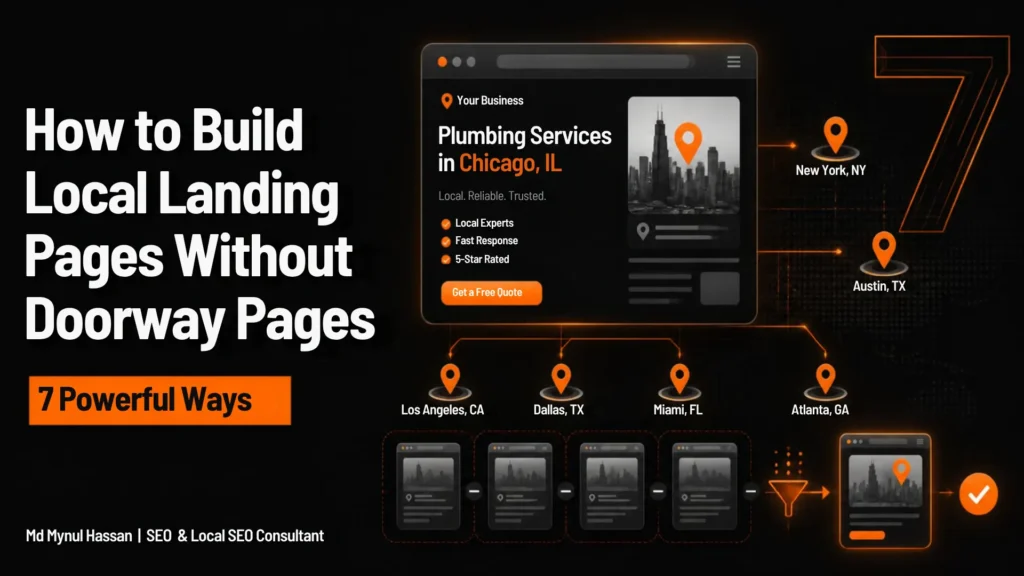
How to Build Local Landing Pages Without Doorway Pages
Local landing pages can help a service business make its website more relevant to searches in specific cities, towns, neighborhoods, or service areas.
But creating a page for every location a business serves is not automatically a good SEO strategy.
The problem usually starts when a business publishes dozens of pages with almost identical content, changes only the city name, and expects each URL to target a different local search. A larger page count does not necessarily create better local relevance. In some situations, it can create overlapping intent, thin content, poor user experience, or doorway-page concerns.
A better approach is to build a local landing page only when it has a clear purpose, genuine local relevance, useful information, and a logical place within the website.
This guide explains how to plan, build, scale, and evaluate local landing pages without turning them into a collection of near-duplicate city pages.
What Is a Local Landing Page?
A local landing page is a website page designed to address a specific geographic search intent by connecting a business, service, product, or offering with a particular location.
For example:
- Plumber in Austin
- Dentist in Brisbane
- Immigration Lawyer in Leicester
- HVAC Repair in Round Rock
- Accounting Services in New Orleans
The location alone does not make the page valuable.
A useful local landing page explains why the business is relevant to people in that area and gives them information they need before taking the next step.
A strong page should make four things clear:
- What the business offers.
- Where the business genuinely operates.
- Why the page is relevant to people in that location.
- What the visitor should do next.
This is why local landing page SEO should be connected to the wider Local SEO strategy instead of treated as a simple exercise in inserting city names into existing content.
Local Landing Page vs Service Area Page vs Location Page
These terms are often used interchangeably, but they can describe different page purposes.
| Page Type | Main Purpose | Typical Example |
|---|---|---|
| Physical location page | Represents a real business location | Dental clinic in Sydney |
| Service-area page | Explains an area the business serves | Plumber serving Brisbane suburbs |
| City landing page | Targets a service or business search in a city | SEO Consultant in London |
| Location page | General geographic page | Company locations in Texas |
| Local landing page | Broad term for a location-focused commercial page | Local service page for a specific market |
The distinction becomes particularly important for service-area businesses.
A company can genuinely serve customers in a city without having a staffed office or storefront there. The website should represent that reality accurately instead of presenting a service area as a physical business location.
Google’s Business Profile guidance distinguishes service-area businesses from businesses with customer-facing locations and provides separate requirements for representing them. Google Business Profile service-area guidance
That means a local landing page should describe the actual business model rather than manufacture local presence.
Are Local Landing Pages Doorway Pages?
No. A local landing page is not automatically a doorway page.
The risk comes from how the pages are created and what purpose they serve.
Google’s current spam policies describe doorway abuse as pages created for similar search queries that funnel users toward less-useful destinations or exist mainly to manipulate search visibility. Google also identifies blocks of cities or regions inserted into pages primarily to manipulate rankings as a form of keyword stuffing. Google Search spam policies
That does not mean every city page violates Google’s guidelines.
The important question is whether each page provides real value and has a legitimate reason to exist.
Example of a weak location-page system
Imagine a landscaping company serves five cities.
It creates:
- Landscaping in Austin
- Landscaping in Round Rock
- Landscaping in Cedar Park
- Landscaping in Pflugerville
- Landscaping in Georgetown
Every page uses the same introduction, services, photographs, testimonials, FAQs, and service description.
Only the city name changes.
The website now has five URLs, but the visitor has effectively been given the same page five times.
Example of a useful location-page system
Now imagine the company creates pages only where there is a strong business and search reason to do so.
Each page accurately explains:
- which services are available
- which parts of the area are served
- the types of customers served
- local service considerations
- genuine project examples where available
- relevant customer questions
- service availability
- relevant internal resources
- the next step for requesting service
The pages still belong to the same website and offer the same general services, but they provide information that makes each location useful.
That difference matters.
The Three-Part Test for Creating a Local Landing Page
Before creating a location page, use this test:
Proof → Purpose → Path
Proof: Can you support the location claim?
Ask whether the business genuinely serves the area.
Possible evidence may include:
- actual service coverage
- real customers
- completed projects
- local staff
- legitimate service records
- genuine local reviews
- relevant local experience
Do not invent local offices, customer stories, reviews, or projects.
Purpose: Does this location deserve a dedicated page?
The location should represent a meaningful search opportunity or customer need.
Consider:
- Is there local search demand?
- Is the service commercially relevant?
- Are customers in this market asking different questions?
- Is there enough information to make the page genuinely useful?
- Does the page answer a need that another existing page does not answer as well?
This is where proper keyword research and search-intent analysis becomes useful.
The goal is not to find 100 city variations.
The goal is to determine which queries belong to which pages.
Path: Does the page lead somewhere useful?
A local landing page should fit naturally into the website.
For example:
Local Landing Page
→ Main Service
→ Supporting Guide
→ Case Study
→ Contact or Enquiry
A visitor should not land on a city page and then have to search the website again to figure out what the business actually offers.
When Should You Create a Local Landing Page?
A separate local page usually makes more sense when several conditions are true at the same time.
The business genuinely serves the location.
The location has meaningful search intent.
The service is relevant to people in that market.
The page can contain useful information beyond simply changing the city name.
The page has a clear relationship with an existing service or commercial offering.
The business can keep the information accurate over time.
You do not need to satisfy every possible location query with a dedicated page.
When one page may be enough
Suppose a cleaning company serves 30 nearby towns.
If there is little meaningful difference between those markets, creating 30 near-identical pages may add more maintenance than value.
A stronger structure might be:
Cleaning Services
→ Service Areas
→ Real locations listed clearly
Then dedicated location pages can be introduced later when specific markets justify them.
The website should grow according to useful search destinations, not the number of towns the business can technically reach.
What Makes a Local Landing Page Useful?
The page needs more than geographic language.
1. Make the service clear immediately
The visitor should understand the service and location without reading several paragraphs.
For example:
Commercial HVAC Services in Austin
communicates the page’s purpose clearly.
A headline such as:
Better Solutions for Modern Businesses
does not.
The On-Page SEO Service approach on my website follows the same principle: page structure should make the subject, search intent, relevance, and next action clear.
2. Add genuine local context
Local information should help the customer.
Useful local context can include:
- areas genuinely served
- neighborhoods
- service coverage limitations
- common customer needs
- property types
- local service conditions
- relevant regulations where applicable
- scheduling considerations
- real project examples
Do not simply write:
“Serving Austin, Round Rock, Cedar Park, Pflugerville, Georgetown, Leander, Hutto…”
and consider the page locally optimized.
A list of locations is not the same thing as useful local information.
3. Use real local proof
Local proof can make a page more informative and credible.
Depending on the business, this might include:
- genuine reviews
- real project photographs
- case studies
- local customer examples
- service history
- team information
- legitimate credentials
- real service-area information
The key word is real.
Do not manufacture a local testimonial because a template has a testimonial section.
4. Explain the relationship between the service and the location
The page should answer:
Why does someone in this location need this service?
That could involve the types of properties served, service availability, customer needs, regulations, project considerations, or other information genuinely connected to the market.
5. Give the visitor a useful next step
The next action might be:
- request a quote
- call the business
- book an appointment
- view the main service
- check service availability
- submit an enquiry
Do not force every visitor through the same CTA.
The next step should match the intent of the page.
How to Build a Local Landing Page Without Creating Doorway Pages
Step 1: Define the page’s primary search intent
Start with the searcher rather than the keyword.
For example:
Query: Emergency Plumber in Austin
Search intent: Find a plumber who genuinely provides emergency service in Austin.
Primary service: Emergency plumbing
Location: Austin
Supporting questions: Availability, service area, response process, types of emergencies, trust, contact method
That gives the page a clear job.
Related variations such as “Austin emergency plumber,” “emergency plumbing Austin,” and “emergency plumber near Austin” may belong to the same page rather than three separate URLs.
Step 2: Map existing pages before creating another URL
Check whether the website already has a page targeting the same intent.
Look for:
- another service page
- an existing city page
- a regional page
- a blog post
- an older location page
- a second-location page
- a category page
This prevents unnecessary overlap.
A local landing page should strengthen the architecture, not create another page competing with an existing one.
Step 3: Research the location itself
Do not research only keywords.
Research the market.
Look at:
- common local searches
- services people actually need
- neighborhoods
- local terminology
- service-area boundaries
- customer questions
- competitors
- relevant local entities
- real business information
Then separate what is genuinely useful from information that only exists to insert a keyword.
Step 4: Collect evidence before writing
Create a simple evidence sheet.
Business facts
What service is offered?
Where is it offered?
Who provides it?
What limitations exist?
Local facts
Which areas are served?
Which locations are operationally important?
What local questions are relevant?
Business proof
What real projects, reviews, examples or experience can be published?
Customer intent
What does a person searching from this location actually need to know?
This research-first process is also the reason I treat SEO audits as more than lists of automated warnings. Page purpose, overlap, architecture, content quality, indexing, and business value all need to be considered together.
Step 5: Create information that cannot be replaced by a city-name swap
This is the most important writing test.
Bad:
“We provide professional roofing services in Austin.”
” We provide professional roofing services in Round Rock.”
“We provide professional roofing services in Cedar Park.”
The sentence changed.
The information did not.
Better:
The Austin page may explain the types of residential and commercial roofing projects commonly handled there.
The Round Rock page may address the specific service area and property types the business regularly works with.
The Cedar Park page may focus on relevant local service questions and coverage details.
Only use differences you can support.
Step 6: Build the page around the customer journey
A useful structure may look like this:
Direct answer
What service is available in the location?
Service explanation
What does the business actually provide?
Local relevance
What should customers in this area know?
Proof
What evidence supports the business’s presence or service capability?
Practical information
Coverage, process, timing, service conditions, or other relevant details.
FAQs
Questions that matter to people in this market.
Next step
Call, book, request a quote, or explore the core service.
Step 7: Connect the location page to the main service
A location page should not replace the main service page.
The two pages should have different roles.
For example:
Core service page:
Explains the service broadly.
Local landing page:
Explains how that service applies to one market.
Supporting article:
Answers a specific related question.
This creates a clearer topical relationship.
Step 8: Add contextual internal links
Internal links should help the reader continue the research journey.
For a local landing page, useful connections may include:
- the primary service
- keyword research
- SEO audit
- on-page SEO
- technical SEO
- content strategy
- Google Business Profile
- relevant case studies
- supporting local SEO articles
Google recommends crawlable internal links with meaningful anchor text. The anchor should help users understand what they will find after clicking.
For example, Technical SEO is a more useful anchor than “click here.”
Technical SEO can matter when location-page architecture creates issues with indexation, canonicals, internal linking, redirects, or duplicate URLs.
Step 9: Optimize the page without forcing keywords
The primary location keyword can appear naturally in:
- title tag
- H1
- opening paragraph
- relevant H2
- body copy
- image filename where appropriate
- image alt text where descriptive
- internal-link context
It does not need to appear in every paragraph.
Semantic relevance comes from explaining the service, location, customer need, business, process, and supporting concepts clearly.
How Much Unique Content Does a Local Landing Page Need?
There is no useful universal word-count threshold that automatically makes a location page valuable.
A page can be 800 words and contain more useful information than a 2,500-word page filled with repetition.
The better measurement is informational value.
Ask:
What can a visitor learn here that they cannot learn as clearly from the main service page?
If the answer is “nothing,” more words will not fix the problem.
The answer should come from real business and customer information.
This is also why content strategy and SEO content writing should begin with topic purpose and page relationships rather than a fixed word count.
Local Landing Page Template
Use this as a practical starting structure.
H1: [Service] in [Location]
Directly establish the service and geographic relevance.
Introduction
Explain who the page is for, what the business provides, and what the reader can find on the page.
H2: [Service] in [Location]
Explain what is available in this market.
H2: Services Available
List the relevant services.
H2: Areas We Serve
Explain genuine service coverage.
H2: Local Considerations
Add information that actually matters to customers in the location.
H2: Why Customers Choose This Business
Use only genuine evidence.
H2: How the Service Works
Explain the process and next steps.
H2: Frequently Asked Questions
Answer high-value customer questions.
H2: Request Service
Provide the appropriate conversion path.
The structure can be reused.
The information should not simply be duplicated.
Worked Example: Local SEO Landing Pages
Imagine an SEO consultant serves businesses in three markets:
- London
- Manchester
- Birmingham
A weak architecture could create three pages that all say essentially:
“We provide SEO services in London.”
“We provide SEO services in Manchester.”
“We provide SEO services in Birmingham.”
That does not create much additional value.
A stronger architecture might begin with a core Local SEO service page and then create location pages only where a market has enough distinct demand and useful information.
The London page might discuss the types of businesses and local search problems relevant to the market.
The Manchester page might focus on service-area businesses, competitive local searches, and the needs of a particular business segment.
The Birmingham page could address a different set of customer questions if the business genuinely has relevant local experience or market information.
The pages should still connect to the main service.
That is the difference between location expansion and location duplication.
Common Local Landing Page Mistakes
Creating pages for every city automatically
The number of pages should come from business value and search intent.
Do not make URL count the KPI.
Replacing only the location name
This is the easiest type of location-page template to create and one of the weakest ways to add local information.
Adding fake local information
Never create:
- fake offices
- fake employees
- fake reviews
- fake customer stories
- fake projects
- fake service areas
Local SEO depends on genuine business information.
Confusing a service area with a physical branch
A business can serve a location without maintaining an office there.
The website should make that distinction clear.
Creating another page for every keyword variation
“Plumber Austin”
“Austin plumber”
“Plumbing company Austin”
may represent the same underlying search intent.
Those variations do not automatically justify separate pages.
Adding long lists of neighborhoods
Geographic names should be used when they help people.
A paragraph containing dozens of place names does not automatically demonstrate local relevance.
Reusing the same FAQ
A generic FAQ copied across 30 pages rarely adds useful information.
Questions should match the service, location, and customer journey.
Ignoring internal linking
A local page that receives no contextual links from related content can become isolated from the rest of the website.
Ignoring technical architecture
Publishing hundreds of pages can create technical problems involving:
- duplicate URLs
- weak internal linking
- crawl paths
- canonicalization
- indexation
- sitemap management
For larger location structures, Technical SEO Service can be relevant because architecture matters alongside the content itself.
How to Scale Local Landing Pages Across Multiple Locations
Scaling requires a page-mapping system.
Start with the business’s core services.
Then map genuine geographic opportunities.
For example:
Core Service
→ Local Location A
→ Local Location B
→ Local Location C
Then add supporting content where it is useful:
Local Location A
→ Service Guide
→ FAQ
→ Case Study
→ Contact
This creates a useful network instead of a flat collection of city URLs.
Use a service × location matrix carefully
Suppose a business offers:
- emergency repair
- maintenance
- installation
and serves:
- City A
- City B
- City C
That creates nine possible combinations.
It does not mean the website needs nine pages.
Some combinations may deserve dedicated URLs.
Others may be better covered by existing service pages and a broader location page.
The correct question is:
Does this service-location combination represent a distinct and useful search destination?
Not:
Can I create another URL?
For businesses with multiple real branches, the architecture can be different. My second-location SEO checklist explains the broader issues involved when a business genuinely expands into another location.
What About Google Business Profile?
A website location page and a Google Business Profile are different assets.
The website page explains the business’s service and geographic relevance.
The Business Profile represents the business on Google’s local platform.
Google says local search results are mainly influenced by relevance, distance, and prominence. Google local ranking guidance
A service-area landing page does not create a new physical business location.
It also does not automatically justify creating another Business Profile.
Google’s guidance for service-area businesses says a business can define the areas it serves while representing the real business accurately. Google service-area business guidance
For businesses that need to align their website, profile information, services, and local presence, Google Business Profile Optimization can be considered as part of the wider Local SEO system.
How to Handle Existing Weak Location Pages
Do not delete every weak location page immediately.
Audit them first.
Look at:
- organic impressions
- clicks
- search queries
- conversions
- indexation
- backlinks
- internal links
- local relevance
- content quality
- overlap with other pages
- business importance
Then classify the page.
Keep
The page has a clear purpose and useful information.
Improve
The location is important, but the page needs stronger content, proof, structure, or internal linking.
Differentiate
The page has potential but overlaps heavily with another URL.
Consolidate
Several pages serve essentially the same search intent and do not provide enough independent value.
Do Not Expand
The current location structure may already be sufficient.
This type of review is especially useful before publishing additional city pages.
How to Measure Local Landing Page Performance
Do not measure a location page only by keyword position.
Search performance
Monitor:
- impressions
- clicks
- queries
- click-through rate
- indexed status
- search visibility by location
- relevant service queries
Business outcomes
Monitor:
- calls
- enquiries
- quote requests
- bookings
- contact-form submissions
- qualified leads
The number of visits is not enough.
A location page that attracts 50 highly relevant visitors and generates enquiries can be more valuable than one attracting hundreds of unrelated visits.
Page relationships
Also look at:
- internal-link clicks
- movement to service pages
- navigation to case studies
- engagement with contact paths
- pages that visitors enter or exit from
This helps answer an important question:
Is the local page helping the visitor move through the website?
How Local Landing Pages Fit Into Topical Authority
A strong local SEO site rarely consists of location pages alone.
The architecture may look like this:
Local SEO
→ Google Business Profile
→ Local Keyword Research
→ Local Landing Pages
→ Reviews and Trust
→ Local Competitor Analysis
→ Supporting Local Content
→ Case Studies
Each page has a different role.
For example, an informational page such as AEO for Local Businesses can support broader questions around how local businesses are understood across traditional and AI-powered search.
A local landing page, however, should remain focused on its own geographic and commercial purpose.
This distinction helps prevent a pillar page from becoming a collection of unrelated articles and prevents cluster pages from simply repeating the pillar.
Can Local Landing Pages Help AI Search Visibility?
They can contribute to a clearer information structure when they contain accurate, understandable, well-organized information.
But there is no legitimate formula that guarantees inclusion in an AI result, citation, recommendation, or specific search feature.
The same fundamentals still matter:
- clear business information
- useful service explanations
- consistent entities
- logical page relationships
- accessible content
- genuine evidence
- descriptive headings
- useful internal links
My AEO and GEO consulting service focuses on this broader relationship between SEO foundations, entities, content, evidence, and AI-search visibility.
I also discuss the wider concept in my guide to creating an AI-search-friendly business website.
AI search should not be treated as a reason to create hundreds of additional location pages.
Useful information comes first.
Local Landing Page Publishing Checklist
Before publishing a new page, ask:
Business
- Is the business genuinely serving this location?
- Is the service available there?
- Are all business claims accurate?
- Does the page avoid implying a physical address that does not exist?
Search intent
- Does the page have one clear primary intent?
- Does the location actually matter to that intent?
- Does another page already target the same search?
Content
- Is there meaningful local information?
- Does the page contain real evidence where available?
- Does it answer local customer questions?
- Is the content more than a city-name replacement?
- Are all claims supportable?
Architecture
- Does the page connect to the main service?
- Does it link to useful supporting resources?
- Does it have a clear role within the website?
- Is there a risk of cannibalization?
Technical SEO
- Unique title tag
- Unique meta description
- One H1
- Logical H2 and H3 hierarchy
- Correct canonical
- Indexable URL
- Crawlable internal links
- Descriptive image alt text
- Appropriate structured data
- No unnecessary URL parameters
Conversion
- Is the next step obvious?
- Can the visitor contact the business easily?
- Does the CTA match the search intent?
Frequently Asked Questions
What is a local landing page?
A local landing page is a location-focused website page that connects a business or service with a specific geographic search intent. Its value comes from providing useful information for people in that market, not simply inserting a city name into otherwise generic content.
Are local landing pages bad for SEO?
No. Local landing pages can be useful when they satisfy a genuine local search need. Problems can arise when businesses create many substantially similar pages that provide little independent value or are primarily designed to manipulate search visibility.
Are city pages doorway pages?
Not automatically. A city page becomes more problematic when it is created as one of many similar pages targeting nearly identical searches without meaningful independent value. The purpose and usefulness of the page matter.
How many local landing pages should a business create?
There is no universal number. Create pages for locations that have genuine business relevance, meaningful search intent, and enough useful information to justify separate URLs.
Do I need a page for every city my business serves?
No. A broader service-area page may be enough when individual cities do not have distinct search needs or enough useful information to support dedicated pages.
How unique should local landing pages be?
There is no fixed word-count or percentage-uniqueness rule that makes a location page valuable. The important issue is whether each page provides meaningful information that makes it useful for its intended market.
Should every location page have different content?
The structure can be consistent, but the information should be relevant to the specific market. A shared framework is fine. Copying nearly all of the content and replacing the location name is not a strong strategy.
Can a service-area business create city pages without having offices in those cities?
Yes, a service-area business can create useful pages for locations it genuinely serves. The page should accurately communicate that the business serves the area rather than suggesting a physical branch that does not exist.
Does a local landing page need a separate Google Business Profile?
No. A website location page and a Google Business Profile are different things. Service-area businesses should follow Google’s Business Profile requirements rather than creating profiles simply because they have created website pages for additional cities.
Should local landing pages link to the main service page?
Usually, yes. The main service page can provide broader information, while the local page explains how that service applies to a particular market. Contextual internal links make that relationship clearer for users and search engines.
What should I do with old city pages that are nearly identical?
Audit them before taking action. Review their search performance, business value, local usefulness, indexation, internal links, and overlap with other URLs. Some pages may need improvement, some differentiation, and some consolidation.
Do local landing pages guarantee rankings?
No. A well-structured local page can improve the clarity and usefulness of a website for geographic searches, but rankings depend on multiple factors and can vary by market, searcher location, competition, relevance, distance, prominence, and other search-system signals.
Final Takeaway
A local landing page should exist because it helps a real searcher in a real market.
That means starting with the business’s actual service area, identifying a genuine search need, collecting real local information, building a page with independent value, and connecting it naturally to the rest of the website.
The practical framework is simple:
Proof → Purpose → Path
Can the business prove that it serves the area?
Does the location deserve a dedicated page?
Does the page give the visitor useful information and a logical next step?
If the answer is yes, a local landing page can become a meaningful part of the site’s architecture.
If the answer is no, another city URL is unlikely to solve the underlying problem.
The goal is not to publish the most local landing pages.
The goal is to make every published location page useful enough to deserve its place on the website.
Work With Md Mynul Hassan
I’m Md Mynul Hassan, an SEO, AEO, GEO and Brand Visibility Specialist focused on Local SEO, Google Business Profile optimization, technical SEO, content strategy, search intent, internal linking and AI-search visibility.
My work focuses on helping businesses make their websites and local presence easier to find, understand, trust, and choose.
You can learn more about my Local SEO Service, SEO Audit Service, Keyword Research Service, On-Page SEO Service, Technical SEO Service, and Content Strategy & SEO Content Writing Service.
You can also review a local SEO case study for an HVAC business or a local SEO case study for an immigration law firm in Leicester to see how local search strategy can connect service pages, local relevance, content, internal linking, and conversion paths.
My Marketplace and Social Profiles
You can find my professional profiles here: