
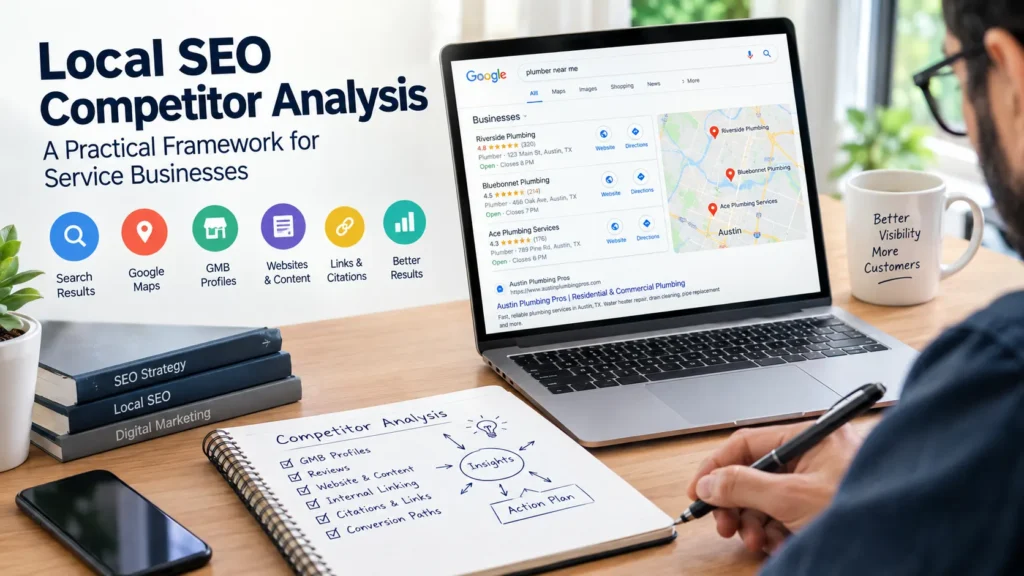
Local SEO competitor analysis is the process of studying the businesses that appear for the searches, services, and locations that matter to your business, then identifying the differences that may explain their visibility.
The goal is not to collect a list of competitors.
The goal is to understand the local search market well enough to answer four practical questions:
Who is actually competing with my business in search?
Where are those competitors stronger?
Which gaps can I realistically improve?
What should I prioritize first?
Google says local results are mainly based on relevance, distance, and popularity. Its guidance also explains that how well-known a business is can be influenced by information such as links from other websites and reviews. This means local competitor analysis needs to consider geography as well as website and business signals. A competitor that appears strongly for one location may not be equally competitive from another location.
A useful analysis connects:
Search query → Search intent → Location → Competitor → Evidence → Gap → Action
This guide explains how to build that process for service businesses without turning competitor research into a spreadsheet full of numbers that do not lead to useful decisions.
What Is Local SEO Competitor Analysis?
Local SEO competitor analysis is a structured comparison of businesses competing for visibility in Google Search, Google Maps, and the Local Pack for relevant services and locations.
Your traditional business competitors and your SEO competitors are not always the same.
For example, an HVAC company may know ten other HVAC companies in its city. But when customers search for “AC repair Austin,” only a smaller group may repeatedly appear in the local results.
Those businesses are especially useful for SEO competitor research.
A strong analysis looks at the relationship between:
- Services
- Search queries
- Search intent
- Geographic areas
- Google Business Profiles
- Reviews
- Websites
- Local citations
- Relevant links and mentions
- Internal linking
- Conversion paths
The result should be a prioritized action plan rather than a competitor ranking report.
Why Local Competitor Analysis Is Different From Traditional Competitor Research
Traditional competitor research often begins with business names.
Local SEO competitor analysis should begin with searches.
Google’s current guidance identifies relevance, distance, and popularity as the main factors behind local results. This makes geography especially important when comparing businesses competing in local search.
Consider a service business with customers across a large metropolitan area.
Competitor A might be closer to customers in the north.
Competitor B might be more visible in central areas because of stronger prominence.
Competitor C might have stronger organic service pages.
All three can be competitors, but the reason they appear for a particular search may be different.
That is why the question should not simply be:
“Who is my biggest competitor?”
A more useful question is:
“Which businesses consistently appear for the searches and locations that matter to my business?”
This distinction becomes especially important when building a Local SEO service strategy because competitor research needs to connect with the actual search environment around each service area.
How to Find Your Real Local SEO Competitors
Start with commercially important services.
Do not begin by collecting every keyword related to your industry. Start with services that can generate calls, enquiries, bookings, consultations, or sales.
For each core service, create a small group of searches.
Useful variations can include:
- Service + city
- Service + neighbourhood
- Service + location
- Service + near me
- Problem-based searches
- Emergency or urgent service terms
- High-intent service variations
For example, a plumbing business might investigate:
- Emergency plumber
- Drain cleaning
- Water heater repair
- Plumber near me
- Emergency plumber + city
- Drain cleaning + city
The exact search set depends on the business.
The objective is to discover the businesses Google repeatedly places in front of potential customers.
Step 1: Search Core Service Queries
Use your most commercially important services first.
A service that generates valuable enquiries should receive more attention than a broad informational keyword with little connection to the business.
This is where keyword research and search intent analysis becomes important.
Keyword research identifies the searches.
Competitor analysis shows who Google currently presents for those searches.
Together, they create a much clearer picture of the local search market.
Step 2: Review Google Search and Google Maps
For each important search, record the visible competitors.
Keep Maps and organic results separate at first.
A business may appear strongly in the Local Pack while having weaker organic visibility.
Another business may rank organically without consistently appearing in Maps.
Do not assume they compete in exactly the same way.
Step 3: Identify Repeated Competitors
A competitor appearing once is less useful for strategic analysis than a business repeatedly appearing across your important searches.
A simple table can help:
| Competitor | Search Coverage | Maps Visibility | Organic Visibility | Main Service | Area |
|---|---|---|---|---|---|
| Business A | 8/10 | Strong | Strong | AC Repair | North |
| Business B | 5/10 | Strong | Moderate | HVAC | Central |
| Business C | 3/10 | Moderate | Strong | Installation | West |
The numbers in a working spreadsheet are for your analysis, not a universal ranking formula.
The purpose is to identify patterns.
Tools You Can Use for Local SEO Competitor Analysis
You do not need a large stack of SEO tools to perform a useful local competitor analysis. The right tools depend on which part of the search environment you are investigating.
| Tool | What to Examine | Why It Helps |
|---|---|---|
| Google Search | Service, location, problem-based and commercial searches | Shows which businesses are visible for the searches that matter |
| Google Maps | Local Pack and map results | Helps identify geographic competitors and local visibility patterns |
| Google Business Profile | Categories, services, reviews, photos, business information | Helps compare how competitors present their local businesses |
| Google Search Console | Your own queries, pages, clicks and impressions | Helps compare competitor observations with your actual search performance |
| Semrush / Ahrefs / Ubersuggest | Keyword gaps, competing pages, backlinks and content opportunities | Helps expand the analysis beyond what is visible directly in Google |
| Your own spreadsheet | Evidence, gaps, actions and KPIs | Turns competitor observations into an actionable plan |
Use tools to collect evidence, not to create assumptions.
For example, a competitor appearing for more keywords does not automatically mean those keywords are the reason the business performs better. Review the actual search intent, ranking page, location, business information and competitive context before deciding what the difference means.
A useful workflow is:
Google Search + Google Maps → Competitor discovery → Tool-based research → Evidence → Gap analysis → Action
The purpose of the tools is to make your analysis more accurate and organized. They do not replace judgment about search intent, business relevance, geography or what your business can realistically improve.
What Should You Compare in a Local SEO Competitor Analysis?
A useful competitor analysis should compare multiple connected areas.
| Area | What to Compare | Possible Gap |
|---|---|---|
| Google Business Profile | Categories, services, information, photos | Relevance or profile completeness |
| Reviews | Count, rating, recent activity, themes | Reputation gap |
| Geography | Address and customer proximity | Distance difference |
| Website | Services, locations, content, structure | Relevance or coverage gap |
| Internal Links | Page relationships and anchor text | Weak topical connections |
| Citations | Business information and relevant listings | Local consistency gap |
| Authority | Relevant local and industry mentions | Authority difference |
| Conversion | CTAs, forms, contact path | Customer journey gap |
The key is interpretation.
A competitor having more reviews does not prove that reviews alone caused better rankings.
A competitor having more website pages does not prove that page count created their visibility.
A competitor being physically closer may explain part of a local visibility difference, but that does not mean you can eliminate the geographic difference through content.
Record the observation first.
Interpret it second.
Choose an action only when the evidence supports one.
Google Business Profile Competitor Analysis
Google Business Profile is one of the most important areas to inspect during local competitor research.
Compare relevant information such as:
- Primary category
- Additional categories
- Services
- Business information
- Business description
- Website
- Hours
- Attributes where applicable
- Photos
- Reviews
- Review responses
Google recommends keeping Business Profile information complete and accurate.
That means competitor analysis should never become an exercise in copying another business’s profile.
For example, discovering that a competitor uses a particular category does not mean you should use that category.
Your category should accurately represent your own business.
The same principle applies to business names, addresses, service areas, and other profile information.
What to Look For in Competitor Profiles
Imagine three businesses are appearing for the same service search.
Business A has strong category relevance.
Business B has detailed service information.
Business C is physically closer to most searchers.
Instead of calling one profile “the best,” record the differences separately.
That gives you more useful questions:
Is our category accurate?
Are our services clearly represented?
Is our business information complete?
Are there genuine profile improvements available?
Which differences are simply geographic?
That distinction produces a much better strategy.
Compare Reviews Beyond the Total Number
Review count is easy to measure.
It is also easy to overinterpret.
Compare:
- Total review count
- Average rating
- Recent review activity
- Recurring customer themes
- Business responses
- Service-related feedback
Suppose Competitor A has 300 reviews and Competitor B has 100.
That tells you there is a numerical gap.
It does not tell you that the review difference alone explains the ranking difference.
Review analysis becomes more useful when you examine what customers actually talk about.
For example, reviews may repeatedly mention:
- Fast response
- Professional communication
- Specific services
- Quality of workmanship
- Customer support
- Convenience
- Clear pricing
Those themes can reveal customer expectations and useful content or conversion opportunities.
A genuine review acquisition process is very different from trying to manipulate review volume.
Compare the Websites, Not Just the Homepages
A common competitor-analysis mistake is opening the competitor’s homepage and stopping there.
The pages that actually compete deserve more attention.
Inspect:
- Core service pages
- Location pages
- Service-area pages
- Supporting articles
- FAQs
- Page titles
- Heading structure
- Content depth
- Internal links
- Trust information
- Contact paths
- Conversion elements
Ask:
Does the competitor have a dedicated service page that my site does not have?
Does that page satisfy a different search intent?
Does it answer customer questions more clearly?
Does it provide useful local information?
Does supporting content link into the commercial page?
Can a visitor easily contact the business?
This is where on-page SEO optimization connects directly with competitor research.
Sometimes a competitor does not have dramatically better content.
Their advantage may come from clearer page targeting and stronger relationships between pages.
Compare Service and Location Coverage Carefully
More pages do not automatically mean better SEO.
You should never create dozens of pages simply because a competitor has dozens.
Instead, analyze the relationship between:
Service → Location → Search Intent → Page
For example, an HVAC competitor may have:
- AC repair page
- AC installation page
- Emergency AC repair page
- HVAC maintenance page
- Austin location page
Your site may have one broad HVAC page.
That is worth investigating, but it does not mean five new URLs are automatically required.
First determine whether each competitor page serves a meaningful search intent.
A location page should also contain genuine local value rather than being a city-name template repeated across dozens of URLs.
Analyze Internal Linking Competitors
Internal linking is often overlooked because it is less visible than backlinks or reviews.
Yet internal links show how a competitor connects its pages.
Look for relationships such as:
Blog article → Service page
Service page → Related service
Location page → Service page
Supporting article → Pillar guide
Commercial page → Relevant supporting resource
Imagine a competitor publishes an article about why an air conditioner stops cooling and links that article to its AC repair service page.
The informational content and the commercial page now have a clear relationship.
If your website has similar informational content but does not connect it to your service page, that may be an internal-link opportunity.
A broader SEO content strategy should therefore consider how articles support important commercial pages.
Compare Citations and Business Information
Citations are references to a business across relevant directories, industry resources, local websites, associations, and other third-party sources.
During competitor analysis, review whether important competitors appear consistently in relevant places.
Look at:
- Industry directories
- Local business directories
- Professional associations
- Chambers of commerce
- Local publications
- Legitimate niche resources
- Community organizations
Focus on relevance and accuracy.
The competitor with the largest number of directory listings is not automatically the strongest competitor.
A better question is:
Which relevant local or industry references mention the competitor but do not mention my business?
Also check whether business information is consistent.
Compare:
- Business name
- Address
- Phone
- Website
- Other important business details
Citation analysis should be part of a broader SEO audit, not a race to create as many listings as possible.
Analyze Local Links and Authority
Backlinks should be reviewed for relevance and context rather than treated as a simple number.
Look for legitimate mentions such as:
- Local publications
- Industry associations
- Community organizations
- Professional organizations
- Suppliers
- Partners
- Relevant regional websites
- Local events or community resources
Ask why the competitor earned the link or mention.
That question is more valuable than:
“How can I get the same link?”
A local publication mentioning a business because it contributed useful expertise is a different situation from an irrelevant directory listing.
The goal is to identify legitimate authority opportunities that make sense for your own business.
Compare Conversion Paths
Competitor analysis should continue beyond visibility.
Open the service pages customers are most likely to visit and review the actual user journey.
Check:
Is the service immediately clear?
Is the contact information easy to find?
Is there a useful next step?
Are important customer questions answered?
Are trust elements visible?
Are forms easy to use?
Is the mobile experience practical?
A competitor can have strong search visibility and still create unnecessary friction for visitors.
A different competitor may convert visitors more effectively because its service page explains the problem, solution, process, trust factors, and next action clearly.
This is why conversion rate optimization can be connected to SEO competitor analysis.
Search visibility gets people to the page.
The page still has to help them make a decision.
The Local Competitive Gap Ledger
Instead of maintaining a spreadsheet filled with isolated metrics, record each important observation in a structured gap ledger.
| Search | Location | Competitor | Signal | Evidence | Controllable? | Action | Target Page | KPI |
|---|---|---|---|---|---|---|---|---|
| AC repair | North | Business A | Reviews | 180 vs 65 | Yes | Improve genuine review process | AC repair | Enquiries |
| AC repair | North | Business B | Proximity | Closer location | No | Consider other geographic opportunities | Location strategy | Visibility |
| AC repair | City | Business C | Service page | Dedicated page | Yes | Improve service-page coverage | AC repair | Organic visibility |
| HVAC | City | Business D | Local authority | Relevant local mentions | Yes | Build legitimate relationships | Main service hub | Referring domains |
This framework helps separate three different things:
What you observed
What you think it means
What you can actually change
That distinction prevents competitor research from becoming a collection of assumptions.
Local SEO Competitor Gap Analysis Template
Once you have collected competitor evidence, turn your findings into an action table. The goal is not to give every competitor a score. The goal is to understand what is different, whether the difference matters, and what you can realistically do about it.
| Search | Location | Competitor | Signal | Evidence | Your Status | Controllable? | Gap | Recommended Action | Target Page | KPI |
|---|---|---|---|---|---|---|---|---|---|---|
| AC repair | North | Business A | Reviews | 180 vs 65 | Lower review activity | Yes | Review-process gap | Improve genuine review requests | AC Repair Service | Qualified enquiries |
| AC repair | North | Business B | Proximity | Closer to searchers | Geographic disadvantage | No | Distance gap | Focus on other competitive opportunities | Location strategy | Local visibility |
| AC repair | City | Business C | Service page | Dedicated page | No dedicated page | Yes | Service coverage gap | Create a useful service page | AC Repair | Organic visibility |
| HVAC | City | Business D | Local authority | Relevant local mentions | Few relevant mentions | Yes | Authority gap | Pursue relevant local relationships | Main service page | Relevant referring domains |
How to Use the Template
Start by recording what you can directly observe.
Then separate the observation from your interpretation.
Finally, decide whether the difference is:
Actionable → something your business can realistically improve.
Constrained → affected by factors such as geography or business circumstances.
Unproven → a difference that you have observed but cannot confidently connect to a ranking outcome.
This prevents competitor analysis from becoming a simple scorecard.
The best competitor research does not ask, “How can I become exactly like this business?”
It asks:
“What does the search environment show, what gap matters to my business, and what evidence supports the next action?”
For repeated analyses, you can save this template as a spreadsheet and update it when you add a new service, enter a new location, see a meaningful visibility change, or review the market again.
How to Prioritize Competitor Gaps
Not every competitive difference deserves immediate action.
Use four filters.
1. Business Value
Does the gap affect a service that matters commercially?
2. Search Relevance
Does the difference occur around a search intent you actually care about?
3. Controllability
Can you realistically improve the issue?
4. Evidence Strength
Is there enough evidence to justify making it a priority?
For example:
A competitor being geographically closer is important, but largely outside your control.
A competitor having a useful service page that you do not have may be more actionable.
A competitor having stronger relevant local mentions can reveal an authority opportunity.
A competitor having more reviews may suggest a need for a better genuine customer-review process, but not a reason to manipulate reviews.
What You Should Not Copy From Competitors
Competitor research is not competitor cloning.
Do not copy:
- Misleading business names
- Fake addresses
- Fake reviews
- Unsupported service areas
- Duplicate location pages
- Keyword-stuffed content
- Thin pages created only for search terms
- Manipulative links
- False credentials
- Fake structured data
A competitor using a tactic does not make that tactic appropriate for your business.
The goal is to understand the market and improve your own site and business information accurately.
A Practical Local SEO Competitor Analysis Workflow
Step 1: Choose Your Important Searches
Select service and location searches connected to meaningful customer intent.
Step 2: Record Search Results
Review Google Search and Google Maps.
Step 3: Identify Repeated Competitors
Look for businesses appearing consistently across important searches.
Step 4: Compare Google Business Profiles
Review categories, services, information, reviews, photos, and relevant profile details.
Step 5: Audit Competing Pages
Compare their service pages, location pages, content, internal links, and conversion paths.
Step 6: Review Citations and Authority
Identify legitimate local and industry references.
Step 7: Separate Evidence From Assumptions
Write down exactly what you observed before interpreting the reason.
Step 8: Identify Controllable Gaps
Prioritize issues your business can realistically improve.
Step 9: Connect Each Action to a Page or Process
Every finding should have a destination.
That might be:
- A service page
- A location page
- A blog article
- Google Business Profile
- Internal linking
- Review process
- Authority activity
- Technical SEO work
Step 10: Measure Meaningful Outcomes
Track changes in relevant visibility and business outcomes, such as:
- Local search visibility
- Organic visibility
- Qualified enquiries
- Calls
- Form submissions
- Bookings
- Relevant referring domains
When competitor research exposes crawl, indexing, sitemap, canonical, redirect, or architecture problems, a technical SEO audit can help determine whether technical issues need to be addressed before content expansion.
Common Local SEO Competitor Analysis Mistakes
Mistake 1: Choosing Competitors From Memory
You may know who your offline competitors are, but Google may show a different set of businesses for your most important searches.
Better approach: build the competitor set from actual search results.
Mistake 2: Checking Only One Location
Local search can change across a service area.
Better approach: analyze multiple important geographic points.
Mistake 3: Treating Reviews as the Entire Ranking Explanation
Reviews are one part of the competitive picture.
Better approach: compare reviews with relevance, geography, website structure, service coverage and authority.
Mistake 4: Copying Competitor Page Counts
A large website does not automatically make a competitor stronger.
Better approach: identify genuine search-intent gaps.
Mistake 5: Chasing Every Competitor Backlink
Not every backlink is relevant or worth pursuing.
Better approach: understand why the competitor earned the mention.
Mistake 6: Ignoring Conversion
Ranking data cannot tell you everything about business performance.
Better approach: review the customer journey and conversion path.
Mistake 7: Treating Assumptions as Facts
A competitor may have stronger rankings and more reviews, but that does not prove reviews caused the ranking difference.
Better approach: distinguish evidence from hypothesis.
Mistake 8: Never Updating the Analysis
Competitors change.
Services change.
Websites change.
Reviews grow.
New businesses enter the market.
Better approach: revisit meaningful competitive signals periodically.
How Often Should You Do a Local SEO Competitor Analysis?
There is no single schedule that fits every market.
A deeper review every three months can be a practical starting point for many service businesses, with additional analysis after major changes.
Review the competitive landscape when:
- A major competitor launches new pages
- A new business enters the market
- Your local visibility changes significantly
- You introduce a new service
- You expand into a new service area
- Your website architecture changes
- Competitor reviews change substantially
- A major search visibility shift occurs
The purpose of recurring analysis is to identify meaningful changes, not to react to every small ranking movement.
How Local SEO Competitor Analysis Supports a Wider SEO Strategy
Competitor research works best as one part of a connected SEO process.
The relationship can look like:
Competitor research
↓
Keyword and search-intent analysis
↓
Website diagnosis
↓
Priority improvements
↓
Content and internal linking
↓
Authority and trust
↓
Measurement
For WordPress websites, these improvements may also involve platform-specific implementation. A WordPress SEO service can connect competitor findings with indexing, internal linking, metadata, schema, page structure, and other WordPress-specific SEO considerations.
For businesses building or redesigning a website, SEO-friendly web design can also help ensure that page architecture, navigation, performance, and conversion paths support the SEO strategy from the beginning.
Local search visibility can also extend beyond conventional search results. For businesses working on broader search visibility, AEO and GEO consulting can connect entity clarity, useful content, structured information, brand consistency, and AI-search visibility with the broader SEO foundation.
Local SEO Competitor Analysis Checklist
Before completing your analysis, check the following.
Search Research
- Core service searches identified
- Location variations included
- Search intent classified
- Google Search reviewed
- Google Maps reviewed
- Important geographic areas sampled
Competitor Research
- Real search competitors identified
- Repeated competitors recorded
- Maps and organic competitors compared separately
- Geographic differences considered
Google Business Profile
- Primary categories compared
- Relevant categories reviewed
- Services compared
- Business information reviewed
- Reviews compared
- Recent review activity considered
- Profile accuracy considered
Website
- Service pages reviewed
- Location pages reviewed
- Search intent compared
- Content gaps identified
- Internal links reviewed
- Trust information checked
- Conversion paths checked
Authority
- Relevant citations reviewed
- Business information consistency checked
- Local mentions investigated
- Industry references investigated
- Relevant links reviewed
Strategy
- Evidence separated from assumptions
- Controllable gaps identified
- Priorities assigned
- Target pages assigned
- KPIs defined
- Follow-up review date established
Work With Md Mynul Hassan
I focus on SEO, Local SEO, Google Business Profile optimization, AEO, GEO, keyword research, on-page SEO, technical SEO, content strategy, internal linking, and search visibility for businesses and professionals.
My approach to competitor analysis is based on understanding the actual search environment, separating evidence from assumptions, and connecting competitive findings with practical website and business actions.
You can also find my professional profiles through my Upwork profile, Freelancer.com profile, LinkedIn profile, YouTube channel, and Facebook page.
Frequently Asked Questions
What is local SEO competitor analysis?
Local SEO competitor analysis is the process of studying businesses that appear for relevant local searches and comparing their Google Business Profile, website, reviews, geographic relevance, citations, authority, content, internal links, and customer journey to identify meaningful and actionable gaps.
How do you find local SEO competitors?
Search the most important service and location queries for your business in Google Search and Google Maps. Record the businesses that repeatedly appear for relevant searches, then group them by service and geography. This creates a competitor set based on actual search visibility rather than assumptions about the local market.
What should I compare between local SEO competitors?
Compare Google Business Profile information, categories, services, reviews, geographic position, service pages, location pages, content coverage, internal links, citations, relevant local mentions, authority signals, and conversion paths. The goal is to identify differences that are relevant, supported by evidence, and realistically actionable.
How many competitors should I analyze?
Five to ten meaningful competitors can be a practical starting point for a service business. The exact number depends on market size, number of services, geographic coverage, and search complexity. It is generally more useful to analyze a smaller set carefully than to collect a large list without extracting actionable findings.
Should I copy a competitor’s Google Business Profile?
No. Competitor profiles can help you understand how businesses present themselves, but your own profile should accurately represent your real business. Do not copy misleading categories, locations, business names, service areas, or reviews.
Does local SEO competitor analysis guarantee higher rankings?
No. Competitor analysis can reveal opportunities and gaps, but it cannot guarantee rankings, Google Maps positions, traffic, or leads. Local search depends on several factors, including relevance, distance, prominence, competition, website quality, implementation, and business-specific conditions.
Can competitor analysis help with keyword research?
Yes. Competitor analysis can reveal service terms, location patterns, search-intent opportunities, content gaps, and queries associated with commercial visibility. Those observations should then be validated through a proper keyword research process before creating or changing pages.
Can competitor analysis improve service pages?
Yes. It can reveal missing services, weak search-intent alignment, unclear information, weak internal links, missing trust content, and conversion problems. Those findings can then be used to strengthen the appropriate service page rather than creating unnecessary content.
Should I analyze competitors’ backlinks?
Yes, but focus on relevance and context rather than raw backlink totals. Useful research asks why the competitor earned a relevant mention, whether the source is credible, whether the relationship makes sense for your business, and whether there is an ethical opportunity to earn similar recognition.
How often should I perform local SEO competitor analysis?
A deeper review every three months can be a useful baseline for many service businesses. Additional checks may be appropriate after a major competitor change, new service launch, geographic expansion, significant website change, or noticeable shift in local search visibility.
What is the biggest mistake in local SEO competitor analysis?
A major mistake is treating a correlation as a proven ranking cause. A competitor may have more reviews, more pages, or more links than your business, but those differences do not automatically prove why they rank higher. Good competitor research records the evidence, considers geographic context, and prioritizes changes that are both relevant and controllable.
Final Takeaway
A useful local SEO competitor analysis should end with decisions, not just data.
You should understand:
who competes with you for important searches,
where those competitors differ from your business,
which differences are explained by geography or other constraints,
which gaps you can realistically improve,
and what should happen first.
That turns competitor research into a practical part of SEO strategy.
The objective is not to reproduce everything competitors are doing. It is to understand the local search environment, identify meaningful gaps, improve the pages and business signals that deserve attention, and measure whether those improvements create better visibility and better business outcomes.