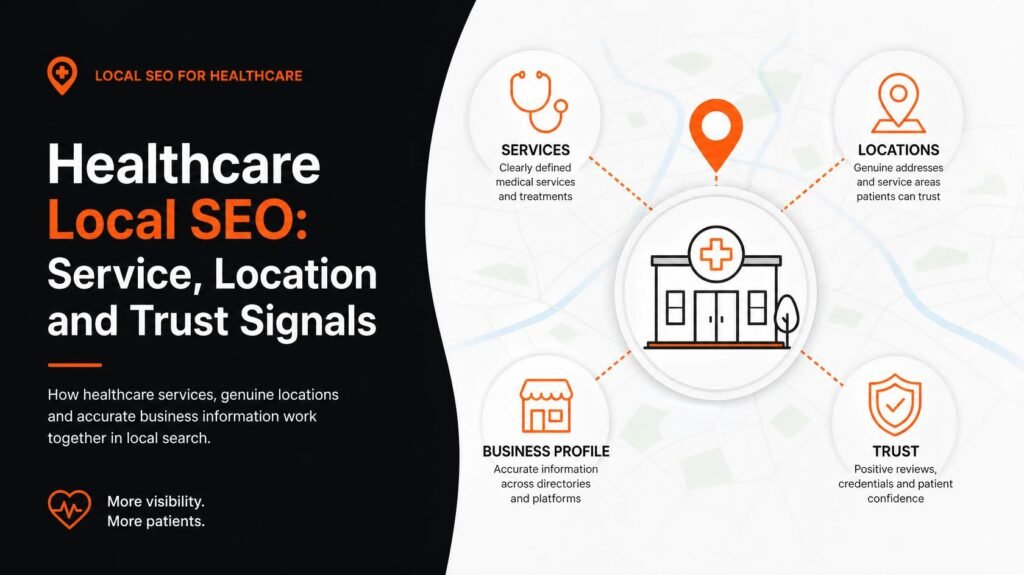
Healthcare local SEO helps clinics, hospitals, doctors and other healthcare providers improve how they appear in relevant local searches. It connects accurate business information, Google Business Profile, useful service pages, real location details, practitioner information and trustworthy website content so people can identify appropriate care and understand how to contact the provider.
A practical strategy starts by verifying the healthcare organization’s identity and locations. Next, it aligns individual services and practitioners with the right website pages, improves local profiles, resolves technical problems and measures whether search visibility leads to relevant inquiries.
The goal is not simply to appear for more medical keywords. It is to make the correct healthcare service easier to discover, understand and evaluate.
What Is Healthcare Local SEO?
Healthcare local SEO is the process of improving a healthcare provider’s visibility in geographically relevant organic search results and local business results. It combines website optimization, local profile management, service and location pages, accurate business information, professional credibility and performance measurement.
It can apply to family clinics, specialist practices, hospitals, diagnostic centers, dental clinics, physiotherapy providers and other eligible local healthcare organizations.
A healthcare website and its local profiles have different but connected responsibilities. The website explains services, practitioners, locations and appointment processes. A Google Business Profile represents an eligible business location on Google Search and Google Maps. Together, these resources help potential patients understand whether the organization offers the service they are looking for and where it is available.
Healthcare providers should begin with their actual business structure and patient needs, not a generic list of keywords.
For a broader industry overview, see the healthcare and service-business industry SEO resources.
How Is Healthcare Local SEO Different From General Local SEO?
The basic foundations of local SEO still apply to healthcare. The difference is the importance of clear service information, accurate practitioner details, responsible health content and careful handling of patient-related information.
A person searching for a medical service may need to confirm the provider’s specialty, location, qualifications, opening hours, accessibility or appointment procedure before making contact.
| General local SEO consideration | Healthcare-specific application |
|---|---|
| Business information | Accurate organization, clinic and practitioner details |
| Service pages | Clear explanations of actual specialties, services and care pathways |
| Location pages | Real locations with locally relevant services, hours and access information |
| Reviews | Genuine feedback handled carefully and without revealing private patient information |
| Content quality | Health-related claims reviewed by appropriately qualified people where required |
| Conversion tracking | Appointment and inquiry measurement designed around applicable privacy requirements |
| Structured data | Markup that accurately describes the actual organization, practitioner or published article |
Healthcare websites should treat accuracy as a core editorial requirement. Google recommends people-first content that provides value, demonstrates relevant knowledge and helps readers achieve their goals. Its guidance is a useful foundation for medical content, although meeting general content guidance does not guarantee rankings. See Google’s people-first content guidance.
The practical implication is straightforward: make it clear what the organization offers, who provides the service, where it is available and how a person can take the next step.
Build the Right Healthcare Service and Location Pages
A healthcare website needs a structure that reflects how the organization actually operates. When every specialty, practitioner and location is placed on one general page, important information can become difficult to find. At the other extreme, creating dozens of near-identical pages can leave visitors with little meaningful information.
Build pages around distinct user needs and genuine differences in the services available.
1. Create a useful page for each main service
A service page should explain what the healthcare provider actually offers. Depending on the service, useful information may include:
The name and scope of the service.
The relevant department or specialist.
Who the service is intended for.
What the appointment or diagnostic process involves.
Any preparation instructions that have been reviewed and approved by an appropriate clinical professional.
Which locations provide the service.
Relevant access, scheduling and contact details.
Answers to common practical questions.
For example, a diagnostic center may need distinct pages for the different types of tests it provides. Each page should explain the relevant service rather than repeating the same general description with a different keyword.
Use the keyword research service to inform keyword selection, page mapping and prioritization. The actual page structure should follow differences in search intent and service availability, not keyword variations alone.
2. Create a location page for each genuine location
A location page should explain what someone can expect at a particular facility. Where applicable, include the real address, opening hours, phone number, available services, relevant practitioners, appointment options, access information and directions.
A page for one clinic should not simply copy the content of another clinic page and substitute a city name. Distinguish locations with factual differences, such as available specialists, departments, hours, parking arrangements or services.
Does each healthcare location need a separate page?
A separate page is appropriate when a real location has sufficient distinct information to help visitors identify the right facility. A multi-location organization may benefit from dedicated pages for its genuine branches, but an invented location or a thin page created solely for a geographic keyword is not a sound substitute for useful local information.
Give every location page a clear purpose and a canonical URL. Link it to the services actually available at that location.
3. Connect practitioners, services and locations
Practitioner profiles should describe the relevant professional accurately. Depending on the organization, useful information may include a person’s name, qualifications, specialty, professional registration where appropriate, affiliated department, actual practice locations and appointment arrangements.
A practitioner profile should connect to the services that person provides and the real location where those services are available. Do not imply that every practitioner works at every branch or offers every service.
An effective page architecture might look like this:
Healthcare organization → Clinic location → Specialty or service page → Relevant practitioner → Appointment information
This relationship helps users move naturally from understanding a service to finding the appropriate provider or facility. It also creates meaningful internal-link connections between related content.
Your on-page SEO service can support this work through page structure, topic alignment, metadata and contextual linking.
Optimize Google Business Profile Accurately
Google Business Profile is an important part of local discovery for eligible healthcare organizations. It helps represent the business on Google Search and Maps, but it does not replace the website or guarantee prominent placement.
Google identifies relevance, distance and prominence as the main factors in local results. Relevance concerns how well the business matches a search. Distance concerns its proximity to the searcher. Prominence relates to how well-known the business is, using information available to Google. Read the official local-ranking guidance.
Google Business Profile checklist for healthcare providers
1. Confirm eligibility and ownership. Establish that the organization or practitioner is eligible for the profile being created and that the business controls the account appropriately.
2. Use the correct real-world name. Do not add specialty keywords, extra locations or promotional phrases to the business name unless they genuinely form part of its real-world name.
3. Select suitable categories. Use the most accurate available category for the business. Do not select unrelated categories just to target more searches.
4. Check contact information and hours. Keep the published details accurate and update them when the actual business information changes.
5. Describe the services truthfully. Ensure that listed services match what the provider actually offers at the relevant location.
6. Add suitable images. Use genuine images of the facility, team and other relevant aspects of the organization, with appropriate permission.
7. Review contact and appointment paths. Confirm that website and booking destinations work and lead to the appropriate location or service.
8. Review duplicate profiles. Investigate duplicate or incorrectly configured entries before creating additional profiles.
Google’s business representation guidelines explain why genuine business details, accurate addresses and policy-compliant profiles matter.
For additional implementation support, see the Google Business Profile optimization service.
Should every doctor have a separate profile?
Not automatically. Profile eligibility depends on Google’s applicable rules for individual practitioners, departments and organizations. Review those rules before creating a separate practitioner profile, and make sure the real-world organization and professional relationships are represented accurately.
Do not create multiple profiles simply to target different treatments or nearby neighborhoods. More listings do not necessarily mean more useful visibility, and inappropriate profile creation can create compliance problems.
Research Healthcare Local Keywords by Search Intent
Keyword research should identify what people are trying to find and which page should answer each need.
A healthcare website may need to cover several types of searches:
| Search pattern | Example | Appropriate destination |
|---|---|---|
| Service + location | [specialty] clinic in [city] | Relevant location or specialty page |
| Practitioner + location | [specialty] doctor in [city] | Genuine practitioner profile or relevant location page |
| Facility search | diagnostic center in [city] | Organization or facility page |
| Practical question | how to prepare for [test] | Clinically reviewed educational content |
| Appointment intent | book [service] at [clinic] | Relevant service page or appointment destination |
| Access information | [clinic] opening hours | Accurate location page and profile |
These are examples of query patterns, not verified search-volume claims.
Map each important keyword to one primary page
Start by grouping queries according to service, location, practitioner, informational need and appointment intent. Then assign each group to the most appropriate existing page or to a genuinely necessary new page.
A specialty query and an appointment query might belong on the same service page if they reflect the same service and need. They do not automatically require separate URLs.
Review actual search data before expanding the page set. Your SEO audit service can support the assessment of indexing, keyword targeting, overlapping pages and content gaps.
The objective is a clear page map that answers genuine needs without making several pages compete for the same purpose.
Strengthen Healthcare Trust Through Accurate Information
A healthcare website should make it straightforward to verify who operates the organization, which professionals provide care and where authoritative service information comes from.
Trust information should be factual and appropriate to the provider. Do not publish qualifications, registrations, affiliations, treatment outcomes or professional distinctions that cannot be verified.
Make professional information easy to find
Where relevant, provide:
The healthcare organization’s real identity and contact details.
Accurate practitioner names and qualifications.
Professional registration or credential information appropriate to the market.
Clear descriptions of the services actually offered.
Authorship and appropriate clinical review for health-related editorial content.
References for important medical claims.
A useful way to contact the organization and find its facilities.
An editorial process for reviewing outdated service and health information.
A medical article should not imply that an SEO consultant is providing clinical advice. Content that discusses medical conditions or treatment should be reviewed by an appropriately qualified professional where the subject requires it.
Dates also require care. Use publication and review dates honestly. Do not change a page’s date merely to suggest that the underlying information has been medically reviewed or substantially updated.
Manage healthcare reviews responsibly
Reviews can help potential patients understand the experiences others report. Healthcare providers should seek genuine feedback through an appropriate, consistent process without offering incentives for positive reviews or selectively requesting only favorable reviews.
Responding to medical reviews requires particular caution. A public reply should not reveal whether a reviewer received care, confirm patient status or disclose treatment details. Follow the organization’s privacy procedures and applicable laws.
Do not purchase reviews, manufacture patient stories or present testimonials as representative clinical evidence. Google’s policy prohibits fake or incentivized review activity, as explained in its Business Profile review restrictions.
Accurate information and responsible review management are more defensible than tactics intended to manufacture reputation signals.
Improve Local Citations and Business Information
A local citation is a reference to a business in an online directory or other relevant source. Healthcare providers may appear in general business directories, professional directories, healthcare directories and official institutional listings.
The first task is to identify relevant sources and compare the information they publish.
Check whether the organization name, address, phone number, website and other important details agree with the real business. For healthcare providers, also review relevant department or practitioner details when the directory supports them.
Not every directory deserves the same investment. Prioritize sources that are credible, relevant to the business and useful to the people it serves.
If an old address or duplicate listing exists, investigate the correct update or removal procedure rather than creating more listings to compete with it.
Do not invent offices, use misleading location details or create false citations for service areas where the organization has no legitimate presence. Directory work should reinforce accurate business information, not manufacture local relevance.
Fix Technical SEO and Structured Data Issues
A useful page cannot perform its intended role if search engines cannot access it properly or if users struggle to navigate it.
Technical checks should cover:
Crawlability and indexability of important service and location pages.
HTTP status codes, redirect chains and broken internal links.
Canonical URLs and duplicate pages.
Logical page hierarchy and contextual internal linking.
Mobile usability and page performance.
Descriptive title tags, meta descriptions and headings.
Accessible, meaningful text content.
Correct XML sitemap references and robots directives.
Structured data that accurately reflects visible content.
Your technical SEO service can support the diagnosis of these issues. Technical fixes should be prioritized by business relevance and actual impact rather than by the number of warnings in a tool.
Use structured data appropriately
Structured data can clarify what a page describes, but it cannot compensate for incorrect or incomplete information.
For the healthcare organization, relevant Schema.org types depend on the real business, such as an appropriate medical clinic, hospital or practitioner type. Use only the information that accurately reflects the organization, its locations and its professional relationships.
For this article, BlogPosting or Article and BreadcrumbList are appropriate candidates if they match the implemented page and website navigation. The website’s existing Person and Organization markup may also need to be maintained consistently.
Do not add fake ratings, reviews, credentials or unsupported organizational information. Google explains the implementation and eligibility requirements in its Local Business structured data documentation.
A valid schema implementation does not guarantee a rich result or a ranking improvement.
Measure Healthcare Local SEO Performance
A useful measurement system separates search visibility from meaningful business outcomes.
A page can gain impressions without receiving many clicks. It can receive clicks without producing inquiries. An inquiry may also fail to become a booked appointment. These are different stages of the journey and should be measured separately where suitable data is available.
| Measurement area | Useful indicators | What to investigate |
|---|---|---|
| Organic search | Impressions, clicks, query patterns and average position | Whether the right service and location queries are gaining visibility |
| Local profile | Available profile performance and customer interactions | Whether people discover and interact with the correct business profile |
| Landing pages | Relevant page visits, engagement and contact actions | Whether visitors find the expected service and location information |
| Inquiry pathways | Form submissions, click-to-call events and booking actions | Whether contact routes function and convert |
| Business outcomes | Qualified inquiries and confirmed appointments, where reliably measured | Whether visibility contributes to meaningful demand |
Google Search Console can help identify the queries that lead to a page and show how its search visibility changes over time. Website analytics can help measure relevant on-site actions. Business profile metrics should be interpreted according to the metrics actually available for that account.
Establish a baseline before judging performance
Record the current state before making major changes. Document the important queries, indexed URLs, profile details, landing-page performance and inquiry measurement that are available.
Then make specific improvements and compare results over an appropriate period. Segment by service, location and page type when the available data supports it.
Avoid claiming that an increase in impressions caused more booked appointments unless the measurement design supports that conclusion.
Healthcare measurement must also respect privacy. Avoid sending patient names, medical details or other sensitive information to analytics tools through URLs, event labels, form fields or tracking parameters. Use approved systems and have the organization’s privacy or compliance lead review the process where necessary.
For broader website conversion work, see the conversion rate optimization service.
A Practical Healthcare Local SEO Example
Consider a hypothetical healthcare group with two clinics offering general consultations, cardiology appointments and diagnostic testing. Its website has one generic service page, an outdated branch address and an appointment button that directs every visitor to a shared contact page.
The problem is not simply that the site lacks more keywords. Its information architecture does not clearly show which services are available at which location or how a patient should contact the right facility.
A practical remediation plan would proceed in stages.
First, verify the underlying facts. Confirm the two real clinic addresses, hours, contact details, available services and practitioner affiliations. Correct inaccurate profile information before expanding the content.
Second, map search intent to pages. Create or improve a location page for each genuine branch if each can provide distinct, helpful information. Improve the relevant service pages so each specialty explains the actual service and connects to the locations where it is available.
Third, connect the pages. Link each location to its available services. Connect relevant practitioner profiles to the locations and services where those professionals actually work. Make appointment paths specific enough to guide visitors to the right destination.
Fourth, resolve technical problems. Review indexing, canonical URLs, internal links, mobile usability and any duplicated content. Make sure the important pages are accessible and discoverable.
Finally, measure the result. Monitor relevant queries, page-level clicks, profile interactions and completed inquiry or booking actions where they can be tracked reliably.
This process establishes a testable improvement plan. It does not establish a guaranteed outcome, a specific ranking or a predicted number of new patients.
Common Healthcare Local SEO Mistakes
1. Creating location pages with only a city name changed
Why it fails: The page provides little distinct information about the actual location.
Better approach: Include real location-specific services, practitioners, hours, access details and other useful information.
2. Treating Google Business Profile as the entire strategy
Why it fails: A profile cannot provide all the detail patients may need about every specialty, practitioner or service.
Better approach: Align the profile with useful website pages and a clear contact process.
3. Putting all specialties on one generic service page
Why it fails: Important services and their relationships can be difficult to understand.
Better approach: Separate services when their intent, content or practical details justify dedicated pages.
4. Publishing unsupported health claims
Why it fails: Inaccurate health information can mislead readers and undermine trust.
Better approach: Use qualified review, appropriate evidence and clear limitations for clinically significant claims.
5. Chasing reviews or local rankings through shortcuts
Why it fails: Fake engagement, misleading information and inappropriate profiles can harm trust and violate platform policies.
Better approach: Use accurate business information, genuine feedback and legitimate optimization.
6. Reporting visibility without measuring inquiries
Why it fails: Rankings and impressions do not establish that the organization received qualified inquiries or booked appointments.
Better approach: Track the different stages of the customer journey and report what the data can actually support.
7. Adding schema without checking the visible content
Why it fails: Structured data can become misleading or inconsistent with the page.
Better approach: Match markup to the actual organization, services, locations and article content, then validate the implementation.
Healthcare Local SEO Implementation Checklist
Use this checklist to organize implementation into manageable stages.
Stage 1: Establish accuracy
Stage 2: Improve page architecture
Stage 3: Improve trust and accessibility
Stage 4: Measure and improve
Frequently Asked Questions
What is the first step in healthcare local SEO?
Start by verifying the organization’s real business information, eligible Google Business Profiles, actual locations and available services. Accurate information establishes the foundation for page planning and local optimization.
How can a clinic improve its Google Maps visibility?
A clinic can improve the controllable parts of its local presence by maintaining an eligible and accurate profile, selecting relevant categories, aligning the website with its services and location, earning genuine reviews and building prominence responsibly. Results still depend on the search, location, competition and other ranking factors.
What should a healthcare location page include?
A useful location page generally includes the actual address, hours, contact information, available services, relevant practitioners, appointment routes and access details. Add only information that is correct for that specific facility.
How should healthcare providers manage reviews?
Encourage genuine feedback without incentives or selective requests for positive ratings. Respond professionally and do not disclose patient status, treatment information or other private details in public replies.
How long does healthcare local SEO take to show results?
There is no universal timeframe. Results depend on the site’s current condition, location, competition, services, technical problems and the work undertaken. Establish a baseline, measure changes consistently and avoid guarantees of a particular ranking or appointment volume.
Should healthcare providers use local SEO and AI search optimization together?
Clear business information, useful content, good technical accessibility and meaningful internal links support a strong foundation for traditional search and can also help modern answer experiences interpret a website. Google’s guidance does not require a separate set of AI-specific ranking tactics. Additional information is available in the AEO guide for local businesses and the AEO and GEO consulting service.
Choose the Next Practical Improvement
Healthcare local SEO works best when business profiles, service information, location pages, practitioner details and the website’s technical foundation communicate compatible facts.
Start with the most important service and location, identify the information people need to make a decision, verify that the relevant pages are accessible, and measure whether improvements lead to meaningful inquiries.
I’m Md Mynul Hassan, an SEO, AEO, GEO and Brand Visibility Specialist based in Bangladesh and working remotely with businesses. My approach connects Local SEO, keyword research, content structure, technical accessibility and practical conversion measurement.
You can explore my work through Upwork, Freelancer.com, LinkedIn, YouTube and Facebook.
For a healthcare website, the next step is to identify which service pages, location details, profiles or technical issues most need attention. A focused review is a more useful starting point than promising a particular Google position.
Discuss your website and goals through the contact page