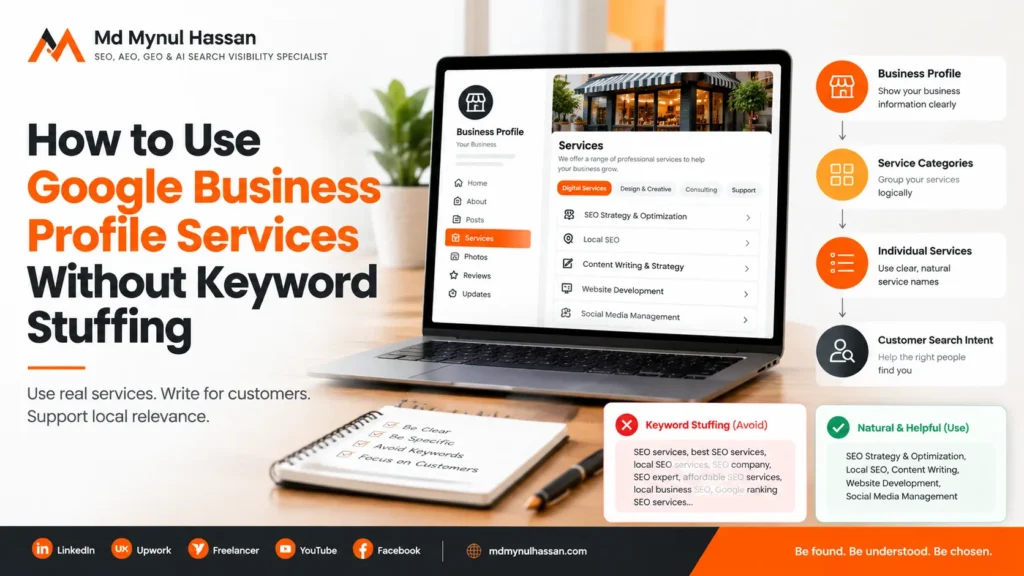
Google Business Profile services should describe the real services your business provides, using clear names and useful customer-facing descriptions. Keywords can appear naturally when they describe the service, but the Services section should not become a list of search phrases, location modifiers, or repeated variations.
Google allows eligible businesses to add suggested or custom services, organize them into categories, and add descriptions and prices where available. Google also says that when local customers search for an offering a business provides, that service may be highlighted on the profile.
The practical goal is simple:
Use Google Business Profile services to make the business easier to understand, not harder to read.
That means choosing accurate service names, writing descriptions that add context, avoiding duplicate variations, and making sure the profile agrees with the website and the actual business.
What Are Google Business Profile Services?
Google Business Profile services are structured offerings that an eligible business can display directly on its Business Profile. Businesses may select services suggested for their category or, where available, add custom services. Services can be grouped into categories, and additional information such as descriptions and prices can be added through the Services editor.
For a local business, think of the Services section as a concise service catalogue.
A plumbing company might have:
- Emergency plumbing
- Drain cleaning
- Water heater repair
- Faucet installation
A marketing consultant might have:
- Local SEO consulting
- Google Business Profile optimization
- SEO audits
- Keyword research
The exact list should come from the real business, not from a keyword spreadsheet.
This is where your broader Local SEO strategy should connect with the profile. GBP services are more useful when they reflect genuine offerings, real service areas, and the language customers actually use.
Should Google Business Profile Services Contain Keywords?
Yes, when the keyword is simply the natural name of the real service. No, when the keyword is being added only to manipulate search relevance.
A service called Emergency Plumbing naturally contains a commercially important phrase.
A service called Best Emergency Plumber Near Me in Austin TX Cheap 24/7 Plumbing Service does not improve clarity. It mixes a service, a location, a sales claim, a search modifier, and several repetitions into one field.
That distinction is central to On-Page SEO strategy too. Search terms should help communicate meaning. They should not replace meaning.
Google’s current documentation does not say that keywords must be removed from service names. Instead, it explains the function of the Services editor and warns that some custom service content can be rejected, including profanity, gibberish, personal information, prices, and phone numbers in custom service names.
So the better question is not:
“How many keywords can I fit into each service?”
Ask:
“What is the clearest name a customer would recognize for this actual service?”
The Service Clarity Model
A useful way to build a GBP Services section is to separate four jobs:
| Layer | Main job | Example |
|---|---|---|
| Business category | Define the broad business type | Plumber |
| Service name | Identify the specific offering | Water Heater Repair |
| Service description | Explain what the service includes | Repair of common residential water heater problems and related components |
| Website service page | Provide deeper information | Detailed Water Heater Repair page |
This prevents the Services editor from becoming a mini website.
Your Keyword Research service can help identify customer language, but the final GBP entry should still represent the real service.
A simple rule works well:
One genuine service first. Search wording second.
How to Build Google Business Profile Services Step by Step
Step 1: List the services the business actually provides
Start with the business, not the keyword tool.
Ask:
What does the company sell?
What does the customer pay for?
Which services are actually available?
Which services are primary?
Which services are occasional or niche?
Which services are no longer offered?
For example, a dental practice might genuinely offer:
- Dental implants
- Teeth whitening
- Root canal treatment
- Emergency dental care
It does not need ten artificial variations such as:
- Best dentist for dental implants
- Affordable dental implant dentist
- Dental implants near me
- Dental implant specialist
- Dental implant service
Those phrases may matter during keyword research, but that does not mean each deserves a separate GBP service entry.
Step 2: Start with Google’s suggested services where relevant
Google may provide predefined services based on the business category. The available options can vary by category and country, and Google says those predefined services are dynamic and can change.
Review the suggestions.
Keep the services that accurately describe what the business offers.
Do not add a suggested service simply because its wording contains a phrase with search demand.
Accuracy comes first.
Step 3: Add custom services only where they fill a real gap
A custom service can be useful when the business genuinely offers something that is not represented by Google’s available options.
Suppose a marketing consultancy offers:
Google Business Profile Optimization
but Google does not provide a sufficiently specific predefined service for the category.
A custom service can make sense.
The service name should still be simple.
Better: Google Business Profile Optimization
Poor: Best Google Business Profile Optimization Service for Local Businesses Near Me
The second version says less about the actual service despite containing more words.
Step 4: Use customer language
Your internal terminology is not always the terminology customers use.
An HVAC company might internally call something “residential HVAC diagnostics,” while customers commonly search for “AC repair” or “air conditioner repair.”
This is where keyword research should inform, not control, the final wording.
The job of keyword research is to uncover how people describe their problem or desired service.
The job of the GBP Service entry is to represent the actual business offering clearly.
Step 5: Write the service name first, then the description
Treat the two fields differently.
Service name: concise identity
Description: context, scope, customer value
For example:
Service: Emergency Plumbing
Description: Plumbing support for urgent issues such as burst pipes, major leaks, blocked drains, and other problems that require prompt attention.
The description does not need five variations of “emergency plumber.”
Its purpose is to help a customer understand what the service involves.
Step 6: Connect the service with the right website page
The GBP entry should not operate in isolation.
If the business has a dedicated website page for a service, that page should describe the same real offering in greater depth.
This is where Technical SEO and site architecture become relevant. Important service pages should be crawlable, indexable, logically linked, and clearly related to the rest of the site.
A useful relationship looks like this:
Google Business Profile
→ Service: Local SEO
→ Website: Local SEO service page
→ Supporting content: local search guides
→ Conversion path: consultation or enquiry
This structure is more useful than trying to make the GBP service itself contain every possible phrase.
Step 7: Check for duplication
Before publishing, compare the entire service list.
Look for entries that mean almost the same thing.
For example:
- SEO Audit
- SEO Website Audit
- Website SEO Audit Service
- SEO Site Audit
- Search Engine Optimization Audit
If they all represent the same offer, adding every variation creates a messy catalogue.
A better structure might be:
SEO Audit
Description: Technical, on-page, content, indexing, internal linking, and search-intent review to identify the most important SEO problems and opportunities.
The keyword variations can be handled naturally through the website architecture, supporting content, or page copy where they genuinely add value.
Your SEO Audit Service follows the same principle of prioritizing meaningful problems rather than producing a long list of low-value warnings.
Bad vs Better Google Business Profile Service Examples
The easiest way to understand keyword stuffing is to compare the wording directly.
| Business | Keyword-stuffed entry | Better entry |
|---|---|---|
| Plumber | Best Cheap Emergency Plumber Near Me Austin TX 24/7 Plumbing | Emergency Plumbing |
| Dentist | Affordable Best Teeth Whitening Dentist Near Me | Teeth Whitening |
| Electrician | #1 Local Electrical Repair Electrician Services | Electrical Repair |
| SEO Consultant | Best SEO Services SEO Expert SEO Agency Near Me | SEO Consulting |
| Lawyer | Top Rated Best Family Law Attorney Near Me | Family Law |
| Cleaning company | Cheap Best Office Cleaning Services Near Me City | Office Cleaning |
The better versions are not “less optimized.”
They are more precise.
A customer immediately understands what each service is.
The description then provides the additional context.
How Should GBP Service Descriptions Be Written?
A good service description should answer a basic customer question:
What does this service actually include?
A practical structure is:
Service + scope + problem solved + relevant context
For example:
Service: Local SEO Consulting
Description: Strategy and recommendations for improving a business’s visibility in local search, including search-intent research, Google Business Profile alignment, service pages, local relevance, and internal linking.
This wording naturally contains important concepts without repeating the same term in every sentence.
The same principle applies to your Content Strategy & SEO Content Writing Service. A description should tell the reader what the service involves, rather than trying to collect every related keyword.
Should You Put Your City in Every GBP Service?
Usually, no.
Your business location or service area is a separate part of the local-search system.
Adding the city to every service name can make the service list look repetitive:
- Plumbing Austin
- Drain Cleaning Austin
- Water Heater Repair Austin
- Emergency Plumbing Austin
- Faucet Installation Austin
If these are simply local services provided by the same real business, the city does not need to be repeated in every service name.
Instead, build location relevance through the correct Business Profile information, service area where applicable, website content, local landing pages where justified, business information consistency, reviews, and other legitimate signals.
Google says local results are mainly influenced by relevance, distance, and prominence.
That makes location strategy broader than repeating a city name.
Do Google Business Profile Services Affect Google Rankings?
They can matter, but they should not be treated as a guaranteed ranking factor or standalone ranking strategy.
Google officially says that local ranking is based primarily on relevance, distance, and prominence. It also says complete and accurate Business Profile information helps Google better understand the business and match it with relevant searches.
Google’s services documentation says that when local customers search for an offering a business provides, that service may be highlighted on the Business Profile.
Third-party testing adds another layer. Sterling Sky’s September 2026 research reports that adding certain services produced measurable ranking changes in its tests, while also noting that impact varies across industries and markets.
The right takeaway is:
Do not ignore GBP Services, but do not build your entire Local SEO strategy around them.
A well-structured service list supports a wider system that includes the business category, accurate business information, location context, website relevance, reviews, prominence, and other factors.
9 Common Google Business Profile Services Mistakes
1. Turning every service into a keyword phrase
Mistake: Best affordable emergency plumber near me in Dallas
Why it happens: The owner tries to “optimize” every possible query.
Better approach: Use the real service name and put useful context in the description.
2. Adding services the business does not actually provide
Mistake: Adding high-volume services because competitors list them.
Consequence: The profile stops accurately representing the business.
Better approach: Only list genuine offerings.
Google requires Business Profile information to accurately represent the location and comply with its policies.
3. Creating dozens of near-duplicate service entries
Mistake: One service becomes five keyword variations.
Consequence: The catalogue becomes difficult for customers to understand.
Better approach: Combine genuinely equivalent variations into one clear service.
4. Repeating the city in every service
Mistake: “Dental Implants Chicago,” “Teeth Whitening Chicago,” “Root Canal Chicago.”
Better approach: Use natural service names and establish geographic relevance across the profile and website.
5. Copying competitors’ service lists
Mistake: A competitor has 25 services, so the business copies the same 25.
Better approach: Build the list from the business’s actual service catalogue.
Competitor research should help identify market expectations and coverage gaps, not replace business knowledge.
6. Writing descriptions that contain no useful information
Weak: We provide professional plumbing services for plumbing needs.
Better: Emergency plumbing support for urgent leaks, burst pipes, blocked drains, and related problems requiring prompt attention.
The second description adds meaning.
7. Ignoring the website
A service in GBP and a website that says something completely different create a weaker overall information system.
Your On-Page SEO service can help align service-page intent, headings, content, internal links, and metadata.
8. Never reviewing the service list
Service offerings change.
Google’s predefined service options can also change by category and country.
Review the list when the business adds or removes an offering and periodically check whether the structure still reflects the company accurately.
9. Treating one GBP edit as proof of SEO success
A change in a profile should be evaluated in context.
A responsible measurement system compares the relevant local-search performance before and after changes and looks for broader business outcomes.
How to Measure Whether GBP Services Helped
Do not use one ranking screenshot as the entire measurement system.
Track signals that connect with the business goal.
Local visibility
Monitor relevant searches and local visibility patterns over time.
Profile actions
Depending on the business, useful actions can include:
- Calls
- Website visits
- Direction requests
- Booking actions
- Enquiries
- Profile interactions
Website performance
Watch the relevant service page.
Ask:
Did organic impressions change?
Did clicks change?
Did qualified enquiries change?
Did the service page attract more relevant searches?
Conversion quality
A service entry is not successful simply because an impression increased.
A stronger question is:
Did the change help the right customers understand and engage with the business?
This is where Conversion Rate Optimization can complement Local SEO. Search visibility and conversion behavior should be analyzed together when enough data exists.
Advanced Considerations for GBP Services
Service categories should reflect real business structure
Google allows businesses to group services into categories. Use categories where they make the service list easier to understand.
Avoid creating artificial categories simply to insert more keywords.
Predefined services are not universal
Google’s API documentation makes clear that predefined services can differ based on category and country and may change over time.
That means there is no reliable universal “perfect GBP services list” that applies to every business.
Service names and service pages have different jobs
A GBP service should be concise.
A website service page can answer deeper questions such as:
What does the service include?
Who is it for?
How does the process work?
What does it cost?
What locations are served?
What should a customer do next?
Trying to fit all of that into a GBP service entry is the wrong use of the field.
Local service businesses need geographic accuracy
A service-area business should represent the areas it genuinely serves. Google provides separate guidance for service-area and hybrid businesses.
Do not use the Services section to manufacture geographic coverage that the company does not actually provide.
GBP should be part of a wider search entity
A local business is represented across multiple sources:
Website
Google Business Profile
Reviews
Directories
Social profiles
Industry references
Maps information
Local content
Google says information about a Business Profile can come from the business, public web content, third parties, users, and other sources.
That is why consistent business information matters beyond the Services editor itself.
A Practical GBP Services Checklist
Before publishing or revising the Services section, check:
Business accuracy
- Does every listed service actually exist?
- Is the service currently available?
- Does the business genuinely have the capability to deliver it?
Service naming
- Is the service name clear?
- Would a customer recognize it immediately?
- Does it describe the actual offering?
- Did you avoid stuffing several phrases into one name?
Descriptions
- Does each description add useful context?
- Does it explain what the service covers?
- Is it written for customers?
- Does it avoid unnecessary repetition?
Structure
- Are related services grouped logically?
- Are duplicate variations removed?
- Are custom services used only where they add real coverage?
Local relevance
- Is the business information accurate?
- Is the service area genuine where applicable?
- Are you relying on actual local relevance instead of repeating city names everywhere?
Website alignment
- Does the corresponding website page describe the same service?
- Are important pages internally linked?
- Does the site’s broader content support the same entity relationships?
Quality control
- Are there phone numbers, prices, personal information, gibberish, or other prohibited material inside custom service names?
- Does the profile still represent the business accurately after editing?
Frequently Asked Questions
What should you add to GBP Services?
Add the real services your business currently provides. Start with Google’s relevant predefined services where available, then use custom services only when they represent genuine offerings that are not adequately represented. Keep service names concise and use descriptions to add useful context.
Should Google Business Profile services contain keywords?
Yes, when the keyword is the natural name of the real service. Avoid turning one service into a collection of search phrases. “Emergency Plumbing” is a normal service name. “Best Cheap Emergency Plumbing Near Me in Austin” is keyword-heavy and communicates poorly.
How do I add services to Google Business Profile?
Open the Business Profile, select the option to edit services, choose relevant predefined services or add custom ones where available, enter descriptions and prices where applicable, and save the changes. Google’s current help documentation provides the same general workflow.
Do GBP services improve Google rankings?
They may contribute to local relevance, but Google does not publish a guarantee that adding services will produce a particular ranking outcome. Google’s official local-ranking guidance identifies relevance, distance, and prominence as the main broad factors. Third-party tests have found potential ranking impact from services, with results varying by market and industry.
Should I add every service my business offers?
Usually, genuine services that help customers understand the business should be represented. That does not mean creating a separate entry for every wording variation. One clear service is usually better than several duplicate versions of the same offering.
Should I put my city in every service name?
Usually not. Geographic relevance should be established through accurate Business Profile information, genuine service areas, website content, local signals, and the wider local-search system. Repeating a city name inside every service can make the catalogue harder to read.
What is the difference between suggested and custom services?
Suggested services are options provided by Google based on the business category and related factors. Custom services are services the business can add when the needed offering is not adequately represented by Google’s available choices. Google’s API documentation notes that predefined services vary by category and country.
Why might a Google Business Profile service be rejected?
Custom service content may be rejected when it violates Google’s policies. Google specifically lists examples such as profanity, gibberish, personal information, prices, and phone numbers in custom service names.
Why are my GBP services not showing?
Possible reasons include feature eligibility, profile changes still being processed, category-specific availability, content rejection, or changes in Google’s interface. Start by checking the Services editor and making sure the business category and service information are accurate.
Should GBP services match my website services?
Yes. They do not need to use identical wording everywhere, but the underlying offering should be the same. GBP should identify the service clearly, while the website provides deeper information, evidence, context, and a conversion path.
The Bottom Line
Google Business Profile Services work best when they function as a clear description of the business’s real offerings.
Use natural service names.
Use descriptions to add context.
Use customer language to improve clarity.
Do not create duplicate variations just to collect keywords.
Do not manufacture location relevance.
And do not treat the Services section as a replacement for a complete Local SEO strategy.
For a business that needs a wider review, Google Business Profile Optimization can connect the Services section with categories, business information, local relevance, website alignment, and the broader search presence.
For deeper search-visibility work, AEO & GEO Consulting can also help connect clear business entities, useful answers, website content, and trust signals across modern search environments.
Connect With Md Mynul Hassan
I share SEO, Local SEO, AEO, GEO and search-visibility work across my professional platforms.