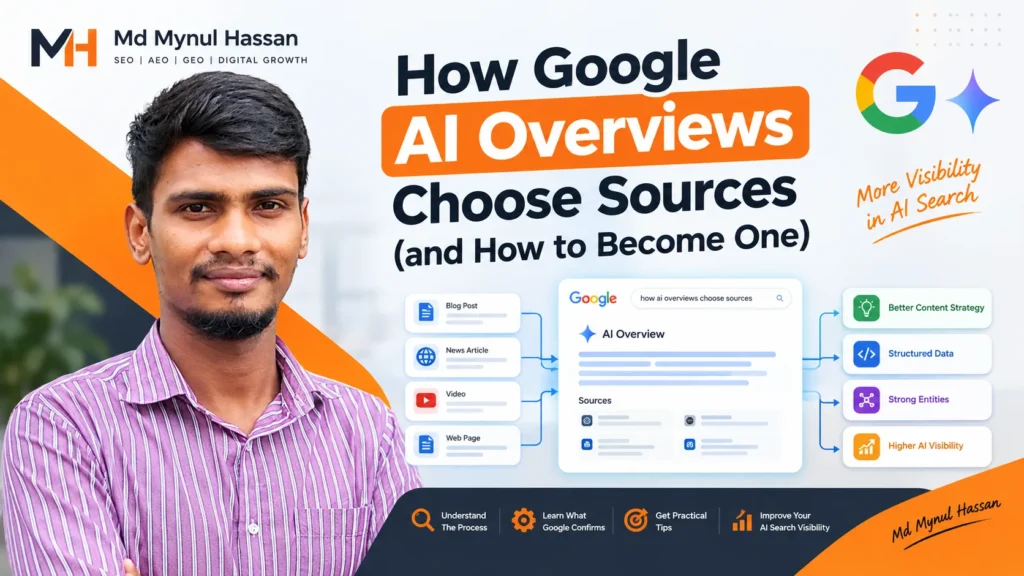
Google AI Overviews do not select sources using a simple rule such as “cite the page that ranks #1.” Google says AI Overviews and AI Mode are built on its existing Search systems, can use query fan-out to explore related searches, and require supporting pages to be indexed and eligible for normal Search with a snippet. Google has not published a complete public formula for deciding why one eligible page is cited instead of another.
That makes the practical goal clearer.
You cannot optimize for a secret citation score. You can make your website easier to crawl, easier to understand, more relevant to the searcher’s question, better supported by evidence, and more clearly connected to the wider topic and entity.
This guide explains what Google confirms, what independent research suggests, what the evidence does not prove, and how to build content that has a stronger foundation for AI Overview visibility.
How Do Google AI Overviews Work?
Google AI Overviews are AI-generated summaries that can appear in Search when Google’s systems determine that a generated response adds useful value to the query. The experience can include links to supporting web pages so searchers can investigate the underlying information.
The important difference from a traditional organic result is the task being performed.
A normal search result is primarily choosing and ordering webpages.
An AI Overview is constructing an answer from information retrieved through Search and then attaching supporting sources.
Google says both AI Overviews and AI Mode may use query fan-out, meaning the initial question can lead to multiple related searches across subtopics and data sources. During answer generation, Google’s systems can identify supporting web pages associated with those searches.
For SEO, that means your opportunity is not limited to one exact keyword.
A strong page should answer the main question and the important supporting questions that naturally surround it.
What Does Google Actually Confirm About Source Selection?
The most useful way to understand AI Overview source selection is to separate documented Google behavior from industry observations.
| Area | What Google confirms | Practical interpretation |
|---|---|---|
| Search eligibility | Pages must be indexed and eligible to appear in normal Search with a snippet | Fix technical visibility first |
| Query expansion | AI features may use query fan-out | Cover the topic’s meaningful sub-questions |
| Special AI SEO | No additional technical requirements | Don’t chase secret technical hacks |
| Special AI schema | No special Schema.org markup is required | Use accurate schema for normal SEO purposes |
| Internal links | Google recommends useful internal links | Connect supporting pages clearly |
| Text content | Important content should be available in text | Don’t hide key information inside inaccessible elements |
| Structured data | Markup should match visible content | Schema describes reality; it does not create it |
| Performance | Generative AI traffic is included in Search Console’s web reporting | Measure changes alongside organic performance |
Google explicitly says that existing SEO fundamentals continue to apply to AI features. It also warns that satisfying technical requirements and best practices does not guarantee crawling, indexing or serving.
That last point is worth remembering.
Eligibility is not selection, and selection is not guaranteed citation.
What Is Query Fan-Out and Why Does It Matter?
Query fan-out is Google’s process of issuing multiple related searches around an original query to gather the information needed to construct an answer.
Suppose somebody searches:
“How can a law firm improve local visibility in London?”
The system may need information associated with several related concepts:
- local search visibility
- legal service relevance
- local business information
- law firm service areas
- reviews and reputation
- service-page quality
- technical accessibility
- structured business information
- relevant local content
Google does not publish the exact fan-out queries it generates for every response. It therefore makes little sense to pretend an SEO can reverse-engineer a permanent list of “AI queries” and optimize for them mechanically.
The better approach is to understand the user’s information journey.
Your keyword research strategy should identify meaningful questions and search themes. Your content should then answer those themes naturally rather than repeating dozens of close keyword variations.
Does Ranking in Google’s Top 10 Guarantee an AI Overview Citation?
No.
Traditional rankings and AI Overview citations overlap, but they are not the same system.
Ahrefs’ March 2026 analysis examined 863,000 keyword SERPs and approximately 4 million AI Overview URLs. In its second test, 37.1% of cited URLs also ranked in the top 10 organic results for the same query, while 26.2% ranked positions 11–100 and 36.7% did not rank in the top 100 standard blue links.
That does not mean rankings are irrelevant.
Google says generative AI features are rooted in Search, and its guidance emphasizes Search fundamentals and retrieval from the Search ecosystem.
The better conclusion is narrower:
Ranking can create an opportunity to be retrieved, but ranking position alone does not determine whether a page becomes an AI Overview source.
A page may rank well but answer the question poorly.
Another page may have a particularly useful answer for one supporting sub-question.
A third page may be surfaced through another related search generated during query fan-out.
This is why “rank first, optimize for AI later” is too simplistic.
Can a Page Outside the Top 10 Be Cited?
Yes.
Current independent research indicates that Google AI Overviews can cite URLs that do not appear in the same query’s traditional top 10, and in some cases do not appear in the top 100 standard organic results.
There is an important qualification.
This should not be interpreted as permission to ignore organic SEO.
Google still requires supporting pages to be indexed and eligible for Search, while its generative systems may retrieve information through related queries and other Search surfaces.
So the sensible strategy is:
Build strong organic search eligibility and relevance, then make each page genuinely useful for a specific information need.
That is more defensible than trying to engineer an artificial “AI citation trick.”
Does Schema Markup Help AI Overviews?
Not as a special AI Overview ranking requirement.
Google explicitly says there is no special Schema.org markup required for AI Overviews or AI Mode. It also says structured data can help Google understand page content and can support eligible Search features when implemented correctly.
Think of schema as a classification and relationship layer, not a citation button.
For example, structured data can clarify that:
A person is the author of an article.
An organization provides a service.
A service serves a geographic area.
A website represents an organization.
A law firm is a legal-service provider.
That type of semantic clarity can be useful across Search, but it should always reflect information that is actually visible and accurate on the page.
Google’s structured-data documentation specifically recommends validating markup and ensuring that the structured data accurately reflects the visible content.
For broader schema planning, see my Schema Markup for Business guide.
Law Firm Schema: What to Add Beyond the Basic Listing
A law firm’s structured data should not stop at name, phone number and address.
Schema.org currently defines LegalService as a business that provides legally oriented services, including law firms. It is part of the LocalBusiness and Organization hierarchy. Schema.org’s current vocabulary also marks Attorney as deprecated and points toward LegalService as the more inclusive and less ambiguous type.
For the individual lawyer, Person is the more appropriate entity type.
Schema.org’s Person vocabulary supports relationships such as worksFor, allowing the individual attorney to be linked to the firm.
A useful conceptual structure is:
Law Firm / LegalService
→ employs → Person
Person
→ worksFor → LegalService
LegalService
→ provides → Service
Service
→ provider → LegalService
Service
→ areaServed → Place
WebSite
→ represents/publishes → LegalService
Article
→ author → Person
This is stronger than treating every entity as an isolated schema block.
Schema.org’s Service type explicitly supports properties such as provider and areaServed, while LegalService supports organization and location relationships.
Example Legal-Service JSON-LD
Use this as a conceptual implementation example. Replace every value with real information before deployment.
{
  "@context": "https://schema.org",
  "@graph": [
    {
      "@type": "LegalService",
      "@id": "https://example.com/#law-firm",
      "name": "Example Law Firm",
      "url": "https://example.com/",
      "telephone": "+1-000-000-0000",
      "areaServed": {
        "@type": "Place",
        "name": "New York"
      },
      "employee": {
        "@id": "https://example.com/attorneys/jane-smith/#person"
      }
    },
    {
      "@type": "Person",
      "@id": "https://example.com/attorneys/jane-smith/#person",
      "name": "Jane Smith",
      "jobTitle": "Attorney",
      "url": "https://example.com/attorneys/jane-smith/",
      "worksFor": {
        "@id": "https://example.com/#law-firm"
      }
    },
    {
      "@type": "Service",
      "@id": "https://example.com/services/business-law/#service",
      "name": "Business Law Services",
      "serviceType": "Business Law",
      "provider": {
        "@id": "https://example.com/#law-firm"
      },
      "areaServed": {
        "@type": "Place",
        "name": "New York"
      },
      "url": "https://example.com/services/business-law/"
    },
    {
      "@type": "WebSite",
      "@id": "https://example.com/#website",
      "name": "Example Law Firm",
      "url": "https://example.com/",
      "publisher": {
        "@id": "https://example.com/#law-firm"
      }
    }
  ]
}
The point is not to create as much markup as possible.
The point is to represent real entities and their relationships accurately.
For a detailed law-firm implementation, my Law Firm Schema Markup guide expands on LegalService, Organization, Person, Service, locations, website relationships and the deprecated Attorney type.
How Do You Make a Page Easier for Google to Retrieve and Cite?
There is no official “AI Overview checklist” from Google. The following process is a practical implementation framework built from Google’s current guidance plus observable research.
1. Make the Page Search-Eligible
Start with the technical foundation.
Check:
- robots.txt access
- noindex directives
- canonical signals
- HTTP status
- internal links
- sitemap discovery
- JavaScript-dependent content
- mobile accessibility
- Search Console indexing
Google says pages need to be indexed and eligible to appear in normal Search with a snippet before they can be eligible as supporting links in its AI features.
For technical diagnosis, see the Technical SEO Service and SEO Audit Service.
2. Answer the Main Question Immediately
Do not make the reader walk through three paragraphs of background before giving the answer.
For this article, the answer should appear immediately:
Google AI Overviews choose supporting sources from the information retrieved through Google’s Search systems. Pages must be indexed and Search-eligible, while Google’s query-expansion and retrieval systems determine which information is useful to construct the answer. Google has not published a complete public formula for individual citation selection.
Then explain the details.
This is useful for readers, featured-answer formats and question-based Search because the answer is located where the question expects it.
3. Map the Searcher’s Supporting Questions
Start with the main query.
Then ask:
What does this person need to know next?
For this topic:
How does the system work?
What makes a page eligible?
Does ranking matter?
Can lower-ranking pages be cited?
Does schema help?
What is query fan-out?
How should content be structured?
How do I measure results?
This is where keyword research and content strategy connect directly to AI-search readiness.
4. Write Complete Answers, Not Keyword Capsules
Google’s current AI-search guidance explicitly says there is no requirement to split content into tiny pieces, and there is no ideal page length. It recommends writing for your audience rather than rewriting everything specifically for generative AI.
That matters because “AEO writing” can easily become unnatural.
A strong answer is simply a strong answer.
Use question headings where they improve clarity.
Use a short direct response when the question deserves one.
Then provide explanation, evidence, exceptions and examples.
My On-Page SEO Service focuses on this broader page-level relationship between search intent, structure, internal links and content relevance.
5. Add Evidence and Information Gain
Suppose five websites already say:
“Create helpful, high-quality content.”
Repeating the same sentence does not create much information gain.
Instead explain:
What does “helpful” mean for the actual query?
Which sub-questions remain unanswered?
What evidence supports the claim?
What is controlled by the site owner?
What is outside the site owner’s control?
What is still uncertain?
Google’s people-first guidance explicitly encourages original information, insightful analysis and useful substance beyond obvious summaries.
6. Strengthen Entity Relationships
Entity consistency is especially important for businesses, professionals and multi-service websites.
A business should be understandable as a coherent entity:
Business → provides → services
Person → responsible for → expertise
Service → serves → audience/location
Website → represents → business
Article → authored by → person
This does not mean repeating the same entity name dozens of times.
It means making the relationships clear through page content, navigation, internal links, appropriate structured data and consistent business information.
For another practical example, see the AI-search-friendly website guide.
7. Build Internal Links Around Meaning
Google specifically recommends making content easily findable through internal links for AI features.
A useful internal-link pattern is:
Core topic → supporting guide → service page → case study
For an AI-search topic, that might look like:
AI Overviews guide
→ AEO & GEO consulting
→ technical SEO
→ content strategy
→ schema markup guide
→ relevant case study
The goal is not to add fifteen links simply because someone said “fifteen links.”
Every link should help the reader continue the information journey.
8. Measure and Improve Instead of Assuming
Google says traffic from AI features is included in the overall Search Console data, within the “Web” search type. Google’s newer generative-AI guidance also directs site owners toward Search Console for monitoring generative-AI performance.
Track:
- impressions
- clicks
- CTR
- target-query visibility
- indexing
- conversions
- brand searches
- referral traffic
- AI visibility where a reliable measurement method exists
Do not judge the entire strategy by whether one page appeared in one AI Overview.
Worked Example: A Local Service Business
Suppose a London law firm wants visibility for:
“How can a law firm improve local search visibility?”
A weak approach would create one article repeating:
“law firm local SEO”
throughout the copy.
A better information system might contain:
Main guide:
How can a law firm improve local search visibility?
Supporting topics:
Google Business Profile
local service pages
reviews and reputation
local landing pages
law-firm schema
technical SEO
service-area clarity
local search intent
Commercial connection:
Local SEO service
Evidence:
Case study or genuine business examples
Entity layer:
Law firm → legal services → attorneys → offices → service areas
Now the website answers the question at several depths.
That structure is also consistent with the way Google’s generative AI guidance emphasizes people-first content, internal links, text accessibility and clear technical foundations.
For local businesses, my Google Business Profile optimization service and GBP description for AI search guide address adjacent parts of that visibility system.
Common AI Overview Optimization Mistakes
Mistake 1: Treating Position One as a Citation Guarantee
Organic rankings matter, but they do not provide a one-to-one citation guarantee. Independent research shows meaningful citation overlap with organic results, but also substantial citations outside the same query’s top 10.
Mistake 2: Adding “AI Keywords” Everywhere
Changing every page to mention:
AI search
AI optimization
AI visibility
GEO
AEO
does not automatically make a page more useful.
Google says its systems understand synonyms and meaning and that site owners do not need to rewrite content specifically for generative AI.
Mistake 3: Treating Schema as a Citation Switch
Schema should accurately describe the visible content.
Google explicitly says there is no special schema required for AI Overviews or AI Mode.
Mistake 4: Creating Tiny Paragraphs for Machines
Google specifically says there is no requirement to break content into tiny pieces for AI. There is also no preferred word count.
Mistake 5: Publishing Huge Volumes of Similar Pages
Creating dozens of near-identical pages around tiny keyword variations can reduce the usefulness of the website rather than increase it.
Build pages because they solve different information problems.
Mistake 6: Hiding Important Information
Important facts should be available in crawlable text.
Google specifically recommends ensuring that important content is available in textual form.
Mistake 7: Using Deprecated or Inaccurate Schema
For law firms, do not build a new implementation around Schema.org’s deprecated Attorney type. Model the legal business with LegalService and the individual attorney with Person when appropriate.
Mistake 8: Chasing Fake “AI Mentions”
Google’s AI-search guidance specifically warns against pursuing inauthentic mentions as an optimization tactic.
Genuine references are useful because they are genuine, not because the site owner is attempting to manufacture an AI signal.
What Should You Do If Your Page Ranks but Is Not Cited?
Use diagnosis rather than guesswork.
First: confirm indexing and snippet eligibility.
Second: confirm the page actually answers the target query.
Third: identify supporting questions that the current page ignores.
Fourth: compare the page against genuinely useful competing information.
Fifth: strengthen evidence, examples, specificity and entity clarity.
Sixth: review internal links and topic relationships.
Seventh: verify structured data.
Eighth: measure changes over time.
A page can have strong authority and still miss the searcher’s exact information need.
A page can also answer a question perfectly and still remain uncited.
That uncertainty is part of the system. Google itself says that satisfying the relevant requirements and best practices does not guarantee that a page will be crawled, indexed or served.
Does Google Require AEO, GEO or Special AI Optimization?
Not as an additional Google technical requirement.
Google’s current documentation says existing SEO best practices remain relevant for generative AI features and explicitly says there are no additional technical requirements and no special schema.org markup required for AI Overviews or AI Mode.
AEO and GEO can still be useful strategic frameworks.
They can encourage clearer answers, stronger topic coverage, entity consistency, better evidence, improved content architecture and better user journeys.
The mistake is turning the frameworks into imaginary Google requirements.
My AEO & GEO consulting service takes this approach by connecting AI-search readiness with normal SEO foundations rather than treating AI visibility as a separate secret algorithm.
What About llms.txt?
Google does not require llms.txt for its Search generative-AI features.
Google’s 2026 documentation clarifies that Google Search ignores llms.txt for Search visibility and that maintaining such a file will neither help nor hurt Google Search rankings or visibility. It can still be maintained for other systems that choose to use it.
That means the priority should remain:
crawlability
indexing
search intent
useful content
internal links
technical quality
accurate structured data
evidence
entity clarity
A Practical AI Overview Source Checklist
Before publishing or updating a page, ask:
Search Eligibility
- Is the URL indexable?
- Is it accessible to Googlebot?
- Is the canonical correct?
- Is there an accidental noindex?
- Does the page return a valid status code?
- Is the important content available as text?
- Can internal links lead to the page?
- Is sitemap discovery working?
Search Intent
- Is the main question answered immediately?
- Are the major follow-up questions covered?
- Does the page solve the actual problem?
- Are unnecessary keyword variations removed?
- Does the content distinguish facts from assumptions?
Evidence
- Are important claims sourced?
- Are statistics dated?
- Is research attributed?
- Are independent studies labeled as independent evidence?
- Are limitations clear?
Entity Clarity
- Is the business clearly identified?
- Is the author clearly identified?
- Are services described accurately?
- Are genuine locations and service areas clear?
- Does structured data match the visible page?
Information Gain
- Is there an original framework?
- Is there a worked example?
- Is there a useful checklist?
- Is there a meaningful comparison?
- Is there a practical troubleshooting path?
- Does the article answer something competitors leave unclear?
Measurement
- Can Search Console data be monitored?
- Are organic clicks and impressions being compared?
- Are conversions tracked?
- Are relevant brand or referral signals monitored?
- Are AI visibility observations recorded carefully rather than treated as universal rankings?
Frequently Asked Questions
How do Google AI Overviews choose sources?
Google AI Overviews use Google’s Search ecosystem to retrieve information that can support an AI-generated response. Supporting pages must be indexed and eligible to appear in normal Search with a snippet. Google also says AI features may use query fan-out to search related subtopics. Google has not published a complete public formula for individual citation selection.
Does ranking #1 guarantee an AI Overview citation?
No. Independent research shows overlap between organic rankings and AI Overview citations, but the two are not identical. In Ahrefs’ March 2026 analysis, roughly 37% of cited URLs in its blue-link comparison ranked in the top 10 for the same query.
Can pages outside the top 10 be cited?
Yes. Current research indicates that AI Overview citations are not restricted to the conventional top 10. Ahrefs found substantial cited URLs outside the first-page organic results in its 2026 study.
Does schema markup improve AI Overview visibility?
There is no special AI Overview schema that Google requires. Accurate structured data can still help Google understand page content and support ordinary Search features, but it should not be treated as an AI citation switch.
Do I need to rewrite every paragraph into short answer blocks?
No. Google says there is no requirement to break content into tiny pieces for generative AI and no ideal page length. Write for the audience and use concise answers where they actually improve the page.
Does internal linking matter for AI search?
Yes, as an SEO foundation. Google specifically recommends making content easily findable through internal links for AI features. Internal links also help users understand the relationship between supporting and commercial pages.
Does llms.txt help Google AI Overviews?
Google says no. Its current documentation says Google Search ignores llms.txt for Search visibility, so maintaining it does not improve or harm Google rankings.
Should law firms still use Attorney schema?
For new implementations, Schema.org’s current vocabulary marks Attorney as deprecated and says LegalService is more inclusive and less ambiguous. Model the law firm as LegalService and individual lawyers as Person when appropriate.
Final Takeaway
The strongest way to think about Google AI Overview visibility is not:
“How do I make Google cite my page?”
Use a more practical question:
“Have I made this information accessible, relevant, specific, trustworthy and clearly connected to the topic and entity behind it?”
Google confirms the foundation: Search eligibility, crawlability, text accessibility, internal linking, useful content, accurate structured data and established SEO practices. Its systems can also expand queries through related searches before assembling a response.
Independent research then adds an important warning: AI Overview citations do not simply mirror conventional rankings.
That leaves you with a strategy you can actually control.
Make the page useful.
Make the answer clear.
Connect it to the right supporting content.
Support important claims with evidence.
Model real entities accurately.
Fix technical barriers.
Measure what changes.
For businesses that need help connecting technical SEO, content, AEO, GEO, entities and search visibility, my AEO & GEO consulting service is the natural next step.
Find Md Mynul Hassan Online
You can also review my professional work and profiles through:
Upwork
Freelancer.com
LinkedIn
YouTube
Facebook
Sources
Google’s official guide to optimizing websites for generative AI features