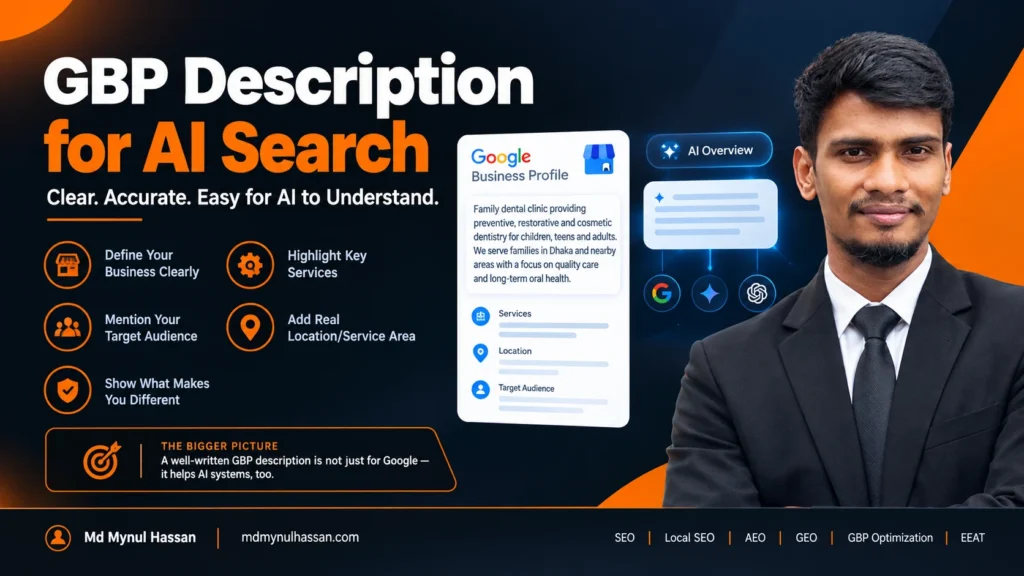
A strong Google Business Profile description should make your business easy to understand in a few sentences. For an AI-search-ready GBP description, focus on clear business identity, core services, audience, location or service area, meaningful differentiation, and factual business context. Do not try to “hack” AI with keyword stuffing. Google says there is no special optimization or schema required for AI Overviews or AI Mode. The practical goal is clear, accurate information that stays consistent across your Business Profile and website.
For businesses that depend on Google Maps and local discovery, this fits naturally into a wider Google Business Profile optimization and Local SEO service.
What Is a Google Business Profile Description?
A Google Business Profile description is the business summary shown in the “From the business” section of a Business Profile. Google says the description should help potential customers understand what the business offers, what makes it special, how long it has been operating, and other useful business information. The field cannot exceed 750 characters, and Google does not allow URLs or HTML in the description. Google also advises businesses to focus on the business itself rather than promotions, prices, or sales.
That makes the description a small field with a specific job.
It is not your entire About page.
It is not your service catalog.
It is not a collection of every keyword you want to rank for.
It is a concise explanation of the business.
The 750-character limit changes how you write
A business description needs enough detail to establish context without trying to explain everything.
A useful description should quickly answer:
- What is the business?
- What does it primarily offer?
- Who does it serve?
- Where does it operate?
- What makes it meaningfully different?
- Is there useful history or context worth mentioning?
Google’s own guidance recommends information such as what you offer, what makes you special, how long you have been in business, and anything else customers should know.
What Does “AI-Friendly” Mean for a GBP Description?
An AI-friendly business description is not a special format approved by Google.
Google’s current guidance says there are no additional technical requirements, special files or special schema.org markup needed for AI Overviews or AI Mode. Google recommends applying the same foundational SEO practices used for Search overall, including useful content, crawlability, internal links, textual information, current Business Profile information and accurate structured data.
That matters because some AI-search articles make the idea sound more complicated than it is.
There is no verified formula such as:
Put five keywords in sentence one, three entities in sentence two, then add a location modifier.
That is not how Google’s official guidance works.
A better approach is to make important business facts explicit.
Instead of:
We are a passionate team committed to delivering exceptional solutions for our valued clients.
Write something like:
Austin-based residential HVAC company providing air conditioning repair, heating repair and seasonal maintenance for homeowners.
The second example gives an information system much more useful context:
Entity: HVAC company
Services: air conditioning repair, heating repair, maintenance
Audience: homeowners
Location: Austin
Context: residential
The same structure also helps human readers.
Google Is Already Using AI to Help Write GBP Descriptions
Google currently provides an AI-powered Business Profile description suggestion feature in selected regions and languages. Google says the feature can use information from the Business Profile and other sources such as the business website. Google also tells businesses to review AI-generated suggestions for accuracy before using them.
This creates an interesting practical workflow.
Do not think:
AI writes it, so it must be better.
Think:
I provide the facts, AI helps generate options, and I verify the result.
That distinction is important.
An AI-generated description can sound polished while still being incomplete, overly broad or factually inaccurate. Google itself tells users to review the suggestion.
The 6-Part GBP Description Formula
A simple structure works well across many industries.
1. Identify the business clearly
Start by saying what the business actually is.
Examples:
Family dental practice…
Residential plumbing company…
Immigration law firm…
Commercial cleaning company…
Boutique accounting firm…
Avoid vague openings such as:
We are passionate professionals dedicated to excellence.
The reader should not have to infer the business category.
2. Name the core services
Choose the services that best represent the business.
A business with 20 services should not try to squeeze all 20 into a 750-character description.
Choose the primary services that define the offer.
For example:
We provide emergency plumbing, drain cleaning and water-heater repair.
This is more useful than:
We offer all kinds of plumbing solutions for all your needs.
Specific nouns create clearer meaning.
3. Explain who the business serves
Audience information can remove ambiguity.
Examples:
serving homeowners and property managers
helping small businesses with bookkeeping and tax preparation
supporting employers with business immigration matters
treating children, teens and adults
The audience does not always need to be stated, but it can be useful when it is a meaningful differentiator.
4. Add genuine geographic context
For a local business, geography is often an important part of business identity.
Use the real city, region or service area where appropriate.
For example:
serving homeowners throughout Austin and nearby communities
Do not create locations where the business does not genuinely operate.
This is where Local SEO and GBP optimization overlap.
The description should support the real-world business location and service-area information rather than contradict it.
5. Add a real differentiator
Do not use empty marketing claims such as:
best
leading
number one
world-class
unmatched
Instead, explain what is actually distinctive.
Examples might include:
locally operated since 2012
focused on immigration law for individuals and employers
family-owned and serving the area for more than a decade
specializes in emergency service appointments
Only include claims the business can substantiate.
6. Use remaining space for useful context
The final section can describe history, focus or an important customer detail.
Do not feel compelled to use all 750 characters.
A shorter description with precise information is better than a longer description padded with promotional language.
A Practical Character Budget
A useful way to draft the field is to think in terms of information priority rather than keyword density.
| Description Element | Approximate Space |
|---|---|
| Business identity | 60 to 100 characters |
| Core services | 120 to 180 |
| Audience | 60 to 100 |
| Location/service area | 50 to 100 |
| Differentiator | 80 to 120 |
| History/context | Remaining space |
These are working ranges, not Google rules.
The goal is simply to prevent the first 500 characters from being spent on generic branding language.
A Copy-and-Adapt Template
Use this as a starting framework:
[Business type] in [location] providing [primary service], [secondary service], and [third service] for [audience]. We focus on [specific differentiator or specialization] and have served [market/history] since [year, if useful]. [Additional factual detail customers should know].
For example:
Family dental practice in Denver providing preventive care, restorative dentistry and cosmetic dental services for children and adults. We focus on practical, patient-centered care and serve families across Denver and nearby communities.
This is a writing framework, not text to publish unchanged.
Your real business facts should replace every placeholder.
What Should You Put in Your GBP Description?
The safest starting point is the information Google itself recommends: what you offer, what makes the business special, how long you have been in business and other information that helps customers understand the business.
A strong description commonly contains:
- The real business category
- One to several important services
- Who the business helps
- Real location or service-area context
- A specific specialization or differentiator
- Useful business history where relevant
It normally does not need:
- A list of 15 keywords
- Promotional prices
- “50% off” offers
- A long sales pitch
- Multiple URLs
- HTML
- Keyword variations forced into every sentence
Google explicitly says not to include URLs or HTML and says the description should not focus on promotions, prices or sales.
How to Use Keywords Without Keyword Stuffing
There is nothing wrong with using relevant terminology in a GBP description.
The problem starts when the text stops sounding like a description of a business and starts sounding like a search query list.
Bad:
Dentist Denver dentist near me Denver dental clinic best dentist Denver affordable dentist Denver cosmetic dentist.
Better:
Denver dental practice providing preventive, restorative and cosmetic dental care for children and adults.
The better version contains relevant terms, but each term has a job.
A simple keyword rule
Use a keyword when it answers one of these questions:
What is the business?
What does it offer?
Who does it serve?
Where does it operate?
What specific problem or service does it focus on?
For more advanced keyword prioritization, connect your GBP wording with keyword research instead of adding every search phrase you discover.
GBP Description vs Service Information
One common mistake is trying to make the business description do the job of every other profile field.
| GBP Element | Main Purpose |
|---|---|
| Business category | Defines what kind of business it is |
| Business description | Summarizes the business |
| Services | Explains individual services |
| Address/service area | Establishes real-world geographic information |
| Reviews | Reflect customer experiences |
| Website | Provides deeper information and evidence |
| Photos/videos | Help people understand the business visually |
The business description should therefore summarize the business rather than repeat every detail stored elsewhere.
Google also says categories should describe what the business is, rather than simply becoming a list of services or keywords.
Why Website Consistency Matters for AI Search
This is where the topic becomes more interesting than a 750-character writing exercise.
Suppose your GBP says:
Immigration law firm in Leicester helping individuals and employers with UK immigration matters.
But your website says:
We are a general legal practice serving clients across the entire United Kingdom.
Then your digital presence creates ambiguity.
Which business is being described?
What does it specialize in?
Where does it actually operate?
Which services are core?
Your GBP should not exist as a disconnected piece of marketing copy.
The same business entity should be understandable across:
GBP → Website → Service pages → Location information → About page → Professional profiles → Relevant third-party references → Structured data
That is the same connected approach reflected in my AEO and GEO consulting work.
Google’s AI-search guidance reinforces this broader principle: AI features use Google’s existing Search systems, and fundamental SEO practices remain relevant.
Does a GBP Description Directly Improve Rankings?
There is an important distinction here.
Google’s public documentation describes the Business Profile description as a way to help potential customers understand the business. It does not present “write your description this way and your local ranking will increase” as a guaranteed rule.
So I would not write an article claiming:
A perfectly optimized GBP description will move you into the local pack.
That goes beyond the evidence.
A more defensible position is:
The description helps communicate what the business does and what makes it unique, while the overall Business Profile, website, local relevance, reviews, technical foundation and other signals form a broader search system.
This is why GBP copy should be treated as one part of Local SEO, not an isolated ranking trick.
Does a GBP Description Help AI Search?
Google’s documentation gives us a useful but limited answer.
Google says its AI features use core Search systems and recommends keeping Business Profile information up to date. It also says there are no special AI optimization requirements for appearing in AI Overviews or AI Mode.
That means the practical strategy is not:
Write a description specifically designed to trick an AI model.
It is:
Make the business facts clear, specific, accurate and consistent.
For third-party AI systems such as conversational assistants and other answer engines, the exact information sources and retrieval methods can vary. There is not one universal public standard proving that every AI tool directly reads the GBP description field in the same way.
That is why entity consistency is a safer long-term strategy than trying to reverse-engineer a particular AI model.
Use the “Seven Questions” AI Readability Test
After writing your GBP description, ask whether the business can be identified without guessing.
Can a reader or information-retrieval system answer:
- What kind of business is this?
- What are its main services?
- Who does it serve?
- Where does it operate?
- What is it specifically known for?
- What factual detail distinguishes it?
- Does the website describe the same business?
If the answers are unclear, the description probably needs editing.
This is not a Google ranking test.
It is a clarity test.
Three Practical Examples
Example 1: HVAC Company
Weak:
We are your trusted HVAC experts dedicated to providing exceptional service and customer satisfaction.
Stronger:
Austin HVAC company providing air conditioning repair, heating repair and seasonal maintenance for homeowners and small businesses. We focus on residential comfort systems and serve customers throughout Austin and nearby communities.
The second version creates explicit relationships among business type, services, audience and location.
Example 2: Dental Clinic
Weak:
We provide high-quality dental care using modern technology and compassionate service.
Stronger:
Family dental clinic in Phoenix providing preventive, restorative and cosmetic dentistry for children, teens and adults. We serve families across Phoenix and nearby communities with a focus on practical long-term oral care.
The stronger version tells the reader what the clinic is and what it actually offers.
Example 3: Law Firm
Weak:
We are a leading law firm committed to excellence and outstanding client results.
Stronger:
Immigration law firm serving Leicester and surrounding areas, helping individuals and businesses with UK immigration matters. The firm focuses on immigration advice and representation for clients dealing with visa, settlement and related immigration needs.
The second version is much easier to interpret because the legal entity, service area, audience and specialization are explicit.
For deeper legal-service examples, see my published immigration law firm SEO case study.
Law Firm GBP Description and Schema Markup: Go Beyond the Basic Listing
A law firm has more entity relationships than:
Law Firm → Address → Phone
A richer website implementation can model:
Law Firm → LegalService
Law Firm → Location
Law Firm → Services
Law Firm → Attorneys/People
Law Firm → Website
Website → Law Firm
Attorney/Person → Law Firm
Service → Provider → Law Firm
Service → Area Served → Location
Schema.org defines LegalService as a type for businesses providing legal services, advice and representation, including law firms. Schema.org also states that LegalService can describe one or more Service entities.
LegalService
Use LegalService as the main business entity when it accurately describes the firm.
It provides a more specific model than using a generic organization alone.
Organization
LegalService is already part of the Organization hierarchy in Schema.org. Organization-level relationships include properties such as employee, location, sameAs and url.
That means you generally do not need to create a confusing duplicate organization for the same law firm simply because you want “Organization schema.”
Person for Attorneys
An attorney should normally be represented as a Person, then connected to the firm.
Schema.org supports relationships such as:
employee from the organization to the person
and
worksFor from the person to the organization.
There is an important current Schema.org detail here: the older Attorney type is deprecated, with LegalService being described as more inclusive and less ambiguous.
So do not build a new implementation around the deprecated Attorney type simply because older schema tutorials still mention it.
Service
Each major legal service can be represented as a Service.
Schema.org supports properties such as provider, areaServed and serviceType.
For example:
Service: Family Immigration
Provider: Example Law Firm
Area served: Leicester
Service type: Immigration legal service
Place and Location
Use a Place or appropriate address entity to connect the firm with its real-world location.
Schema.org’s location relationship can describe where an organization is located, while Place can represent the physical location itself.
Website
A law firm’s WebSite entity can be connected to the organization through about and publisher. Schema.org defines WebSite as a collection of related web pages and supports those relationships.
Example relationship graph
A simplified JSON-LD structure could look like this:
{
  "@context": "https://schema.org",
  "@graph": [
    {
      "@type": "LegalService",
      "@id": "https://example.com/#law-firm",
      "name": "Example Law Firm",
      "url": "https://example.com/",
      "location": {
        "@id": "https://example.com/#location"
      },
      "employee": [
        {
          "@id": "https://example.com/#attorney-1"
        }
      ],
      "makesOffer": [
        {
          "@id": "https://example.com/#service-immigration"
        }
      ],
      "sameAs": [
        "https://www.linkedin.com/company/example-law-firm/"
      ]
    },
    {
      "@type": "Person",
      "@id": "https://example.com/#attorney-1",
      "name": "Jane Example",
      "worksFor": {
        "@id": "https://example.com/#law-firm"
      }
    },
    {
      "@type": "Service",
      "@id": "https://example.com/#service-immigration",
      "name": "Immigration Legal Services",
      "serviceType": "Immigration law",
      "provider": {
        "@id": "https://example.com/#law-firm"
      },
      "areaServed": {
        "@id": "https://example.com/#location"
      }
    },
    {
      "@type": "Place",
      "@id": "https://example.com/#location",
      "name": "Example Law Firm Leicester Office",
      "address": {
        "@type": "PostalAddress",
        "addressLocality": "Leicester",
        "addressCountry": "GB"
      }
    },
    {
      "@type": "WebSite",
      "@id": "https://example.com/#website",
      "url": "https://example.com/",
      "about": {
        "@id": "https://example.com/#law-firm"
      },
      "publisher": {
        "@id": "https://example.com/#law-firm"
      }
    }
  ]
}
The example is intentionally generic.
Only publish entities, names, addresses, attorneys, services and profiles that genuinely exist on the real website.
Google also says structured data should match visible content, and its AI-search guidance explicitly says there is no special schema required for AI features. Structured data should therefore support the overall entity model, not be presented as an AI-ranking trick.
For on-page implementation quality, it can also be useful to review the site through an On-Page SEO service and a Technical SEO service.
Common GBP Description Mistakes
1. Writing a slogan instead of a description
Excellence you can trust.
This may sound polished, but it says very little about the entity.
2. Stuffing keywords
Repeating the same service and city names makes the description harder to read and can create low-quality text.
3. Listing every service
A 750-character field is not the place for a complete service catalog.
4. Using unsupported superlatives
Claims such as “best,” “number one” or “leading” need evidence and often contribute less than specific facts.
5. Adding promotions
Google specifically says descriptions should not focus on special promotions, prices or sales.
6. Adding a URL
Google’s description guidance says URLs and HTML should not be included in the description.
7. Copying the website About page
The GBP description should be a concise summary, not a duplicate of a 1,000-word company history.
8. Making the description contradict the website
A GBP that says “serving Dallas” while the website only documents services in Houston creates unnecessary ambiguity.
9. Letting AI invent facts
Google itself advises reviewing AI-powered suggestions for accuracy.
10. Treating schema as a replacement for content
Structured data describes entities. It does not excuse vague visible copy.
How to Align Your GBP Description With Your Website
Your SEO content strategy should connect the business description with the site’s deeper pages.
For example:
GBP description:
Austin HVAC company providing AC repair and heating services.
Service page:
Detailed AC repair information.
Location page:
Evidence of service coverage in Austin.
About page:
Business history and team information.
Reviews:
Customer experiences related to the services.
Structured data:
Business, location and service relationships.
The description becomes the concise summary.
The website becomes the evidence layer.
This is also why strong internal linking matters. Google explicitly recommends making important content findable through internal links for AI features as part of normal SEO best practices.
A Practical GBP Description Checklist
Before publishing, check:
Business identity
- Is the business type immediately clear?
- Is the wording accurate?
Services
- Are the most important services named?
- Are the services actually offered?
Audience
- Is the intended customer clear where useful?
Location
- Does the geographic information reflect reality?
Differentiation
- Is the differentiator factual rather than promotional?
Trust
- Are history and experience claims accurate?
Rules
- Is it under 750 characters?
- Does it contain no URL?
- Does it contain no HTML?
- Does it avoid promotional pricing and sales language?
Consistency
- Does it match the website?
- Does it match the real business category?
- Does it match the services and locations shown elsewhere?
AI clarity
- Can a reader identify the business without guessing?
- Are the relationships between business, service, audience and location obvious?
How to Test the Description Before Publishing
Do not test the description only by reading it as the business owner.
Test it as a stranger.
Read the description and write down the answers to:
What does this business do?
Who does it help?
Where does it operate?
What are its main services?
What makes it different?
What would I search for to find this business?
If the answers are vague, rewrite the description.
You can also compare the text with the homepage, About page, major service pages and other public business profiles.
A practical SEO audit can help identify inconsistencies that are easy to miss when you only review the GBP field itself.
What About Reviews, Categories and Other GBP Fields?
The description should not carry the entire burden of local search visibility.
Google’s Business Profile guidance covers many separate elements, including categories, website information, social links, attributes, photos and services.
That means a business should think in terms of a complete profile.
For example:
Category tells Google what type of business it is.
Services explain specific offerings.
Description summarizes the business.
Website provides deeper evidence.
Reviews document customer experiences.
Photos help customers understand the real-world business.
Social and professional profiles can help establish broader brand identity.
A well-written description is useful because it fits into this larger structure.
A Better Workflow for Writing Your Description
Here is the process I would use.
Step 1: Collect the verified facts
Gather the exact business name, category, primary services, service area or location, audience, differentiators and history.
Step 2: Choose the highest-value information
Do not try to include everything.
Choose the facts that most clearly identify the business.
Step 3: Draft for a human reader
Write naturally without worrying about every keyword variation.
Step 4: Check the 750-character limit
Edit aggressively.
Remove repeated phrases before removing useful facts.
Step 5: Compare it with the website
Check your homepage, service pages and About information.
Step 6: Review for unsupported claims
Remove anything that cannot be substantiated.
Step 7: Use Google’s AI suggestion as an editing aid
Where the feature is available, compare your draft with Google’s generated suggestion.
Do not assume Google’s suggestion is automatically better.
Step 8: Publish and monitor
Keep the entire Business Profile accurate as the business changes.
For websites that also need broader WordPress SEO, the same principle applies: technical settings, structured data, content, internal links and business information should describe the same underlying entity.
Where AI Search Fits Into the Bigger SEO Strategy
A GBP description is one small text field.
It should not become a standalone “AI SEO campaign.”
Google’s official guidance says AI Overviews and AI Mode continue to rely on core Search systems and existing SEO fundamentals. Google also says there is no special AI markup or separate technical requirement.
So the bigger strategy is:
Clear business identity
→ Accurate GBP
→ Relevant services
→ Useful website pages
→ Consistent locations
→ Strong internal links
→ Accurate structured data
→ Relevant external references
→ Helpful content
→ Trust and conversion
That is a much more durable strategy than trying to predict exactly how one AI platform retrieves business information.
For businesses that want this connected approach, my AEO and GEO consulting work focuses on search intent, entity clarity, content structure, technical foundations and AI-search readiness.
About Md Mynul Hassan
I’m Md Mynul Hassan, an SEO, AEO, GEO and Brand Visibility Specialist based in Bangladesh and working remotely with businesses in local and international markets. My work focuses on Local SEO, Google Business Profile optimization, technical SEO, content strategy, AEO, GEO and broader search visibility. My approach is business-first: understand the business, identify the visibility gaps, prioritize the work and connect search visibility with real business goals. You can learn more on my About page and SEO approach.
For professional work and additional SEO resources, you can also find me on Upwork, Freelancer.com, LinkedIn, YouTube and Facebook.
Suggested FAQ
What is a Google Business Profile description?
A Google Business Profile description is a short business summary shown in the “From the business” section of a Business Profile. It explains what the business offers, what makes it distinctive and other useful business information. Google limits the field to 750 characters and does not allow URLs or HTML.
How long can a Google Business Profile description be?
The Business Profile description field can contain up to 750 characters. Google recommends focusing on useful information about the business rather than promotions, prices or sales.
Can I put keywords in my GBP description?
Yes, relevant terminology can be used naturally. The description should still read like normal business information. Use terms that accurately describe the business, services, customers and locations rather than repeating keywords unnaturally.
Can I put a website link in my GBP description?
No. Google’s current Business Profile guidance says URLs and HTML should not be included in the business description.
Does a GBP description directly improve local rankings?
Google’s public documentation does not describe the description as a guaranteed ranking lever. It describes the field as a way to help customers understand the business and what makes it unique. Local visibility depends on the wider Business Profile and search ecosystem rather than one sentence or field.
Can Google AI write my Business Profile description?
In selected regions and languages, Google offers an AI-powered business description suggestion feature. Google says the feature can use information from the Business Profile and other sources such as the business website. It also recommends reviewing the generated text for accuracy before publishing it.
How do I make a GBP description easier for AI search systems to understand?
Use clear business entities and relationships. State what the business is, its main services, who it serves, where it operates and any meaningful factual differentiator. Then make sure the same information is supported consistently by the website and other relevant business sources. Google says there is no special schema or separate AI optimization requirement for AI Overviews or AI Mode.
Should a law firm use Attorney schema?
Do not build a new implementation around Schema.org’s deprecated Attorney type. Schema.org identifies LegalService as the more inclusive type for law firms. Represent individual lawyers as Person entities and connect them to the firm using appropriate relationships such as employee and worksFor.
Final Takeaway
The best GBP description for AI search is not the one with the most keywords.
It is the one that makes the business easy to identify.
A useful description should clearly communicate:
what the business is,
what it offers,
who it serves,
where it operates,
what distinguishes it,
and which facts should remain consistent across its wider online presence.
Google’s current documentation supports a straightforward approach: follow the normal rules for Business Profiles, keep information accurate, and build on strong SEO fundamentals rather than searching for a special AI trick.
That is the real opportunity behind this topic.
Write for people first, but make the business entity clear enough that search systems do not have to guess.
For businesses that need the profile, website and wider local-search presence reviewed together, you can contact Md Mynul Hassan for an SEO consultation.