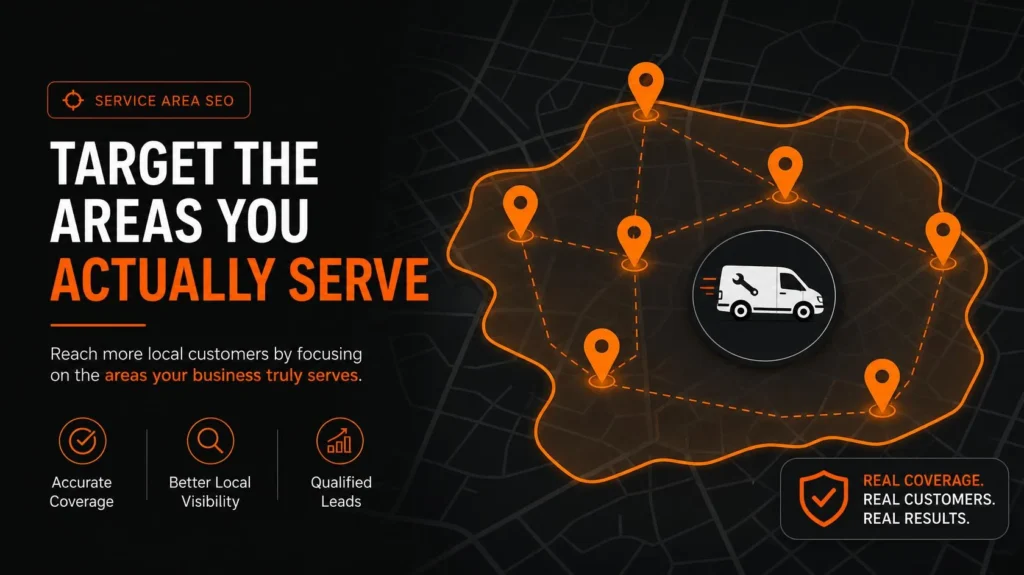
Service area SEO helps a business improve its visibility for relevant searches in the cities, towns, neighbourhoods, and regions where it genuinely provides services. It combines accurate business information, Google Business Profile configuration, local keyword research, useful website pages, and performance measurement.
For example, an electrician might work across a central city and several nearby towns without operating a customer-facing storefront in each place. The business needs to communicate where it works, what services it provides, and how customers can request those services.
The objective is to reach people in realistic service areas without creating misleading business locations or dozens of nearly identical pages.
This guide explains how to choose service areas, decide which pages to publish, structure those pages, avoid common mistakes, and measure the results. It also connects service-area SEO with a broader Local SEO strategy for small businesses.
What Is Service Area SEO?
Service area SEO is the process of improving a service-based business’s online visibility for relevant searches in the geographic areas it actually serves.
It can involve Google Business Profile settings, service-area keyword research, location-specific landing pages, website content, internal links, technical SEO, genuine local references, and lead tracking.
A service-area business typically travels to customers instead of relying on people visiting a public storefront. Examples include plumbers, electricians, mobile mechanics, cleaners, HVAC contractors, and certain repair or installation businesses.
Service area SEO answers three connected questions:
What does the business do? Its services and areas of expertise.
Where can it deliver those services? Its genuine operating area.
Why should a potential customer consider it? Relevant information, credible evidence, service details, and a clear enquiry process.
A business may serve ten towns, but that does not automatically mean it needs ten separate landing pages. The right approach depends on genuine service availability, search demand, competition, and whether each page can provide useful information.
Service area SEO vs traditional local SEO
Local SEO is the broader practice of improving visibility for searches with local intent. Service area SEO is one part of that work, focused on businesses that serve customers across a defined geographic area.
A storefront-based business may emphasize its address, opening hours, directions, and in-person visits. A service-area business must also clarify which places its team can realistically reach.
Both business models can benefit from accurate profiles, relevant website content, customer trust, and sound technical foundations. The specific implementation differs according to how the business operates.
How Service Area SEO Works
Service-area SEO connects local demand with the business’s actual services, geographic reach, and website structure.
A practical strategy follows this sequence:
Identify the business’s service model. Determine whether customers visit the business, the business travels to customers, or both.
Define the genuine coverage area. List the places the team can serve reliably.
Research local search demand. Identify relevant combinations of services, locations, and customer problems.
Improve the business profile and website. Make the service information accurate and consistent.
Create or improve useful pages. Publish dedicated local pages only when they provide meaningful value.
Measure visibility and enquiries. Use available search data and conversion records to refine the strategy.
These activities work together. A correctly configured profile does not replace useful website content, and a well-written landing page does not guarantee visibility in Google Maps.
The goal is to make the business easier to understand and discover for searches that align with its real operations. This is also the foundation of the Local SEO services provided by Md Mynul Hassan.
What Google Business Profile Service Areas Actually Do
Google Business Profile lets eligible service-area and hybrid businesses specify the areas where they provide services. These settings help customers understand where the business can visit or deliver.
Google currently permits up to 20 named service areas, using cities, postal codes, or other supported geographic areas. A service area cannot be configured as a new radius distance around the business, and Google advises that the overall coverage should generally remain within about two hours of driving time from the business base. Larger areas may be appropriate in some circumstances.
How to set or update service areas
Open the eligible business’s Google Business Profile.
Select Edit profile, then Location.
Find the Service area setting and select Edit.
Add the cities, postal codes, or other areas the business actually serves.
Remove places the business no longer serves.
Save the changes and check the profile again after Google’s review or processing period.
The setting should reflect operational reality, not a list of places where the business hopes to rank. Adding more locations does not automatically produce more visibility.
Should a service-area business display its address?
It depends on the business model.
A service-area business that visits customers and does not receive them at its business address should hide that address on its profile. A hybrid business that serves customers at its eligible business location and also travels to customers may display its address and define its service area.
Google’s official service-area and business representation guidelines explain the current requirements.
Do not create a profile for every city served. A service-area business generally uses one profile for its service area. Separate eligible locations with their own staff and operations may qualify for separate profiles under Google’s guidelines.
Do service areas directly replace website location pages?
No. These are different tools with different purposes.
The profile defines service coverage within Google’s business information system. Website pages explain the service in greater depth and can answer area-specific customer questions.
For example, a cleaning company might set its actual service area in Google Business Profile and maintain one comprehensive website page describing its residential cleaning service. It might add another page for a distant, commercially important town only if there is enough genuine local demand and useful information to justify it.
Businesses needing assistance with profile accuracy, categories, services, or website alignment can explore the Google Business Profile optimization service. For profile messaging, the guide to writing an accurate Google Business Profile description provides additional context.
How to Choose Which Service Areas to Target
The best target areas are not necessarily the closest or the most frequently mentioned by competitors. They are places where the business can deliver its service reliably and where reaching suitable customers makes commercial sense.
Use a serviceability-first framework before creating pages or adding areas to a profile.
1. Check operational coverage
Start with places the team regularly serves, can reach within an acceptable time, and can support without disrupting existing commitments.
Consider travel time, staffing, dispatch arrangements, delivery costs, emergency response requirements, and whether the business has the necessary licensing or permissions for the area.
2. Research local demand
Use keyword research to identify how customers describe services in each target location.
Examples include:
emergency plumber in Oakwood
air conditioning repair in Northfield
home cleaning services in Westbrook
mobile mechanic serving Lakeside
These are examples of keyword formats, not claims about verified search volume in real markets.
A structured keyword research process helps distinguish meaningful search demand from speculative keyword variations. Tools such as Google Search Console can reveal searches a site already appears for, while keyword platforms can provide additional estimates. Estimated demand should be treated as directional, not a guarantee of enquiries.
3. Evaluate business value
A location may generate searches but still be a poor target if it is expensive to serve or attracts customers outside the business’s capabilities.
Consider the expected service value, travel burden, competition, profitability, existing enquiries, and ability to deliver a good customer experience.
4. Prioritize a manageable shortlist
Score potential target areas against four factors:
| Factor | What to check |
|---|---|
| Serviceability | Can the team reliably serve the area? |
| Search opportunity | Is there relevant search demand or evidence of customer interest? |
| Commercial fit | Could the area produce suitable, profitable work? |
| Page potential | Can the website provide useful, specific information about serving that area? |
Prioritize locations that meet the first requirement and score well on the others. A business should not target an area simply because it appears in a keyword tool.
When Should You Create a Service-Area Page?
Create a dedicated service-area page when a geographic market has a distinct customer need and the business can provide enough useful information to justify its own destination.
Do not create a page merely because a city name can be inserted into a title.
Before publishing, ask:
Does the business genuinely serve this area?
Is there a real customer or search need that the existing pages do not satisfy?
Can the page describe relevant services, availability, or local conditions specifically?
Is there credible evidence or useful context that distinguishes the page?
Can the page help visitors take a meaningful next step?
Will the page remain useful to a customer who arrives directly from search?
If most answers are no, improving an existing page may be better than creating another URL.
This decision is particularly important for businesses with several services and many potential locations. A business with eight services and 15 towns could theoretically create 120 service-and-city combinations. That does not mean it should publish 120 pages.
Begin with the core service pages and the most valuable geographic markets. Add more specific pages only when there is a clear need.
Google identifies doorway abuse as a spam practice that can include substantially similar pages targeting similar queries or regions and funneling people toward the same destination. Avoid that pattern by publishing genuinely useful pages rather than location-name variations.
What to Include on a Useful Service-Area Page
A good service-area page should make the service, coverage, relevance, trust information, and next step clear.
Use this structure as a starting point.
Service-specific headline and direct answer
Explain the service and target area in clear language. For instance, an eligible contractor might use a headline such as “Heating Repair Services in Northfield” if the company actually serves that market.
The opening paragraph should tell visitors what is available in the area, whom the service is intended for, and how to request it.
Genuine local context
Explain how the company serves customers in the area. Useful information might include the towns covered, types of properties serviced, relevant travel or scheduling arrangements, or a genuine local example.
Do not invent a local office, named landmark relationship, customer testimonial, or completed project. If there is no location-specific case study, provide accurate service information instead.
Clear service details
Explain what the customer can request, any relevant service limitations, and what the process involves.
A page about electrical services, for example, should explain the applicable types of work rather than merely repeating the city name beside a generic list of services.
Trust and evidence
Use real customer feedback, valid qualifications, appropriate certifications, genuine project photographs, or accurate information about the business where available.
If the business has completed a relevant project in the area and has permission to share it, explain the work and its context. If not, do not manufacture a local success story.
The guide to reviews, testimonials, and case studies provides further guidance on presenting proof accurately.
Internal links and a useful call to action
Connect the location page to the relevant service page, useful supporting guide, and enquiry destination.
A visitor reading a page about air conditioning repair in one town should be able to understand the service and contact the business without returning to the search results to find basic information.
A focused on-page SEO review can help assess headings, relevance, internal links, metadata, and the page’s conversion path.
How to Build a Service-Area SEO Strategy
A practical implementation process should move from research to architecture, content, technical checks, and measurement.
Step 1: Map services to actual locations
Create a working spreadsheet with these fields:
| Field | Example |
|---|---|
| Core service | Electrical repair |
| Target market | Northfield |
| Coverage status | Confirmed |
| Customer type | Residential |
| Search opportunity | To be researched |
| Existing page | URL or none |
| Proposed action | Improve existing page or create a new one |
This provides a single reference for the locations the business serves and stops different team members from targeting inconsistent markets.
Step 2: Map keywords to pages
Group terms according to the searcher’s need rather than making a URL for every variation.
For example, “electrician in Northfield,” “Northfield electrical repairs,” and “electrical repair Northfield” may belong on the same useful page if their intent is substantially the same.
Assign different URLs only when the service, audience, geographic need, or depth genuinely differs.
Step 3: Improve existing pages before expanding
Review the main service page and existing location content before drafting new pages.
Check that each priority page explains the service, uses relevant geographic information, has a clear title and heading structure, provides contact options, and links to related content.
When broader site structure or content needs attention, an organized SEO content strategy can connect local pages with the rest of the site’s subject coverage.
Step 4: Publish useful pages and connect them
Create a location page only when the research justifies it. Link it from the relevant parent service page or geographic hub, and link back to related service information when doing so helps the reader.
The navigation should reflect the website’s actual structure. Avoid publishing dozens of orphan pages that can only be discovered through search.
Step 5: Check the technical foundation
Verify the following:
The URL returns the intended status code.
The page is indexable and has an appropriate canonical URL.
Internal links point to working destinations.
Important pages appear in the appropriate XML sitemap.
Mobile users can read the content and use the contact options.
The page has relevant metadata and an appropriate heading hierarchy.
For WordPress websites, the technical SEO service and WordPress SEO service are relevant resources for addressing these implementation issues. Businesses planning substantial site changes may also benefit from an SEO-friendly web design review.
Step 6: Establish a baseline and review performance
Record current impressions, clicks, relevant queries, landing pages, website enquiries, calls, and qualified leads where available.
Review the same measures after publishing or updating pages. Do not assume an increase in impressions automatically means more business value.
Service-Area Pages vs Location Pages vs Service Pages
These page types serve related but distinct purposes.
| Page type | Main purpose | Appropriate content |
|---|---|---|
| Service page | Explain a core service | What the service covers, process, benefits, limitations, and enquiry options |
| Service-area page | Explain a service in a geographic market | Actual availability, locally relevant context, service details, evidence, and CTA |
| Physical location page | Represent a genuine branch or customer-facing office | Accurate address, opening hours, branch details, directions where useful, and local services |
A service-area page should not falsely imply that a business has a storefront in the target city. A physical location page should not be created for a city merely because the business sends technicians there.
This distinction also matters for expanding businesses. A genuine second branch has different requirements from a wider travel radius or a newly added service territory. The second-location SEO checklist explores the separate considerations involved in representing an additional business location.
Practical Example: A Plumbing Business Serving Several Towns
Consider a hypothetical plumbing business based in one town that also serves three nearby communities. The business provides emergency repairs, general plumbing maintenance, and water-heater installation.
The owner wants to improve visibility across all four markets.
The first step is to confirm which locations the business can serve consistently. Then it should check local search demand and review existing service pages.
A sensible initial structure could include:
One main plumbing service page covering the core offering.
A focused emergency plumbing page if it serves a distinct search need.
A dedicated location page for a high-priority town if there is enough genuinely useful local information.
Other areas listed accurately in the business profile where appropriate, without automatically receiving their own website pages.
If demand and meaningful local differences later justify more pages, the business can expand. If several areas have identical needs and the content would barely change, improving the existing page may be more useful.
This example illustrates a planning method, not a real client result or a guarantee that specific pages will rank.
Common Service-Area SEO Mistakes
Creating a page for every city
Problem: The pages repeat the same service description with only the location changed.
Why it matters: Readers receive little additional information, and the site can accumulate overlapping pages with no distinct purpose.
Better approach: Require each page to demonstrate a real need, meaningful local detail, and a clear business purpose.
Adding areas that cannot be served reliably
Problem: The website or business profile claims coverage beyond actual operations.
Why it matters: Customers may request unavailable services, and the business’s public information becomes misleading.
Better approach: Make operational serviceability the first condition for targeting any area.
Treating Google Business Profile settings as a ranking shortcut
Problem: The owner assumes that adding a long list of towns automatically creates visibility in each one.
Why it matters: Profile coverage alone does not replace relevance, useful website content, or a legitimate business presence.
Better approach: Maintain accurate profile information and connect it with the website’s actual services and locations.
Ignoring existing content
Problem: New pages compete with existing service pages for closely related searches.
Why it matters: The site’s targeting becomes harder to manage, and the wrong page may receive attention.
Better approach: Audit the existing URLs first. Improve or consolidate pages where their intent overlaps.
Measuring only a single ranking
Problem: The business checks one query from one location and treats that result as representative of every target area.
Why it matters: A single position cannot describe overall geographic visibility or business performance.
Better approach: Review several priority query and location combinations, then compare visibility with actual enquiries.
Forgetting the next step for the visitor
Problem: A page describes an area but gives no useful service details or obvious way to contact the business.
Why it matters: The page may attract attention without helping users complete their task.
Better approach: Explain what the business can do in the area and provide a relevant contact, booking, or quote-request option.
How to Measure Service-Area SEO Results
Evaluate service-area SEO using both search visibility and business outcomes.
| Metric | What it tells you | Where to review it |
|---|---|---|
| Impressions | How often pages appear in relevant searches | Google Search Console |
| Clicks and CTR | Whether search appearances attract visits | Google Search Console |
| Query performance | Which service and location terms generate visibility | Google Search Console |
| Landing-page performance | Which pages attract organic visitors | Search Console and analytics |
| Geographic visibility | Whether important query and location combinations are improving | Consistent local rank tracking |
| Calls and forms | Whether visitors take meaningful actions | Analytics, call tracking, or CRM |
| Qualified enquiries | Whether the contacts match the services and markets targeted | CRM or enquiry records |
| Business outcomes | Whether work from target areas contributes to sales or revenue | Sales and business records |
Establish a baseline before making changes. Record which URLs were updated, what changed, and when each page was published.
Then review performance over an appropriate interval. The interpretation should account for competition, seasonality, changes in demand, and other marketing activity. There is no universal period in which service-area SEO must produce a ranking improvement or lead increase.
A structured SEO audit can help prioritize problems when the site has overlapping pages, indexation issues, weak location targeting, or unclear conversion paths.
Service-Area SEO Checklist
Use this checklist to assess the strategy before publishing new location pages.
Do not attempt to complete the entire list indiscriminately. Start with the locations and services that matter most to the business, fix important weaknesses, and use the results to guide further investment.
Frequently Asked Questions About Service Area SEO
What is the difference between service-area SEO and local SEO?
Local SEO covers the wider process of improving visibility for geographic searches. Service-area SEO focuses on businesses that serve customers across defined areas, often without a customer-facing storefront in every location. Its work can include business profile settings, geographic keyword research, useful local pages, and measurement.
How many service areas can I add to Google Business Profile?
Google currently permits up to 20 service areas for eligible service-area and hybrid businesses. Areas are specified using supported geographic names rather than a newly configured radius. The listed locations should represent where the business genuinely operates.
Can a service-area business rank without a storefront?
A service-area business can be eligible for a Google Business Profile without a public-facing storefront, provided it meets Google’s requirements. Businesses that visit customers and do not receive them at their business address should hide that address on the profile. Eligibility depends on the real business model, not simply on the website’s location keywords.
Should I create a separate page for every city I serve?
No. Create a dedicated page when the location has a meaningful search or customer need and the business can provide genuinely useful, distinct information. If several pages would be nearly identical, improve an existing page or group the coverage more sensibly.
What should a service-area page include?
It should explain the service, the target area, availability, relevant local context, genuine trust evidence where available, links to related services, and a clear way to enquire. The content should help customers understand what the business can do for them in that area.
Why are my service-area pages not ranking?
Possible causes include weak or overlapping content, poor search-intent alignment, limited internal links, indexation issues, inaccurate targeting, and stronger competitors. Diagnose the affected URLs and queries before creating additional pages. A technical or content audit can help identify the most likely issues.
How long does service-area SEO take to work?
There is no universal timeline. Results depend on the existing website, competition, local demand, technical condition, quality of the pages, and changes made. Track a baseline and evaluate meaningful trends instead of promising a fixed ranking date.
How do I measure whether service-area SEO produces leads?
Combine Search Console data, geographic visibility checks, available Google Business Profile performance information, analytics, and enquiry records. Look for qualified calls, forms, bookings, customers, and business outcomes. Impressions and rankings are useful diagnostic metrics, but they do not independently establish commercial success.
Final Takeaway: Target the Areas You Can Serve Well
Effective service-area SEO begins with operational reality. Establish where the business can reliably work, research the demand in those areas, represent the business accurately, and create pages only when they serve a distinct customer need.
A smaller collection of useful, well-connected pages is a stronger starting point than a large collection of city-name variations. The next action is to map the services and locations the business already supports, review its existing website pages, and prioritize the few changes most likely to address genuine customer needs.
For businesses that need help connecting geographic targeting with their website and wider local-search presence, the Local SEO service is the relevant next step.
About the Author and Professional Profiles
Md Mynul Hassan is a Local SEO and search visibility specialist based in Dinajpur, Bangladesh, working remotely with businesses and agencies. His work connects Local SEO, Google Business Profile optimization, website optimization, content strategy, and AI-search visibility.
You can connect with Md Mynul Hassan on LinkedIn, follow updates on Facebook, and watch educational content on YouTube. Businesses looking for freelance SEO support can also view his profiles on Upwork and Freelancer.com.
To discuss your website’s geographic targeting or local-search priorities, use the contact page to describe your business, services, and the areas you actually serve.