
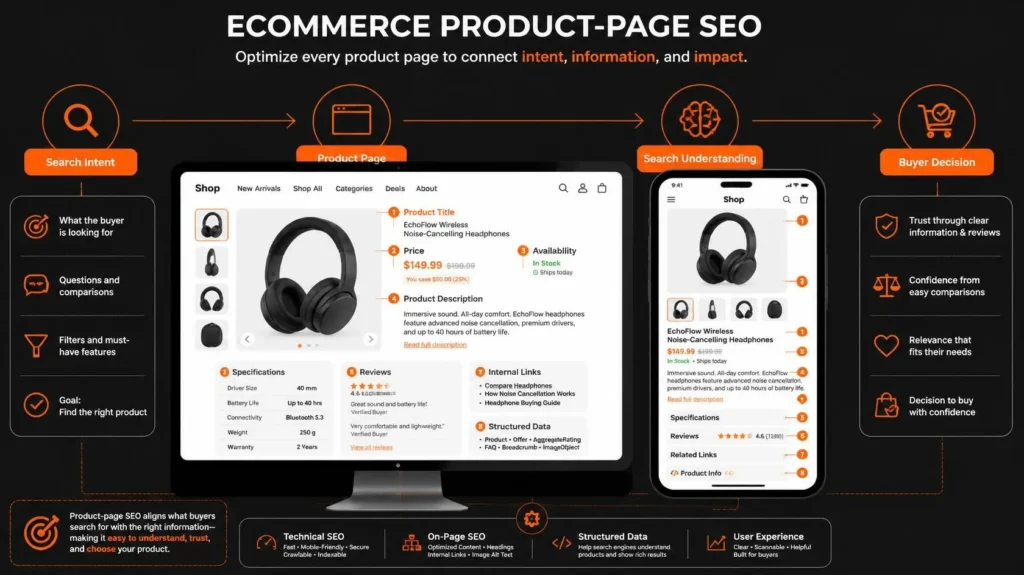
A product page needs to do two jobs at the same time: help search engines understand exactly what the product is and help shoppers decide whether it is right for them.
Product page SEO is the process of improving an ecommerce product page’s content, structure, technical signals, internal links, images, structured data, and user experience so the page can better satisfy relevant search intent.
The strongest product pages do not rely on repeating a keyword. They provide the information a buyer needs: what the product is, who it is for, its important attributes, price, availability, shipping or returns where relevant, and reasons to choose it.
That approach also creates better signals for search engines because the page contains clear information about the product and its relationship to the wider ecommerce website. Google’s current documentation supports Product structured data for product information such as price and availability, while variant documentation explains how related variants can be represented through ProductGroup and Product markup.
What Is Product Page SEO?
Product page SEO is the process of optimizing an individual ecommerce product page so that search engines can understand the product and shoppers can quickly evaluate whether it meets their needs.
It includes keyword and search-intent research, product titles, descriptions, headings, specifications, images, internal links, structured data, product variants, indexation, page performance, reviews, and other information that supports the purchasing decision.
A useful way to think about it is:
Search query → Product understanding → Product evaluation → Trust → Purchase decision
The SEO work should support that entire journey rather than focusing only on rankings.
For example, someone searching for a generic “running shoes” may need a category page. Someone searching for “women’s waterproof trail running shoes size 8” may be much closer to a specific product or tightly relevant category.
That distinction matters.
Your page needs to match the intent behind the search rather than simply contain the searched phrase.
Learn more about ecommerce keyword research
What Should an SEO Product Page Include?
A strong ecommerce product page normally includes:
- A clear product title and H1
- A unique, useful product description
- Important specifications and attributes
- High-quality product images
- Descriptive image alt text
- Price and availability
- Shipping and return information where relevant
- Product variants handled clearly
- Reviews or other legitimate trust information
- Relevant internal links
- Appropriate Product structured data
- Clear calls to action
- Helpful answers to important buyer questions
- Strong mobile usability
- Appropriate technical indexation and canonical signals
Not every product needs every possible content element.
A technical product may need detailed compatibility specifications. A simple household item may need much less written content.
The goal is useful completeness, not maximum word count.
Product Titles and H1s
The product title should identify the product clearly.
Compare:
Weak:
Premium Product
Better:
Stainless Steel Insulated Water Bottle, 750ml
The second version tells shoppers and search engines substantially more.
Important product attributes can include:
- Product type
- Brand
- Model
- Material
- Size
- Color
- Compatibility
- Important distinguishing feature
Do not turn the product title into a string of keywords.
A title such as:
Best Cheap Buy Stainless Steel Water Bottle Insulated Water Bottle Online
is harder for humans to read and communicates less clearly.
The product title should describe the actual product.
Write Unique Product Descriptions
Product descriptions are one of the biggest opportunities for information gain.
Many ecommerce stores import the manufacturer’s description and publish it unchanged.
That creates a problem when multiple retailers sell the same product and publish similar wording.
A stronger description explains the product in the language of the customer.
Instead of:
Premium wireless headphones with advanced technology and superior sound.
Explain things such as:
- Who the headphones suit
- Battery expectations
- Connection method
- Fit
- Weight
- Noise-control features
- Compatibility
- Important limitations
- What makes this model different
The point is not to force a target keyword into every paragraph.
The point is to answer the questions that matter before someone buys.
Google’s people-first guidance emphasizes content that directly fulfills the purpose of the page, including useful text, media, specifications and other information that helps users make decisions.
Explore my Content Strategy & SEO Content Writing Service
Use Product Specifications as Real Information
A specification table can make a product easier to evaluate.
For example:
| Specification | Example |
|---|---|
| Material | Stainless steel |
| Capacity | 750 ml |
| Weight | 420 g |
| Insulation | Double-wall |
| Lid type | Screw-top |
| Dishwasher safe | Yes |
| Warranty | 12 months |
Do not hide important product facts inside a large paragraph when a structured specification table would make them easier to compare.
This can also help answer long-tail searches naturally.
Optimize Product Images
Product images influence how shoppers understand the item.
Use clear images that show the product from useful angles.
Depending on the product, useful images may include:
- Main product photograph
- Side or rear view
- Close-up of important features
- Size or dimension reference
- Packaging
- Product in use
- Variant images
- Lifestyle image
Use descriptive filenames and useful alt text.
For example:
Weak alt text:product123.jpg
Better:750ml stainless steel insulated water bottle with screw lid
Do not use alt text as a place to repeat five keywords.
Describe the image accurately.
Image optimization also affects performance. Large ecommerce images can become significant performance problems, especially on mobile devices.
See my Website Speed Optimization Service
Show Price and Availability Clearly
A buyer should not have to search the page to discover whether the product is available.
Important information can include:
- Current price
- Currency
- Sale price when applicable
- Stock status
- Available sizes
- Available colors
- Shipping information
- Return information
- Estimated delivery information where appropriate
This is useful for humans and structured product data.
Google’s merchant-listing documentation supports product information such as price, availability, shipping and return information through appropriate structured data.
Handle Product Variants Carefully
Products often have variants such as:
- Size
- Color
- Material
- Pattern
- Capacity
- Storage
- Configuration
A common mistake is treating every variation as a completely unrelated product without considering how the variants relate to the parent product.
Google’s current product-variant documentation supports ProductGroup alongside Product to describe relationships between variants.
For example:
Product Group:
Running Shoe Model X
Variants:
Black / Size 8
Black / Size 9
Blue / Size 8
Blue / Size 9
The technical implementation depends on how your ecommerce platform handles URLs, variants, canonical pages and inventory.
Do not create a large collection of nearly identical indexable URLs without a clear purpose.
Add Real Reviews and User-Generated Content
Legitimate customer reviews can provide information that the store’s original description does not.
Customers may mention:
- Fit
- Actual size
- Durability
- Ease of use
- Compatibility
- Texture
- Noise
- Setup experience
- Common problems
That language can help future buyers answer practical questions.
Do not manufacture reviews or ratings.
If ratings are marked up with structured data, the markup needs to represent genuine visible information. Google states that structured data must accurately represent the page.
Build Contextual Internal Links
A product page should not exist as an isolated URL.
Useful links can connect it with:
Category → Product
Buying guide → Category
Buying guide → Product
Product → Related product
Product → Related accessory
For example:
A page about “How to Choose a Coffee Grinder” could link to a relevant coffee-grinder category and then to specific products.
Internal linking gives users more ways to continue their research and gives search engines clearer context about relationships between pages.
My internal linking approach treats product pages, categories, supporting content and commercial pages as connected parts of the site architecture rather than isolated URLs.
How to Optimize Product Pages for SEO
The following process is more useful than applying the same checklist to every product.
Step 1: Identify the Search Intent
Start with the question:
What is someone actually trying to accomplish with this search?
Consider whether the query is:
- Product discovery
- Transactional
- Commercial investigation
- Comparison
- Problem solving
- Informational
For example:
“Buy waterproof hiking backpack 40L”
has a stronger transactional purpose.
“Best backpack for weekend hiking”
could indicate commercial research.
“How should a hiking backpack fit?”
is informational.
The right page should match the intent.
My SEO keyword research service uses intent, relevance, commercial value, competitors, content opportunities and page mapping rather than relying only on search volume.
Step 2: Choose One Primary Product Topic
Do not make a product page target every possible keyword.
Choose one clear product topic.
Then identify useful supporting terms.
For a fictional product:
Primary topic:
noise cancelling wireless headphones
Supporting concepts:
Bluetooth headphones, over-ear headphones, wireless audio, battery life, microphone, travel headphones
These concepts should appear only where they make the page more useful.
Step 3: Write a Clear Product Title
Use the product’s actual identity.
A practical pattern can be:
Brand + Product + Important Attribute + Model/Size
For example:
Example:
SoundPro Noise Cancelling Wireless Headphones X2
You can include additional information in supporting copy rather than forcing every attribute into the H1.
Step 4: Create a Useful Product Description
A useful product description should answer:
What is it?
Who is it for?
What does it do?
What makes it different?
What should the buyer know before ordering?
Use short paragraphs, bullet points, specifications and subheadings when they improve readability.
Do not choose the description length first and then add filler to reach it.
There is no universal SEO word count for product descriptions. Current ecommerce guidance similarly emphasizes usefulness and completeness rather than a fixed number of words.
Step 5: Add Product-Specific Information Competitors May Not Have
This is where information gain becomes practical.
Instead of copying the manufacturer’s paragraph, add things such as:
Best for:
Daily commuters who need a lightweight insulated bottle.
Not ideal for:
Users who need a bottle with a built-in straw.
Compatibility:
Fits standard vehicle cup holders.
Important limitation:
The lid is not designed for carbonated drinks.
Those details help the buyer make a better decision.
Only include information that is genuinely accurate.
Step 6: Optimize Product Images
Check:
- Correct dimensions
- Compression
- Modern image formats where supported
- Descriptive filenames
- Useful alt text
- Explicit image dimensions
- Responsive images
- Lazy loading where appropriate
- Avoiding oversized original uploads
The main product image deserves particular attention because it often becomes one of the largest elements on the page.
Step 7: Add Product Structured Data
For merchant product pages, Product structured data can communicate information such as product name, offers, availability, and other supported attributes.
Google’s documentation states that valid Product markup can make pages eligible for product-related search experiences, but structured data does not guarantee that Google will display a rich result.
Validate the markup before publishing at scale.
Pay particular attention to:
- Product name
- Brand
- SKU
- GTIN where applicable
- Price
- Currency
- Availability
- Product URL
- Images
- Reviews and ratings only when genuine
For products with variants, use the appropriate ProductGroup and Product relationships.
Step 8: Align Product Data With Merchant Center
Product-page SEO does not operate separately from product feeds.
Your website, product feed and Merchant Center information should not contradict each other.
Google’s current Merchant Center documentation highlights accurate product information and notes that conflicting product data can cause eligibility or display problems.
In 2026, Google also introduced additional Merchant Center product-feed capabilities such as a product-level video link attribute. Google has also announced new minimum image-size enforcement for certain product-feed image attributes beginning January 31, 2027.
This is one reason ecommerce SEO should be coordinated with the product-data system rather than treated as only on-page copywriting.
Step 9: Strengthen Internal Links
Check whether the product is linked from:
- Relevant category pages
- Subcategories
- Buying guides
- Comparison content
- Related products
- Accessories
- Helpful educational content
Do not add links only because you need to reach a number.
The relationship should make sense.
Step 10: Review Technical Accessibility
A great product page cannot help search visibility if search engines cannot properly access or understand it.
Review:
- Indexability
- Canonical URL
- HTTP status
- Robots directives
- XML sitemap inclusion
- JavaScript rendering
- Internal links
- Duplicate URLs
- Parameter URLs
- Pagination
- Faceted navigation
- Mobile accessibility
For a large ecommerce website, this becomes increasingly important because a catalogue can generate thousands of URLs.
My Technical SEO Service covers areas such as crawling, indexation, canonicals, redirects, sitemaps, structured data and site architecture.
Step 11: Improve the Buying Experience
SEO should not push the buying information below an enormous block of content.
A product page should make the core decision information easy to find.
The shopper typically needs:
Product → Key benefit → Price → Availability → Important options → Trust → Purchase action
Additional information can follow below.
This is where SEO and conversion optimization overlap.
My Ecommerce Website Design Service and Conversion Rate Optimization Service address related UX and conversion considerations.
Step 12: Measure the Page After Publishing
Do not judge product-page SEO only by keyword position.
Track:
- Organic impressions
- Organic clicks
- CTR
- Queries
- Indexed status
- Organic landing sessions
- Add-to-cart rate
- Checkout starts
- Purchases
- Revenue from organic sessions
- Product availability issues
- Search Console performance
A page can gain impressions without producing valuable customers.
The business outcome matters.
Product Page SEO Example
Consider a fictional ecommerce store selling outdoor equipment.
Weak Product Page
Product name:
Trail Backpack
Description:
High-quality backpack designed for outdoor adventures. Durable, stylish and comfortable.
Problem:
The shopper still does not know:
- Capacity
- Intended use
- Material
- Dimensions
- Weight
- Weather resistance
- Laptop compatibility
- Hydration compatibility
- Fit
- Warranty
- Who should buy it
Stronger Product Page
H1:
40L Waterproof Hiking Backpack for Weekend Trips
Opening description:
A 40L waterproof hiking backpack designed for weekend trips, day hikes and lightweight outdoor travel. The main compartment provides space for clothing and gear, while the padded back panel is designed for longer carrying sessions.
Useful specifications:
| Attribute | Information |
|---|---|
| Capacity | 40L |
| Recommended use | Weekend hiking and outdoor travel |
| Material | Waterproof fabric |
| Weight | Product-specific measurement |
| Laptop compartment | Product-specific information |
| Hydration support | Product-specific information |
| Warranty | Product-specific information |
Helpful buyer section:
Who is this backpack best for?
This backpack is best suited to hikers who need more capacity than a daypack without moving to a much larger expedition pack.
What should you know before buying?
Check the dimensions against your torso length and packing requirements. Capacity alone does not determine how comfortable a backpack will be for your body type.
That page gives the shopper substantially more decision-making information.
It also creates natural opportunities to rank for product attributes and use cases without repeating the same phrase unnaturally.
Common Product Page SEO Mistakes
1. Copying Manufacturer Descriptions
Why it happens:
Product data is imported automatically.
Problem:
The page contributes little original information.
Better approach:
Rewrite the description and add product-specific details, use cases, limitations and useful specifications.
2. Optimizing Only the Product Name
Why it happens:
The title is easy to edit.
Problem:
The page still lacks useful supporting information.
Better approach:
Optimize the entire information system.
3. Keyword Stuffing
Example of a weak sentence:
Our best product page SEO product is the best SEO product page for product page SEO buyers.
The keyword is visible.
The meaning is terrible.
Use the phrase naturally and let related concepts appear through useful explanations.
4. Creating Thousands of Thin Product Pages
A large catalogue does not automatically mean every page deserves indexation.
Products need enough useful information and a legitimate reason to exist as search destinations.
5. Ignoring Product Variants
Color, size, capacity and other variants can create complicated URLs and duplication.
Plan the variant architecture before generating thousands of URLs.
Google’s current guidance provides specific technical patterns for products with variants.
6. Treating FAQs as a Rich-Result Shortcut
FAQs can still answer genuine buyer questions.
However, Google removed FAQ rich-result support from Search in 2026. Do not add FAQ content solely because you expect FAQ rich results.
Use FAQs because customers actually need the information.
7. Ignoring Out-of-Stock Products
Do not automatically delete every out-of-stock product URL.
The appropriate treatment depends on whether the product will return, whether the page has historical value, whether alternatives exist, and how the ecommerce platform handles inventory.
The decision should be based on the business and URL architecture rather than a blanket rule.
8. Using Fake Reviews or Ratings
Never create artificial social proof.
Use genuine customer feedback and mark it up only when the structured data accurately represents what is visible.
9. Ignoring Mobile UX
A desktop product page can look excellent while becoming difficult to use on a phone.
Check:
- Image size
- CTA visibility
- Variant selection
- Sticky elements
- Text readability
- Specifications
- Reviews
- Checkout path
10. Measuring Rankings Only
A product ranking for an impressive keyword means little if the searcher never clicks or buys.
Combine SEO data with business data.
How to Measure Product Page SEO
Use Google Search Console to understand search performance at page and query level.
Look for:
Impressions
Are product pages appearing for relevant searches?
Clicks
Are people visiting after seeing the page in search?
CTR
Does the search result accurately communicate what the product offers?
Queries
Are pages being discovered for useful product attributes, use cases and commercial terms?
Indexation
Are important product pages indexed while low-value URLs remain appropriately controlled?
Conversions
Are organic visitors adding products to cart and purchasing?
The strongest measurement framework connects:
Search visibility → qualified visitors → product interaction → purchase
My SEO Audit Service can be relevant when an ecommerce website has visibility problems but the cause is unclear.
Advanced Ecommerce Product SEO Considerations
Faceted Navigation
Filters such as:
- Brand
- Color
- Size
- Price
- Material
- Rating
can generate large numbers of URL combinations.
Not every filter URL deserves to be indexed.
The correct approach depends on whether a filtered combination represents a meaningful search destination.
Product Lifecycle
Products may be:
- New
- Active
- Temporarily unavailable
- Discontinued
- Replaced
- Permanently removed
The SEO treatment should reflect the lifecycle.
Deleting valuable URLs without a replacement can create unnecessary losses.
Manufacturer Descriptions
Manufacturer data can be useful as raw product information, but relying on the same paragraph used by many retailers reduces your opportunity to differentiate the page.
Add your own verified information, buyer context and product-specific explanation.
Internal Search Pages
Ecommerce websites often create internal search URLs with little search value.
Review whether these pages are being crawled or indexed unnecessarily.
The product and category architecture should remain the primary discovery system.
Product and Category Cannibalization
A product page and category page should not compete for exactly the same purpose.
For example:
Category:
Women’s Waterproof Hiking Boots
Product:
Brand X Women’s Waterproof Hiking Boot Model 500
The category covers the product group.
The product page covers one specific product.
Clear page roles reduce unnecessary overlap.
Large Ecommerce Websites Need Prioritization
Do not try to manually optimize 30,000 products with the same intensity.
A practical priority model can be:
Tier 1: High-revenue, high-demand products
Tier 2: Products with strong organic potential
Tier 3: Strategically important products
Tier 4: Long-tail or low-value products requiring scalable templates
This makes ecommerce SEO more manageable.
Product Page SEO Checklist
Before publishing or refreshing a product page, check:
Search Intent
- Primary search intent is clear
- Product page is the correct content type
- Primary keyword matches the product topic
- Supporting concepts are relevant
Content
- Product name is clear
- H1 identifies the product
- Description is unique
- Product benefits are explained accurately
- Important specifications are visible
- Buyer questions are answered
- Product limitations are disclosed where relevant
Images
- Main image is clear
- Additional views are useful
- Images are appropriately sized
- Filenames are descriptive
- Alt text describes the actual image
Technical SEO
- URL is clean
- Canonical is correct
- Product is indexable when appropriate
- Important product links are crawlable
- Sitemap handling is correct
- Variant URLs are intentionally managed
- No unnecessary parameter/indexation problems
Structured Data
- Product schema is present where appropriate
- Price is accurate
- Currency is accurate
- Availability is accurate
- Product identity is accurate
- Variant relationships are appropriate
- Reviews and ratings are genuine
UX and Conversion
- Price is easy to find
- Add-to-cart or purchase action is clear
- Shipping information is accessible
- Return information is accessible
- Variant selection is easy
- Mobile experience works properly
- Related products are useful rather than distracting
Frequently Asked Questions
What is product page SEO?
Product page SEO is the optimization of an individual ecommerce product page so search engines can understand the product and shoppers can evaluate it. It includes product titles, descriptions, specifications, images, internal links, structured data, technical accessibility, variants, reviews, page performance and other information relevant to the buying decision.
How do you optimize a product page for SEO?
Start with search intent and product-specific keyword research. Then improve the product title, H1, description, specifications, images, URL, internal links, structured data, variant handling, technical accessibility and mobile experience. Measure organic clicks and conversions after implementation rather than relying only on rankings.
How long should a product description be for SEO?
There is no universal required word count. A simple product may need only enough copy to explain its important attributes and buying considerations, while a complex or expensive product may need significantly more detail. The correct length is the amount of useful information required to help the shopper make a confident decision.
Should every product have a unique description?
A unique description is preferable when the products are meaningfully different. Avoid generating thousands of slightly rewritten descriptions that add no useful information. The strongest approach combines scalable templates with product-specific details.
Does product schema improve SEO?
Product structured data helps Google understand product information and can make eligible pages suitable for product-related search experiences. It does not guarantee rankings or a particular search appearance. The markup must accurately represent the visible product information.
Should product pages include FAQs?
They can, when the questions are genuinely useful to buyers. FAQs should answer real product-specific concerns such as compatibility, sizing, installation, care, delivery or returns. They should not be added simply to insert more keywords or chase deprecated FAQ rich results.
How should ecommerce product variants be optimized?
First determine whether variants belong to one parent product or should exist as distinct products. Then implement the appropriate URL, canonical, inventory and structured-data architecture. Google recommends ProductGroup relationships for product variants in supported implementations.
What should you do with an out-of-stock product page?
There is no universal rule. Temporary stock shortages may justify keeping the page available and communicating the status clearly. Permanently discontinued products may need a different treatment depending on replacement products, historical value, links and search demand. The decision should follow the product lifecycle and website architecture.
How do you measure product page SEO?
Use Google Search Console and analytics to monitor impressions, clicks, CTR, queries, landing sessions, add-to-cart actions, purchases and organic revenue. Also monitor indexation, technical errors, structured-data issues and product availability.
Final Takeaway
Good product page SEO starts with a simple question:
What information does the shopper need to decide whether this product is right for them?
That answer should shape the title, description, specifications, images, variants, trust information, internal links and technical implementation.
The strongest ecommerce product pages do not become useful because a keyword appears a certain number of times.
They become useful because the product is clearly understood.
Your Ecommerce SEO Service is the natural commercial connection for businesses that need this work applied across product pages, category architecture, technical SEO, internal linking, content and structured data. Your published ecommerce pet-food case study also demonstrates the broader model of connecting customer problems, useful content, category pages, product pages and the purchase journey rather than treating products as isolated URLs. See the ecommerce SEO case study.
Connect With Md Mynul Hassan
For ecommerce SEO, AEO, GEO, content and search-visibility work: