
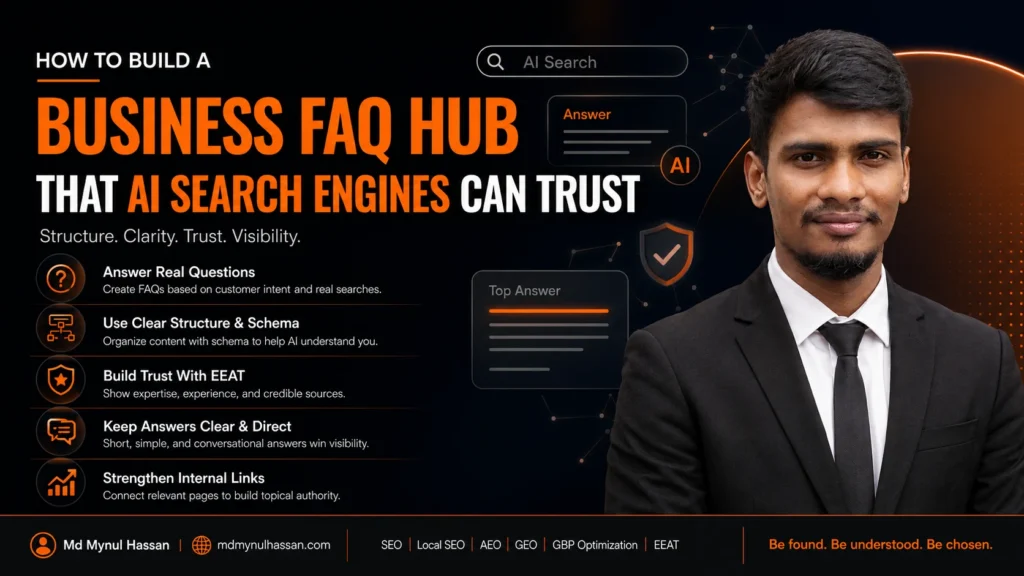
Many businesses already know the questions their customers ask.
The problem is that their websites often do not organize those answers in a way that is easy for customers, search engines, or AI-powered search systems to understand.
A customer may want to know:
What exactly does the service include? How much could it cost? Who is the service suitable for? Which locations does the business serve? How long does the process take? What happens after someone contacts the company? How is one service different from another?
The business may answer these questions every day through calls, WhatsApp messages, emails, sales conversations, Google Business Profile messages, consultations, and customer support.
Yet when I review websites, I often find that these valuable answers are missing, buried inside long pages, repeated inconsistently, or spread across several sections with no clear structure.
This is where an AEO FAQ hub can become useful.
An AEO FAQ hub is not simply a page containing 50 or 100 questions.
It is a structured system that connects real customer questions with useful answers, relevant service pages, supporting content, internal links, business expertise, and trust signals.
When built correctly, it can support SEO, Answer Engine Optimization (AEO), Generative Engine Optimization (GEO), topical authority, EEAT, customer experience, and modern AI-search visibility.
From my experience working with practical SEO strategies over the last two years, I have found that many businesses do not necessarily need more random content.
They need better organized information.
That is what a strong business FAQ hub should solve.
What Is an AEO FAQ Hub?
An AEO FAQ hub is a central question-and-answer structure designed around the real information customers need before, during, and after choosing a business.
Instead of publishing disconnected FAQ sections across the website, the hub organizes important questions according to topics and search intent.
For example, a local service business might organize its FAQ hub into:
- Service questions
- Pricing questions
- Process questions
- Location questions
- Comparison questions
- Problem-based questions
- Customer objections
- Before-purchase questions
- After-service questions
The hub does not need to contain the complete answer to every possible question.
Some questions should receive a concise answer directly on the hub.
Others should lead users toward a detailed service page, guide, comparison article, location page, product page, policy page, or another relevant resource.
I prefer to think of the FAQ hub as a knowledge navigation system, not simply another content page.
Why an FAQ Hub Matters for AI Search in 2026
Search behaviour continues to become more conversational.
People do not always search with short phrases such as:
“local SEO service”
They may ask:
“Why is my business not showing in Google Maps even though I have a Google Business Profile?”
Or:
“What should I improve first if my website ranks but does not generate enquiries?”
These longer questions contain more context.
They reveal the user’s problem, intention, situation, and sometimes their stage in the buying journey.
That is useful for businesses because it creates an opportunity to answer the real question rather than simply target another keyword.
Google’s 2026 guidance for generative AI features also makes an important point: SEO fundamentals continue to matter because Google’s generative Search experiences use its existing Search ranking and quality systems.
For me, that means businesses should not abandon traditional SEO and start chasing a separate set of mysterious “AI ranking factors.”
A better approach is:
Strong SEO foundation + useful answers + clear site structure + real experience + authority + trust + technically accessible content.
That is also how I approach my own AEO and GEO work.
My goal is not to find a secret trick that forces an AI platform to mention a business.
The goal is to make the business easier to discover, interpret, verify, and trust.
For businesses that need this type of wider AI-search strategy, my AEO and GEO consulting service connects traditional SEO with AI-search visibility, content structure, entity clarity, and stronger brand signals.
FAQ Hub vs Traditional FAQ Page
A normal FAQ page usually looks like this:
Question 1 → Answer
Question 2 → Answer
Question 3 → Answer
That can still be useful.
But an FAQ hub is broader.
It connects questions to the wider website.
Consider this question:
What is included in a Local SEO service?
A short answer can appear inside the FAQ hub.
However, the user may need a complete explanation covering keyword targeting, Google Business Profile optimization, Google Maps visibility, local landing pages, reviews, citations, technical SEO, and local content.
Instead of repeating the complete explanation in the FAQ hub, the answer should naturally lead to the relevant service resource.
The same principle works for SEO audits.
Someone searching:
Why does my website need an SEO audit?
can receive a short answer explaining when an audit becomes valuable, followed by a contextual link to the SEO Audit Service where the topic is explained in depth.
That creates a cleaner architecture.
FAQ hub → direct answer → supporting page → next logical action
This is much stronger than maintaining dozens of disconnected FAQ sections.
Step 1: Start With Questions Real Customers Actually Ask
This is where I would begin.
Not with an SEO tool.
Not with AI-generated questions.
Not with “People Also Ask” alone.
I would first look at the business itself.
Useful question sources include:
- Customer phone calls
- Sales conversations
- WhatsApp enquiries
- Email enquiries
- Consultation calls
- Contact forms
- Google Business Profile messages
- Reviews
- Sales objections
- Support tickets
- Live chat conversations
- Questions asked before purchase
- Questions asked after purchase
- Search Console queries
- Customer misunderstandings
These conversations often contain valuable language that keyword tools cannot fully capture.
Once I understand what customers are actually asking, I can expand the research using SEO data.
This is where professional keyword research becomes useful.
Keyword research helps determine:
what people search,
why they search,
how they describe the problem,
whether the query is informational or commercial,
which questions belong together,
and which questions deserve deeper content.
But I would not reject a useful customer question simply because an SEO tool shows zero or low search volume.
Search volume is not the only measure of value.
Some questions help qualify leads.
Others remove objections.
Some improve trust.
Others help visitors understand a complicated service.
A useful FAQ strategy combines search demand with real customer demand.
Step 2: Group Questions by Search Intent
Once the questions are collected, I would not publish them randomly.
I would cluster them.
Service Questions
These explain what the business offers.
Examples:
What does the service include?
Who is the service suitable for?
Which problems can the service solve?
What is not included?
Pricing Questions
These help customers understand cost.
Examples:
How is the price calculated?
What factors affect pricing?
Is the consultation free?
Can the price change after an assessment?
Process Questions
These explain what happens next.
Examples:
What happens after I contact the business?
What information do I need to provide?
How long does the process normally take?
Comparison Questions
These help people make decisions.
Examples:
Which service is right for my situation?
What is the difference between Service A and Service B?
Should I repair something or replace it?
Location Questions
These are especially useful for Local SEO.
Examples:
Which areas do you serve?
Do you provide the service outside the main city?
Can customers visit your location?
Objection Questions
These address hesitation.
Examples:
What happens if the service does not solve the problem?
Do I need to sign a contract?
Can I cancel?
Trust Questions
These help users evaluate the company.
Examples:
Who performs the work?
What experience does the team have?
How does the company handle customer information?
What happens if something goes wrong?
This clustering improves user experience and makes the relationship between questions easier to understand.
Step 3: Map Every Question to the Right Page
This is one of the most important parts of the process.
Every question does not need a separate page.
Every answer does not need to stay inside the FAQ hub either.
I would create a simple mapping system:
Question → Search Intent → Topic → Best Answer Location → Supporting Content → Conversion Page
For example:
Question:
How do I find the right keywords for my business?
Direct answer:
Start by understanding your customers, services, products, market, competitors, and search intent before expanding relevant keyword opportunities.
Best supporting page:
Keyword Research Service
Internal-link destination:
Keyword Research Service & Strategy
Another example:
Question:
Why is my website technically healthy but still not ranking?
This question might require a detailed SEO-audit discussion covering content, intent, internal links, competition, authority, or indexing rather than another short FAQ answer.
The question should therefore connect to an appropriate audit or strategy resource.
This prevents duplication and strengthens internal linking.
Step 4: Give the Direct Answer First
One problem I regularly see in SEO content is delayed answers.
The visitor asks a straightforward question.
The article responds with three paragraphs of introduction.
Then the answer appears.
That structure is frustrating for users and unnecessary for many FAQ queries.
My preferred structure is:
Direct answer → explanation → conditions → example → next step
Consider:
Can SEO guarantee the number-one position on Google?
A strong answer should start directly:
No responsible SEO professional can guarantee a specific organic position because rankings depend on many variables that no consultant controls completely.
Then the answer can explain relevance, competition, site quality, authority, technical condition, search intent, algorithm changes, and other factors.
This approach is useful because the visitor gets the essential answer immediately.
It also creates clearer passages that search and answer systems can interpret.
Step 5: Add Experience to the Answers
This is where EEAT becomes much more meaningful.
A lot of SEO content talks about EEAT without actually demonstrating experience.
Writing:
“We are experienced professionals”
does not prove much.
A stronger answer demonstrates experience through the way the problem is explained.
For example:
“From my experience reviewing service-business websites, one issue I regularly notice is that the main service page describes what the company does but does not answer the questions customers normally ask before contacting the business.”
That statement communicates an observation.
It tells readers what I have actually noticed while working.
Other useful experience signals include:
- Common mistakes you regularly encounter
- Conditions that change your recommendation
- Situations where a strategy is not appropriate
- Questions clients repeatedly ask
- What you normally check first
- What businesses often misunderstand
- What information you need before making a recommendation
- What cannot honestly be guaranteed
Google’s current guidance for generative AI Search specifically encourages publishers to create unique, valuable content based on their own knowledge and experience instead of simply rewording information already available elsewhere.
That is a strong reason to use real business experience throughout FAQ content.
Step 6: Connect the FAQ Hub to Topical Authority
A FAQ hub should support the larger topic structure of the website.
Suppose my main business topics include:
SEO,
Local SEO,
Google Business Profile,
Google Maps SEO,
AEO,
GEO,
AI Search,
keyword research,
content strategy,
technical SEO,
and SEO audits.
My FAQ hub should not become an unrelated content area.
Instead, questions should connect naturally with these topic clusters.
For example:
What is AEO?
→ AEO/GEO service
How does keyword research support AI search?
→ Keyword Research Service
How do technical problems affect AI-search visibility?
Why isn’t my website generating organic leads?
→ SEO Audit Service
This creates a connected content ecosystem.
Rather than dozens of isolated pages, you begin creating clear relationships between:
core services → supporting guides → customer questions → commercial pages → expertise
That is a much stronger foundation for topical authority.
Step 7: Use Internal Links Strategically
Internal linking is not about inserting ten links into every paragraph.
The link should help the reader continue the journey.
A useful internal link answers the question:
“What should this person read next?”
For example, a visitor reading about question research may naturally benefit from your keyword research resource.
Someone reading about crawlability may need technical SEO information.
A local business owner may need Google Business Profile optimization.
A company preparing for AI-driven search may benefit from an AEO/GEO guide.
The anchor text should also explain what the destination contains.
Instead of:
click here
I prefer:
keyword research for search-intent mapping
or:
technical SEO audit
or:
AEO and GEO consulting
This creates better context for both users and search engines.
Step 8: Connect the FAQ Hub With Local SEO
For local businesses, the FAQ hub can also support local relevance.
But this needs to be handled carefully.
Do not manufacture local questions simply to insert city names.
For example:
“Do you offer plumbing services in Birmingham?”
is useful only if Birmingham is genuinely part of the service area.
A good local FAQ hub can cover:
- Genuine service areas
- Opening hours
- Appointment availability
- Travel charges
- Emergency availability
- Local regulations
- In-store vs on-site service
- Parking
- Service radius
- Areas not currently covered
The information should also remain consistent with the Google Business Profile and other important business references.
This is important because SEO is not only about visibility.
The business needs to make sense when someone finds it.
Step 9: Build Answers That Are Easy to Verify
Trust is important.
If an FAQ says:
“We are the number-one company in the country,”
what evidence supports that claim?
If there is no evidence, I would not use it.
If an FAQ states a fixed price but the real price depends on project requirements, the answer should explain the conditions.
If a company can only serve certain locations, it should not pretend to have national coverage.
A trustworthy answer can include:
- clear limitations
- factual explanations
- relevant qualifications
- real experience
- links to supporting pages
- policy information
- author information
- dates where freshness matters
- sources for factual claims
I believe honesty is a stronger long-term strategy than exaggerated marketing language.
Step 10: Optimize the FAQ Hub for AI Search Without Chasing AI Tricks
This is important because AEO and GEO are becoming popular marketing terms.
Google’s current documentation explains that from Google’s perspective, optimizing for generative AI search is still fundamentally search optimization.
So I would focus on:
- crawlable content
- indexable pages
- useful information
- strong traditional SEO
- clear headings
- direct answers
- relevant internal links
- original experience
- supporting evidence
- descriptive entities
- business consistency
- high-quality images
- technical accessibility
I would not build a strategy around supposed “AI hacks.”
A business should first become understandable.
Then it should become verifiable.
Then it should become trustworthy.
Visibility can grow from that stronger foundation.
Do You Still Need FAQ Schema in 2026?
This is where outdated SEO advice can create confusion.
Google discontinued FAQ rich results in Google Search beginning May 7, 2026, and later removed its FAQ rich-result documentation.
That means businesses should not build FAQ strategies around the old idea that adding FAQPage markup will automatically create expanded FAQ listings in Google’s search results.
The FAQ content itself can still be useful.
The questions can still:
support customers,
strengthen content,
improve topical coverage,
create internal-link opportunities,
support AEO,
help explain services,
and address real buying concerns.
But the value is the information, not an outdated rich-result tactic.
Do Not Confuse FAQ Content With Q&A Structured Data
Another mistake is trying to use QAPage markup for normal business FAQs.
A business FAQ normally has an official answer written by the site owner.
That is different from a community Q&A environment where users can submit multiple answers.
Structured data should represent the actual content on the page.
Do not choose schema simply because the name sounds useful.
Build a Practical FAQ Hub Map
Before writing the content, I recommend creating a simple spreadsheet.
Use columns such as:
Question
Question Cluster
Search Intent
Primary Keyword
Supporting Keywords
Customer Journey Stage
Direct Answer
Main Destination Page
Supporting Internal Links
Trust/Evidence Requirement
Content Owner
Last Reviewed
Update Required
For example:
Question
What is an SEO audit?
Cluster
SEO Audit
Intent
Informational / Commercial investigation
Direct Answer
An SEO audit is a structured review of technical, content, indexing, search-intent, architecture, authority, and visibility issues that may affect a website’s organic performance.
Destination
SEO Audit Service & Action Plan
This creates a manageable system instead of a page filled with random questions.
Common AEO FAQ Hub Mistakes
1. Creating Hundreds of AI-Generated Questions
Volume is not quality.
Publishing hundreds of almost identical questions can create thin, repetitive content rather than useful topical depth.
2. Keyword Stuffing Every Question
Do not force the focus keyword into every heading.
Use natural language.
3. Writing Promotional Answers Instead of Useful Answers
“This is the best service available” is not an answer.
Explain the question.
4. Repeating Existing Service-Page Content
The FAQ hub should connect content, not duplicate the whole website.
5. Creating Fake Location Questions
Only target locations the business genuinely serves.
6. Ignoring Internal Linking
An answer should lead naturally toward deeper information where appropriate.
7. Never Updating Answers
Business information changes.
Prices change.
Policies change.
Services change.
Locations change.
Your FAQ system needs maintenance.
8. Treating Schema as the Strategy
Structured data can help machines understand certain content types, but markup cannot rescue weak content.
9. Removing Human Experience
Generic answers are easy to reproduce.
Experience-based explanations make the content more useful and differentiated.
My Approach to Building an AEO FAQ Hub
When I approach this type of project, I do not begin by asking:
“How many FAQ questions can we publish?”
I start with:
What does the customer need to understand?
Then I examine:
What questions are repeatedly asked?
Which questions reveal commercial intent?
Which questions show confusion?
Which answers already exist?
Which answers are missing?
Which answers are outdated?
Which pages should own the information?
Which service pages need more support?
Where are internal links missing?
Does the website contradict the Google Business Profile?
Are important business claims verifiable?
Are users getting direct answers?
Can search engines crawl the important content?
Is the website explaining its expertise clearly?
This is why I do not treat SEO as a collection of isolated tasks.
Keyword research, technical SEO, Local SEO, Google Business Profile optimization, content, AEO, GEO, internal linking, and trust signals should support the same visibility system.
AEO FAQ Hub Example Structure
A simple small-business FAQ hub could look like this:
About the Business
Who do you help?
Where are you based?
Which areas do you serve?
Services
What services do you provide?
Which service is right for my situation?
What does each service include?
Pricing
How is pricing calculated?
Do you provide estimates?
What can change the final cost?
Process
How do I get started?
What happens after contacting you?
How long does the process take?
Comparisons
What is the difference between Service A and Service B?
Which option is suitable for a small business?
Trust
Who performs the work?
What experience do you have?
How do you handle customer information?
Support
What happens after the project is completed?
Do you provide ongoing support?
Each section can then connect to the right supporting resource.
AEO FAQ Hub Checklist
Before publishing, I would check:
- Does the page answer real customer questions?
- Is one clear primary topic used?
- Is the focus keyword naturally present?
- Does the H1 match the page intent?
- Are H2 and H3 headings logically structured?
- Does the first section answer the main topic quickly?
- Are answers direct?
- Are service pages internally linked?
- Are supporting informational pages linked?
- Are important claims accurate?
- Is the author identified?
- Is experience visible naturally?
- Is the page updated when necessary?
- Are images relevant?
- Are image alt attributes descriptive?
- Is the featured image high quality?
- Can search engines crawl the images?
- Is Article/BlogPosting structured data implemented correctly?
- Is the canonical URL correct?
- Is the page included in the XML sitemap?
- Has the page been inspected in Search Console?
Final Thoughts
An AEO FAQ hub is not simply a page created to target question keywords.
It is a way to organize business knowledge.
Done properly, it can connect:
- customer questions,
- search intent,
- service pages,
- content clusters,
- internal links,
Local SEO, AEO,GEO, EEAT,
and conversion opportunities.
The strongest FAQ hubs do not try to answer everything.
They answer the questions that matter and direct users toward the right next step.
From my experience, many businesses already have valuable knowledge.
The challenge is turning that knowledge into a structure that customers, search engines, and AI-driven discovery systems can clearly understand.
That is why I see FAQ hubs as part of a broader modern search visibility strategy rather than a small SEO tactic.
Your business should not only appear in search.
People should understand it when they find it.
They should be able to verify what you do.
They should know whether you are relevant to their problem.
And they should have enough confidence to decide what to do next.
Be found. Be understood. Be chosen.
— Md Mynul Hassan
SEO, AEO, GEO & Brand Visibility Specialist