One thing I often notice when reviewing business websites is that the business already has useful answers, but those answers are not clearly available on the website.
The sales team may answer the same questions every week. Potential customers ask about pricing, availability, service areas, timelines, processes, guarantees, suitability and what happens next. Reviews and enquiries reveal what customers are confused about. Search data shows what people want to understand before contacting the business.
Yet much of that knowledge stays inside phone calls, emails, sales conversations and support messages.
That is a missed search visibility opportunity.
Over the last two years of working with SEO, Local SEO, Google Business Profiles, website content, search intent and modern search visibility, I have started looking at FAQ content differently.
I do not see an FAQ section as something a website should add simply because an SEO checklist says every page needs FAQs.
I see it as a way to turn real customer questions into useful content assets.
When those questions are answered clearly and placed on the right pages, they can support traditional SEO, Answer Engine Optimization (AEO), Generative Engine Optimization (GEO), topical authority, internal linking, customer trust and AI-search readiness.
The important part is not the FAQ format itself.
The value comes from the quality and usefulness of the answer.
What Are FAQ Pages in AEO?
Answer Engine Optimization is about making useful business information easier for people and search systems to find, understand and use when answering questions.
That does not mean adding hundreds of questions to a website.
It also does not mean rewriting every heading as a question or creating artificial long-tail keywords simply because AI search is becoming more important.
My approach to AEO and GEO consulting starts with a simpler question:
Does the website clearly answer what potential customers genuinely want to know?
FAQ content fits naturally into that approach.
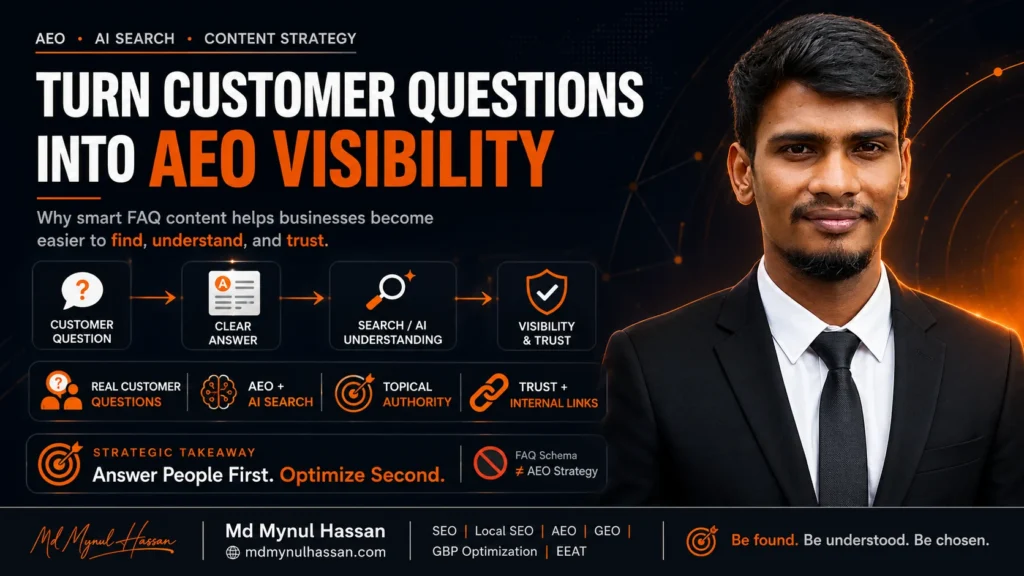
A question provides context. A direct answer provides clarity. Supporting information adds depth. Relevant internal links help the reader continue exploring the topic.
That structure can work well for users, traditional search engines and AI-powered search experiences.
For example, someone searching for an air-conditioning service may begin with:
“AC repair near me.”
But another potential customer may ask:
“Why is my AC running but not cooling?”
“Can my AC be repaired on the same day?”
“Should I repair or replace an old AC unit?”
“What should I check before calling an AC technician?”
These searches represent different concerns and stages of the customer journey.
A useful website should be able to answer them naturally.
Why FAQ Content Matters in Modern Search
Search is becoming more conversational, but the foundation has not disappeared.
Google’s current guidance for its generative AI search experiences continues to emphasize strong SEO fundamentals, useful original content, clear site structure and information created primarily for people.
That is why I do not see AEO or GEO as replacements for SEO.
I see them as extensions of good search visibility strategy.
A technically weak website does not become strong because someone adds an FAQ section.
A thin service page does not suddenly become authoritative because five questions were added underneath it.
And unclear business information does not become trustworthy simply because it is marked up with structured data.
The fundamentals still need to work together.
This is why my approach connects AEO with keyword research, on-page SEO, technical SEO, internal linking, Local SEO, Google Business Profile optimization, EEAT and content strategy.
FAQ content is one part of that system.
Your Customers Are Already Giving You FAQ Topics
When businesses ask me what questions they should add to their website, I usually recommend looking inside the business before using an SEO tool.
Real FAQ opportunities often come from customer conversations.
Look at the questions people ask before buying. Look at objections your sales team repeatedly handles. Review contact-form submissions. Read support messages. Look at Search Console queries. Study customer reviews. Notice what customers misunderstand about your service. Compare the questions competitors answer well and the questions they ignore.
Keyword research can then help validate and expand those ideas.
This produces much stronger FAQ content than taking a list of long-tail keywords and mechanically turning each phrase into a question.
For me, keyword research should help reveal search intent, not dictate unnatural writing.
If your customers repeatedly ask whether you serve a certain area, that is useful information.
If they repeatedly ask what is included in a service, that is useful information.
If buyers do not understand the difference between two products, that is useful information.
Those questions reveal gaps between what the business knows and what the website explains.
Good FAQ content closes those gaps.
FAQ Pages Can Strengthen Search Intent Coverage
A page can contain the correct keyword and still fail to satisfy the searcher.
That is why I pay close attention to intent when working on on-page SEO and content optimization.
Suppose a roofing company has a service page targeting “roof repair service.”
The primary page should clearly explain the service, but potential customers may also want to understand whether a leaking roof can be repaired, how serious certain warning signs are, how the inspection process works and when replacement may be more appropriate than repair.
Those questions belong to the wider topic.
Answering them can make the service page more complete without forcing the business to create a separate article for every minor question.
The FAQ section supports the main content.
It should not replace it.
FAQ Content Can Improve Service Pages
One of the problems I often see is a service page that explains very little beyond what the company sells.
There may be a heading, a few generic paragraphs and a contact button.
Technically, the service exists on the website.
But the page does not answer enough questions for someone evaluating the business.
A useful service page should help a visitor understand what the service is, who it is for, what problems it addresses, how the process works, what customers should reasonably expect and what they should do next.
Relevant FAQs can fill important information gaps while keeping the page easy to scan.
For businesses unsure whether weak service pages, technical issues or unclear site structure are limiting visibility, I normally recommend starting with a proper SEO audit rather than adding content randomly.
FAQ Content and Topical Authority
Topical authority is another area where FAQ content can help when it is used correctly.
I do not define topical authority as publishing dozens of articles around slightly different keyword variations.
The goal should be meaningful coverage of the subject.
Consider Local SEO.
A business owner learning about Local SEO may naturally want to understand Google Business Profile optimization, Google Maps visibility, local keywords, service-area pages, reviews, citations, location relevance and “near me” searches.
Those questions belong to a connected topic.
Answering the important ones across relevant pages creates a clearer information structure.
This is also where FAQ content can connect naturally with deeper resources such as my Local SEO service, Google Business Profile optimization service, or guide to AEO for local businesses.
The website becomes a connected resource rather than a collection of isolated pages.
Internal Linking Makes FAQ Answers More Valuable
Not every FAQ answer needs to become a miniature article.
Sometimes the best structure is:
Give the direct answer first, add enough context to make it useful, then help the reader reach a more detailed resource when necessary.
For example, a short answer to “What is an SEO audit?” can explain the purpose of an audit and then direct a reader who wants deeper information to an SEO audit service or guide.
A question such as “How can I prepare my website for AI search?” can provide the core answer and then connect to a detailed guide about building an AI-search-friendly website.
Good internal links help both people and search engines understand how different parts of a website relate to each other.
I prefer contextual internal links that genuinely help the reader rather than inserting links simply to increase the number of internal links on a page.
FAQ Content Can Support Local SEO
FAQ strategy can be particularly useful for local and service-based businesses because local customers often ask highly practical questions.
They want to know where the business operates, whether specific services are available in their area, whether appointments are required, whether emergency support exists, what customers should prepare before a visit and how the process works.
Those are useful questions because they can reduce uncertainty.
They can also reinforce genuine service and location relevance.
But businesses need to be careful.
I do not recommend creating fake location questions just to repeat city names.
If the company genuinely serves an area, explain that accurately.
If it does not, do not create content suggesting otherwise.
The information on the website should also remain consistent with the company’s Google Business Profile and real operating model.
Local SEO works better when the website, profile, services, locations and customer information tell the same story.
Good FAQ Content Can Strengthen EEAT
FAQ content can also contribute to trust.
This is one of the reasons I see EEAT as a practical content consideration rather than simply an SEO acronym.
A generic answer usually sounds generic.
An experienced answer explains the situation more clearly.
Consider this question:
How long does the service take?
A weak answer might say:
“Our professional team provides fast and high-quality service.”
That does not really answer the question.
A more useful answer could explain that the timeline depends on the size or condition of the project and that an estimated schedule is provided after the requirements are reviewed.
The second answer is more trustworthy because it acknowledges real conditions rather than making an empty promise.
Good FAQ content should sound like someone who understands the customer’s problem is answering the question.
That is where experience becomes visible.
Should FAQs Be on One Page or Individual Pages?
There is no single structure that works for every website.
A central FAQ page can make sense when a business has company-wide questions about payments, policies, bookings, deliveries, returns, support or other general processes.
But service-specific questions usually belong on the service page where they are most relevant.
Product questions may belong on product or category pages.
Detailed informational questions may deserve their own articles.
Local questions may belong on genuine location or service-area pages.
This is why I do not start with:
“How many FAQs should this website have?”
I start with:
What does the customer need to know, and where would that answer be most useful?
That usually leads to a better content structure.
FAQ Schema and Google Search in 2026
This is one area where older SEO articles can now create confusion.
For years, FAQPage structured data was widely discussed because qualifying pages could receive FAQ rich results in Google Search.
That should no longer be the reason a business creates FAQ content.
In 2026, Google deprecated the FAQ rich-result feature and later removed its FAQ rich-result documentation because those rich results are no longer displayed in Google Search.
This means businesses should not build an FAQ strategy around the promise of gaining extra FAQ SERP space.
It also means I would not tell a client:
“Add FAQ schema and you will get better AI visibility.”
That is not supported by Google’s current guidance.
Google has also clarified that no special AI-specific markup is required for its generative AI search experiences.
Structured data still has legitimate uses across SEO when a supported type accurately describes visible content, but it should not become the main reason for creating FAQ content.
For FAQ strategy, I would focus first on the questions, the answers, the page structure, internal links, expertise and usefulness.
Useful content first. Markup second.
Old FAQ SEO Thinking vs Modern AEO Thinking
Older FAQ strategies often followed a predictable formula:
Find long-tail keywords, convert them into questions, add short answers, implement FAQ schema and hope for more visibility.
Modern search visibility needs more thought.
The better question is whether the FAQ helps someone understand the business, solve a problem or make a decision.
I want to know whether the question reflects real intent, whether the answer demonstrates useful knowledge, whether it belongs on that page, whether a deeper resource should be linked, whether the information is accurate and whether the wider website supports what the answer claims.
That connects FAQ content with SEO, AEO, GEO, EEAT, user experience, topical authority and conversion thinking.
The format is not the strategy.
The usefulness of the information is the strategy.
My Practical Process for Building FAQ Content
When I work on FAQ opportunities, I normally follow this process:
- Understand the business and page purpose. I first identify what the business offers, who the page serves and what action the visitor should eventually take.
- Collect real customer questions. I review search queries, customer conversations, support questions, reviews, sales objections, keyword data and relevant competitor content.
- Group questions by intent. Some belong on service pages, some on product pages, some on location pages and some deserve complete articles.
- Answer the question directly. I try to provide the useful answer early instead of hiding it behind unnecessary introduction.
- Add supporting context and internal links. When another page explains the subject better, I connect the reader to that resource rather than repeating everything.
- Review accuracy and usefulness. Before keeping an FAQ, I ask whether it actually helps the visitor or whether it exists only because someone wanted another keyword on the page.
Sometimes three strong questions are enough.
Sometimes a complex service genuinely requires more.
Sometimes the page does not need an FAQ section at all.
SEO should adapt to the business instead of forcing every website into the same template.
Common FAQ Mistakes Businesses Should Avoid
The most common problem is creating questions nobody actually needs answered.
Another is turning every response into a sales pitch.
Some websites repeat the service page almost word for word inside their FAQ section. Others use awkward keyword-heavy questions that no real customer would naturally ask.
Another mistake is publishing generic answers that could belong to any competitor.
Businesses also need to review FAQ content over time. Prices, service areas, policies, processes and products can change. An outdated answer can reduce trust instead of increasing it.
And in 2026, businesses should avoid treating FAQ schema as a shortcut to Google visibility.
The content needs to deserve its place on the page even if no rich result appears.
FAQ Pages for AEO: The Bigger Opportunity
The biggest opportunity is not creating an “FAQ page.”
The opportunity is capturing the knowledge your business already has and making it accessible.
Your customers are telling you what they need to know.
Search data is telling you what people are trying to understand.
Your sales and support conversations are showing where uncertainty exists.
Your website should turn that knowledge into clear, accurate and useful information.
That can support traditional SEO because the page better covers search intent.
It can support AEO because important answers become easier to identify.
It can support GEO and AI search because business information becomes clearer and better contextualized.
It can support EEAT because real knowledge and honest limitations become visible.
And it can support conversions because visitors have fewer unanswered questions before deciding whether to contact the business.
Final Thoughts
FAQ pages can be powerful for business AEO, but not because the word “FAQ” has some special ranking advantage.
Their strength comes from the information they contain.
Good FAQ content answers real customer questions, improves search-intent coverage, strengthens relevant pages, supports internal linking, adds topical depth, demonstrates experience and makes the business easier to understand.
That is why I do not treat FAQs as an isolated SEO tactic.
I connect them with keyword research, on-page SEO, technical SEO, Local SEO, Google Business Profile optimization, content strategy, EEAT, AEO and GEO.
If your website already has content but still struggles to clearly explain what your business does, who it helps or why customers should choose it, adding more random content may not be the answer.
The better starting point is understanding the gaps.
If you need help identifying those gaps, an SEO audit or AEO & GEO visibility review can help determine what should be improved first.
The goal is simple:
— Md Mynul Hassan
Local SEO consultant
Turn Customer Questions Into Better Search Visibility
Your customers may already be showing you what your website needs to explain more clearly.
If your service pages, FAQ content or website structure are not connecting customer questions with search intent, Local SEO, AEO and AI search visibility, I can help you identify the gaps and build a more practical strategy.
Start with an SEO audit or AEO & GEO visibility review.