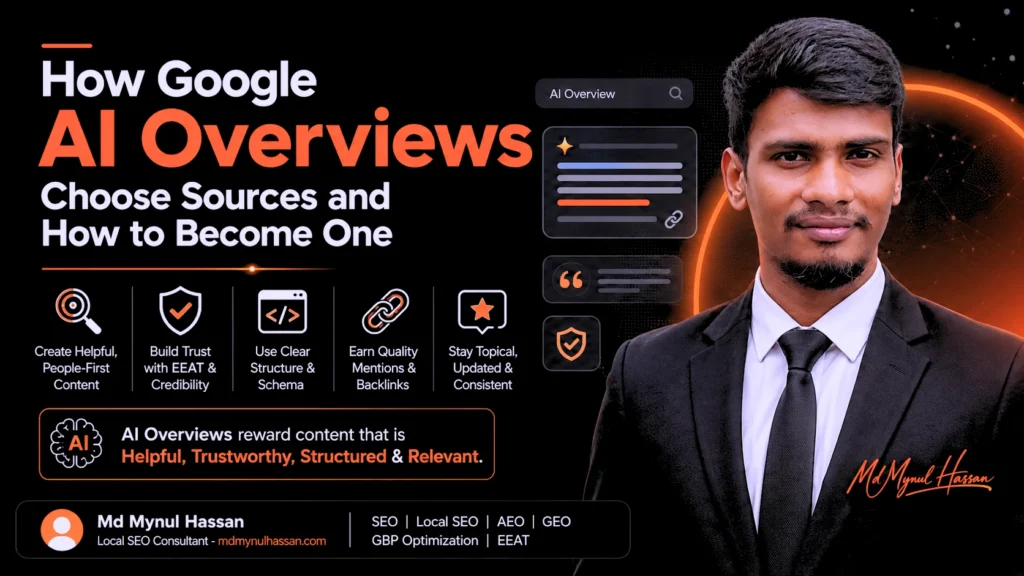
Google AI Overviews do not use a simple rule such as “the page ranking #1 gets cited.”
Google says AI Overviews and AI Mode use the same underlying Search ecosystem and require pages to be indexed and eligible to appear in Google Search with a snippet. Google also says there is no special AI Overview schema, AI text file, or separate optimization requirement for appearing in these features.
So what does that mean for a business trying to become a cited source?
The practical answer is this:
Google first needs to be able to discover, crawl, understand, and retrieve your content. Then its AI systems decide which information is useful for answering the specific search.
AI Overviews can combine information from multiple web sources, and Google says AI Mode can break a complicated question into multiple subtopics and search for them simultaneously.
That changes how content should be approached.
You are not simply trying to create a page that ranks for one keyword. You are trying to create useful, clearly structured information that can answer a specific part of a searcher’s question better than competing sources.
This guide explains what Google has officially confirmed, what independent research suggests, what does not appear to be a special AI ranking factor, and what you can practically do to make your website easier to understand and retrieve.
What Are Google AI Overviews?
Google AI Overviews are AI-generated summaries that can appear in Google Search when Google’s systems determine that a generative response is useful.
The summary can combine information from multiple sources and provide links that allow searchers to investigate the underlying information. Google describes AI Overviews as a way to help people understand complicated topics more quickly while giving them opportunities to explore supporting web content.
AI Overviews are therefore different from a traditional blue-link ranking.
A normal search result primarily answers:
“Which webpage should appear for this query?”
An AI Overview has another problem to solve:
“Which information from the web can help construct a useful answer to this query?”
That distinction matters for SEO.
How Do Google AI Overviews Choose Sources?
Google has not published a complete formula showing exactly how individual AI Overview citations are scored.
However, Google’s current documentation gives us several important boundaries.
A page must be indexed and eligible to appear in normal Google Search with a snippet to be eligible as a supporting link in AI Overviews or AI Mode. Google also says there are no additional technical requirements specifically for AI features.
Google’s documentation also recommends fundamentals such as:
- Allowing Googlebot to access important pages
- Making important content available as text
- Building useful internal links
- Providing good page experience
- Using structured data accurately
- Keeping structured data consistent with visible content
- Maintaining accurate Business Profile information where relevant
For local businesses, the same principle applies across different markets. A business serving customers in Bangladesh, the USA, UK, Canada, Australia, or Singapore should make its location, service area, business information, and customer-facing content clear and accurate.
Independent research adds another useful layer.
An Ahrefs analysis updated in March 2026 found that 38% of pages cited in AI Overviews also ranked in Google’s top 10, based on its analysis of 1.9 million citations. The important point is not the exact percentage. It is that citation selection and traditional organic ranking overlap, but they are not identical.
That means:
Ranking can put your content in a strong position, but ranking alone does not guarantee an AI Overview citation.
The 7 Factors That Make a Page More Useful as an AI Overview Source
There is no official Google “AI Overview ranking checklist.”
The following framework combines Google’s published guidance with observable search behavior and current industry research. It should be treated as a practical strategy, not a guaranteed formula.
1. Your Page Must Be Search-Eligible
The first requirement is surprisingly basic.
If Google cannot properly crawl, index, and retrieve your page, the quality of the writing becomes irrelevant.
Google specifically states that pages need to be indexed and eligible to appear in Search with a snippet to be eligible as supporting links in AI Overviews and AI Mode.
Check:
robots.txtnoindexdirectives- Canonical tags
- HTTP status codes
- XML sitemap
- Internal links
- JavaScript-dependent content
- Mobile accessibility
- Crawl paths
- Search Console indexing status
A technical problem affecting an important page should be fixed before spending weeks rewriting its content.
For deeper technical checks, see my Technical SEO Service and SEO Audit Service.
2. The Page Should Answer a Real Search Question
AI search is question-driven.
Consider these two pages:
Page A
AI SEO is an important part of modern digital marketing.
Page B
Google AI Overviews can cite pages that are indexed and eligible for normal Search. Google does not require special AI Overview schema or a separate AI optimization file.
Page B provides a much clearer answer to a specific question.
This is why answer-first writing matters.
For example, if your target query is:
“Does schema markup help AI Overviews?”
Start with the answer:
Schema markup is not required for AI Overviews. Google says there is no special Schema.org markup required for inclusion in AI Overviews or AI Mode. However, accurate structured data remains useful for helping Google understand eligible page content and can support other Search features.
Then explain the nuance.
That structure gives both the reader and the search system a clear starting point.
3. Content Must Be Easy to Understand
Google’s current guidance is particularly useful here.
Google says you do not need to rewrite content in a special way for generative AI. It also says there is no ideal page length and no requirement to split content into tiny pieces simply so AI systems can process it.
That means you should not turn every paragraph into a 40-word answer simply because someone calls it “AEO optimization.”
Instead, make the information clear.
For example:
Weak
AI visibility is an evolving area that requires businesses to leverage modern optimization strategies across multiple search environments.
Strong
Google AI Overviews can use information from indexed web pages to help construct answers. Businesses should therefore focus on making important information crawlable, accurate, clearly structured, and useful for the searches they want to serve.
The second version contains actual relationships:
Google AI Overviews → use → web information
Web pages → must be → accessible and understandable
Content → should answer → search intent
That is semantic clarity.
4. Answer the Main Question Before Adding Context
This is one of the simplest improvements you can make.
Suppose someone searches:
“How do Google AI Overviews choose sources?”
Do not begin with three paragraphs about the history of artificial intelligence.
Begin with:
Google AI Overviews use information from Google’s Search ecosystem to construct answers and provide supporting links. Pages must be indexed and eligible for normal Google Search, while the specific sources shown can vary according to the query and the information Google considers useful. Google has not published a complete formula for individual citation selection.
Then go deeper.
This approach works well for:
- Featured snippets
- People Also Ask
- AI Overviews
- Voice search
- AI assistants
- Human readers
The reason is simple.
The answer appears where the question expects it.
5. Build Topic Depth Instead of One Isolated Article
A single article can answer a question.
A connected website can demonstrate that the business understands the subject more broadly.
For example, a website focused on AI search could connect:
AI Search
→ AI Overviews
→ AEO
→ GEO
→ Search intent
→ Entity SEO
→ Technical SEO
→ Structured data
→ Internal linking
→ EEAT
→ Content strategy
This creates useful relationships between pages.
Google’s own AI-search guidance emphasizes existing SEO fundamentals, including making content discoverable through internal links and ensuring important content is available in textual form.
My Content Strategy & SEO Content Writing approach follows the same principle: content should form a useful information system rather than become a collection of unrelated keyword-targeted posts.
For businesses building that foundation, Keyword Research Service can help identify the questions and search themes that deserve separate pages or supporting content.
6. Make Important Information Specific
Generic statements are difficult to differentiate.
Compare:
Businesses need good SEO for AI search.
with:
A page that discusses AI search should clearly identify what the system is, what information it uses, what the website owner can control, and what remains outside the site’s control.
The second statement gives the reader a decision framework.
Specificity can come from:
- Definitions
- Examples
- Comparisons
- Processes
- Dates
- Sources
- Limitations
- Original analysis
- Practical checklists
- Clear entity relationships
This is also where information gain becomes important.
If ten competing articles all say “create high-quality content,” simply writing an eleventh article saying the same thing does not create much value.
Explain what high-quality means in the context of the problem.
7. Keep Your Technical and Entity Information Consistent
Search engines need to understand what a page represents.
For a business website, that can include relationships such as:
Person → operates → consultancy
Consultancy → provides → SEO service
Service → serves → target market
Person → has expertise → SEO / AEO / GEO
Website → represents → business
Service → has area served → relevant geographic market
Structured data can help express some of these relationships in machine-readable form.
But there is an important distinction:
Schema is not an AI citation button.
Google explicitly says there is no special Schema.org markup required for AI Overviews or AI Mode. It also says structured data should match visible page content.
So use schema to describe real information accurately, not to tell Google that your business is something it is not.
Does Schema Markup Help You Get Into AI Overviews?
Not directly as a special AI Overview ranking requirement.
Google says there is no special schema.org structured data required for AI features. Structured data still has value because it helps Google understand page content and can make pages eligible for supported Search features.
Think of schema as clarification, not promotion.
For example, if a law firm has a page about its legal services, structured data can describe the organization, person, service, location, and website relationships.
But adding Attorney markup to a marketing consultant’s website would be inaccurate.
Schema should represent reality.
LegalService, Attorney, Organization, Person and Service: How the Relationships Work
For an attorney website, a useful conceptual model might look like this:
Website
   ↓ represents
Organization / LegalService
   ↓ has employee / founder
Person
   ↓ provides
Service
   ↓ serves
Place / Location
Schema.org currently describes Service as a service provided by an organization, while Person can be connected to an organization through properties such as worksFor or affiliation.
One important update: Schema.org identifies Attorney as deprecated and says LegalService is more inclusive and less ambiguous.
Example JSON-LD for a Legal Service Website
Use this as a structural example, not something to copy blindly.
<script type="application/ld+json">
{
  "@context": "https://schema.org",
  "@graph": [
    {
      "@type": "LegalService",
      "@id": "https://example.com/#legalservice",
      "name": "Example Law Firm",
      "url": "https://example.com/",
      "description": "Legal services for individuals and businesses.",
      "areaServed": {
        "@type": "Place",
        "name": "New York"
      },
      "employee": {
        "@id": "https://example.com/attorney/#person"
      }
    },
    {
      "@type": "Person",
      "@id": "https://example.com/attorney/#person",
      "name": "Jane Smith",
      "jobTitle": "Attorney",
      "worksFor": {
        "@id": "https://example.com/#legalservice"
      },
      "url": "https://example.com/attorney/"
    },
    {
      "@type": "Service",
      "@id": "https://example.com/services/business-law/#service",
      "name": "Business Law Services",
      "provider": {
        "@id": "https://example.com/#legalservice"
      },
      "areaServed": {
        "@type": "Place",
        "name": "New York"
      },
      "url": "https://example.com/services/business-law/"
    },
    {
      "@type": "WebSite",
      "@id": "https://example.com/#website",
      "url": "https://example.com/",
      "name": "Example Law Firm",
      "publisher": {
        "@id": "https://example.com/#legalservice"
      }
    }
  ]
}
</script>
The important part is not the amount of markup.
The important part is the relationship between the entities.
Google recommends that structured data accurately describe the visible page and that the markup be validated before deployment.
For an SEO consultant website such as mine, the entity model should instead represent the actual business, person, services and website. Do not use LegalService or Attorney simply because they appear in a schema example.
Does Ranking on Page One Guarantee an AI Overview Citation?
No.
Current evidence shows meaningful overlap between traditional rankings and AI Overview citations, but the two systems do not behave identically.
Ahrefs reported that 38% of pages cited in AI Overviews also ranked in Google’s top 10 in its March 2026 update. That means many citations came from pages outside the traditional top 10 as well.
This is one of the most important points for modern SEO strategy.
A page can have:
- Strong organic rankings but weak answer extraction
- Useful answers but weak organic visibility
- Strong topical relevance but technical indexing problems
- Good content but insufficient authority
- Strong authority but poor search intent alignment
The job is to improve the complete system.
Can a Page Outside the Top 10 Be Cited?
Yes, available research indicates that AI Overview citations are not limited to traditional top-10 results.
That does not mean rankings are irrelevant.
Organic visibility still matters because Google needs to discover and retrieve the information. But AI-generated answers can use information from a broader set of sources than a simple “position one equals citation one” model.
This is why optimizing a page only around its current ranking position can be misleading.
Instead ask:
What information does Google need to answer this question, and does my page provide a particularly useful version of that information?
Why Clear Answer Blocks Matter
An answer block is simply a concise section that directly answers a question.
For example:
How do AI Overviews select sources?
AI Overviews use Google’s Search ecosystem to retrieve information that can help answer a query. Eligible pages must be indexed and available for normal Search, but Google does not publish a complete formula explaining why one eligible source is selected over another. The sources shown can change according to the query and available information.
Then you can explain the mechanics.
This structure gives readers the answer immediately while still allowing the article to provide deeper context.
It is also useful for PAA and other answer-focused search surfaces.
What Role Does People Also Ask Play?
People Also Ask can reveal the questions that surround a topic.
Historical research from Ahrefs found PAA appearing on a very large share of AI Overview SERPs in its analysis, which supports the broader idea that question-based search behavior is closely connected to AI-search research.
For a topic like AI Overviews, useful follow-up questions include:
- What are Google AI Overviews?
- How does Google AI Mode work?
- How do AI Overviews choose sources?
- Does ranking in the top 10 guarantee an AI Overview citation?
- Does schema markup help AI Overviews?
- Can pages outside the top 10 appear in AI Overviews?
- How can a website become more visible in AI search?
- Does structured data help Google understand a website?
- Does internal linking matter for AI search?
- Does Google require special AI optimization?
These questions should not all be dumped into an FAQ.
For local businesses, these questions can also become location-specific. A dentist in Dhaka, a lawyer in London, an HVAC company in Texas, or a professional service provider in Sydney may need to answer the same type of customer questions while also making their local relevance clear.
The important ones deserve proper explanations inside the article.
Does Google Require Special AEO or GEO Optimization?
No.
Google’s current documentation says the existing SEO fundamentals remain relevant for AI Overviews and AI Mode. Google specifically says there are no additional technical requirements and no special schema.org markup required for these AI features.
That does not mean AEO or GEO strategy is useless.
It means the strategy should not be built around imaginary Google requirements.
A sensible AEO/GEO strategy focuses on:
- Search intent
- Useful answers
- Clear information architecture
- Strong topical coverage
- Entity consistency
- Technical accessibility
- Internal linking
- Trust and evidence
- Original information
- Clear business and author information
This is much more sustainable than trying to find a secret “AI ranking signal.”
Does Google Recommend LLMs.txt for AI Search?
No special AI file is required by Google.
Google’s current guidance says you do not need to create new machine-readable files or special AI text files to appear in its generative AI search features. Google’s newer guidance also says that maintaining an llms.txt file does not help or hurt Google Search visibility because Google Search ignores it.
A business can choose to create such files for other systems if there is a separate reason to do so.
But don’t confuse that with a Google ranking requirement.
What Should You Do If Your Website Is Not Being Cited?
Start with diagnosis rather than publishing more content.
Step 1: Check Indexing
Confirm that the page is indexed and eligible for normal Search.
Look at:
- Google Search Console
- URL Inspection
- Indexing status
- Canonical URL
- Robots directives
- Sitemap inclusion
If there is a technical problem, address that first through a Technical SEO review.
Step 2: Check Search Intent
Ask:
Does this page actually answer the query?
A page targeting “local SEO consultant” should not spend most of its content discussing generic digital marketing.
A page targeting “how AI Overviews choose sources” needs to explain source selection.
Intent comes before keyword density.
Step 3: Identify Missing Questions
Search for the questions that naturally follow the main query.
For example:
Main question:
How do AI Overviews choose sources?
Follow-up questions:
- What qualifies a page?
- Does ranking matter?
- Does schema matter?
- Does authority matter?
- Can lower-ranking pages be cited?
- How should content be structured?
- What technical problems prevent inclusion?
This creates a useful query fan-out.
My Keyword Research Service can be used to turn these search themes into a structured content plan.
Step 4: Improve the Page’s Information Gain
Do not simply add 2,000 words.
Add something useful.
For example:
- A decision framework
- A comparison
- A technical checklist
- A schema example
- A real limitation
- A process
- A visual model
- A clearly sourced statistic
- A practical example
- A troubleshooting section
Length is not information gain.
Useful information is.
Step 5: Strengthen Internal Links
Internal links help users and search engines discover related information.
A page about AI search could naturally link to:
- On-Page SEO
- Technical SEO
- SEO Audit
- Keyword Research
- WordPress SEO
- White Label Local SEO
- Ecommerce SEO
- Conversion Rate Optimization
- AEO & GEO Consulting
- AEO for Local Businesses
- How to Make a Business Website AI-Search Friendly
- How to Measure AEO Success
These links should appear where they help the reader, not as a forced list of keywords.
What About Entity SEO?
Entity SEO becomes particularly useful when a business has multiple services, people, locations and content topics.
Imagine a website that clearly communicates:
Md Mynul Hassan
→ is → SEO, AEO, GEO and Brand Visibility Specialist
Md Mynul Hassan
→ provides → SEO services
SEO services
→ include → Technical SEO, Local SEO, AEO, GEO, Keyword Research
AEO & GEO consulting
→ addresses → AI search visibility
Business website
→ represents → Md Mynul Hassan
These relationships give the website a coherent meaning.
They are more useful than repeating:
“SEO expert, SEO specialist, SEO consultant, SEO agency, SEO expert…”
over and over.
Google’s Organization documentation specifically explains that structured data can help Google understand an organization’s details and disambiguate the organization in Search.
What Google Says About AI Search and Content Quality
Google’s current guidance is clear on one central point:
Do not create content primarily for AI systems. Create useful content for people and follow strong SEO fundamentals.
Google says its generative AI search features rely on the same fundamental Search infrastructure and recommends people-first content, technical accessibility, useful internal linking, textual content, and accurate structured data.
That is good news for businesses that already invest in good SEO.
You do not need to rebuild your website around a mysterious AI algorithm.
You need to make the website clearer.
Common AI Overview Optimization Mistakes
1. Assuming Position One Equals Citation One
It doesn’t.
Research shows meaningful overlap, but AI Overview citations are not simply a copy of the organic rankings.
2. Adding Schema Everywhere
Schema should describe real page content.
More schema does not automatically create more AI visibility.
3. Writing Tiny Paragraphs for Machines
Google explicitly says there is no requirement to break content into tiny pieces for AI systems.
Write naturally.
4. Creating Fake Expertise
Don’t invent:
- Credentials
- Customer results
- Case studies
- Reviews
- Statistics
- Research
- Experience
Trust is difficult to build and easy to damage.
5. Publishing Hundreds of Similar Pages
Ten useful pages can be more valuable than 100 pages that repeat the same explanation with different city or keyword variations.
6. Ignoring Technical SEO
A brilliant article that cannot be properly crawled or indexed has a fundamental visibility problem.
7. Treating AEO as a Separate Replacement for SEO
Google’s own documentation says existing SEO fundamentals remain relevant for AI features.
AEO should strengthen the way useful information is presented, not replace technical and organic SEO.
A Practical AI Overview Source Checklist
Before publishing an important article, check the following.
Search Eligibility
- Page can be crawled
- Page can be indexed
- No accidental
noindex - Correct canonical
- Valid HTTP response
- Included in useful internal-link paths
- Important content available as text
Search Intent
- Main question answered quickly
- Search intent is clear
- Follow-up questions covered
- Relevant comparisons included
- Common misconceptions addressed
Content
- Clear definition
- Direct answers
- Useful examples
- Specific explanations
- Original information gain
- Appropriate evidence
- Clear limitations
Entity Understanding
- Business identity is clear
- Author identity is clear
- Services are clear
- Locations are accurate
- Relevant entities are connected
- Structured data matches visible content
Trust
- Claims are supported
- Dates are clear where needed
- Statistics have sources
- No fake experience
- No fake reviews
- No exaggerated guarantees
Conversion
- Reader knows the logical next step
- Relevant service page is linked
- CTA fits the search intent
- Commercial information does not overwhelm the article
What Makes Content Citation-Worthy?
If you want other websites, search systems or AI systems to use your content, ask a simple question:
What information does this page provide that would be useful to cite?
A citation-worthy page might contain:
- A well-researched definition
- A clear original framework
- Verified data
- A practical calculation
- A useful checklist
- A unique comparison
- A detailed implementation example
- A transparent methodology
- An original case study
- A well-supported explanation of a confusing subject
For example, saying:
“Internal linking is important for SEO.”
adds little.
A more useful explanation would show how a service page, supporting article, FAQ and location page can form a connected topic cluster, and explain why those relationships are useful to users and search engines.
That is information a reader can actually apply.
How I Would Approach AI Overview Visibility for a Business
I would not start by adding the phrase “AI search” to every page.
I would start with the business itself.
First, understand the entity
What does the business do?
Who does it serve?
Where does it operate?
For example, a service business in Bangladesh, a law firm in the United Kingdom, an HVAC company in the United States, or a professional service business in Canada or Australia may have different audiences and local search contexts. The underlying SEO and AEO principles remain the same, but the business information, service areas, customer questions, and local entities need to be accurate for the market being served.
Which services matter commercially?
Who is responsible for the information?
Then understand search intent
What questions do potential customers ask?
Which questions indicate research?
Which indicate commercial intent?
Which require local context?
Then inspect the website
Are important pages crawlable?
Are services clearly explained?
Are pages connected?
Are there indexing problems?
Is the site architecture logical?
Then improve content
Answer important questions directly.
Add evidence.
Explain mechanisms.
Add examples.
Remove generic filler.
Then connect the information
Use internal links to connect:
Topic → supporting topic → service → conversion path
Finally, measure
Monitor:
- Organic impressions
- Organic clicks
- Query visibility
- Indexed pages
- Search appearance
- Referral traffic
- AI visibility where measurable
- Brand mentions
- Conversion actions
There is no reliable way to guarantee that a particular page will appear as an AI Overview citation. Google explicitly says that meeting requirements and best practices does not guarantee crawling, indexing or serving.
That is why responsible AEO/GEO strategy focuses on improving the things you can actually control.
Frequently Asked Questions
Can I guarantee that Google will cite my website in an AI Overview?
No. There is no legitimate method for guaranteeing a citation. Google says that meeting eligibility requirements and following best practices does not guarantee that a page will be crawled, indexed or served.
Does Google require special schema for AI Overviews?
No. Google says there is no special Schema.org markup required for AI Overviews or AI Mode. Accurate structured data can still support Google’s understanding of page content and eligibility for other Search features.
Does ranking in Google’s top 10 guarantee an AI Overview citation?
No. Independent research shows substantial overlap between organic rankings and AI Overview citations, but the two are not identical. Ahrefs’ 2026 analysis found that 38% of cited pages also ranked in the top 10.
Can a page outside the top 10 be cited?
Yes. Current research indicates that AI Overview citations are not restricted to traditional top-10 organic results. This is one reason citation visibility should not be treated as a simple extension of traditional rankings.
Does internal linking matter for AI search?
Internal linking remains an important SEO practice because it helps search engines discover pages and understand relationships within a website. Google specifically recommends making content easily findable through internal links for AI features.
Do I need to create an llms.txt file?
Google does not require one for its AI search features. Its current guidance says Google Search ignores llms.txt for Search visibility.
Is AEO replacing SEO?
No. AEO works best as part of a broader search strategy. Google’s current guidance says existing SEO fundamentals remain relevant to AI Overviews and AI Mode.
The Simple Model to Remember
You can reduce the entire strategy to five questions:
Can Google access it?
↓
Can Google understand it?
↓
Does it answer the searcher’s question?
↓
Is the information useful and trustworthy?
↓
Does the wider website support the topic and entity clearly?
If the answer to all five is yes, you have built a much stronger foundation for traditional search and AI-powered search.
There is no secret “AI Overview keyword. “
There is no guaranteed citation formula.
There is no special schema that automatically puts a business into Google’s AI answers.
The practical opportunity is to create information that is accessible, specific, useful, well-supported and clearly connected to the entity behind it.
That is where SEO, AEO, GEO, technical SEO, content strategy and entity optimization meet.
Work With Me on SEO, AEO & GEO
If your website already has content but search engines and AI-powered systems do not clearly understand your services, expertise, audience or business entity, the first step should be diagnosis rather than publishing more random articles.
I provide AEO & GEO Consulting alongside On-Page SEO, Technical SEO, Keyword Research, content strategy and other search visibility services.
For businesses that need a broader review, an SEO Audit can help identify whether the real problem is technical accessibility, search intent, content quality, internal linking, entity clarity or another part of the search foundation.
Find Md Mynul Hassan Online
You can also verify my professional presence and work through my marketplace and social profiles: