
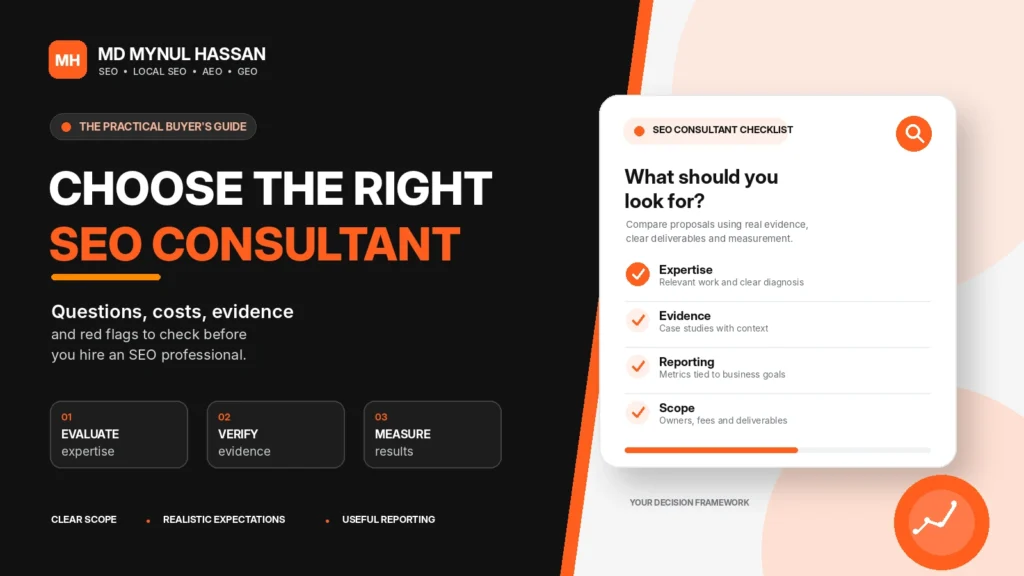
Choosing an SEO consultant starts with identifying the problem you need to solve, then evaluating who can diagnose it, explain the proposed work, and measure progress against your business goals. The right consultant should show a clear process, relevant evidence, realistic expectations, and a defined scope of work.
Before signing a contract, compare the consultant’s expertise, implementation capability, reporting, communication, account ownership, and understanding of your market. A polished proposal is not enough. You need to understand what will actually change on your website and how the work will be evaluated.
This guide explains how to compare SEO consultants, understand pricing, review case studies, identify warning signs, and choose a service that fits your business.
What should an SEO consultant actually do?
An SEO consultant evaluates how a website performs in organic search, identifies relevant problems and opportunities, and develops a plan to improve search visibility. Depending on the engagement, the work may include research, technical diagnosis, content planning, on-page improvements, Local SEO, implementation guidance, or performance measurement.
The exact scope depends on your website and objectives. Some businesses need an independent strategist to guide an existing marketing team. Others need someone who can carry out agreed changes.
A sound engagement usually has five connected stages:
Diagnosis: Review the website, search performance, business model, competition, and existing SEO work.
Prioritization: Identify the problems and opportunities that deserve attention first.
Planning: Turn the findings into specific tasks, owners, dependencies, and expected deliverables.
Implementation: Complete agreed work directly or coordinate with the people responsible for development, content, or marketing.
Measurement: Review what changed, how search performance responded, and whether the work is contributing to business objectives.
An SEO audit and prioritized action plan can be a sensible starting point if you do not yet know why your website is underperforming.
The consultant should also explain what falls outside the engagement. An audit, a strategy document, monthly implementation, link acquisition, content production, and conversion optimization are different deliverables. They should not be treated as interchangeable simply because each is labelled SEO.
Start by identifying the SEO problem you need to solve
Before comparing consultants, write down the business problem in plain language. This makes proposals easier to evaluate because every shortlisted provider must explain how their work addresses the same objective.
For example, a business may have one of the following problems:
| Business problem | Potential area of work | Evidence to examine |
|---|---|---|
| Important pages are not indexed | Technical SEO | Indexing reports, crawl findings, canonical and robots checks |
| Visitors arrive for irrelevant queries | Keyword and intent research | Search queries, landing pages, audience fit |
| Service pages receive impressions but few enquiries | On-page SEO and conversion review | Page relevance, offer clarity, form and call performance |
| A local business struggles with local discovery | Local SEO and Google Business Profile | Profile accuracy, local search context, landing pages |
| The website publishes articles without a connected strategy | Content strategy and information architecture | Topic relationships, search intent, internal links |
| Organic traffic rises but qualified leads do not | Measurement and conversion analysis | Lead quality, conversion tracking, landing-page performance |
These are possible starting points, not diagnoses. A provider should inspect the available evidence before deciding which problem explains your results.
For example, if an important service page is receiving impressions but few clicks, rewriting the entire website may be premature. The title, snippet, search intent, ranking position, competing results, and actual page content should be checked first.
Similarly, low organic traffic does not automatically mean that you need more backlinks or more blog posts. The website may be targeting the wrong queries, have indexing problems, lack relevant pages, or attract visitors unlikely to become customers.
Ask the consultant to separate verified findings from hypotheses. A responsible recommendation explains the evidence behind it, the uncertainty that remains, and what should be investigated next.
How do you compare an SEO consultant, freelancer, agency, and in-house team?
The best model depends on the work required, the available budget, and the resources already inside your business.
| Factor | Independent consultant | Freelancer | SEO agency | In-house team |
|---|---|---|---|---|
| Main advantage | Strategic depth and direct advice | Flexible task delivery | Multiple specialist roles | Direct access to the business |
| Implementation | Depends on the engagement | Depends on skills and scope | Depends on team and contract | Depends on internal capability |
| Communication | Often direct with the specialist | Usually direct | May involve several account and delivery staff | Continuous internal communication |
| Best fit | Diagnosis, strategy, prioritization | Clearly defined tasks | Broader ongoing delivery | Sustained work needing daily coordination |
| Main question | Who will execute the plan? | Can they handle the required complexity? | Who will actually work on the account? | Does the team have the right skills and capacity? |
Titles alone do not establish competence. A consultant may provide excellent strategy but not perform implementation. A freelancer may be a strong technical specialist but not offer the full range of skills your project needs. An agency may have broader resources, yet you still need to know who will handle your account.
Before choosing, decide which functions you need: strategy, execution, development, content, Local SEO, reporting, or a combination of them. Purchase the capability you need rather than paying for a service model simply because it is popular.
Six factors to evaluate before hiring an SEO consultant
1. Can the consultant explain the diagnosis?
Ask the provider to identify the most important problems on your website and explain the evidence supporting each one.
A useful diagnosis should distinguish high-impact issues from minor recommendations. It should also connect each proposed change with a clear reason.
For instance, a technical report may identify hundreds of warnings. A good consultant explains which findings affect important URLs or interfere with crawling, indexing, usability, or search relevance. The number of warnings alone tells you little about business value.
2. Is the research connected to search intent?
Keyword research should establish why people search, which pages should answer those needs, and whether the queries match your business objectives.
Ask how the consultant evaluates query intent, competing page types, existing rankings, related topics, and the commercial value of a search. The keyword research service on your website describes this broader approach.
A long spreadsheet of phrases is not a complete strategy. You should understand which queries belong on existing pages, which need new resources, and which are not worth targeting.
3. Does the consultant understand technical and on-page SEO?
Technical work helps search engines access and interpret a website. On-page work helps individual pages communicate their purpose, relevance, and useful information.
Depending on the project, a consultant may need to investigate:
Crawling, indexing, canonical tags, redirects, and XML sitemaps.
Page titles, headings, internal links, and content relevance.
Mobile usability and performance issues.
Structured data and whether it matches visible page content.
Content duplication, overlapping page intent, and weak site architecture.
Review the consultant’s approach to technical SEO and on-page SEO. You do not need every detail explained in technical jargon, but you should receive a clear explanation of what is wrong and what action is justified.
4. Can the consultant provide relevant evidence?
Evidence helps you determine whether the provider can explain and document their work. It should not be treated as a guarantee that your website will achieve the same outcome.
Look for case studies that identify:
The website’s starting condition and business context.
The work completed and the decisions behind it.
The measurement period and data source.
What changed during the engagement.
Limitations, external influences, or unresolved problems.
A claim that traffic increased by a large percentage is incomplete without the baseline, measurement period, and context. A rise in impressions also does not necessarily mean that the business gained qualified leads or revenue.
Your evaluation can include the Local SEO case study for a mental health practice in Singapore. It is an example from a different market, not evidence of Atlanta-specific experience or a prediction of your results.
5. Will the consultant explain implementation and communication?
Strategy has limited value if important recommendations never reach the website. Ask who will make the changes, who is responsible for quality assurance, and what happens when implementation depends on another team.
A practical proposal should specify:
Who performs each task.
What access and approvals are required.
Which deliverables are included.
How often progress is reviewed.
How blockers and unexpected findings are handled.
Which tasks require additional fees or specialist support.
If your business already has developers and writers, an advisory engagement may be sufficient. If nobody can execute the recommendations, you may need implementation support or a provider that can coordinate the work.
6. Does the consultant measure outcomes that matter?
Rankings and organic traffic can be useful diagnostic metrics, but the right reporting framework depends on the business.
A local service business may care about qualified enquiry forms and calls. An ecommerce business may care about organic revenue and transactions. A professional firm may care about relevant consultation requests rather than the total number of visitors.
A consultant should explain which metrics are available, how tracking will be configured, which outcomes can be attributed confidently, and what remains uncertain.
For businesses needing clearer content and landing-page performance, conversion rate optimization can complement SEO by examining what happens after a visitor arrives.
How much does an SEO consultant cost?
There is no single reliable fee that applies to every SEO consultant or business. Cost depends on the project scope, website size and condition, competition, specialist requirements, number of locations, implementation workload, and whether the engagement is a one-time project or ongoing support.
A useful proposal tells you what the fee buys. It should describe the deliverables, timing, assumptions, exclusions, and responsibilities rather than relying on a vague monthly activity list.
Common pricing structures include:
| Pricing model | What you are paying for | What to check |
|---|---|---|
| Fixed project | A defined audit, strategy, migration review, or other deliverable | Scope, revisions, handover, exclusions |
| Hourly consulting | Agreed time for advice, analysis, or implementation | Time records, priorities, spending limits |
| Monthly retainer | Ongoing work over an agreed period | Specific deliverables, capacity, reporting |
| Strategy-only engagement | Research and recommendations for your team to execute | Documentation, prioritization, implementation guidance |
| Specialist implementation | A defined technical, content, or other workstream | Acceptance criteria, testing, dependencies |
How to compare two different proposals
Suppose one consultant offers a short audit and another offers ongoing optimization. Comparing their totals alone will not tell you which represents better value because the deliverables are different.
Ask each provider to separate the proposal into diagnosis, strategy, implementation, content, reporting, and any external costs. Then compare the work against your actual needs.
For example, a business with a clear technical problem may benefit from a defined project before committing to an ongoing arrangement. A business operating multiple services or locations may need continued work, provided the scope and responsibilities remain clear.
Do not choose the cheapest provider automatically. Equally, a higher fee is not evidence of better expertise. The decision should reflect the quality of the diagnosis, the required capability, the clarity of the scope, and the likely usefulness of the deliverables.
The published SEO audit and service information can help readers understand what an audit-led starting point may involve. Obtain an actual proposal for your circumstances rather than inferring a fee from a general service description.
What questions should you ask before hiring?
Ask every shortlisted provider substantially the same questions. Consistent questions make it easier to compare their answers without being distracted by different presentation styles.
What is the most important SEO problem you see, and what evidence supports that conclusion?
Which tasks would you prioritize first, and why?
What work will you perform directly, and what must my team handle?
How will keyword research influence page targeting and content decisions?
Can you show a relevant case study with its baseline, time period, and data source?
Which metrics will you report, and how will they relate to business outcomes?
Who will own the website, analytics, Search Console, content, and other accounts?
What is excluded from the quoted fee?
How will you handle delays, failed tests, changing requirements, or unsuccessful recommendations?
What happens when the agreement ends, and how will I retain access to the work and documentation?
A good consultant does not need to promise a specific result to demonstrate expertise. The explanation of the problem, quality of the plan, and clarity of the working relationship are themselves valuable evidence.
For Google’s own advice on evaluating SEO providers and avoiding unrealistic claims, read its official guide, Do you need an SEO?.
Red flags to investigate before signing
Be cautious if a provider:
Guarantees a number-one Google position or a fixed ranking within a short period.
Refuses to explain the work or relies on secret methods.
Sells link quantities without explaining relevance, quality, or risk.
Proposes many new pages without demonstrating distinct user needs.
Cannot explain who will implement recommendations.
Avoids discussing account ownership, access, contracts, or reporting.
Uses large percentage improvements without providing a baseline or timeframe.
Reports activity but cannot explain what changed or why it matters.
Pressures you to sign before you have reviewed the scope.
Google explicitly warns that SEO can carry risks when performed irresponsibly, and that no provider can guarantee a number-one ranking.

How should local businesses evaluate SEO support?
Local SEO requires the provider to understand the relationship between a business, its services, its eligible locations, its website, and the people searching for those services.
A local business may need help with service-page relevance, Google Business Profile accuracy, location-specific content, competitive research, local citations, internal links, or conversion paths. The right combination depends on the business’s actual situation.
If your priority is local search, review whether the consultant understands Local SEO strategy and Google Business Profile optimization.
Google explains that local results are mainly influenced by relevance, distance, and prominence. Its guidance also makes clear that a business cannot simply pay Google to secure a better local ranking. See Google’s official local ranking guidance.
Does an SEO consultant need an office in your city?
Not necessarily. A business can hire a remote consultant for research, audits, website changes, content planning, reporting, and strategy. The important questions are whether the consultant understands the target market, communicates effectively, has the necessary implementation capacity, and can provide evidence relevant to your business.
However, remote SEO consulting does not automatically establish local business eligibility. A consultant must not claim an office, address, client base, or local experience that they do not genuinely have.
A business targeting a particular city should also check whether it needs broader SEO, Local SEO, Google Maps support, or a combination of these services. A location modifier in a keyword list is not enough to decide the answer.
For more detail about developing useful location-specific content, see how to build local landing pages without doorway pages. Each proposed page should address a genuine user need and contain useful information that distinguishes it from existing pages.
What should an SEO report measure after you hire someone?
An SEO report should show what was done, what changed, what remains unresolved, and what the next priorities are. It should use metrics that match the objective rather than presenting every available chart.
The following framework can help:
| Metric | What it can tell you | Important limitation |
|---|---|---|
| Search impressions | How often eligible results were shown in measured search contexts | Impressions alone do not mean visitors or conversions |
| Organic clicks | Clicks from search results | Click volume does not establish traffic quality |
| Average position | A summary of a site’s or page’s position for measured results | It is not a fixed rank for every user or query |
| Qualified leads | Whether relevant visitors become potential customers | Requires appropriate conversion tracking and lead qualification |
| Organic conversions | Actions attributed to organic search under the configured analytics model | Attribution can be incomplete or affected by tracking issues |
| Revenue or sales | Commercial outcomes where measurement is available | Many external factors influence revenue |
| Completed deliverables | What the consultant actually implemented or delivered | Activity completion alone does not prove business impact |
Search Console data helps evaluate search visibility, while analytics and a suitable CRM process may be required to connect visitors with leads or revenue. The reporting setup should explain how these systems connect and which figures can be compared.
How long should you give an SEO consultant?
There is no universal deadline at which every SEO engagement should produce a ranking or revenue improvement. The time needed depends on the starting condition, competition, work scope, website changes, and the outcome being measured.
You can evaluate process quality much earlier than final commercial results. Check whether the baseline is documented, agreed tasks are being completed, recommendations are actionable, implementation problems are being resolved, and reporting explains what changed.
Do not interpret normal diagnostic or implementation work as failure simply because it has not produced immediate ranking changes. At the same time, do not accept an open-ended contract with no deliverables, review points, or explanation of progress.
A practical scorecard for comparing SEO consultants
Use the following scorecard to assess providers on the same criteria. The weights are a suggested decision framework, not a statistically validated industry standard.
| Criterion | Weight | What a strong proposal demonstrates |
|---|---|---|
| Diagnosis and prioritization | 25 | Specific findings, evidence, realistic priorities |
| Relevant proof and expertise | 20 | Verifiable examples, clear limitations, relevant skills |
| Measurement and reporting | 20 | Agreed metrics, tracking plan, meaningful interpretation |
| Implementation capability | 15 | Clear ownership, resources, dependencies, quality assurance |
| Communication and transparency | 10 | Accessible explanations, clear reporting, honest limitations |
| Contract and account ownership | 10 | Documented scope, transparent fees, appropriate client control |
| Total | 100 |
Score each criterion from 1 to 5, then multiply that score by its weight divided by 5.
For example, a score of 4 out of 5 on diagnosis and prioritization contributes 20 points out of its possible 25. Add the six weighted scores to obtain a total out of 100.
Use the result to structure the decision, not to create an illusion of precision. A provider with a high total may still be unsuitable if they lack a skill your project absolutely requires or if a contract includes unacceptable conditions.
Before selecting a provider, record any unresolved questions and ask for clarification in writing. It is better to discover a gap before signing than to assume that a polished proposal covers it.
Common mistakes businesses make when hiring an SEO consultant
Choosing by ranking promises
Problem: The provider uses a guaranteed position as the main reason to hire them.
Why it matters: A promise does not explain what work will happen, how it will be measured, or what conditions affect the outcome.
Better approach: Evaluate the diagnosis, process, deliverables, and measurement plan.
Buying an oversized package too early
Problem: The business commits to multiple services before anyone has diagnosed the main problem.
Why it matters: Budget may be spent on activities that are not the current priority.
Better approach: Consider an appropriately scoped audit or initial diagnostic project if the problem is unclear.
Treating more content as the default answer
Problem: Every decline in organic performance triggers a plan to publish more articles.
Why it matters: The actual issue may involve intent mismatch, page overlap, indexing, weak service pages, or inadequate implementation.
Better approach: Review existing content, page intent, technical conditions, and performance data before expanding the website. A content strategy and SEO writing service should help determine what deserves creation, improvement, consolidation, or removal.
Ignoring website usability
Problem: The provider focuses entirely on rankings and traffic.
Why it matters: Visitors may still struggle to understand the offer, navigate the website, or complete an enquiry.
Better approach: Check whether speed, usability, landing-page clarity, and conversion paths need attention. Website speed optimization may be relevant when performance issues are supported by evidence.
Confusing new terminology with a strategy
Problem: A proposal promises AI-search or answer-engine visibility without explaining the actual work.
Why it matters: Labels do not replace useful content, accurate information, relevant expertise, sound technical foundations, or credible evidence.
Better approach: Ask what will be changed, how success will be evaluated, and which claims cannot be guaranteed. Where appropriate, AEO and GEO consulting can be considered alongside established SEO work.
Frequently asked questions
Can an SEO consultant guarantee first-page rankings?
No. A responsible consultant can identify opportunities, explain the proposed work, and measure outcomes, but cannot guarantee a specific Google position. Rankings depend on multiple factors, including competition and the search context.
Should you hire an SEO consultant before redesigning your website?
Often, an SEO review before a redesign is useful when organic search matters to the business. It can help identify important URLs, technical dependencies, redirects, content that should be retained, and opportunities to avoid preventable search problems. The scope should fit the planned redesign.
Is an SEO consultant suitable for a small business?
Yes, when the scope fits the business’s needs and resources. A small business may benefit from a focused audit or strategy project instead of a large ongoing package. The right choice depends on the problem, internal capacity, and value of the work.
Does an SEO consultant need access to my accounts?
They may need appropriate access to tools such as Search Console, analytics, or the website to perform the agreed work. Access should be limited to what the engagement requires, with clear permissions and account ownership. A consultant should explain why access is needed and how it will be managed.
How do you compare an SEO consultant’s case studies fairly?
Check the initial baseline, timeframe, work completed, measurement source, business context, and limitations. Prefer examples with enough detail to understand the decisions and outcomes. Do not assume results from a different market, website, or industry will repeat for your business.
Choose the engagement that fits the problem
The right SEO consultant should make the business’s search problems easier to understand and the proposed work easier to evaluate. Clear diagnosis, relevant evidence, realistic expectations, transparent scope, and meaningful reporting are more useful than a long list of deliverables or promises about rankings.
Begin with the business objective, establish the evidence, and agree what the engagement must deliver. If the problem is unclear, an audit can establish priorities. If the problem is understood, choose the specialist work that addresses it.
If your website needs a clear starting point, review the SEO audit service and SEO working approach before deciding which form of support is appropriate. You can also contact Md Mynul Hassan to discuss the website, the problem being investigated, and the scope that makes sense.
About the author
Md Mynul Hassan is an SEO, Local SEO, AEO, GEO, and AI Search Visibility Specialist based in Dinajpur, Bangladesh, working remotely with businesses and agencies. His work includes search-intent research, technical and on-page SEO, Local SEO, content strategy, and search visibility analysis. Read more about Md Mynul Hassan’s background and approach.
For professional profiles and work history, visit Upwork, Freelancer.com, LinkedIn, YouTube, and Facebook.