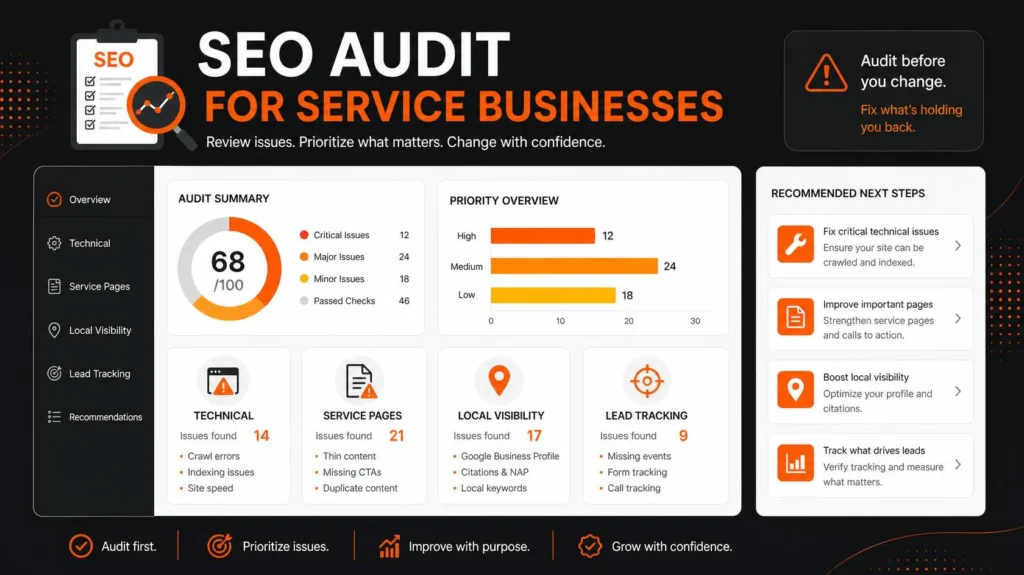
An SEO audit for a service business examines whether the right pages can be found and indexed, whether they match what potential customers search for, and whether the website gives visitors a clear path to making an enquiry. It covers technical SEO, service pages, content, local visibility, internal links, website experience, and conversion tracking.
The purpose is to identify what is working, what needs attention, and which changes deserve priority before you invest in new content, a redesign, or further SEO activity.
For a business that depends on calls, consultations, bookings, quotations, or contact forms, an audit should go beyond ranking positions. A page can attract visitors without bringing in suitable prospects. Another page may offer exactly the service customers need but remain difficult to discover.
A useful audit connects search visibility with the customer journey and the business outcomes the website is supposed to support.
What Is an SEO Audit for a Service Business?
An SEO audit for a service business is a structured review of a website’s technical health, search intent, service pages, content, local relevance, internal linking, user experience, and performance measurement.
Unlike a narrow technical scan, a service-business audit considers the relationship between a website’s search presence and its ability to generate qualified enquiries. The priorities for a local plumber, accounting firm, IT consultancy, dental practice, and marketing agency may differ because their customers search differently and follow different buying journeys.
An audit should produce more than a list of warnings. Each important finding needs evidence, an explanation of its likely impact, a recommended action, and a way to verify whether the change worked.
What Should a Service Business SEO Audit Include?
A practical audit should review the following areas.
1. Business goals and conversion baseline
Start by defining what a useful result means for the business.
A service website may aim to generate phone calls, consultation requests, booked appointments, quotation requests, or qualified contact-form submissions. Those actions should influence which pages receive the most attention.
Review:
- The services the business most wants to sell.
- The locations and customer groups it genuinely serves.
- The main conversion action on each important page.
- Existing organic traffic, search impressions, and clicks.
- Enquiry volume and lead quality where reliable tracking exists.
- Pages that already attract valuable visitors.
- Changes to the website, tracking setup, or marketing activity that may affect comparisons.
Record a baseline before making changes. Without one, it becomes difficult to distinguish the effect of an SEO improvement from seasonal demand, paid campaigns, tracking changes, or normal fluctuations.
2. Crawling, indexing, and technical SEO
Search engines need to access important pages and process their content. A technically attractive website can still have problems if valuable service pages are blocked, redirected incorrectly, duplicated, or difficult to discover.
Check:
- HTTP status codes for important URLs.
- Robots.txt rules and page-level indexing directives.
- Canonical tags and duplicate URL variations.
- XML sitemap accuracy.
- Redirect chains and broken internal links.
- Important pages that are missing from the internal linking structure.
- Mobile rendering and JavaScript-dependent content.
- Structured data errors where relevant.
- Security issues and HTTPS consistency.
Do not assume every URL should appear in Google’s index. Search results should contain pages that are useful and appropriate for search, not every archive, duplicate parameter URL, or internal search page generated by the website.
Use Google Search Console to investigate indexing and search performance, then combine it with a website crawl to understand the wider site structure. Google’s SEO Starter Guide explains foundational practices for making content accessible, understandable, and useful to searchers.
For implementation-focused problems, a dedicated technical SEO service may be relevant when diagnosis requires changes to crawling, indexing, redirects, architecture, or other technical elements.
3. Service pages and keyword intent
A service business usually has a small set of commercially important pages. These pages deserve careful review because they explain what the business offers and give interested visitors a route to enquire.
For every major service, ask:
- Is there a suitable page for the service?
- Does the page match the likely intent behind its target searches?
- Does it explain the service, who it is for, and the problems it addresses?
- Are the scope, process, limitations, and next steps clear?
- Does the page provide relevant evidence of credibility?
- Is there a visible and appropriate call to action?
- Can visitors reach the page through useful internal links?
Consider an IT support company with a page targeting managed IT services. If the page mainly discusses generic technology trends but barely explains the support offered, response arrangements, customer fit, or service scope, adding more keywords will not address the underlying problem.
The better approach is to identify the information a prospective customer needs and improve the page around that decision.
Keyword mapping is essential here. A focused keyword research service can help determine which searches belong on service pages, which need supporting articles, and which do not justify separate URLs.
4. Content quality and topical coverage
A content audit checks whether existing pages answer the questions they were created to address.
Review whether the content is accurate, useful, up to date, clearly organized, and specific to the service. Look for pages that repeat the same explanation without adding value, use vague claims instead of meaningful detail, or target a keyword without satisfying its underlying intent.
Common problems include:
- Service descriptions that could apply to almost any competitor.
- Articles that answer only the opening question and ignore important follow-ups.
- Outdated pricing, processes, regulations, or product information.
- Several pages targeting the same search intent without meaningful differentiation.
- Thin location pages that simply replace one city name with another.
- Important customer questions that are missing from the relevant service page.
- Claims about experience or results that cannot be supported.
Before rewriting a page, decide which action is appropriate: improve it, update it, consolidate it with another page, redirect it when justified, or leave it unchanged.
Publishing more content is not automatically the best response to weak search performance. Sometimes the problem is a poor page structure, incorrect targeting, technical accessibility, or a missing conversion path.
A structured content strategy and SEO content writing process can help connect individual pages with the broader subject and the questions customers need answered.
5. Local SEO and location relevance
Local service businesses need to consider how customers search within their service area. That includes searches containing a city or neighbourhood, searches with local intent that omit a location, and searches that lead people to Google Maps or a business profile.
Review:
- Whether the business has accurate and consistent contact information.
- Whether its Google Business Profile represents the real business.
- Whether important services are clearly described on the website.
- Whether location pages serve genuine customer needs.
- Whether location claims match the areas the business actually serves.
- Whether business information and website content are consistent.
- Whether reviews, local mentions, and other trust signals are managed appropriately.
- Whether important service and location pages link to one another where useful.
A business should not create dozens of nearly identical location pages solely to target more place names. A location page needs a genuine purpose, such as explaining service availability, local processes, customer needs, or relevant operating details.
Google states that local results are primarily influenced by relevance, distance, and prominence. These factors have different implications: a website can improve the clarity of its service information, but it cannot control a searcher’s physical distance from the business.
6. Titles, headings, and on-page relevance
Review the elements that communicate a page’s purpose to both visitors and search engines.
Check the title tag, main heading, subheadings, introductory answer, body content, image descriptions, metadata, and relevant links.
A useful title should communicate the page’s subject without promising something the content does not deliver. The H1 should make the main topic clear, while H2 and H3 headings should organize the explanation logically.
For example, a page about emergency electrical repairs should not use a vague heading such as “Our Solutions.” A heading that identifies emergency electrical repair services makes the topic and purpose clearer.
Check that each important page has a distinct purpose. Changing titles and inserting additional keyword variations will not fix a page whose actual content does not address the searcher’s need.
Use an on-page SEO review to evaluate intent alignment, content organization, metadata, headings, internal links, and conversion opportunities as connected elements.
7. Internal links and website architecture
Internal links help visitors navigate between related pages and give search engines additional paths to discover content.
A service business might publish a detailed article explaining the signs that a company has outgrown its current IT setup. If the article never links to the related managed IT service page, the reader may have to return to the navigation and search for the offering independently.
Useful internal linking should follow the customer’s journey.
Connect:
- Relevant educational articles to the service pages they support.
- Parent guides to narrower supporting resources.
- Related services where customers may reasonably compare or combine them.
- Important service pages to relevant case studies or evidence.
- Supporting pages back to the main topic where that relationship is useful.
Use descriptive anchor text that tells readers what they will find. Avoid adding links simply to reach a predetermined count.
Also check for orphan pages, excessively deep navigation, repeated links that provide little additional value, and destinations that redirect or return errors.
8. Performance, mobile usability, and website trust
An audit should examine whether visitors can use the website comfortably, especially on mobile devices.
Check loading delays, responsiveness, unexpected layout shifts, unreadable text, difficult navigation, intrusive overlays, broken forms, and buttons that do not behave as expected.
Google’s Core Web Vitals provide measurements for loading performance, interaction responsiveness, and visual stability. These measurements are useful diagnostic signals, but a perfect tool score does not guarantee strong rankings or conversions.
Review the experience on actual important pages rather than relying only on a homepage performance test. A website may have a fast homepage but a heavy service page, an unresponsive booking form, or a slow page containing third-party scripts.
For WordPress websites, a WordPress SEO review may help investigate platform-specific configuration and implementation problems. A separate website speed optimization review can focus on loading, responsiveness, image weight, scripts, and performance bottlenecks.
Trust matters as well. Make contact information, service details, business identity, relevant qualifications, policies, and genuine customer evidence easy to find where appropriate. Do not add fabricated testimonials or unsupported claims to make a page appear more credible.
9. Lead tracking and conversion paths
An audit is incomplete if it measures visibility but cannot determine whether the website produces useful business actions.
Check that important conversion events are measured correctly. Depending on the business, this may include contact-form submissions, booked appointments, qualified phone calls, quotation requests, or completed consultation bookings.
Review the entire path:
- A potential customer sees a search result.
- The customer visits a relevant landing page.
- The page answers the customer’s question.
- The customer finds a clear next step.
- The customer completes an action.
- The business records and qualifies the enquiry.
If organic visitors reach the correct service page but rarely enquire, investigate the page’s message, trust evidence, offer clarity, form usability, response expectations, and tracking accuracy before assuming that more traffic is needed.
A dedicated conversion rate optimization service may be useful when the evidence points to a problem in the visitor-to-enquiry process rather than search visibility alone.
How to Conduct an SEO Audit Step by Step
Use a repeatable process so the audit produces clear decisions instead of disconnected observations.
Step 1: Establish access and scope
Collect access to the relevant analytics, Search Console, website CMS, and crawling tools. Confirm the priority services, locations, business goals, and conversion actions.
Record limitations in data access before drawing conclusions.
Step 2: Build an inventory of important pages
List the homepage, primary service pages, key location pages, contact and booking pages, important educational articles, and any supporting resources.
Map each page to its purpose, intended audience, primary topic, and desired action.
Step 3: Collect technical and performance evidence
Crawl the website and investigate important URLs for status codes, indexability, canonicals, redirects, internal links, and other relevant technical issues.
Use Search Console to review impressions, clicks, search queries, indexing information, and available page-experience reports.
Step 4: Match pages to search intent
Compare the intended keyword and page purpose with the questions a real customer expects the page to answer.
Identify missing pages only when a distinct customer need justifies them. Avoid creating a separate URL for every slight keyword variation.
Step 5: Evaluate the user journey
Visit the site as a prospective customer. Start from a relevant landing page, identify the offering, look for proof, navigate to supporting information, and attempt the main conversion action.
Record friction that could prevent a customer from enquiring.
Step 6: Prioritize findings
Give each important finding a priority, evidence source, business impact, recommended action, implementation owner, and verification method.
Separate critical technical blockers from valuable but non-urgent improvements.
Step 7: Implement and verify
Make changes in manageable groups. Confirm that the implementation works, the intended page remains accessible, tracking still operates, and the change addresses the original problem.
Request recrawling through appropriate Search Console tools when useful, but do not assume a request causes immediate indexing or ranking changes.
Step 8: Monitor the right outcomes
Compare results with the original baseline, accounting for seasonality, campaign changes, and other known influences.
Look for improvements in relevant search visibility, qualified organic traffic, and valid enquiry actions. Record unexpected results and use them to guide the next round of work.
Which SEO Audit Issues Should You Fix First?
Prioritize findings by their likely impact, urgency, business relevance, confidence in the diagnosis, and implementation effort.
| Priority | Typical finding | Recommended response |
|---|---|---|
| Critical | Important service pages blocked from indexing, incorrect site-wide directives, or broken primary conversion paths | Investigate and correct promptly |
| High | Key service pages have incorrect targeting, major content gaps, or broken internal links that restrict discovery | Address after confirming the diagnosis |
| Medium | Weak supporting content, unclear headings, gaps in relevant internal links, or usability friction | Plan focused improvements |
| Lower | Minor cosmetic SEO warnings with no clear effect on important pages or user experience | Review when resources permit |
A simple working model is:
Priority = Business impact × Confidence × Urgency, considered alongside implementation effort.
This is a prioritization aid, not a Google ranking formula. It helps a team compare findings consistently rather than treating every warning as equally important.
A low-impact metadata issue on an unimportant archive page should not automatically outrank a broken enquiry form on a commercially important landing page.
A Practical Example of an SEO Audit
Consider a hypothetical plumbing business that offers drain cleaning, emergency repairs, and water-heater installation.
The website receives organic visitors, but the owner reports that enquiries are inconsistent.
The audit identifies three findings:
- The emergency repair page is difficult to reach from the main navigation and has few relevant internal links.
- The page explains plumbing services generally but does not clearly describe the emergency service or the next step for someone seeking urgent help.
- Contact-form submissions are not being recorded reliably, making lead performance difficult to evaluate.
The appropriate response is not to publish five new plumbing articles immediately.
First, fix the measurement problem so future results can be interpreted. Next, confirm the emergency page is technically accessible, improve its service-specific information, and strengthen relevant internal links. Then test the enquiry journey on desktop and mobile.
This hypothetical example illustrates the audit process, not a real client result or a prediction of performance.
Common SEO Audit Mistakes
Fixing every tool warning
Automated tools find potential problems, but not every warning matters equally. Confirm the issue on the actual page and assess its effect before changing the website.
Rewriting content before checking the underlying problem
Low traffic can result from targeting, indexation, competition, internal linking, seasonality, or other factors. Rewriting an otherwise useful page without diagnosing the cause can waste time and introduce new problems.
Creating pages for every keyword variation
Similar searches often express the same need. Separate pages are appropriate when the user intent or service genuinely differs, not just because a keyword tool lists another phrase.
Treating all traffic as equally valuable
Broad informational visits and high-intent service searches may play different roles in the buying journey. Review engagement and qualified enquiries alongside traffic volume.
Measuring rankings without checking conversions
Ranking data can help diagnose visibility, but it cannot tell the whole business story. A report should also assess relevant landing pages, enquiry tracking, and lead quality where those data are available.
Making several changes without recording them
When content, navigation, tracking, and technical settings change together, identifying the cause of a later result becomes harder. Keep a change log and test important updates.
SEO Audit Checklist for Service Businesses
Use this checklist before approving major content changes or commissioning further SEO work.
Business and tracking
- Priority services, locations, audiences, and conversion goals are documented.
- Baseline search and enquiry data are available where tracking permits.
- Important phone calls, forms, bookings, or quotation requests are measured appropriately.
Technical SEO
- Important URLs return the expected status codes.
- Robots rules and indexing directives do not unintentionally block priority pages.
- Canonicals, redirects, and sitemaps are reviewed.
- Internal links to key pages work and point to appropriate destinations.
- Mobile rendering and relevant performance issues are tested.
Content and service pages
- Important pages match their intended search intent.
- Service descriptions address real customer questions.
- Titles, headings, and metadata accurately represent the content.
- Duplicate, outdated, thin, or overlapping content is reviewed.
- Trust information and evidence are genuine and relevant.
Local visibility
- Business information is accurate and consistent.
- Location pages have real customer value.
- Service areas are described truthfully.
- The website and any relevant business profile accurately represent the business.
Prioritization and verification
- Every major finding includes evidence and a recommended action.
- Priorities reflect likely impact, confidence, urgency, and effort.
- Fixes have owners and a validation plan.
- Results are reviewed against a documented baseline.
How to Measure Whether the Fixes Worked
Choose metrics that correspond to the original finding.
| Audit objective | Useful measurements |
|---|---|
| Improve search discovery | Relevant impressions and clicks, query coverage, indexed status where appropriate |
| Improve landing-page relevance | Queries and landing pages, engagement context, qualified actions |
| Improve service-page performance | Organic visits to priority pages and relevant conversion actions |
| Fix technical problems | Crawl results, HTTP responses, indexing observations, successful rendering |
| Improve website experience | Real-user Core Web Vitals data where available, form usability, mobile task completion |
| Improve lead generation | Valid enquiries, qualified lead counts, booking completions, and appropriately tracked calls |
Google Search Console provides search-performance and technical information that helps website owners understand how their pages perform in Search. Read the official Search Console getting-started guide for the reports and diagnostics available.
Use comparisons that make sense. If enquiries vary seasonally, compare similar periods where possible. If a tracking event was broken before the audit, do not interpret its newly recorded conversions as proof that the underlying conversion rate improved.
For businesses reviewing website structure, an SEO-friendly web design approach can help connect future site changes with crawlability, page organization, usability, and conversion requirements.
How Often Should a Service Business Audit Its Website?
There is no single schedule that suits every website.
A small, stable service website may need periodic checks and additional reviews after significant changes. A larger site, a website undergoing a redesign, or a business operating across many locations may need more frequent technical and content monitoring.
Conduct an additional review after events such as:
- A redesign or migration.
- A major change in services or service areas.
- A noticeable change in relevant organic search performance.
- New indexing or technical problems.
- A change to lead forms, booking systems, or analytics.
- Significant updates to important service information.
The purpose is to detect meaningful changes and keep the website aligned with business needs, not to perform an audit merely to create another report.
Further Resources from Md Mynul Hassan
An SEO audit can also reveal whether the website communicates customer problems and business expertise clearly. The guide on using customer pain points to create AEO content explores the relationship between customer questions and useful content. For businesses reviewing credibility and evidence, reviews, testimonials, and case studies in SEO offers additional context.
Where AI-driven search visibility is relevant to the business, AEO and GEO consulting can support a broader review of content clarity, entity consistency, and how a business is represented across search experiences.
For a website that needs an audit-led improvement plan, visit the SEO Audit Service page to review the service’s scope and next steps.
About the Author
Md Mynul Hassan is an SEO, AEO, GEO, and brand visibility specialist based in Bangladesh, working with businesses remotely. His work focuses on connecting technical SEO, search intent, content structure, internal linking, local visibility, and conversion-focused website improvements.
Explore the Md Mynul Hassan website, connect on LinkedIn, watch SEO-related content on YouTube, or visit the Facebook page.
Marketplace profiles are also available on Upwork and Freelancer.com.
The Next Step
Before rewriting a service page or investing in more content, identify the evidence behind the problem. Confirm that important pages can be discovered, check that their content matches customer intent, review the enquiry journey, and prioritize the findings that matter most to the business.
A useful SEO audit ends with clear decisions and a way to verify them. That is what turns website analysis into a practical improvement plan.