
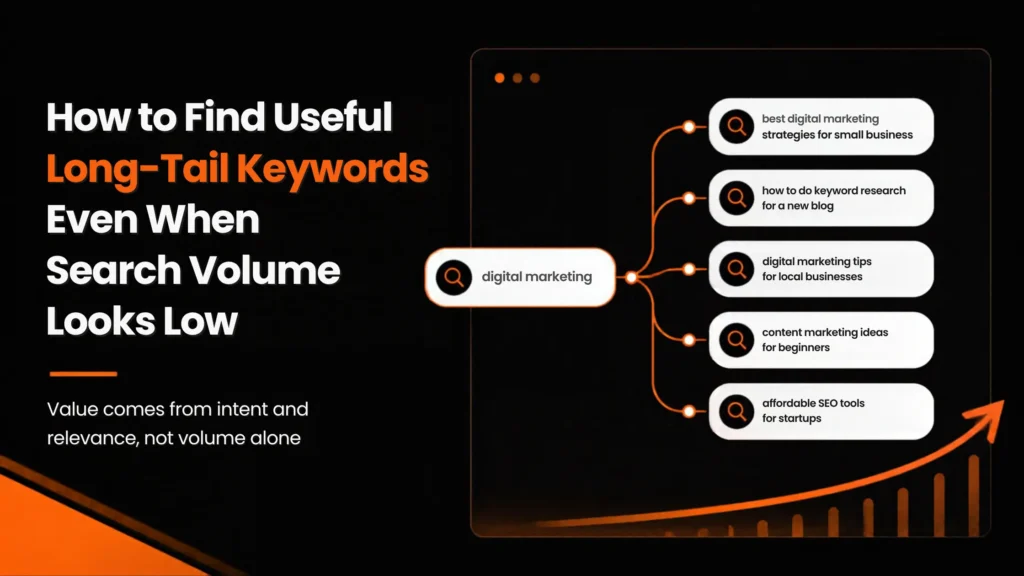
A low search-volume estimate does not automatically make a keyword useless. A specific query may reveal a clear customer problem, fit a valuable service, or help an existing page reach a more relevant audience. On the other hand, a long keyword with little relevance to your business may not deserve any investment.
The right way to evaluate long-tail keywords is to look at search intent, business relevance, evidence of demand, ranking feasibility, and the page that should answer the query. Search volume is one input, not the whole decision.
This guide explains how to find long-tail keywords, assess opportunities that keyword tools may underestimate, and decide whether each query deserves a new page, belongs within existing content, or should be left alone.
Are Low-Volume Keywords Worth Targeting?
Yes, low-volume keywords can be worth targeting when they match a real audience need and have a clear place in your content strategy. Their value depends on relevance, intent, feasibility, and the resources needed to address them. A low-volume keyword is not automatically easy to rank for, highly commercial, or capable of generating conversions.
Consider a company selling specialist accounting software. A broad keyword such as “accounting software” can represent several different needs. A more specific search about accounting software for a particular type of regulated business may communicate a narrower problem.
The specific query might have a much lower estimated search volume. Yet if the company genuinely serves that audience and can answer the question well, investigating it may be worthwhile.
The opposite is also true. A long phrase that mentions a product or service your business does not offer may be irrelevant even if a tool reports a reasonable amount of demand.
Before adding a low-volume keyword to your plan, ask five questions:
Does the query represent an audience you actually want to reach?
Can you identify the searcher’s likely goal?
Is there evidence that this query, or a related cluster of queries, represents demand?
Can your website produce a genuinely useful answer that has a reasonable chance of competing?
Does the query have a clear place in your existing website structure?
If the answers are promising, investigate further. If the only positive signal is that the phrase contains several words, keep researching.
What Are Long-Tail Keywords?
Long-tail keywords are specific search queries that generally have relatively low individual search demand compared with broader terms. They often communicate a more defined need, situation, preference, problem, or intended action.
For example:
| Broad search | More specific query | Possible intent |
|---|---|---|
| Keyword research | How to evaluate low-volume keywords for a new website | Learn a process |
| SEO services | SEO keyword research for a multi-location service business | Investigate a specific service need |
| Project management software | Project management software for a small remote design team | Compare solutions for a defined use case |
| Website audit | How to identify indexing problems on a WordPress site | Solve a technical problem |
These examples illustrate query intent. They are not verified search-volume estimates.
A keyword is not long-tail simply because it contains a particular number of words. Word count can help generate ideas, but specificity and search demand are more useful concepts for evaluating a query. A short phrase can be highly niche, while a long phrase can be vague or poorly aligned with what you sell.
For keyword research, focus on the need behind the wording.
A searcher looking for “best accounting software for a two-person consultancy” needs something different from a searcher looking for “what is accounting software.” The terms overlap in subject matter, but the searcher’s decision stage and expected answer are different.
That difference should influence the content format, not just the keywords you add to a spreadsheet.
Why Search Volume Can Mislead You
Search-volume tools estimate demand according to their own data sources, time ranges, settings, and methodologies. They do not provide a perfect, universal count of every search made for every possible query.
Google’s Keyword Planner documentation, for example, explains that average monthly searches are based on the selected settings and include close variants. Those estimates should be interpreted in their advertising research context rather than treated as an exact measure of the organic traffic an SEO page will receive.
Four situations deserve particular attention.
1. A keyword may have a low estimate but strong relevance
Suppose you provide technical SEO services to small SaaS companies. A very specific query about diagnosing indexing problems on a SaaS website might not have an impressive volume estimate.
It may still be useful if it describes the exact problem your audience needs to solve.
Relevance alone does not guarantee traffic or a lead. It does, however, give you a reason to investigate the query instead of dismissing it immediately.
2. A zero-volume estimate does not establish that nobody searches for the topic
Keyword tools may not report enough demand to produce a meaningful estimate for a particular phrase. The query could be genuinely rare, newly emerging, or part of a broader group of similar searches.
Do not treat these possibilities as interchangeable. A zero-volume result is a reason to look for additional evidence, not a reason to assume demand exists.
Check related queries, actual customer questions, search results, and any Search Console data available for your site. If none of those provides support, do not create a page purely on speculation.
3. Similar queries may represent the same opportunity
A keyword tool may return several phrases with slightly different wording. Publishing an individual article for every variation may split one topic across multiple URLs without serving a distinct user need.
Group queries according to intent before deciding how many pages to create.
4. Search demand is not the same as business value
A broad keyword may have more estimated searches but attract people who are not relevant to your business. A narrow query may reach fewer people while being closely related to a service or product you genuinely provide.
The correct choice depends on your objectives, not on which row has the largest volume number.
How to Find and Validate Long-Tail Keywords
A useful long-tail keyword research process combines query discovery with evidence and prioritization. Use the steps below to build a shortlist instead of collecting phrases without a clear plan.
Step 1: Start with customer problems, not only seed keywords
Write down the questions your audience asks before contacting a business, choosing a product, or trying to solve a problem.
Useful sources include:
Customer enquiries, sales conversations, and support questions.
Product reviews, service feedback, and relevant discussion forums.
Existing website searches and contact-form messages.
Questions raised during consultations.
Common objections, comparisons, and implementation difficulties.
Your website’s existing customer-language and topic research can be expanded through this guide to using customer pain points in AEO content.
For example, an ecommerce business might hear questions about selecting the correct product size, understanding material differences, or choosing an item for a particular use. Those questions can provide better starting points than simply adding words to a broad product keyword.
Do not assume every customer question has meaningful Google demand. Use these inputs to discover topics worth validating.
Step 2: Expand each seed topic into related queries
Start with a small number of terms that describe the products, services, or problems you want to address. Expand them using natural modifiers.
Useful modifiers include:
Audience: for beginners, for small businesses, for consultants.
Problem: not indexing, low search volume, poor conversion.
Use case: for ecommerce, for a B2B sales team, for a new website.
Comparison: versus, alternatives, difference between.
Decision: best, should I, which, worth it.
Process: how to, steps, checklist, how to fix.
Context: cost, location, industry, platform, or technical constraints.
Use Google autocomplete and related searches to discover possible wording. When a People Also Ask section appears for your target query, review it for relevant questions. Question-generating tools can also help expand an initial list.
Treat all suggestions as candidates. A suggested phrase is not proof of search demand, and a question should not become a new page unless it deserves separate coverage.
Step 3: Inspect the actual search results
Search for the candidate keyword in the target country and language. Review the types of pages that appear and the needs they seem to satisfy.
Check:
Are the results guides, service pages, product pages, comparison pages, or forums?
Do the visible titles and snippets address the same problem you want to solve?
Are the ranking pages broad resources or specific solutions?
Do results consistently address a particular audience or situation?
Are the results relevant to your business and the customers you want?
What useful information is missing or poorly explained?
The purpose is not to copy the top results. It is to determine what a searcher likely expects and whether your proposed page has a distinct contribution.
A specific query that returns a strong set of relevant results may be worth investigating even if a tool provides little volume data. If results are inconsistent or mostly unrelated, the query may be too ambiguous for the page you have in mind.
Step 4: Review your existing Google Search Console data
For a site that already receives search impressions, Search Console can provide evidence that external keyword tools do not show for your particular website.
The Search Console performance report includes metrics such as impressions, clicks, click-through rate, and other performance information, along with query and page dimensions where available.
Use it to look for:
Specific queries already generating impressions.
Relevant queries for which an existing page receives impressions but few clicks.
Groups of related queries that point to a content gap.
Queries where the ranking page does not fully answer the apparent need.
Pages that attract relevant traffic but do not generate meaningful business actions.
For example, imagine an existing guide already receives impressions for several specific queries around keyword prioritization. Before writing a new article for one phrase, inspect the current page. It may need a stronger section, a clearer explanation, or more relevant internal links rather than a separate URL.
Search Console data is evidence of your site’s observed visibility, not a complete inventory of all searches in the market. It should be combined with the other research methods.
Step 5: Compare demand signals rather than relying on a single tool
Use available evidence together:
| Signal | What it can tell you | What it cannot prove |
|---|---|---|
| Keyword tool volume | Estimated search demand under the tool’s methodology | Exact future organic visits |
| Search Console impressions | Your site’s observed search visibility for a query | Total market demand |
| SERP results | Search-result formats and apparent intent | That a new page will rank |
| Customer questions | Real audience problems and language | That the exact phrasing is popular in Google |
| Related query patterns | Whether a broader topic may have meaningful demand | That every variation needs its own page |
| Competitor coverage | Existing content and possible gaps | That copying a competing page will succeed |
A candidate becomes more promising when several independent signals support it.
For instance, a low-volume query might deserve further work if customers ask about the same problem, related search queries show a coherent topic, and your existing page already receives impressions for adjacent questions.
If the only evidence is an automatically generated phrase, keep it in your research backlog until you can validate its relevance.
How to Evaluate a Low-Volume Keyword
Once you have a shortlist, judge each candidate on more than volume and difficulty.
Use the following five criteria.
1. Search intent: Does the query express a clear problem or objective, and can your page satisfy it?
2. Business relevance: Does the topic connect to your audience, your services or products, and your website’s purpose?
3. Evidence of demand: Do multiple sources suggest that the need exists? Consider query estimates, related searches, Search Console data, and genuine customer questions.
4. Ranking feasibility: Are the current results realistically addressable with your available expertise, content resources, and website strength? Keyword difficulty can inform this judgment but should not decide it alone.
5. Value relative to effort: Is the potential benefit worth the research, writing, implementation, and ongoing maintenance required?
A practical opportunity score
For internal planning, score each criterion from 0 to 5, where 0 means no meaningful support and 5 means strong support. This is an editorial prioritization framework, not a standardized industry metric.
| Criterion | Score |
|---|---|
| Search intent fit | 0 to 5 |
| Business relevance | 0 to 5 |
| Evidence of demand | 0 to 5 |
| Ranking feasibility | 0 to 5 |
| Value relative to effort | 0 to 5 |
| Total | 0 to 25 |
Use the result as a discussion aid:
20 to 25: Strong candidate for priority research or publication.
15 to 19: Worth investigating further or adding to a relevant content cluster.
10 to 14: Consider strengthening an existing page before creating something new.
Below 10: Defer or discard unless new evidence changes the assessment.
The thresholds are suggested internal rules, not search-engine benchmarks. A score should not override an obvious problem, such as irrelevant intent or the absence of a credible page to answer the query.
Example: choosing between a broad and a specific query
Imagine a hypothetical SEO website comparing two candidate topics.
Candidate A is a broad keyword about keyword research with a relatively high volume estimate but several different possible intents.
Candidate B is a specific question about evaluating low-volume keywords, with little estimated volume but a clear connection to the site’s subject.
Candidate B may be a better fit for a focused educational article if its SERP supports that intent and the page provides useful guidance. Candidate A may need a broader resource, or it may be too competitive or ambiguous for the website’s current priorities.
No ranking or traffic outcome can be predicted from this comparison alone. The point is to identify a researchable opportunity rather than accept the volume ranking as the final decision.
When Should a Keyword Get Its Own Page?
A low-volume query should receive a separate page only when the subject deserves distinct coverage and the new URL has a clear role in the website.
| Situation | Recommended action |
|---|---|
| The query expresses a distinct problem that requires a different answer | Consider a new page |
| The query is a natural subquestion within a useful, existing guide | Add or improve a section |
| Several variations share the same dominant intent | Cluster them on one suitable page |
| Another URL already answers the query well | Improve internal links or update that URL |
| The topic has little business relevance and no supporting demand evidence | Defer or discard |
| A page exists but has weak relevance, poor structure, or technical problems | Diagnose before producing another page |
This decision protects the website from content duplication and unnecessary page creation.
For example, your site already has a Keyword Research Service that addresses service intent, long-tail opportunities, research methods, keyword mapping, and clustering. This new article should focus on the specific problem of deciding whether low-volume terms are worthwhile.
It should then link to the service page for readers who need hands-on research. That creates a clear relationship between educational content and commercial support without forcing the two URLs to compete for the same primary intent.
A similar process can be applied during an SEO audit, especially when existing pages appear to target overlapping queries.
Practical Examples of Low-Volume Keyword Research
The examples below are illustrative scenarios. They are not case studies or measured results from actual client projects.
Example 1: A niche B2B service
A company offers specialist compliance software to a narrow industry. A broad software keyword may not communicate whether the searcher has the right industry, company size, or compliance need.
A specific query may help identify the problem more clearly.
What to check: whether the company serves that industry, whether the current results indicate a distinct question or purchase need, and whether the existing product or service page already answers it.
Possible action: improve the relevant product page or create a focused supporting guide if the need is genuinely different from the existing content.
Example 2: A local service business
A home-service company may find specific queries combining its service with a property type or repair problem. These searches may be more relevant than a broad service phrase, but location wording should reflect where the business actually operates.
A genuine service-area strategy should connect the services, location information, and customer needs. It should not generate a separate page for every possible wording variation.
For this kind of business, relevant research should be connected to the broader Local SEO service and the specific pages that genuinely serve local customers.
Example 3: An existing informational article
Suppose a page about technical SEO already receives impressions for several specific questions, but its content only answers one of them briefly.
Before creating a collection of new articles, review the existing page, its intent, and the related questions.
A better explanation or a more useful section could satisfy the existing audience. If one question has a genuinely different intent and needs substantial independent coverage, a cluster article may be justified.
That decision may also require checking the technical condition of the website with a Technical SEO review and reviewing the page-level content structure through On-Page SEO.
Common Mistakes to Avoid
Rejecting every keyword with little reported volume
A low estimate is a signal to investigate, not a universal rejection rule. Review the query’s relevance, intent, related demand, and business context.
Assuming every long-tail keyword is easier to rank for
Specificity does not remove competition. A detailed query can still have strong, relevant competitors. Assess the actual results instead of relying only on a general rule about long-tail terms.
Creating a new page for every keyword variation
Publishing similar pages can fragment coverage and create confusion about which URL should satisfy the query. Cluster related terms by intent before creating new content.
Treating keyword difficulty as an objective ranking score
Third-party difficulty metrics use their own methodologies. They can help compare candidates, but they do not guarantee that one term is easier to rank for than another.
Writing content without enough value to justify a new URL
A page should solve a clear problem, explain relevant relationships, and provide actionable information. If it only repeats the same answer in slightly different language, improve an existing resource instead.
Your wider content strategy and SEO writing process should connect keyword discovery with intent, coverage, page relationships, and the reader’s next step.
Forgetting internal links
A useful supporting article should connect to the parent topic and relevant pages without forcing irrelevant destinations into the body.
A clear, contextual link can help users discover related resources and helps search engines understand how the pages relate. Your guide to internal linking for service pages explains this relationship in more detail.
How to Measure Results After Publication
Do not evaluate a low-volume keyword page solely by comparing its traffic with a broad keyword’s estimated search volume.
Review several types of evidence.
Search visibility: use Search Console to monitor query impressions, clicks, CTR, average position, and relevant pages over a meaningful period. Compare like-for-like date ranges and markets when possible.
Query relevance: check whether the page is appearing for the intended topic or attracting unrelated searches.
Page performance: evaluate whether the content is satisfying the intended query. If a page gains impressions but few clicks, review its title, snippet, and intent match before assuming the answer is to add more keywords.
Business outcomes: where measurement is available, consider qualified enquiries, product interest, bookings, signups, or sales. The relevant conversion will depend on the business model.
Content architecture: check whether the page strengthens the wider topic cluster or competes with another URL that is already more appropriate.
Search Console helps explain how a website performs in Google Search. It does not prove that a given phrase caused a conversion, and a low-volume query may be part of a broader group of searches that needs to be assessed together.
When visibility is present but the next business action remains unclear, the problem may be the page’s offer, messaging, or conversion path rather than keyword selection. Your Conversion Rate Optimization service is the relevant next resource for investigating those issues.
Low-Volume Keyword Research Checklist
Use this checklist before approving a keyword for publication.
Final Recommendation
Do not reject a keyword only because its estimated search volume is low. Investigate whether the query reflects a real problem, whether your business is relevant to the searcher, and whether the website can provide a distinct and useful answer.
Then decide whether the opportunity belongs on a new page, inside an existing resource, or in a future research backlog.
The strongest long-tail keyword strategy is selective. It connects actual audience needs to appropriate pages, makes sensible use of search data, and avoids creating content simply because a keyword tool returned another phrase.
For businesses that need structured research, intent analysis, keyword clustering, and page mapping, Md Mynul Hassan’s Keyword Research Service is the natural next resource.
Connect with Md Mynul Hassan
For more on SEO, search intent, AEO, GEO, and content strategy, visit my profiles:
For independent project support and professional collaboration, you can also find me on Upwork and Freelancer.com.
FAQ
These are suggested FAQs for the end of the article. They are not presented as verified Google PAA results.
1. Are low-volume keywords worth targeting?
Yes, when they match a relevant user need, have credible supporting evidence, and fit your content strategy. Low volume by itself is not enough to reject a keyword, but it is not evidence that the keyword will generate traffic or conversions.
2. How do you find long-tail keywords without paid tools?
Start with customer questions, Google autocomplete, related searches, relevant SERP questions, and your existing Google Search Console data. Organize the candidate phrases by intent and validate them before writing. Free discovery methods generate ideas, but they do not remove the need to evaluate relevance and page fit.
3. Can zero-volume keywords generate organic traffic?
They can, but a tool’s zero-volume estimate does not prove that demand exists. Check related queries, the actual search results, customer language, and relevant Search Console impressions. If there is no supporting evidence, treat the term as an unverified idea rather than a publishing priority.
4. Should every long-tail keyword have its own page?
No. Several closely related keywords can often be answered by one page when they represent the same search intent. Create a separate URL when the user need and required answer are meaningfully different, not merely because the wording changes.
5. Is keyword difficulty more important than search volume?
Neither metric should decide the strategy alone. Keyword difficulty estimates competition according to a tool’s methodology, while search volume estimates demand. Both should be considered alongside intent, business relevance, content quality, and the feasibility of producing a useful page.
6. How many long-tail keywords should one page target?
There is no universal number. A page should target one coherent topic and its closely related query variations. Add related terms when they improve coverage, but do not force unrelated keywords into the same page merely to increase keyword counts.
7. How do you know when to update an existing page instead of creating a new one?
Review whether the current URL serves the same intent, whether it already receives related impressions, and whether the new query requires a substantially different answer. If the existing page can satisfy the question naturally, improvement is often preferable to publishing a near-duplicate page.