
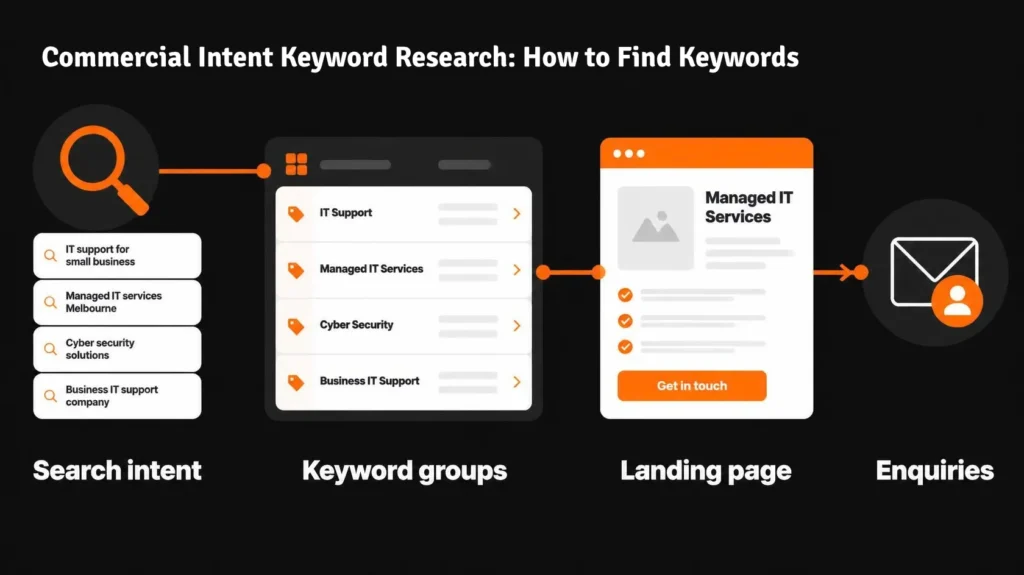
Commercial intent keyword research is the process of finding and prioritizing search queries used by people who are evaluating products, services, or providers before making a decision. It helps businesses move beyond search volume and focus on the relationship between what people search for, what the business offers, which page should answer the query, and whether the resulting traffic supports meaningful enquiries.
A keyword with commercial intent does not guarantee a customer. The goal is to identify relevant opportunities, match them with the right pages, and measure what happens after visitors arrive.
This guide explains how to find commercial intent keywords, distinguish research-stage queries from buying-stage queries, prioritize them, and turn the research into a practical SEO plan.
What Is Commercial Intent Keyword Research?
Commercial intent keyword research identifies search terms that suggest a person is comparing options or evaluating a purchase before committing. These searches often involve reviewing providers, comparing services, checking prices, examining alternatives, or deciding which solution fits their needs.
For example, someone searching for what is keyword research is mainly seeking an explanation. A person searching for commercial intent keyword research service may be comparing providers or looking for professional help.
The distinction matters because these searchers need different information. A guide should explain a concept, a comparison page should help people evaluate alternatives, and a service page should explain an offer and how to enquire.
Commercial intent research connects three decisions:
What does the searcher need? Identify the question, concern, or buying decision behind the query.
Which page should answer it? Select an existing page or determine whether a new page is justified.
How will success be measured? Track relevant visibility, engagement, enquiries, and qualified business opportunities where measurement is available.
For businesses that need to turn a large keyword list into an actionable plan, strategic keyword research services can connect search demand with customer needs, page targeting, and commercial priorities.
Commercial vs. Transactional vs. Informational Search Intent
Commercial and transactional keywords are related, but they do not always indicate the same stage of a decision.
| Intent | What the searcher is trying to do | Example query | Typical page type |
|---|---|---|---|
| Informational | Learn or solve a problem | What is commercial search intent? | Educational guide |
| Commercial investigation | Evaluate available options | Best keyword research service for a small business | Comparison guide or service evaluation page |
| Transactional | Take an action, such as hiring or purchasing | Hire a keyword research consultant | Service page or enquiry page |
| Navigational | Find a particular website or destination | Md Mynul Hassan keyword research service | Relevant brand page |
These categories help with planning, but they are not rigid labels. A query may have mixed intent, and different tools may classify the same term differently.
The live search results provide useful context. If a query primarily returns detailed guides and comparisons, publishing a short sales page may not satisfy the dominant intent. If the results mainly show providers and service pages, an informational article alone may be insufficient.
For a service business, the objective is to cover the buyer journey without making every page compete for the same purpose.
How to Recognize Commercial Intent in a Keyword
Commercial intent can be indicated by words and phrases, but the entire query matters more than any single modifier.
1. Evaluation and comparison terms
These queries suggest that searchers are narrowing their options.
Examples include:
Best keyword research service
Keyword research agency comparison
SEO consultant reviews
Alternatives to an SEO platform
Keyword research tools for agencies
Recommended response: Give readers useful comparison criteria, explain the differences that matter, and disclose relevant limitations. A comparison should help people decide rather than simply promote one option.
2. Price and value terms
Queries containing pricing, cost, packages, and quote may indicate that someone is evaluating affordability or return on investment.
Examples include:
Keyword research consultant pricing
SEO keyword research service cost
Keyword research agency packages
Cost of keyword research for a small business
Recommended response: Where possible, provide genuine pricing information, clarify what affects cost, and explain the deliverables. Do not invent a market average or publish a price that the business cannot substantiate.
3. Provider and service terms
These queries identify the type of help the searcher needs.
Examples include:
Keyword research consultant
Commercial keyword research service
B2B SEO keyword research
SEO keyword research specialist
Recommended response: A relevant service page should make the scope, process, intended customer, deliverables, and enquiry method clear.
4. Action-oriented terms
Words such as hire, book, request, and get a quote can signal that the searcher is closer to acting.
However, not every occurrence represents a completed purchase decision. Someone searching for how to request an SEO quote may still be researching the process.
Recommended response: Match the content to the complete query and the type of result appearing on Google, rather than relying on a word list alone.
How to Find Commercial Intent Keywords Step by Step
A repeatable process works better than collecting modifiers and assuming they indicate buyer readiness.
Step 1: Define the business outcome
Start by identifying the action that would make the research valuable.
For a service business, that might be a qualified enquiry, a consultation request, a phone call, or a proposal request. For an ecommerce website, it may be a purchase or another meaningful action in the buying journey.
Then define the target customer, service, market, and problem you solve. These details help eliminate queries that attract people outside the business’s actual audience.
For example, a consultant selling strategic keyword research may find a large set of searches related to free keyword generators. Some of those searchers could become clients, but many only need a free tool. Their relevance should be evaluated rather than assumed.
Step 2: Build a seed keyword list
Seed keywords describe the core services, products, customer problems, and buying decisions relevant to the business.
For an SEO consultancy, useful starting groups could include:
Keyword research services
Commercial search intent
Buyer-intent keyword analysis
SEO strategy for service businesses
Keyword mapping for landing pages
SEO content planning
Use the existing website, service descriptions, customer questions, sales enquiries, and relevant Search Console queries as starting points. These can reveal how the business describes its offer and how potential customers describe their problems.
Review existing URLs before planning more content. An SEO audit can help identify pages with overlapping targets, weak relevance, indexing issues, or content gaps that should be addressed before new pages are created.
Step 3: Expand the keyword list
Use appropriate keyword tools to find related queries, variations, questions, and commercial modifiers. Google Search Console can show queries already associated with a verified website property, while keyword research platforms can estimate demand and competition for broader opportunities.
Organize the expanded list into meaningful groups.
| Cluster | Example queries | Likely purpose |
|---|---|---|
| Definitions | What are commercial intent keywords? | Understand the concept |
| Research methods | How to find commercial intent keywords | Learn the process |
| Provider evaluation | Best commercial keyword research service | Compare providers |
| Service selection | Keyword research consultant for B2B | Find relevant professional help |
| Pricing | Commercial keyword research service cost | Evaluate affordability |
| Implementation | How to map keywords to service pages | Apply the research |
Avoid treating each variation as a separate article opportunity. If several terms express essentially the same need, one well-planned page may answer them all.
Step 4: Inspect the live search results
This is where a keyword spreadsheet becomes a content decision.
Search for the main query and examine the results. Pay attention to the types of pages ranking, the angles they use, and what a searcher would expect to find.
Ask:
Do the results favour educational guides, service pages, comparisons, or product listings?
Are searchers looking for a definition, a shortlist, pricing information, or a provider?
Which important questions appear in the ranking pages?
Is there a meaningful information gap your page can address?
Does your proposed page fit the dominant intent?
Do not assume that a keyword tool’s intent label fully explains the query. Treat its classification as a starting point, then check the SERP yourself.
For further context, Semrush’s commercial intent keyword guide discusses common commercial-query patterns and ways to research them. Use such guides to inform your process, but make the final decision based on your own audience, market, and page requirements.
Step 5: Group keywords by searcher need
Keyword clustering should reflect shared intent, not just matching words.
Consider these queries:
What are commercial intent keywords?
How do you find commercial intent keywords?
Commercial keyword research service
Commercial keyword research pricing
The first two could belong to an educational guide. The service and pricing queries may need a different destination because their primary purpose is evaluating professional help.
A clear content structure could include:
Pillar article: Explain commercial intent research, the workflow, and prioritization.
Supporting guide: Explore keyword-to-page mapping and cannibalization in greater depth.
Supporting guide: Explain how to research keywords for B2B service businesses.
Service page: Describe professional keyword research, deliverables, process, and the enquiry route.
Your SEO content strategy and writing service is a relevant resource for planning these relationships across existing and new pages.
Step 6: Map each keyword cluster to the right URL
Before creating a page, check whether the website already has a suitable destination.
| Search query | Likely intent | Appropriate destination |
|---|---|---|
| What is commercial search intent? | Informational | Pillar guide |
| Commercial intent keyword research | Informational with commercial investigation | Pillar guide |
| Keyword research service for B2B | Commercial | Relevant service page or dedicated guide, based on SERP |
| Keyword research consultant pricing | Commercial or transactional | Pricing information or service page |
| How to improve service-page relevance | Informational | On-page SEO guide or service resource |
The table describes likely choices, not automatic rules. Review the results and your existing content before deciding.
If a service page has the correct purpose but weak content, improving it may be more appropriate than publishing another page. If two pages address distinct needs, make their roles clear through their titles, headings, content, and internal links.
Use on-page SEO improvements to strengthen the relationship between the target query, page content, structure, and intended visitor action.
Step 7: Prioritize the opportunities
Not every commercially relevant keyword deserves immediate attention. Some may have little connection to the offer; others may be difficult to serve well with the current website or resources.
Use the following practical scoring model to compare candidates.
Commercial Opportunity Score = Business Fit + Buying Signal + SERP/Page Fit + Conversion Value
Score each dimension from zero to its maximum:
| Dimension | Maximum points | How to assess it |
|---|---|---|
| Business fit | 3 | Does the query relate closely to a service the business genuinely provides? |
| Buying signal | 3 | Does it indicate provider evaluation, pricing research, or a meaningful next step? |
| SERP/page fit | 2 | Can the proposed page satisfy the dominant intent? |
| Conversion value | 2 | Would the resulting visit plausibly support a valuable business action? |
| Total | 10 | A prioritization aid, not a ranking prediction |
This is an editorial framework for making consistent decisions. It is not an established industry benchmark, and the score does not predict search rankings or guarantee conversions.
For internal planning, a score of 8 to 10 can indicate a candidate worth evaluating first, 5 to 7 may justify further research, and 0 to 4 may suggest low relevance or a need for more information. Consider implementation effort and competition before making the final decision.
For example, a query closely related to a service you offer may deserve attention despite modest estimated search volume. A broad, high-volume phrase could receive a lower priority when its audience is poorly matched to your offer.
Step 8: Build the page around the decision
Once a keyword cluster has a destination, make sure the page addresses the actual concern that brought the searcher there.
For an educational guide, define the concept early, explain the steps, demonstrate the differences between options, and address common mistakes.
For a service page, clarify what the service includes, who it is for, how the process works, what information is needed, and how to make an enquiry.
For a comparison page, use consistent criteria and explain limitations fairly.
A strong content plan also supports topical depth through related pages, while avoiding repetition. Each supporting page should have a clear reason to exist.
Technical accessibility matters as well. Relevant internal links should lead to working canonical pages, and the website must allow search engines to access important content. A technical SEO review can help identify problems that make the intended page difficult to crawl, index, or interpret.
Step 9: Measure the outcome and update the research
Keyword research should be reviewed against actual performance rather than treated as a permanent spreadsheet.
Google Search Console’s Performance report documentation explains metrics including impressions, clicks, click-through rate, and search position. Use those metrics to identify queries that already bring relevant visitors and pages that may need improvement.
Where reliable analytics and CRM tracking are available, connect landing-page visits to enquiries and lead qualification. This creates a clearer view of business value than search volume alone.
Review the evidence before changing a page. A query with impressions but few clicks might need a clearer result title or a better intent match. A page with clicks but few qualified enquiries may need a more suitable audience, a stronger offer explanation, or a clearer conversion path.
Commercial Keyword Examples for Different Business Models
The best use of a keyword depends on what the business sells, whom it serves, and what the searcher expects to do next.
The examples below are illustrative, not verified search-volume or conversion data.
| Keyword | Likely intent | Practical response |
|---|---|---|
| Best keyword research tools for agencies | Commercial investigation | Comparison guide with clear evaluation criteria |
| Commercial intent keyword research | Informational with commercial investigation | Broad guide with an actionable methodology |
| Hire a keyword research consultant | Transactional | Service or enquiry page |
| Keyword research pricing for small businesses | Commercial | Pricing explanation or service page |
| Keyword research for ecommerce product pages | Informational or commercial investigation | Ecommerce-focused guide or relevant service page |
| Local SEO keyword research for dentists | Commercial investigation | Relevant Local SEO content or service page |
| What is transactional keyword intent? | Informational | Educational guide or relevant section within an existing resource |
For ecommerce companies, keyword intent can influence how category and product pages are planned. For local service businesses, location modifiers may matter when they reflect genuine service coverage. B2B firms may need to account for longer evaluation processes and multiple decision-makers.
These differences are reasons to adapt the research, not to publish separate pages for every slightly different phrase.
Common Commercial Keyword Research Mistakes
| Mistake | Why it causes problems | Better approach |
|---|---|---|
| Choosing keywords by volume alone | Demand estimates do not show whether the audience matches the offer | Assess intent, business fit, page type, and conversion value |
| Treating every modifier as proof of buying intent | Words such as “best” and “pricing” can appear in different contexts | Inspect the full query and SERP |
| Creating a page for every variation | Similar pages can overlap without meeting distinct needs | Cluster by intent and map keywords to URLs |
| Ignoring current website content | A new page may duplicate a useful existing destination | Review the site and improve or consolidate where appropriate |
| Trusting tool classifications without checking | Intent labels and metrics are estimates and may disagree | Use tools to generate candidates, then manually validate |
| Measuring only clicks or rankings | Visibility does not establish whether the traffic is qualified | Track meaningful actions and lead quality where possible |
| Publishing comparisons without evidence | Unsupported comparisons can mislead readers and weaken trust | Explain the evaluation criteria and disclose limitations |
Commercial keyword research should give a business a clearer basis for making decisions. If the process simply produces more terms in a spreadsheet, it has not gone far enough.
How to Measure Commercial Keyword Performance
Use metrics that reflect both search visibility and business relevance.
| Metric | What it helps answer | Limitation |
|---|---|---|
| Impressions | Is the page appearing for relevant queries? | Visibility does not prove relevance or conversion value |
| Clicks | Are searchers visiting the page? | Clicks alone do not show lead quality |
| CTR | Are impressions generating clicks? | Interpretation depends on query, position, SERP features, and audience |
| Average position | How prominently does the site appear under Search Console’s reporting method? | It is an aggregate metric, not a fixed ranking for every searcher |
| Relevant landing-page sessions | Are target audiences reaching the intended page? | Depends on correctly configured analytics |
| Qualified enquiries | Are visitors taking a useful business action? | Requires a consistent definition of a qualified enquiry |
| Sales or opportunities | Is organic search contributing to business outcomes? | Attribution can be complicated when buyers use multiple channels |
For a basic website, begin with Search Console and an accurate enquiry-tracking process. A more mature business may connect analytics events with CRM records to distinguish enquiries from qualified leads and completed sales.
For service businesses, the next step after acquiring relevant traffic is making the offer easy to understand and act on. Conversion rate optimization can help evaluate landing-page clarity, forms, calls to action, and friction in the enquiry journey.
The measurement process should remain realistic. Some keywords support early research, while others are closer to a buying decision. A useful reporting model considers assisted journeys and supporting content rather than expecting every article to produce an immediate sale.
Commercial Intent Keyword Research Checklist
Use this checklist before publishing a new page or changing an existing one.
For WordPress sites, a WordPress SEO review can help connect content planning with implementation, indexing, metadata, internal linking, and structured data. For a new website or redesign, an SEO-friendly web design approach can address page architecture before it becomes more difficult to change.
Frequently Asked Questions
Do commercial intent keywords always generate more enquiries?
No. They indicate that a searcher may be evaluating a purchase or provider, but they do not guarantee that the person fits the business, trusts the offer, or completes an action. Relevance, page quality, competition, and the visitor’s circumstances also matter.
Can a blog post target a commercial intent keyword?
Yes. A blog post can serve commercial investigation when readers need an explanation, comparison, or decision framework before selecting a provider. When the SERP strongly favours service pages, a commercial landing page may be more appropriate.
Should a business target every commercial keyword it finds?
No. Prioritize terms that relate to the actual offer, have a suitable page destination, and support a meaningful customer need. Irrelevant queries can consume resources without contributing to the business objective.
Is keyword-tool intent data enough to choose a page type?
No. Treat automated intent classification as a research signal. Inspect the live search results, compare the ranking page types, and review the existing site before deciding what to publish.
A Practical Next Step
Commercial intent keyword research works best when it ends in clear decisions: which searchers matter, what they need, which pages should serve them, and how performance will be evaluated.
Start with a small set of relevant keywords, check the live SERPs, map them to the right URLs, and measure the results. Expand the work as the evidence improves.
If you need help turning search queries into a prioritized plan, Md Mynul Hassan’s keyword research service provides a relevant next step for businesses that want a more structured approach to keyword targeting and page planning.
About the Author
Md Mynul Hassan is an SEO, AEO, GEO, and brand visibility specialist based in Bangladesh, working remotely with businesses and agencies. Learn more about Md Mynul Hassan and his SEO approach.
You can also connect through LinkedIn, follow SEO-related videos on YouTube, or visit the Facebook profile. For professional project enquiries, find Md Mynul Hassan on Upwork and Freelancer.com