
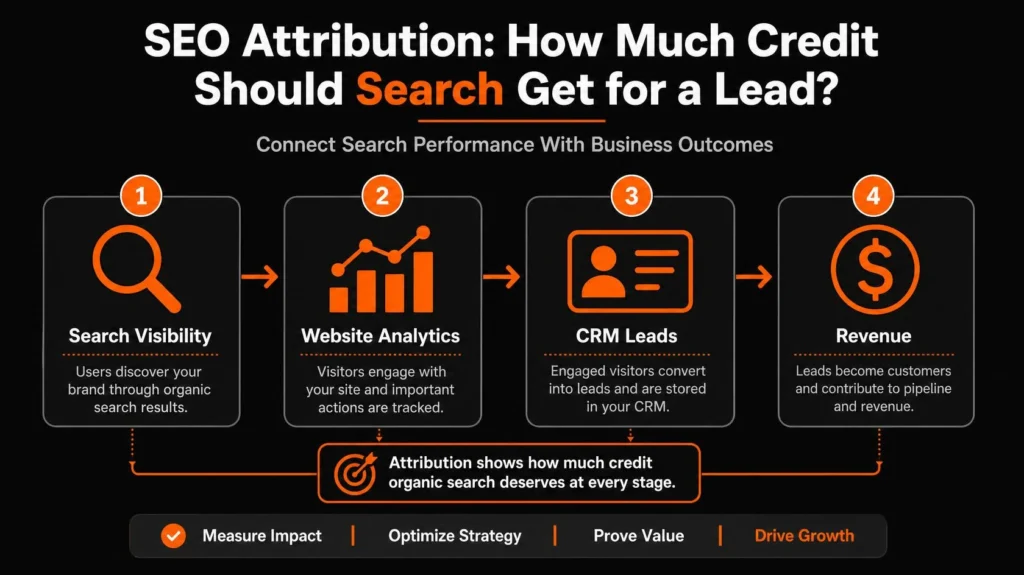
SEO attribution is the process of assigning credit to organic search for the leads, customers, or revenue it helps generate. The difficult part is deciding how much credit search deserves when a prospect also interacts with paid advertising, social media, email, referrals, or direct visits before converting.
A useful SEO attribution system connects four layers: search visibility, website activity, lead qualification, and commercial outcomes. Google Search Console helps measure organic search performance, Google Analytics 4 records website interactions and applies attribution rules, and a CRM connects enquiries with opportunities and sales.
No single report explains the entire customer journey. The goal is to build a consistent, evidence-based view of SEO’s contribution without claiming that every customer or dollar of revenue came from organic search.
What Is SEO Attribution?
SEO attribution is a measurement approach that assigns some or all of a lead’s or customer’s conversion credit to organic search interactions. It helps businesses understand where search fits into the journey from discovering a brand to submitting an enquiry and eventually becoming a customer.
For example, a potential customer may discover a company through an informational Google search, return a week later through a branded search, review the service page, and then call after receiving a recommendation from a colleague. Organic search contributed to the journey, but the available evidence may not justify giving SEO all the credit.
SEO attribution needs to answer three separate questions:
- Acquisition: Did organic search introduce this person or business?
- Conversion assistance: Did search help the prospect research, compare or revisit the business?
- Commercial outcome: Did the enquiry become a qualified opportunity, customer or sale?
These are related questions, not interchangeable metrics.
SEO attribution vs. SEO performance tracking vs. SEO ROI
SEO performance tracking measures activity such as impressions, clicks, organic sessions, landing-page engagement and tracked events. Attribution determines how conversion credit is assigned. SEO return on investment compares the business value attributed to SEO with the cost of producing that result.
A page can gain impressions without gaining clicks. Organic visits can increase without generating qualified enquiries. Leads can increase without generating profitable customers. The reporting system should preserve those distinctions.
Why Is SEO Attribution Difficult?
Organic search rarely operates in isolation. People can discover a brand in one session, return through another channel, and convert after several additional interactions. The longer the buying journey, the more difficult it becomes to assign complete credit to each influence.
Four issues commonly complicate measurement.
1. Buyers use multiple channels. A prospect may discover a guide through organic search, watch a YouTube video, return via an email link, and submit a form after a branded search. A last-touch model may credit the final eligible interaction without showing the full contribution of the earlier guide.
2. SEO can influence future demand. Informational content may help someone understand a problem long before they are ready to contact a supplier. Its contribution can be understated if the report focuses only on the final session.
3. Some interactions are not captured consistently. Phone calls, messages, offline conversations and referrals may happen outside website analytics. Returning visitors may also appear differently across reports, depending on the attribution model and the data available.
4. A recorded interaction is not proof of causation. Assigning 40% of a conversion to organic search under a chosen model does not mean a controlled experiment has proved that SEO created exactly 40% of the sale. It means the model assigned that share of the recorded credit.
This is why a report needs both a clear attribution rule and a statement of its limitations.
Which Data Sources Should You Use for SEO Attribution?
The most useful measurement system combines search data, web analytics and customer records. Each source has a different job.
| Data source | What it helps answer | What it cannot establish alone |
|---|---|---|
| Google Search Console | Which search queries and pages generate impressions and clicks? How are CTR and average position changing? | Which named lead or closed sale came from a particular query |
| Google Analytics 4 | Which recorded sources, sessions, landing pages and key events are associated with website activity? | Complete offline sales attribution if the necessary records and connections are missing |
| CRM or lead-management system | Which enquiries became qualified leads, opportunities and customers? What value was recorded? | Every prior anonymous interaction if it was never captured or linked |
| Call tracking or booking system | Which tracked calls, bookings or enquiries occurred, and what happened next? | Conversations that were never tracked or could not be matched reliably |
Google explains how to use Search Console performance reports to examine queries, pages, clicks, impressions and CTR. Those reports are useful for finding organic search opportunities and measuring visibility changes, but they should not be mistaken for an individual customer’s complete conversion history.
For website traffic sources and recorded key events, the GA4 Traffic acquisition report provides another layer of evidence. It distinguishes session-level acquisition information from first-user acquisition information. A person who first discovered a website through organic search can return later through another channel, so the two reports can legitimately tell different stories.
Build a four-layer measurement framework
A practical framework is:
- Discoverability: Use Search Console to measure organic visibility, relevant queries and landing-page clicks.
- Website activity: Use GA4 to examine organic sessions, landing pages and properly configured lead events.
- Lead quality: Use a CRM or lead register to track valid enquiries, qualification status and opportunity creation.
- Commercial outcomes: Connect opportunities with closed sales, recorded revenue and the cost of the SEO programme.
This structure is useful because it reveals where results break down. If organic clicks rise but qualified leads do not, the response may involve search intent, landing-page relevance or conversion friction. If qualified leads rise but revenue does not, sales qualification, pricing or follow-up may deserve attention.
An SEO audit can help identify technical or measurement problems before the team draws conclusions from incomplete numbers.
Which Attribution Model Should You Use?
An attribution model defines how conversion credit is distributed among recorded interactions. The right model depends on the decision being made, the available data and the business’s sales cycle.
| Model or reporting view | How credit is assigned | Useful for | Main limitation |
|---|---|---|---|
| First-touch | Gives credit to the first recorded eligible interaction | Understanding which channels introduce prospects | Understates later interactions that help close the sale |
| Last-touch | Gives credit to the final eligible interaction | Understanding which recorded interaction preceded conversion | Can understate earlier research and discovery |
| Organic-entry cohort | Groups leads or conversions by an organic first visit or acquisition source | Comparing the downstream outcomes of people first acquired through organic search | Requires a consistent cohort definition and suitable tracking |
| Multi-touch | Distributes credit across several recorded interactions according to defined rules | Understanding journeys involving several channels | Different rules can produce different allocations |
| Data-driven attribution | Uses available path data and a model to distribute credit | Analysing eligible journeys where sufficient data and platform support exist | Still depends on the system’s coverage, model and configuration |
These categories are not all selectable models in every analytics platform.
Google’s current GA4 attribution guidance lists data-driven attribution, paid and organic last click, and Google paid channels last click for its Attribution reports. Google’s guidance also explains that earlier options, including first click, linear, time decay and position-based models, are no longer available as GA4 attribution-report models. A first-touch view can still be useful as a separate reporting question, but do not assume that every conceptual model is a current GA4 setting.
Which model is best for SEO?
For most lead-generation businesses, one model is not enough to answer every management question. A practical report can show three separate views:
- First recorded source: Where did the contact first become identifiable, when that information is available?
- Conversion attribution: Which channel or touchpoint received credit under the selected analytics model?
- CRM outcome: How many leads became qualified opportunities and customers, and what value was recorded?
Keep those views separate. Do not add first-touch leads, last-touch leads and fractional multi-touch credit together as though they represent independent conversions. They are alternative views of overlapping customer journeys.
For a long B2B sales cycle, a CRM-based cohort view may be particularly useful. For a short purchase journey, session-based conversion reporting may provide a clearer day-to-day signal. Both depend on accurate event definitions and consistent reporting windows.
How to Set Up SEO Lead Attribution
A repeatable implementation process is more useful than choosing a sophisticated model before the tracking foundation is reliable.
Step 1: Define the conversions that matter
Write down what counts as an enquiry and what makes it commercially useful. For example:
- A form submission is a raw lead.
- A valid enquiry meets basic contact and service criteria.
- A qualified lead matches the business’s target customer and has a relevant need.
- An opportunity has progressed into a genuine sales discussion.
- A converted lead has become a customer.
Do not treat every click on a phone number, every form interaction or every contact-page visit as a lead. Track a genuine submission or completed action, and separate that event from later qualification and sale stages.
Google’s GA4 event recommendations include generate_lead for initial lead acquisition, qualify_lead for leads that meet qualification criteria, and close_convert_lead for a lead that becomes a customer. These event names can support a consistent design when they fit the implementation. The names alone do not create reliable tracking; each event must fire at the correct point and use appropriate data.
Step 2: Establish an organic search baseline
In Search Console, review a consistent period and record:
- Organic clicks and impressions.
- CTR and average position.
- Pages receiving organic clicks.
- Queries related to important services or products.
- Branded versus non-branded search patterns, where the available data permits.
- Relevant country and device differences.
Compare equivalent periods and annotate important changes, such as a site migration, a major content release or a technical fix.
Search Console query data has reporting limitations. Some queries may be omitted for privacy reasons, and the visible table may not contain every query. Therefore, query totals and attributed lead counts should not be expected to match exactly.
Step 3: Configure GA4 traffic and lead measurement
Check the Traffic acquisition report for organic search and examine the landing pages and key events associated with those sessions. Then compare that view with first-user acquisition information where it helps explain how people first reached the website.
Before trusting the numbers, test the implementation:
- Complete a test form or booking using a controlled test journey.
- Verify that the expected event fires once, at the correct time.
- Confirm that the source and landing-page information appear as expected.
- Check that unsuccessful form attempts do not count as completed leads.
- Confirm that duplicate tags or multiple event triggers are not inflating totals.
Document your chosen attribution model and lookback settings. When those settings change, note the date and the effect they may have on comparisons.
Step 4: Capture marketing source and landing-page information
Your lead form or analytics setup should preserve the useful context available at the time of the enquiry. Depending on the site and privacy requirements, this might include:
- First recorded source and medium.
- Converting session source and medium.
- Original landing page.
- Form or service page submitted.
- Campaign parameters for properly tagged campaigns.
- Lead creation date and a record ID for deduplication.
Use UTM parameters consistently for marketing campaigns that need them, such as tagged email campaigns or social campaigns. Do not add campaign parameters indiscriminately to internal website links, because doing so can distort source reporting.
Do not assume that a single hidden form field can reconstruct the full customer journey. It captures only the information its implementation is designed to preserve.
Step 5: Connect website enquiries with CRM outcomes
Record what happens after the form submission. Useful fields can include a unique lead ID, creation date, qualification status, opportunity value, closed status, close date and revenue.
Preserve the original source separately from the latest source where your CRM supports both. A prospect who first entered through an organic article and later clicked a branded search result should not silently lose the original acquisition context.
For calls, offline conversions and bookings, establish a documented process for matching outcomes to earlier web activity when reliable identifiers and appropriate permissions are available. If the lead cannot be matched, report it as unknown or unattributed rather than assigning it to SEO by assumption.
Step 6: Reconcile the reports
GA4 and a CRM can show different totals without either system necessarily being broken. They may use different definitions, counting methods, timestamps, deduplication rules, attribution windows or records.
Investigate differences in this order:
- Confirm both systems count the same type of event.
- Compare the same reporting period and timezone.
- Remove internal tests, spam and duplicate submissions.
- Check whether calls and offline leads are included in one system but not the other.
- Review whether source data was absent or overwritten.
- Record any unresolved difference in the report.
A report should identify these limitations rather than force the numbers into a false match.
Step 7: Build a decision-focused dashboard
The dashboard should let a manager move from visibility to business outcome without confusing the metrics.
A useful monthly report can include:
- Organic clicks and important landing-page trends.
- Tracked organic sessions and valid lead submissions.
- Qualified leads and opportunity creation.
- Closed customers and associated recorded revenue.
- SEO cost for the reporting period.
- Changes implemented and the next measurement question.
For local or service-area businesses, reporting may also need tracked calls, appointment requests and location-specific landing pages. The relevant measurement plan will differ from an ecommerce site that can record online purchases directly.
A Practical SEO Attribution Example
Consider a hypothetical B2B service company.
A prospect discovers a detailed service guide through an organic search. Several days later, the prospect returns through a branded organic search, visits the service page and submits an enquiry. A salesperson follows up, and the prospect eventually signs a contract worth $12,000.
The records might show:
| Journey stage | What the team records | Why it matters |
|---|---|---|
| First discovery | Organic landing page, if recorded | Shows an initial search-related entry point |
| Research visit | Additional source, page and session data | Helps explain the wider journey |
| Enquiry | Valid lead submission and CRM ID | Creates the measurable lead record |
| Qualification | Qualification status and date | Separates a raw enquiry from a suitable opportunity |
| Closed sale | Contract value and close date | Connects marketing records with a business outcome |
A first-touch report may emphasise the initial guide. A last-touch report may emphasise the later organic interaction. A multi-touch model may spread credit across several eligible touchpoints, depending on the system’s rules.
None of these reports, on its own, proves the incremental effect of SEO. The practical objective is to show what the evidence supports, keep the attribution rule consistent and give sales and marketing teams enough context to make better decisions.
How to Measure SEO-Attributed Leads, Pipeline and ROI
Start with formulas that match your actual data rather than reporting impressive figures that the systems cannot support.
1. Organic session lead conversion rate
Formula:
Organic session lead conversion rate = organic sessions containing a valid lead event ÷ total organic sessions × 100
This measures the percentage of organic sessions in which a valid lead event occurred, using the same session definition and date range in both figures.
It is not the same as the percentage of people originally acquired through organic search who become customers months later. That is a cohort or customer-lifecycle question and may require CRM data.
2. Qualified lead rate
Formula:
Qualified lead rate = qualified organic-attributed leads ÷ total organic-attributed leads × 100
This rate helps identify whether search is bringing relevant prospects. It depends on a consistent qualification definition and a clearly documented method for assigning lead attribution.
3. SEO-attributed pipeline value
For a simple single-source report, pipeline value may be the total value of opportunities assigned to SEO under a documented rule.
For fractional multi-touch attribution, use:
SEO-attributed pipeline value = sum of each opportunity’s eligible pipeline value × its assigned SEO credit percentage
For example, if a hypothetical $10,000 opportunity receives 30% SEO credit under the selected model, the associated attributed pipeline value is $3,000. That is an allocation of pipeline value, not $3,000 of booked revenue or profit.
Do not include the same entire opportunity at 100% in several channel totals and then sum them as if each channel independently generated the full value.
4. SEO ROI
When the required financial records exist, a useful margin-based formula is:
SEO ROI = (SEO-attributed gross profit − SEO investment) ÷ SEO investment × 100
The SEO investment should include the costs that belong to the analysis period, such as consultant or agency fees, content production, relevant development work, tools and internal time where measurable.
If gross profit or an appropriate margin figure is unavailable, report attributed revenue and SEO cost separately. Do not present a revenue-to-cost calculation as a precise profit-based ROI.
SEO attribution and ROI reporting become more useful when the method stays consistent from one reporting period to the next. A well-documented estimate is often more informative than a seemingly exact figure based on missing source data.
Common SEO Attribution Mistakes
Giving organic search credit for every branded search conversion
A branded organic visit may be the final recorded touchpoint, but the prospect could have discovered the brand through a recommendation, advertising, social media or previous offline contact.
Better approach: Preserve first-source information where available and compare it with the selected conversion-attribution view.
Measuring rankings and clicks as if they were leads
Rankings, impressions and clicks describe visibility and traffic. They do not independently show whether the visitors are suitable prospects.
Better approach: Track the progression from search visibility to valid enquiry, lead qualification, opportunity creation and closed sale.
Treating Search Console queries as customer-level attribution
Search Console helps identify query and page trends. It does not provide a full identity-linked history that reliably connects a specific search query with a named customer.
Better approach: Use search queries for content and landing-page analysis, then use properly recorded website and CRM data for conversion reporting.
Counting duplicate submissions as separate leads
A repeated form submission, a thank-you-page reload or a duplicate tag may inflate conversion totals.
Better approach: Use unique lead identifiers where possible and audit the event trigger before interpreting changes.
Losing the original lead source
A prospect may return through direct traffic or another channel before submitting a form. If the CRM stores only the latest session, the earlier acquisition context may disappear.
Better approach: Preserve first recorded source and current conversion source as distinct fields when the tracking design supports both.
Changing attribution rules every month
A reporting model change can alter how credit is distributed, making a previously strong or weak channel appear to change for methodological reasons.
Better approach: Keep the primary reporting model stable and document model changes. If the new model materially changes the interpretation, explain the break in the trend rather than presenting the series as directly comparable.
SEO Attribution Reporting Checklist
Use this checklist before presenting results to management.
- The primary KPI is defined, including what counts as a lead.
- Lead submissions and qualified leads are reported separately.
- Search Console and GA4 cover documented reporting periods.
- GA4 organic traffic dimensions and key events have been tested.
- Duplicate submissions, internal tests and spam are handled consistently.
- The CRM stores source information and lead progression where available.
- Original source and converting source are not silently treated as identical.
- Call, booking and offline conversions have a defined handling process.
- The attribution model and reporting window are documented.
- Pipeline value and revenue are not treated as the same outcome.
- Cost inputs are documented before SEO ROI is calculated.
- Unmatched or unattributed records remain visible in the report.
For measurement problems involving incomplete page tracking, broken events or inconsistent landing-page targeting, begin with a focused technical SEO review and on-page SEO review. For deeper work connecting customer intent with the right pages, review the keyword research service and SEO content strategy service.
How to Interpret Attribution Without Overclaiming
Attribution is a reporting method, not a substitute for causal evidence. The amount of credit assigned to SEO depends on the selected model, the information captured, the conversion window and the quality of lead records.
When assessing SEO’s contribution, compare several signals rather than relying on a single number. Consider whether important organic landing pages are gaining relevant traffic, whether qualified enquiries are changing, whether the sales cycle has had enough time to progress, and whether other marketing or business changes could explain the results.
Where practical, businesses can supplement attribution reports with a broader evaluation of incremental impact. That might involve comparing appropriate time periods, examining non-branded search trends, accounting for seasonality and major campaigns, or designing a suitable experiment. Each method has limitations, and a simple before-and-after change does not automatically establish causation.
A useful attribution report should be clear about three things: what the data directly records, what the chosen model assigns, and what remains uncertain. That discipline makes SEO reporting more credible and helps managers decide where the next investment or investigation should go.
Final Recommendation
Build SEO attribution around a clear chain of evidence: search visibility, recorded website activity, qualified leads, opportunities and closed outcomes. Use Search Console to understand how organic search performs, GA4 to analyse recorded sessions and events, and CRM records to connect enquiries with business results.
Choose an attribution model that suits the decision being made, document its limitations, and keep the definitions stable. When the available evidence cannot connect a sale to a particular search interaction, report that limitation instead of manufacturing certainty.
For additional context, review my SEO case studies and industry SEO resources. If you need a more specific strategy for tracking, search visibility or conversion paths, you can learn about my SEO approach or contact me to discuss your measurement goals.
About the author: Md Mynul Hassan is an SEO, AEO, GEO and brand visibility specialist based in Bangladesh, working remotely with businesses internationally. You can connect with me on LinkedIn, watch my YouTube content, or follow my Facebook updates. You can also review my professional profiles on Upwork and Freelancer.com.