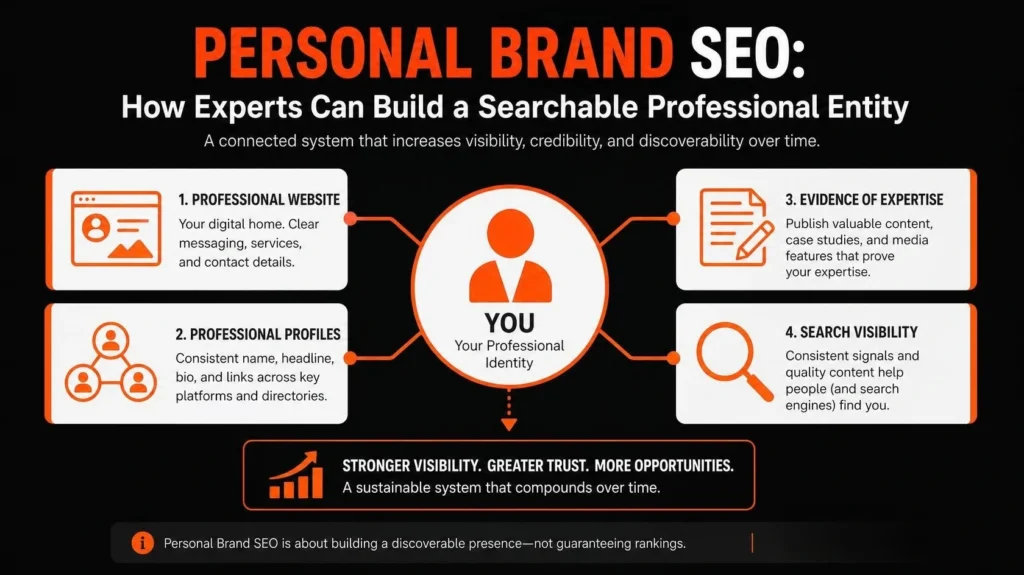
Personal brand SEO is the process of making a professional’s name, expertise, website, published work, and online profiles easier to discover and understand through search engines. It combines a clear personal website, consistent professional information, useful content, credible evidence of expertise, and accurate technical signals. The goal is to build a recognizable online identity that people can discover and verify, without relying on one social platform or promising a particular Google ranking.
For consultants, freelancers, founders, and independent experts, this requires more than creating a LinkedIn profile or publishing occasional posts. The website, profile pages, service descriptions, articles, professional contributions, and third-party mentions should reinforce the same real identity.
This guide explains how to plan that system, connect the relevant pages, measure its performance, and avoid the mistakes that make professional identities difficult to understand.
What Is Personal Brand SEO?
Personal brand SEO is the application of search engine optimization to an individual’s professional identity. It helps connect a person’s name with their actual field of expertise, work, website, professional profiles, and relevant public contributions.
For example, someone searching for a consultant might want to know:
Who is this person?
What does this professional actually specialize in?
Does the website support the claims made in their profile?
Can I find relevant work, publications, or qualifications?
Is this the same person I found on LinkedIn or a freelance marketplace?
Personal brand SEO helps organize the information needed to answer those questions.
It includes several related activities: optimizing a personal website, aligning professional biographies, creating useful expert content, improving branded search visibility, connecting related pages through contextual links, and using structured data where appropriate.
It does not mean filling every profile with the same keywords. A professional identity becomes clearer when the information is accurate, specific, and supported by relevant evidence.
Personal branding versus personal brand SEO
Personal branding defines what a professional wants to be known for and how that identity is communicated. Personal brand SEO focuses on making the identity and its supporting information discoverable through search.
| Aspect | Personal branding | Personal brand SEO |
|---|---|---|
| Primary objective | Establish professional positioning and reputation | Improve discoverability and understanding through search |
| Main activities | Positioning, communication, networking, visual identity | Website optimization, content, internal links, indexing, structured data |
| Typical assets | Biography, portfolio, social profiles, presentations | Those same assets organized around search intent and verifiable identity |
| Measurement | Recognition, engagement, opportunities, reputation | Branded impressions and clicks, relevant visibility, referrals, qualified inquiries |
Both disciplines support each other. A well-positioned professional may still be difficult to find in Google if the information is scattered across disconnected profiles. Conversely, a website may attract search impressions without giving visitors a clear reason to trust or contact the person behind it.
How Does Personal Brand SEO Work?
Personal brand SEO works by making the connections between a person and their professional information clear, accessible, and consistent.
A personal website gives the professional a central source of information. An About page explains the person’s background and expertise. Service pages clarify what they offer. Articles demonstrate how they think about specific problems. Professional profiles and third-party publications provide additional context.
Search engines can discover these resources through crawling and links, then evaluate their content and relevance when determining what to show for particular searches. Structured data can provide additional explicit information about entities and relationships, but it does not replace useful content or guarantee special search features.
Consider a consultant whose website describes them as a technical SEO specialist, while their LinkedIn profile says they provide general digital marketing and an old marketplace profile focuses on web design.
These descriptions are not necessarily contradictory. However, if the consultant now wants to be recognized for technical SEO, the inconsistent positioning makes the intended specialization less immediately clear to prospective clients.
A better system would keep the person’s real professional background intact while clearly explaining their current specialization, related skills, work examples, and services across the most relevant profiles.
The objective is consistency without pretending that every platform must contain identical text.
Why Personal Brand SEO Matters for Experts
It makes professional information easier to verify
A prospective client may encounter your name in a search result, a LinkedIn discussion, a marketplace listing, or a recommendation from another person. They may visit your website to establish whether the information is genuine and relevant.
An accurate About page, clear service descriptions, accessible contact details, and useful work samples help visitors investigate your professional background without piecing together an incomplete story.
It connects your name to a meaningful specialty
A name alone provides limited context, especially when several people share it.
A relevant collection of articles, service pages, project examples, and professional contributions can help clarify the subject you work on. Each item should contribute something useful rather than repeat your name and job title.
It gives you a stable home for your work
Social platforms and freelance marketplaces serve different audiences and purposes. Their layouts, discovery features, and profile requirements can change.
A personal website provides a central place to publish a biography, explain services, organize resources, and link to other professional profiles. It does not replace those platforms, but it reduces dependence on any single one.
It supports better commercial decisions
Personal brand SEO is not successful merely because a person’s name appears in search results. The visibility also needs to serve the intended audience.
A freelance SEO consultant, for example, may want a prospective client to find a useful article, understand the consultant’s specialization, review relevant work, and then decide whether to start a conversation. The website should make that journey straightforward.
For a useful starting point, review Md Mynul Hassan’s SEO and search visibility approach and the existing professional background and About page. A personal brand strategy should communicate the same kind of clarity: who the professional helps, what they do, and how visitors can assess their work.
The Five Foundations of a Searchable Professional Identity
A practical personal brand SEO framework has five parts: identity, consistency, evidence, connections, and measurement.
1. Identity: Define what you want to be found for
Start with a clear professional description. It should identify the work you actually do, the audience you serve, and the problems you help solve.
Avoid positioning such as “passionate digital expert” when a specific description would be more useful.
A consultant might use:
“Technical SEO consultant helping businesses identify crawling, indexing, website structure, and content problems.”
This communicates a professional role and its scope. It also helps the consultant plan relevant service pages and supporting content.
Your positioning should remain truthful. If you work across several fields, explain their relationship rather than claiming expertise in a specialty you cannot demonstrate.
2. Consistency: Align your important profiles
Review the profiles people are most likely to encounter when searching for your name.
Compare the following details:
| Profile element | What to check |
|---|---|
| Professional name | Is the correct name displayed consistently? |
| Main specialization | Do the profiles describe your current work accurately? |
| Biography | Does each version communicate the right professional background? |
| Website | Does the profile link to the correct personal website? |
| Profile image | Is it recognizable and appropriate for the platform? |
| Work evidence | Are portfolio links, publications, projects, or credentials current? |
| Contact route | Can an interested person find a legitimate way to reach you? |
Different platforms have different audiences, so the descriptions can vary. The underlying facts should not.
Do not create extra accounts simply to increase the number of matching profiles. A small set of complete, authentic profiles is more useful than numerous abandoned or misleading ones.
3. Evidence: Demonstrate expertise instead of relying on claims
A professional biography explains who you are. Supporting evidence helps visitors evaluate that description.
Depending on the profession, useful evidence may include:
Published articles that explain an important subject clearly.
Portfolio samples showing the nature and scope of completed work.
Public projects, presentations, or professional contributions.
Verifiable qualifications, licenses, or certifications where relevant.
Case studies with a clear methodology and documented results.
Recommendations or testimonials that are genuine and used with permission.
Evidence must be described accurately. Do not invent client names, performance improvements, credentials, or first-hand experience to strengthen a profile.
If a project is confidential, explain the problem, approach, and permitted lessons without revealing information the client has not authorized you to share.
4. Connections: Help people and search engines navigate your work
Internal links connect the pages on your website. Profile links connect the website with relevant external destinations. References from legitimate publications may provide additional context about your work.
These connections should be useful in their own right.
An article about technical SEO might link to a relevant service page. An About page can link to published work that demonstrates a stated specialization. A professional marketplace profile can link to the website so a potential client can read more about the person’s approach.
For the website, SEO content strategy and writing can support the creation of related, intent-led content. A thoughtful internal-link structure helps readers move between an introductory article, a detailed guide, a service page, and an appropriate next step.
5. Measurement: Check whether the identity is becoming more discoverable
Set a baseline before making substantial changes. Record the branded queries for which your website appears, its relevant impressions and clicks, important profile referrals, and any qualified inquiries that can be attributed to the work.
Track meaningful outcomes rather than assuming a complete profile or a structured-data implementation has automatically improved visibility.
These five foundations work together. A clear identity without evidence may feel unconvincing. Good evidence without accessible pages may be difficult to discover. Strong visibility without a useful conversion path may not support the professional’s goals.
How to Build Personal Brand SEO Step by Step
Step 1: Establish a clear identity statement
Write a concise statement covering your professional role, primary expertise, intended audience, and relevant outcome.
Then check whether the statement is supported by your website, profiles, and work. If you are changing specialties, describe the transition honestly. Do not erase relevant experience or invent a more impressive history.
Use the statement to guide your website title, short biography, About page introduction, service descriptions, and profile summaries.
Step 2: Research your name and target searches
Search for your full name, common name variations, your name plus your specialty, and your name plus your business or website.
Look for:
Your website and its important pages.
Professional profiles you control.
Other people with similar names.
Outdated information or old profiles.
Relevant mentions, publications, or portfolio entries.
Queries that demonstrate how potential clients describe your specialty.
This is an investigation of your current public footprint, not a reason to create a page for every phrase.
Use keyword research and search intent analysis to organize the most relevant queries around distinct purposes. A search for your name has a different intent from a search for “how to fix an indexing problem” or “hire a technical SEO consultant.”
Map each query to the page that can best satisfy it.
Step 3: Build or improve your personal website
A personal website should make your identity understandable without requiring visitors to investigate several other platforms first.
Prioritize these pages:
Homepage: Communicate your professional identity, core expertise, intended audience, and primary next step.
About page: Explain your background, qualifications where relevant, professional focus, working approach, and links to authentic profiles.
Service or portfolio pages: Detail what you offer, the types of problems you address, and the relevant evidence you can share.
Articles and resources: Demonstrate knowledge by answering questions your intended audience actually has.
Contact page: Give visitors a clear, legitimate way to enquire about relevant work.
These pages should not be thin copies of one another. The homepage introduces the professional, the About page establishes identity, service pages explain the work, and articles address specific questions.
Good SEO-friendly website design can help make that structure easier to navigate. If you are using WordPress, also review the technical setup through WordPress SEO services.
Step 4: Create a consistent profile system
Choose the platforms that genuinely matter to your audience and maintain them regularly.
For example, a freelance SEO specialist may prioritize a personal website, LinkedIn, Upwork, and a professional video or article channel. A researcher may prioritize their university profile, publications, professional association, and personal website.
For each selected platform, complete the relevant fields, describe your real specialization, link to the correct website, and review outdated information.
Do not automate identical promotional posts everywhere. Adapt your communication to each platform while preserving the facts about your identity and work.
Step 5: Publish supporting expertise content
A personal brand needs useful substance behind its positioning.
Start with a central topic that relates to your expertise. Identify the main questions people ask, explain the fundamentals, and create supporting resources that answer more specific questions.
For instance, a technical SEO consultant could publish a central guide to technical SEO audits, then develop separate resources on indexing errors, canonical tags, crawl budget, and audit prioritization. Those supporting pages should each answer a distinct question rather than merely repeat the central article.
Use on-page SEO optimization to keep titles, headings, content, and internal links aligned with each page’s purpose. Google’s people-first content guidance is a useful reference for deciding whether a page provides genuine value or exists primarily to manipulate search rankings.
Step 6: Connect the pages naturally
Create relevant links between the pages that help visitors continue their research.
Your About page might link to an article demonstrating your specialty. That article can link to a related guide or service page. A case study can link back to the relevant service it describes.
Avoid inserting a link simply to increase the internal-link count. The surrounding text should explain why the destination is useful.
For existing sites, review internal links and page relationships as part of an SEO audit and action plan. This helps identify important pages that are difficult to reach or have unclear roles.
Step 7: Implement appropriate technical signals
Make sure the website can be crawled, the intended pages can be indexed, and each important page has a clear canonical URL.
Review titles, meta descriptions, internal links, sitemap inclusion, redirects, mobile usability, and page experience. Use technical SEO guidance and auditing to prioritize issues that actually affect accessibility, indexing, or user experience.
Structured data is another tool, but it must accurately describe the page. It should not be used to invent affiliations, credentials, or relationships.
Step 8: Review and refine the system
Personal brand SEO requires maintenance. Revisit profiles when your role changes, remove outdated information, update articles when necessary, and check important pages for broken links or indexing problems.
Review the results against the baseline you established. If branded impressions improve but the website receives few qualified visits, the next improvement may involve page relevance or the call to action rather than publishing more content.
For questions about answer engines and generative search, AEO and GEO consulting is a relevant next resource. It should complement useful content and sound SEO foundations, not replace them with unsupported promises about AI visibility.
Personal Brand SEO Profile Audit
Use this audit to identify the highest-priority gaps before creating more content.
| Area | Pass condition | Action if it fails |
|---|---|---|
| Identity | The role and expertise are clear | Rewrite the professional positioning |
| About page | Background and current focus are understandable | Improve the biography and add relevant evidence |
| Profile links | Important profiles point to the correct website | Update outdated destinations |
| Profile consistency | Important factual details agree | Correct conflicting or obsolete information |
| Work evidence | Claims have appropriate supporting examples | Add genuine work samples or remove unsupported claims |
| Website structure | Important pages have clear purposes | Separate overlapping pages and improve navigation |
| Internal links | Relevant pages connect naturally | Add contextual links where they help readers |
| Indexing | Important pages are accessible and eligible for indexing | Investigate crawl, index, canonical, or noindex issues |
| Structured data | Markup matches the visible page | Correct or remove inaccurate markup |
| Measurement | A baseline and review process exist | Configure tracking and record starting values |
| Conversion | Visitors can find the appropriate next step | Improve service explanations, contact information, or calls to action |
Do not treat every failed item as equally urgent. A page blocked from indexing may deserve attention before a minor biography difference. A broken contact path may matter more to business outcomes than an optional schema property.
Prioritize issues according to their effect on accessibility, identity clarity, evidence, and the reader’s ability to take the next step.
Should You Use Person Schema or ProfilePage Schema?
Structured data can help express information about the entities represented on a website. It should be accurate, appropriate to the page, and consistent with what visitors can see.
Google documents ProfilePage structured data for suitable creator and profile pages. Its examples show a person represented as the page’s main entity, with properties such as a name, description, image, and links to other profiles.
| Type or property | Practical use | Important limitation |
|---|---|---|
| Person | Describe the professional as an individual | Do not add unsupported credentials or affiliations |
| ProfilePage | Describe a suitable page focused on that person | It is not a guarantee of a particular search feature |
sameAs | Link to legitimate external pages that identify the same person | Use authentic profiles, not unrelated websites |
| BlogPosting or Article | Describe the article and its author, headline, and relevant dates | The markup must match the visible article |
| BreadcrumbList | Represent the hierarchy of the site | Breadcrumbs should reflect the actual page structure |
For your site, the About page is the natural place to review the professional’s identity markup. The new pillar article should identify its actual author through the site’s article schema configuration.
If Rank Math already outputs the relevant structured data, review and correct that implementation before adding another schema block. Duplicate or conflicting markup is not the objective. Accurate information is.
How to Measure Personal Brand SEO
A measurement system should connect search discovery with business outcomes.
Track branded searches
Use Google Search Console to examine queries containing your name, meaningful name variants, and relevant combinations of your name and expertise.
Monitor impressions and clicks for the queries and pages that matter. Branded impressions indicate that your site was shown in relevant results; they do not establish that visitors recognize or trust you.
Compare similar date ranges, account for seasonal differences where relevant, and check which landing pages receive the visibility.
Check which pages are discoverable
Use Search Console’s URL Inspection and indexing reports to investigate important pages. Confirm whether the intended canonical URL is accessible and eligible for indexing.
A site: search can help investigate how Google displays pages from a domain, but Google’s documentation cautions that it is not an exhaustive inventory of indexed URLs. Do not treat a missing result from a site: query as conclusive proof that a page is not indexed.
Measure referral quality and business outcomes
Review referral traffic from relevant professional profiles and marketplaces when the available analytics permit it. Record qualified inquiries, consultation requests, and other meaningful outcomes.
If a reader finds your article and then contacts you through a marketplace, the website may have supported that decision even if the final inquiry did not occur directly on the website.
Where practical, use consistent campaign tracking and privacy-appropriate analytics to distinguish referral sources. Do not attach unnecessary tracking parameters to the canonical internal links in the article.
Use a simple measurement framework
| Metric | What it helps you understand | What it cannot prove by itself |
|---|---|---|
| Branded impressions | Whether your site is shown for relevant name-related searches | Whether people trust the information |
| Branded clicks | Whether searchers visit your pages | Whether the visits generate value |
| Indexed priority pages | Whether important pages are eligible to appear in Google | Whether they will rank for a particular query |
| Profile referral visits | Whether external profiles send visitors to your site | Whether every referral is qualified |
| Qualified inquiries | Whether visibility is contributing to relevant business opportunities | Which individual SEO change caused the result |
| Relevant external mentions | Where your professional work is referenced | That every mention improves rankings |
Review this information on a consistent schedule. Change one or two meaningful priorities at a time where possible, document the changes, and avoid attributing all movement to a single tactic without supporting evidence.
Common Personal Brand SEO Mistakes
Treating a collection of profiles as a strategy
Having profiles on several platforms does not automatically create a clear professional identity.
Better approach: Select the platforms that serve your audience, keep the information accurate, connect them to a central website, and maintain a manageable set of useful professional assets.
Using inconsistent or exaggerated positioning
A professional may describe themselves differently across several channels, or claim expertise that their published work does not substantiate.
Better approach: Create a factual biography and positioning statement. Adapt the wording to the platform, but keep the underlying details accurate.
Publishing many thin articles about the same topic
Creating multiple pages targeting nearly identical queries can make their purposes overlap. More URLs do not necessarily make an expert’s identity clearer.
Better approach: Assign one main purpose to each page. Use supporting articles for distinct questions and link them to the central resource when a useful relationship exists.
Adding structured data without checking the visible content
Schema is not a place to invent authority. A property should describe something that is true and appropriate for the entity.
Better approach: Confirm that the details are visible where required, accurate, and connected to the right person or page. Validate the markup and remove duplicates.
Buying mentions or manufacturing authority
Fake profiles, fabricated testimonials, misleading affiliations, and irrelevant links may create reputational problems and undermine trust.
Better approach: Earn recognition through useful contributions, relevant collaborations, legitimate publications, verifiable work, and professional relationships.
Measuring only rankings
A name query reaching a particular position says little about whether the right audience understands the professional’s expertise.
Better approach: Combine visibility data with profile referrals, relevant landing-page engagement, and qualified inquiries. Rankings are one measurement, not the entire outcome.
Expecting instant or guaranteed results
Search visibility depends on the site’s starting condition, competition, query relevance, indexing, available evidence, and other factors.
Better approach: Work through the controllable foundations, record a baseline, and review progress without promising a fixed timeline, Google Knowledge Panel, featured snippet, or AI citation.
Personal Brand SEO Implementation Checklist
Before publishing or revising your personal brand assets, verify the following.
The order matters. First clarify the identity and correct factual inconsistencies. Then ensure the important pages are accessible and useful. Expand the content and professional connections once the foundations are sound.
Professional Profiles and Marketplaces
A personal website should be the central reference point for your professional identity, while relevant external profiles can help visitors evaluate your work and contact you through familiar platforms.
Readers can also explore these professional profiles for Md Mynul Hassan:
Professional marketplaces: Upwork profile and Freelancer.com profile.
Professional and social profiles: LinkedIn, YouTube, and Facebook.
Keep the profiles accurate and current. Where practical, link them to your personal website, and use the same professional name so visitors can verify they have reached the intended person.
Final Recommendations
Personal brand SEO begins with a clear, truthful professional identity. Give that identity a useful home on your website, align the most relevant profiles, demonstrate expertise through genuine work, and connect the supporting pages with meaningful links.
Measure whether the right pages are discoverable and whether that visibility helps your intended audience make informed decisions. Review and improve the system as your expertise or services change.
For a professional who needs help turning a scattered online presence into a coherent search strategy, the next step is to identify the most significant gap first. That may be unclear positioning, weak content architecture, an indexing issue, or an ineffective path from an article to a relevant service. Choose the action that addresses the actual problem rather than simply creating more profiles or pages.