A service page needs to do three things clearly: explain the service, match the searcher’s intent, and help the visitor decide what to do next.
That is why a useful on-page SEO checklist for a service business should go beyond keywords.
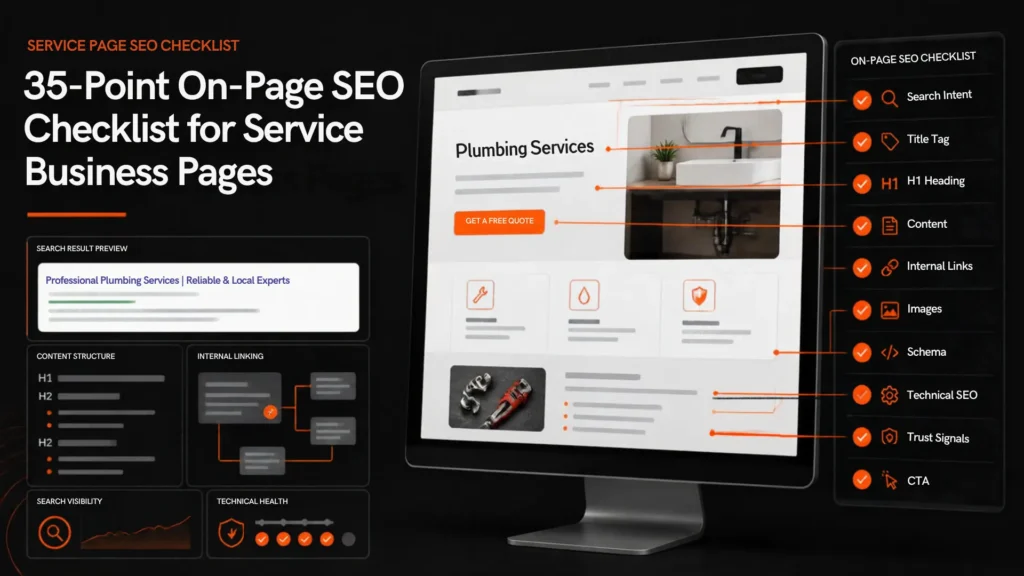
You need to review the page purpose, search intent, keyword targeting, title, headings, content, trust signals, internal links, images, technical accessibility, structured data, local relevance, calls to action, and measurement.
This guide gives you a practical 35-point checklist for reviewing service business pages before publishing or updating them.
It is designed for local businesses, professional services, agencies, consultants, home-service companies, healthcare providers, legal firms, small businesses, and other businesses that depend on website pages to generate enquiries, calls, bookings, consultations, or sales.
What Is On-Page SEO for a Service Business Page?
On-page SEO is the process of improving the content, structure, relevance, and important page elements of a specific URL so that users and search systems can better understand what the page is about.
For service businesses, that means connecting the service being offered with the searcher’s problem, relevant search intent, supporting information, trust signals, internal links, and a clear next action.
A service page should make these questions easy to answer:
- What service does this business provide?
- Who is the service for?
- What problem does it solve?
- What is included?
- Where is the service available?
- Why should the visitor trust this business?
- What should the visitor do next?
For a deeper page-level review, see the On-Page SEO Service, which covers search intent, content relevance, metadata, headings, internal links, images, structured data, and conversion opportunities.
Why Service Page SEO Is Different
A blog article and a service page can target related topics while serving completely different purposes.
A blog may explain:
What is technical SEO?
A service page may target:
Technical SEO services for small businesses
The first query is primarily informational. The second is much closer to evaluating a provider.
That difference affects the page structure.
A strong service page needs educational information, but it also needs enough commercial context for someone to understand the offer and make a decision.
Google’s current guidance emphasizes people-first content, useful information, clear purpose, and satisfying the user’s need rather than creating content primarily to manipulate search rankings. Google’s people-first content guidance explains this approach in more detail.
The 35-Point On-Page SEO Checklist
1. Define the Exact Purpose of the Page
Before changing keywords or writing new content, identify what the page is supposed to accomplish.
Document:
- The service
- The target customer
- The main problem
- The target market
- The primary search intent
- The preferred conversion action
If you cannot explain the purpose of the page in one or two sentences, the page may be trying to cover too much.
2. Match the Page With Search Intent
Search intent should come before keyword placement.
Ask:
What does the searcher expect to see?
If Google mainly shows service pages for the target query, a long informational article may be the wrong format.
If the SERP mainly shows guides and educational resources, turning the query into an aggressive sales page may also be a poor match.
The content format should reflect the dominant intent.
3. Choose One Primary Keyword
Give the page one primary keyword or central search topic.
For this article, the primary keyword is:
on page SEO checklist
Use supporting terms naturally rather than trying to rank the same page for every variation.
4. Map Supporting Keywords to the Same Intent
Supporting keywords should strengthen the main topic.
For a service-page SEO article, relevant terms may include:
- service page SEO
- service page optimization
- on-page optimization checklist
- service business SEO
- on-page SEO for service businesses
- service page SEO checklist
- local service page SEO
- commercial page SEO
Do not add a keyword simply because an SEO tool suggests it.
The keyword must help explain the subject.
For stronger targeting, a keyword research strategy can help determine which terms belong on one page and which deserve separate URLs.
5. Check Existing Pages Before Creating Another One
Search your own website before publishing a new service page.
Ask:
Does another page already target the same service?
Does another URL target the same search intent?
Does an existing blog already answer the query?
Could the new page create keyword cannibalization?
This matters because more URLs are not automatically better.
Sometimes the correct solution is to improve an existing page instead of creating another one.
6. Write a Descriptive SEO Title
Your title should tell the searcher what the page is about.
For this page:
35-Point Essential On-Page SEO Checklist for Service Business Pages
It contains the primary topic while making the scope clear.
Avoid vague titles such as:
“Important SEO Things You Need to Know”
A descriptive title gives the user a clearer reason to click.
Google explains that title links are generated from several page signals, so a useful HTML title should be consistent with the page’s visible topic. Google’s title link documentation.
7. Write a Useful Meta Description
Your meta description should summarize the actual page.
Suggested meta description for this article:
Use this 35-point on-page SEO checklist for service business pages to improve search intent, titles, headings, content, links, technical SEO, trust, and conversions.
Do not treat the meta description as a keyword container.
Google says snippets are primarily generated from page content, although it may use the meta description when it provides a better description of the page.
8. Keep the URL Clean
Use a short, descriptive URL.
Recommended:
/on-page-seo-checklist/
Avoid unnecessary parameters, dates, or keyword repetitions.
Your final URL should not contain:
?chatgpt
?chatgpt.com
?utm_source
or other unnecessary query parameters.
9. Use One Clear H1
The page should have one main H1.
For this article:
35-Point On-Page SEO Checklist for Service Business Pages
Use H2s for major topics and H3s for meaningful supporting sections.
Do not create multiple H1s simply because a page builder makes that easy.
10. Make the Introduction Answer First
Do not spend hundreds of words explaining what SEO is before answering the actual question.
The visitor should understand the main answer quickly.
For a service business, the core answer is simple:
A good on-page SEO checklist should evaluate search intent, page purpose, keywords, titles, headings, content, trust, internal links, technical accessibility, images, structured data, conversion elements, and measurement.
Then expand each area.
11. Explain Exactly What the Service Includes
A visitor should never have to guess what they are paying for.
Instead of:
“We provide professional digital marketing services.”
Use specific information such as:
- Search intent analysis
- Keyword mapping
- Page structure
- Content optimization
- Internal linking
- Technical review
- Image optimization
- Structured data review
- Conversion analysis
Only include services that the business actually provides.
12. Explain Who the Service Is For
A service page becomes more useful when the audience is clear.
For example:
“This service is designed for businesses that rely on organic search to generate calls, enquiries, appointments, consultations, bookings, or sales.”
You can then explain the relevant industries, business sizes, locations, or situations where appropriate.
Specificity makes the page easier to understand.
13. Explain the Customer’s Problem
Do not write only about what the business does.
Explain what may be wrong.
A service page may have:
- Weak keyword targeting
- Unclear search intent
- Thin content
- Poor heading structure
- Missing internal links
- Weak trust signals
- Poor conversion paths
- Duplicate information
- Technical accessibility problems
The visitor should recognize their own problem in the page.
14. Answer the Important Buyer Questions
A visitor may want to know:
- What is included?
- How does the process work?
- Who performs the work?
- How long does it take?
- What information is needed?
- How is pricing determined?
- What happens after the initial enquiry?
- Is the service suitable for my business?
These should be answered where they naturally belong in the main content.
Do not hide every important question inside a large FAQ section.
15. Make the Main Content Specific
Avoid statements that could appear on every website.
Weak:
“We deliver high-quality SEO solutions that drive business growth.”
Better:
“The page review examines whether the service, target keyword, search intent, headings, supporting information, internal links, trust signals, and conversion path all work together.”
Specific information adds value.
16. Cover the Core Topic Without Padding
A service page should be complete enough to satisfy the reader.
That does not mean making it unnecessarily long.
A 1,000-word page can be excellent.
A 3,000-word page can still be weak if most of it repeats generic marketing claims.
Google does not specify a preferred word count for ranking.
The correct length is the amount needed to answer the important questions well.
17. Build Clear Heading Relationships
Your headings should reflect the actual information architecture.
A useful service page may look like:
H1
Service Name
H2
What Is the Service?
H2
Who Is It For?
H2
What Does It Include?
H2
How Does the Process Work?
H2
Why Is It Important?
H2
Common Problems
H2
Frequently Asked Questions
H2
Next Steps
This structure is useful for users, editors, crawlers, and answer systems because each heading communicates a specific concept.
18. Use Internal Links as Part of the Strategy
Internal links should create meaningful relationships between pages.
For example:
A keyword research page can support a service page.
A technical SEO page can support technical implementation.
A content strategy page can support content planning.
A case study can provide supporting evidence.
A local SEO page can support local service-page architecture.
This is more useful than placing links simply to increase the number of links.
Your SEO Audit Service can be a logical supporting page when a broader website review is needed before prioritizing individual page changes.
19. Use Descriptive Anchor Text
Good anchor text tells the reader what is behind the link.
Examples:
- keyword research strategy
- technical SEO service
- local SEO strategy
- content strategy
- conversion rate optimization
Avoid:
- Click here
- Read more
- This page
- Learn more
Descriptive anchors improve the relationship between the linked page and its context.
20. Connect Service Pages With Supporting Content
A service page should not exist as an isolated URL.
Where relevant, connect it to:
- Supporting blog articles
- Parent service categories
- Related services
- Case studies
- About information
- Technical resources
- Local SEO resources
This creates a stronger topical structure across the site.
For businesses that need deeper content planning, the Content Strategy and SEO Content Writing Service is a natural supporting resource.
21. Add Relevant Local Context
For local businesses, location information should be genuine.
A service page may need:
- Actual service areas
- Relevant location information
- Local customer context
- Business contact information
- Genuine local relevance
- Connections with location pages
Do not add city names repeatedly just to target more locations.
The Local SEO Service covers the wider relationship between services, locations, Google Search, Google Maps, website relevance, and local visibility.
22. Align the Website With Google Business Profile
For local businesses, the website and Google Business Profile should represent the same real business.
Check:
- Business name
- Services
- Location information
- Website URL
- Service areas
- Contact information
- Business categories
- Other important details
The goal is consistency and accuracy, not keyword stuffing.
For more detail, see the Google Business Profile Optimization Service.
23. Add Genuine Trust Signals
People need a reason to trust the business.
Useful trust signals may include:
- Real author information
- Relevant qualifications
- Case studies
- Testimonials
- Reviews
- Business information
- Methodology
- Contact details
- Genuine experience
Only use evidence that can be verified.
For example, a business can link to its SEO case studies rather than simply claiming to have produced results.
24. Make Authorship Clear
For professional and informational content, make it clear who created the article.
A useful author section can include:
Md Mynul Hassan
SEO, AEO, GEO and Brand Visibility Specialist
The author’s profile should contain real information and should never use invented credentials.
You can also connect the article to the About Md Mynul Hassan page for additional context.
25. Optimize Images for the Page
Every image should have a purpose.
Useful service-page images can explain:
- A process
- A framework
- A workflow
- A dashboard
- A checklist
- A before-and-after example
- A comparison
Avoid uploading several generic stock images that do not add information.
For a service business page, one useful diagram may be more valuable than five decorative images.
26. Write Descriptive Alt Text
Alt text should describe the image.
Good:
On-page SEO checklist for a service business website
Poor:
on page SEO service SEO checklist SEO service page SEO
The second example is keyword stuffing rather than image description.
Use the keyword only when it naturally describes what the image actually shows.
27. Review Technical Accessibility
On-page SEO does not happen independently of technical SEO.
Check:
- Indexability
- Canonical URL
- Robots directives
- Internal links
- Redirects
- Broken links
- XML sitemap inclusion
- Mobile usability
- JavaScript-dependent content
- Page performance
For deeper technical diagnostics, see the Technical SEO Service.
The purpose is not to fix every warning from an SEO tool.
The purpose is to fix issues that actually affect the important pages.
28. Review Core Web Vitals and Page Performance
A service page should be usable on real devices.
Review:
- Largest Contentful Paint
- Interaction to Next Paint
- Cumulative Layout Shift
- Image size
- JavaScript
- Fonts
- Caching
- Server response
- Third-party scripts
Performance work should focus on actual bottlenecks instead of chasing a perfect automated score.
For deeper performance work, see the Website Speed Optimization Service.
29. Use Structured Data Carefully
Structured data can help search systems understand eligible information about a page.
Depending on the actual visible content, appropriate schema may include:
- Article
- BlogPosting
- BreadcrumbList
- Person
- Organization
- Service where genuinely applicable
Do not add fake:
- Reviews
- Ratings
- Locations
- Authors
- Credentials
- Businesses
The markup must accurately represent the visible page.
30. Optimize the Conversion Path
SEO and conversion should support each other.
Ask:
Can the visitor understand the offer?
Can they find the important details?
Can they identify the next step?
Is the form easy to use?
Does the CTA match their intent?
For example, someone researching a complex SEO service may need a consultation rather than a “Buy Now” button.
The Conversion Rate Optimization Service provides a natural next step when the problem involves the journey from visitor to enquiry or customer.
31. Make the CTA Specific
Weak:
“Contact us.”
Stronger:
“Request an On-Page SEO Review”
Other examples:
- Request a Quote
- Book a Consultation
- Discuss Your Website
- Request an SEO Audit
- Send Your Project Details
The CTA should explain what happens next.
32. Check WordPress Implementation
If the site runs on WordPress, review the actual page implementation rather than assuming a plugin has handled everything correctly.
Check:
- SEO title
- Meta description
- H1
- Headings
- Canonical
- Indexation
- Images
- Alt text
- Internal links
- Schema
- Permalinks
- Performance
- Plugin conflicts
For WordPress-specific implementation, see the WordPress SEO Service.
33. Review the Page After Publishing
Publishing is not the end of the process.
Check performance in tools such as Google Search Console and review:
- Impressions
- Clicks
- CTR
- Search queries
- Indexed status
- Important landing pages
- Conversions
- User behavior
Do not change a page simply because rankings moved for a few days.
Look for meaningful patterns and compare the page against its original purpose.
34. Recheck the Page for Cannibalization and Duplication
After publishing, review nearby pages again.
Ask:
Is another service page targeting the same topic?
Did a new article accidentally compete with the service page?
Are multiple location pages substantially similar?
Are internal links consistently pointing toward the preferred URL?
Website architecture changes over time, so this check should not happen only once.
35. Run a Final Human Review
Before publishing, read the page as if you knew nothing about the business.
Ask:
Does this page immediately explain the service?
Does it answer the important customer questions?
Is the information specific?
Does the page match the search intent?
Can I understand who provides the service?
Is there genuine evidence?
Can I find related information easily?
Does the CTA make sense?
Would I still trust this page if the search engine disappeared and I visited the site directly?
That final question is valuable because strong service pages should work for people first.
A Simple Service Page Review Framework
When reviewing a service page, use this order:
1. Purpose
What is the page supposed to achieve?
2. Intent
What does the searcher actually want?
3. Relevance
Does the page clearly address that need?
4. Evidence
Why should the visitor trust the business?
5. Structure
Can the visitor scan and understand the page?
6. Relationships
Does the page connect naturally with other useful pages?
7. Technical Access
Can search engines access, understand, and index the important content?
8. Conversion
What should the visitor do next?
This order prevents you from spending an hour rewriting a meta description when the real problem is that the page targets the wrong intent.
Service Page Clarity Score
You can also use the following internal QA model.
This is an editorial framework, not a Google ranking score.
| Area | 0 Points | 1 Point | 2 Points |
|---|---|---|---|
| Search intent | Misaligned | Partly aligned | Clearly aligned |
| Service clarity | Vague | Understandable | Specific |
| Buyer questions | Missing | Some answered | Key questions answered |
| Proof | None | Limited | Relevant proof |
| Internal links | Weak | Some links | Strong contextual structure |
| Technical accessibility | Problems | Minor issues | Verified |
| Conversion | Unclear | Present | Logical and obvious |
Maximum: 14 points
A page scoring well should still be reviewed by a human. A score is useful for prioritization, not a substitute for judgment.
Common On-Page SEO Mistakes on Service Pages
Keyword Stuffing
Repeating the same phrase throughout the page does not fix poor relevance.
Write naturally and use related concepts where they help explain the service.
Creating a Page for Every Keyword Variation
Different keyword wording does not automatically mean different search intent.
Several keyword variations may belong on one strong page.
Making Every Service Page Look the Same
A template can provide consistency, but every service still needs specific information.
The page should reflect the actual service, audience, process, evidence, and customer questions.
Copying Competitor Structure
Competitor research is useful for understanding the information landscape.
It should not turn into copying or closely paraphrasing another page.
Build your own organization and explanations.
Writing Only About the Business
A page that constantly says “we provide,” “we deliver,” and “we offer” may still leave the customer without useful information.
Explain the problem first.
Then explain how the service addresses it.
Adding Fake Local Relevance
Do not create artificial city references or misleading business locations.
Local information should reflect where the business genuinely operates.
Adding Every Possible Schema Type
More schema does not mean better SEO.
Use only structured data that genuinely applies to visible content.
Ignoring the Website’s Wider Architecture
A service page is part of a system.
It should connect naturally with the homepage, related services, relevant content, case studies, local pages, and other important resources.
How Service Pages Fit Into a Wider SEO Strategy
On-page optimization should not operate alone.
A useful structure may look like this:
Keyword Research
↓
Search Intent
↓
Service Page
↓
Supporting Content
↓
Internal Linking
↓
Technical SEO
↓
Trust and Evidence
↓
Conversion
For websites with local search goals, add:
Google Business Profile + Local SEO + Genuine Location Signals
For websites concerned about AI search, the same SEO fundamentals still matter.
Google’s current guidance for AI Overviews and AI Mode says the foundational SEO practices remain relevant. Google specifically points to crawlability, internal linking, useful content in text, page experience, quality media, and accurate structured data. Google’s AI features and website guidance
That means you do not need a separate collection of unnatural “AI keywords” or special AI markup simply to make a page eligible for those experiences.
The better approach is to make the page clear, useful, accessible, and factually trustworthy.
When Should You Improve an Existing Service Page Instead of Creating a New One?
Improve the existing page when:
- The service is already correct
- The target intent is broadly correct
- The URL has useful history
- The page has some relevant content
- The main problems are optimization or structure
Consider a new page when:
- The service has substantially different intent
- The audience is different
- The business offer is genuinely different
- A separate page would answer a distinct customer problem
- The current page cannot reasonably satisfy both intents
This distinction is important for preventing unnecessary content expansion.
When Should You Use Professional On-Page SEO Help?
DIY optimization is often practical when one or two pages need improvement.
Professional analysis becomes more useful when a website has:
- Many service pages
- Multiple locations
- Technical problems
- Duplicate pages
- Cannibalization
- Weak internal linking
- Poor search-intent targeting
- Large amounts of outdated content
- Complex conversion paths
- A significant SEO backlog
The important question is not whether a business needs “more SEO.”
It is which problem should be solved first.
A proper SEO audit can help establish those priorities before implementation begins.
For businesses that also need their website architecture considered during development or redesign, an SEO-friendly web design approach can connect site structure, usability, performance, service pages, internal linking, and SEO from the beginning.
Frequently Asked Questions
What should an on-page SEO checklist include?
A practical on-page SEO checklist should review search intent, keyword targeting, title tags, meta descriptions, H1 and heading structure, content relevance, entities, internal links, images, alt text, structured data, technical accessibility, trust signals, conversion paths, and measurement.
How do you optimize a service page for SEO?
Start with the searcher’s intent and the purpose of the page. Then optimize the title, URL, H1, headings, content, supporting information, internal links, images, technical accessibility, structured data, trust signals, and CTA. Review the complete page rather than optimizing individual elements in isolation.
How long should a service page be?
There is no universal word count. The page should be long enough to answer the important customer and search-intent questions without padding the copy with repetitive statements.
Should a service page include pricing?
Pricing information can be useful when accurate information is available. Depending on the business, that may be a fixed price, starting price, price range, cost factors, or a clear quotation process.
Do not invent pricing simply to make a page appear more complete.
Should every service have its own page?
Not necessarily.
A service deserves its own page when it has a sufficiently distinct customer need, search intent, offer, or depth requirement.
Several closely related services may be better explained together when the intent is substantially the same.
Should service pages include FAQs?
Useful FAQs can help answer remaining customer questions.
They should not become keyword-dumping sections.
Important questions that deserve detailed explanations should be answered in the main body rather than hidden at the bottom.
Does a service page need schema?
Structured data can be useful when an appropriate schema type matches the visible content, but it should not be added simply because an SEO plugin offers the option.
The markup must accurately describe the page.
Should I create city-specific service pages?
Only when there is genuine location relevance and enough unique information to justify separate pages.
Changing only the city name is not a strong local SEO strategy.
What is the difference between on-page SEO and technical SEO?
On-page SEO focuses mainly on the page’s content, structure, relevance, headings, metadata, internal links, images, and related page-level elements.
Technical SEO focuses more on crawling, indexing, canonicals, redirects, site architecture, performance, JavaScript considerations, and other technical foundations.
They are connected and often need to work together.
Does on-page SEO guarantee rankings?
No.
On-page SEO can improve clarity, relevance, structure, content quality, and user experience, but search visibility depends on many factors that no SEO consultant directly controls.
A responsible strategy should focus on improving the factors that can actually be analyzed and influenced.
Final On-Page SEO Checklist
Before publishing a service page, confirm:
☐ The page has one clear purpose
☐ Search intent is understood
☐ One primary keyword is defined
☐ Supporting topics are relevant
☐ Existing URL overlap has been checked
☐ SEO title is descriptive
☐ Meta description is useful
☐ URL is clean
☐ One H1 is present
☐ H2 and H3 hierarchy is logical
☐ Main answer appears early
☐ Service scope is clear
☐ Target audience is clear
☐ Customer problems are explained
☐ Buyer questions are answered
☐ Content is specific
☐ Important entities are covered naturally
☐ Internal links are contextual
☐ Anchor text is descriptive
☐ Relevant supporting pages are connected
☐ Local information is genuine where applicable
☐ Google Business Profile alignment is accurate where applicable
☐ Trust signals are genuine
☐ Author information is clear
☐ Images add useful information
☐ Alt text describes images accurately
☐ Indexability has been checked
☐ Canonical URL is correct
☐ Technical issues have been reviewed
☐ Core Web Vitals and mobile usability have been considered
☐ Structured data matches visible content
☐ CTA is clear
☐ Conversion path is easy to understand
☐ Post-publish measurement is planned
☐ Cannibalization will be monitored
☐ Final human review has been completed
Final Takeaway
A strong service page does not become useful because the target keyword appears twenty times.
It becomes useful when the page makes the service, customer problem, search intent, evidence, process, relevance, relationships, and next step easy to understand.
That is the real purpose of an on-page SEO checklist.
Start with the page’s purpose.
Then match the intent.
Then improve the content and structure.
Then strengthen internal relationships and technical accessibility.
Then make the next action clear.
And after publishing, measure what happened before deciding what to change.
For businesses that need deeper page-level optimization, On-Page SEO Service is the most direct next step.
You can also connect with Md Mynul Hassan through Upwork, Freelancer.com, LinkedIn, YouTube, and Facebook.
Md Mynul Hassan
SEO, Local SEO, AEO, GEO & AI Search Visibility Specialist
Be found. Be understood. Be chosen.