
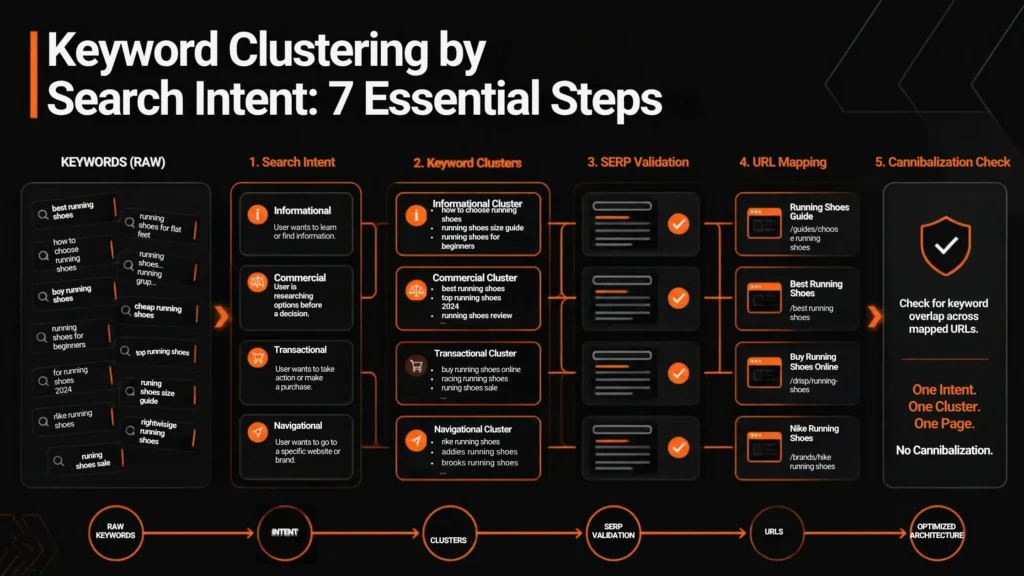
Keyword clustering by search intent is the process of grouping search queries that represent the same or closely related search need, then deciding whether each group should be served by one page, a broader existing page, or a separate URL.
The important part is not simply finding keywords that look similar.
The real job is deciding which searches can be satisfied by the same page without creating weak, confusing, or overlapping content.
A practical workflow is:
Keyword research → intent classification → semantic grouping → SERP validation → URL mapping → cannibalization check → content architecture
This guide breaks that process into seven steps and shows how to handle the difficult cases where keyword wording, intent, and search results do not line up perfectly.
What Is Keyword Clustering by Search Intent?
Keyword clustering by search intent means organizing related queries into groups based on the problem, task, or goal behind the search.
For example, these queries may describe one underlying research task:
- keyword clustering
- keyword clustering SEO
- how to cluster keywords
- SEO keyword grouping
- group keywords by intent
They do not necessarily need five separate pages.
A useful cluster asks a more practical question:
Can one well-designed page answer these searches without forcing unrelated information into the same article?
That question changes keyword clustering from a spreadsheet exercise into a content architecture exercise.
Search intent provides the starting point. SERP analysis provides additional evidence. Semantic similarity helps reveal relationships. Existing website structure tells you whether the opportunity should become a new URL or improve a page you already have.
The goal is not the biggest cluster.
The goal is the best page-to-search relationship.
Why Keyword Clustering Matters for SEO
Keyword clustering helps turn a raw keyword list into decisions.
Without clustering, a keyword research export can become hundreds or thousands of phrases with no clear answer to these questions:
- Which keywords belong on the same page?
- Which keywords require separate content?
- Which terms are secondary variations?
- Which page already targets this intent?
- Where is there a cannibalization risk?
- Which topics should become supporting articles?
- Which commercial pages should receive internal links?
That matters because publishing one page for every slightly different keyword can create unnecessary overlap.
A better approach is to organize the search landscape before content production starts.
This also fits Google’s broader guidance that useful content should provide substantial value, original analysis, and a satisfying answer rather than being produced simply to chase search traffic or an arbitrary word count.
What keyword clustering helps you decide
One page
Use one page when several queries represent essentially the same need and a single useful resource can satisfy them naturally.
One page plus sections
Use this when the queries are closely connected but one or two subtopics deserve dedicated treatment inside the same resource.
Separate pages
Create separate URLs when the searcher’s goal, expected page type, audience, commercial stage, location, product, or problem is meaningfully different.
That decision is more important than the size of the keyword list.
The 4 Main Search Intent Types
Search intent describes what the searcher is trying to accomplish.
| Intent | Searcher Goal | Typical Example | Likely Page |
|---|---|---|---|
| Informational | Learn something | what is keyword clustering | Guide |
| Commercial investigation | Compare options | best keyword clustering tools | Comparison / commercial guide |
| Transactional | Take action | keyword clustering tool free | Tool / product page |
| Navigational | Find a specific destination | Ahrefs keyword clustering | Brand / specific page |
These categories are useful, but they should not be treated as perfect labels.
A query can have mixed characteristics.
For example, “keyword clustering tool” could be interpreted as informational by one searcher and commercial by another. The actual result set can provide useful evidence about what search systems currently surface for the query.
That is why intent classification should remain a working hypothesis rather than a rigid rule.
How to Cluster Keywords by Search Intent
The following seven-step process is designed to move from raw research to an actionable content plan.
Step 1: Build the Keyword Set
Start with a meaningful dataset.
Collect keywords from sources such as keyword research tools, Search Console, customer questions, competitor research, existing pages, related searches, site search data, sales questions, and industry terminology.
Do not begin by grouping everything immediately.
First establish the universe you are working with.
For each keyword, useful fields include:
| Field | Example |
|---|---|
| Keyword | keyword clustering |
| Intent | Informational |
| Topic | Keyword research |
| Modifier | how to |
| Funnel | TOFU |
| Existing URL | None |
| Business relevance | High |
| Priority | High |
A large keyword list is not automatically a useful keyword list.
Remove obvious duplicates, irrelevant variations, unrelated meanings, and queries that do not fit the business or content strategy.
This is where a structured keyword research service can become useful because the final output should connect search data with page decisions rather than stop at keyword collection.
Step 2: Normalize the Dataset
Before clustering, clean the data.
Look for:
- Duplicate phrases
- Singular and plural variations
- Spelling variants
- Close modifier variations
- Country or city modifiers
- Brand terms
- Unrelated meanings
- Extremely broad terms that need separate treatment
For example:
keyword clustering tool
and
keyword clustering tools
may be close variations.
But:
keyword clustering
and
keyword clustering tool pricing
may represent different stages in the search journey.
Normalization reduces noise.
It also prevents a spreadsheet from making tiny wording differences look like separate strategic opportunities.
Step 3: Classify Search Intent
Now ask what each query is trying to accomplish.
Do not start with:
“Where can I put this keyword?”
Start with:
“What does the searcher want to achieve?”
For example:
| Query | Intent | Likely Destination |
|---|---|---|
| what is keyword clustering | Informational | Guide |
| how to cluster keywords | Informational | Guide |
| keyword clustering examples | Informational | Guide |
| keyword clustering tool | Commercial / Transactional | Tool or commercial page |
| keyword clustering service | Commercial | Service page |
| keyword clustering pricing | Commercial | Pricing / service page |
This step often exposes the first major clustering mistake:
related words do not necessarily represent the same page intent.
A service page and an educational article can be closely related semantically while still deserving separate URLs.
Your on-page SEO service follows the same principle at page level: the page should communicate its purpose, search intent, relevance, structure, internal links, and conversion path rather than simply contain a keyword.
Step 4: Group by Meaning
After classifying intent, group queries that describe the same underlying concept.
This is semantic clustering.
For example:
Cluster: Keyword clustering
- keyword clustering
- SEO keyword clustering
- keyword grouping
- SEO keyword grouping
- cluster keywords
- group keywords for SEO
These phrases are closely related.
But semantic similarity should not be the final decision.
Consider:
SEO audit
SEO audit pricing
SEO audit service
The phrases share the same core topic, but their business purpose differs.
A single page might still cover several of them if the page is designed correctly. Or they may need different destinations depending on the website.
The point is to use semantic grouping to generate candidates, then validate those candidates.
Step 5: Validate the Cluster With SERP Overlap
This is one of the most useful quality-control steps.
Search the keywords individually and compare the ranking pages.
If two queries consistently return many of the same URLs, that is evidence that search engines currently treat them as sufficiently related.
Ahrefs describes keyword clustering as grouping terms with the same or similar search results because shared ranking pages can indicate similar intent.
Recent 2026 research is increasingly combining this SERP evidence with intent and semantic similarity instead of relying on one signal alone.
A simple SERP comparison method
Take two queries.
Collect the same number of top organic results for each.
Then compare the URLs.
Example:
| Query A | Query B |
|---|---|
| keyword clustering | how to cluster keywords |
| URL 1 | URL 1 |
| URL 2 | URL 2 |
| URL 3 | URL 4 |
| URL 5 | URL 5 |
| URL 6 | URL 7 |
Several shared URLs suggest a relationship.
Very little overlap suggests that the queries may deserve separate treatment.
But do not turn this into a universal “magic number.”
A particular overlap threshold is not a permanent law of search.
SERPs change.
Query ambiguity changes.
Verticals behave differently.
Large authoritative domains can also appear across several related searches.
The best practice is:
Use overlap as evidence, not as a substitute for judgment.
Step 6: Map Each Cluster to a URL
Once the cluster is validated, give it a page owner.
This is where keyword clustering becomes keyword mapping.
Every important query should have a logical destination.
A simple system is:
Primary keyword → supporting keywords → search intent → page type → URL
Example:
| Primary Keyword | Supporting Terms | Intent | URL |
|---|---|---|---|
| keyword clustering by search intent | keyword clustering, search intent clustering, keyword grouping | Informational | New guide |
| keyword research service | keyword research, keyword mapping, keyword clustering | Commercial | Service page |
| SEO audit service | SEO audit, SEO audit checklist, SEO cannibalization audit | Commercial | Service page |
| AEO and GEO consulting | AI search visibility, AEO, GEO | Commercial / informational | Service page |
This is also where you should inspect the website before creating a new page.
Ask:
Does an existing page already own this intent?
If yes, improving that page may be better than publishing another article.
Google recommends contextual internal linking and descriptive anchor text to help users and Google understand site relationships.
Your SEO audit service is particularly relevant when the problem involves competing URLs, duplicate targeting, weak internal links, or unclear page architecture. Its current service page explicitly discusses keyword cannibalization, page targeting, internal linking, and competitor analysis.
Step 7: Run a Cannibalization Check
Before publishing, ask:
Does another page on my site already target this same search intent?
Search for:
- Similar primary keywords
- Similar titles
- Similar page types
- Similar topics
- Similar customer problems
- Similar commercial purpose
Then decide:
Keep separate
The intent is genuinely different.
Differentiate
The pages overlap but can have clearly different purposes.
Consolidate
The pages are unnecessarily repetitive.
Redirect or replace
One URL is clearly the better owner of the intent.
Do not create
The proposed page adds little new value.
This step is critical because keyword clustering should happen before writing, not after five similar articles already exist.
Your technical SEO service is relevant when this analysis also reveals crawl paths, canonical, sitemap, redirect, architecture, or indexing issues.
When Should Keywords Stay on the Same Page?
A practical decision framework is:
| Question | Same Page? |
|---|---|
| Same searcher problem? | Usually yes |
| Same search intent? | Strong signal |
| Same expected page type? | Strong signal |
| Similar SERP results? | Strong signal |
| Same audience? | Helpful |
| Same conversion goal? | Helpful |
| Different location? | Often split |
| Different product/service? | Often split |
| Different funnel stage? | Often split |
| Different page format? | Often split |
| Existing page already owns the query? | Investigate first |
The strongest cluster usually sits at the intersection of:
Meaning + intent + SERP behavior + page usefulness
Not just one of them.
Worked Example of Keyword Clustering
Imagine a business sells SEO consulting.
Suppose the keyword dataset contains:
- SEO consultant
- SEO consultant pricing
- what does an SEO consultant do
- how to choose an SEO consultant
- SEO audit consultant
- keyword research service
- SEO strategy consultant
These should not automatically become one giant cluster.
A better architecture could look like this:
Cluster 1: SEO Consultant
Search goal: Understand or evaluate SEO consulting.
Primary page:
SEO Consultant
Supporting content can cover responsibilities, selection criteria, process, and expectations.
Cluster 2: SEO Consultant Pricing
Search goal: Understand cost and pricing factors.
This may belong on a dedicated pricing section or commercial page depending on the site’s architecture.
Cluster 3: SEO Audit Consultant
Search goal: Find help specifically with an audit.
This deserves stronger alignment with the SEO audit service rather than being forced into a general SEO consultant article.
Cluster 4: Keyword Research Service
Search goal: Obtain keyword research.
This is a distinct commercial need and should map to the Keyword Research Service.
Cluster 5: SEO Strategy Consultant
Search goal: Obtain strategic SEO support.
This may deserve a broader consulting or strategy page rather than being buried inside a keyword research article.
The lesson is simple:
The topic may be related, but page ownership still depends on the underlying need.
Common Keyword Clustering Mistakes
1. Clustering by shared words
Two keywords can share the same noun and still require different pages.
“SEO audit checklist” and “SEO audit service” are related, but the first is mainly educational and the second is commercial.
2. Creating one page for every keyword
This often creates thin or repetitive content.
Not every long-tail variation needs a dedicated URL.
A long-tail phrase can often work better as a section, FAQ, subsection, example, or supporting term on a stronger page.
3. Trusting an automated cluster without review
Automation can speed up research.
It should not replace human judgment.
A clustering tool may identify semantic relationships, but the final decision still needs to consider:
- Search intent
- SERP behavior
- Page format
- Existing URLs
- Business purpose
- Audience
- Content depth
4. Using a rigid SERP-overlap threshold
A threshold can be useful operationally.
It should not become a law.
A cluster with partial overlap may still deserve one page if the user need is essentially the same.
A high-overlap group may still need separation if one query has a materially different commercial or local requirement.
5. Ignoring existing pages
One of the biggest mistakes is building the content plan without checking what already exists.
Before creating a new URL, compare the keyword against:
- Existing service pages
- Existing blog posts
- Category pages
- Location pages
- Product pages
- Case studies
Your SEO content strategy service specifically connects content planning with existing pages, intent, clusters, page relationships, and internal links, which is the right level of analysis for this stage.
6. Treating volume as the final priority
Search volume tells you about reported demand.
It does not answer whether the query is relevant to the business.
A lower-volume search can be highly valuable when the intent is strong.
7. Ignoring internal links
Clusters become much more useful when the resulting pages are connected logically.
A supporting article should link to the main commercial or pillar page when that relationship helps the reader.
A commercial page can also link back to useful educational resources.
Google’s documentation specifically recommends linking to relevant resources and using clear anchor text.
How Keyword Clustering Supports Content Architecture
Think of the final structure as a graph rather than a list.
Parent topic
↓
Pillar page
↓
Cluster pages
↓
Supporting articles
↓
Service / product pages
For a business website, that might look like:
Keyword Research
→ Keyword clustering by search intent
→ Keyword mapping
→ Competitor keyword research
→ Long-tail keyword research
→ Search intent analysis
And those resources can connect to:
Keyword Research Service
SEO Audit Service
Content Strategy Service
This makes each article part of a larger knowledge structure.
The purpose of the cluster is not merely to create more URLs.
It is to create clearer relationships between pages.
Keyword Clustering for Local SEO
Local SEO makes clustering even more important because location modifiers can make a keyword list appear much larger than the actual number of search intents.
For example:
- local SEO consultant
- local SEO consultant in Boston
- Boston local SEO consultant
- local SEO services Boston
These may belong to one intent depending on the actual SERPs and website structure.
But:
- local SEO consultant
- local SEO services for dentists
- local SEO for multi-location businesses
- Google Business Profile optimization
may represent distinct service or use-case needs.
Your Local SEO Service is a relevant commercial destination when a cluster involves genuine local search intent. The page itself emphasizes service intent, location relevance, competitor analysis, internal links, Google Business Profile alignment, and business goals.
Likewise, a dedicated Google Business Profile optimization service should remain distinct when the searcher specifically needs profile optimization rather than broader Local SEO.
Keyword Clustering for Ecommerce
Ecommerce sites introduce another challenge because product, category, brand, comparison, and informational searches can sit close together.
Consider:
running shoes
best running shoes
running shoes for flat feet
buy running shoes
running shoe size guide
These are related.
They are not necessarily one page.
The expected page type, commercial stage, user problem, and product architecture can differ.
A strong ecommerce strategy therefore maps clusters to:
- Category pages
- Product pages
- Brand pages
- Buying guides
- Comparisons
- Informational resources
Your Ecommerce SEO Service already connects product and category targeting with site architecture, internal linking, content, technical SEO, and commercial intent.
Keyword Clustering for WordPress Websites
WordPress sites can accumulate overlapping URLs through:
- categories
- tags
- archives
- pages
- posts
- custom post types
- duplicate templates
That means keyword clustering should eventually connect with technical and architectural review.
A content team may think it has four distinct keyword opportunities.
A site audit may reveal that four URLs already cover almost the same intent.
Your WordPress SEO Service is relevant when clustering also exposes archive, indexing, internal-linking, permalink, schema, or duplicate-URL concerns.
How Keyword Clustering Supports AEO and AI Search
Keyword clustering is also useful when content needs to serve question-based search experiences.
A searcher may ask:
What is keyword clustering?
Then:
How do I cluster keywords?
Then:
Should every keyword have its own page?
Then:
How do I prevent keyword cannibalization?
These are separate queries, but they form one connected search journey.
That means the content architecture should make the relationships obvious.
A strong article can answer the broad question while also connecting to deeper resources.
This is consistent with Google’s current generative-AI guidance, which emphasizes creating useful, distinctive, people-first content rather than relying on artificial AI-specific writing patterns.
Your AEO and GEO consulting can naturally support the broader discussion around answer-focused content, entity clarity, direct answers, and AI-search visibility.
The important point is that AI-search considerations do not justify unnatural keyword repetition.
The underlying content still needs to be useful.
A Practical Keyword Clustering Spreadsheet
A useful spreadsheet can contain:
| Column | Purpose |
|---|---|
| Keyword | Raw query |
| Primary Topic | Main subject |
| Intent | Informational / commercial / transactional / navigational |
| Modifier | how, best, price, near me, etc. |
| Funnel | TOFU / MOFU / BOFU |
| Semantic Cluster | Related group |
| SERP Overlap | Evidence |
| Page Type | Blog / service / product / category |
| Existing URL | Current owner |
| Proposed URL | New destination |
| Primary Keyword | Page focus |
| Supporting Keywords | Secondary coverage |
| Cannibalization Risk | Low / Medium / High |
| Business Relevance | Low / Medium / High |
| Priority | P1 / P2 / P3 |
| Internal Links | Supporting relationships |
| Notes | Edge cases and decisions |
That table becomes much more useful than a spreadsheet containing only:
Keyword | Volume | KD
Volume and difficulty help with prioritization.
They do not solve page architecture.
Practical Keyword Clustering Checklist
Before creating content, check:
Research
- Keyword dataset collected
- Irrelevant terms removed
- Duplicates normalized
- Search intent classified
- Semantic groups created
- SERPs reviewed
- Related queries evaluated
Page Mapping
- Each cluster has a logical owner
- Existing pages checked
- Primary keyword selected
- Supporting keywords identified
- Page type selected
- Business relevance assessed
Cannibalization
- Similar URLs compared
- Similar titles checked
- Similar page purposes checked
- Existing rankings checked
- Consolidation considered
- Differentiation documented
Content Architecture
- Pillar relationship defined
- Cluster relationship defined
- Commercial page identified
- Internal links planned
- Anchor text made descriptive
- Supporting content identified
Quality
- No keyword stuffing
- No unnecessary pages
- No duplicate article concepts
- Evidence added where required
- Important questions answered directly
- Content provides value beyond a keyword list
Google’s own guidance favors people-first content, original value, clear authorship, and useful information over content produced primarily to capture search traffic.
Frequently Asked Questions
What is keyword clustering?
Keyword clustering is the process of grouping related search queries according to shared intent, meaning, and other useful evidence so they can be mapped to appropriate pages. The goal is to avoid treating every keyword variation as a separate content opportunity and instead build pages that can satisfy closely related searches naturally.
How do you cluster keywords by search intent?
Start by collecting and cleaning the keyword dataset. Then classify each query by intent, group semantically related phrases, compare their SERPs, check existing website pages, assign each cluster to a logical URL, and review the result for cannibalization. Search intent should guide the process, while SERP behavior and website context help validate the final decision.
Should one keyword cluster map to one page?
Usually, one coherent cluster should have one primary page owner, but that does not mean every cluster must become a new page. An existing page may already own the intent, or several closely related subtopics may belong inside a broader pillar page. The practical goal is clear page ownership, not a fixed page-count formula.
How much SERP overlap is enough for keyword clustering?
There is no universal percentage that works for every query or industry. Greater overlap is useful evidence that two queries may share an underlying intent, while low overlap can suggest that the queries need separate treatment. Review the actual ranking pages, page types, intent, and audience before making the final decision.
How many keywords should be in one cluster?
There is no ideal cluster size. A cluster can contain only a few tightly related queries or a larger set of variations that a single page can satisfy naturally. The cluster should be limited by usefulness and page scope, not by a target number of keywords.
Can keywords with different intent belong on the same page?
Sometimes, but it requires care. Closely connected intents can occasionally be handled on one page when the page can serve the different needs clearly. When the expected action, audience, page type, or commercial purpose is substantially different, separate pages are usually easier to structure.
How does keyword clustering prevent cannibalization?
Clustering makes you decide which page owns each search intent before new content is published. That makes overlapping URLs easier to identify. When two existing pages target the same intent, the solution may be differentiation, consolidation, repositioning, or redirecting rather than publishing another page.
Should every long-tail keyword have its own page?
No. Many long-tail variations are better handled as supporting sections, FAQs, examples, or secondary keywords on a stronger page. A separate URL makes more sense when the long-tail query represents a meaningfully different problem, audience, use case, or search intent.
What is the difference between keyword clustering and topic clustering?
Keyword clustering generally groups search queries that can be targeted together. Topic clustering is broader and describes how related pages connect around a central subject. Keyword clustering can therefore inform the page-level structure inside a larger topic cluster.
How often should keyword clusters be reviewed?
Review them when search results, website structure, business priorities, or important page performance changes. Freshness is especially important when the topic is affected by changing search behavior, products, regulations, software, or other evolving conditions.
Final Takeaway
Keyword clustering by search intent is not about creating the largest possible groups.
It is about making better page decisions.
The most reliable workflow is:
Collect → Clean → Classify intent → Group → Validate SERPs → Map URLs → Check cannibalization
Use semantics to identify relationships.
Use search intent to understand the underlying need.
Use SERP overlap as evidence.
Use existing pages to avoid unnecessary URLs.
Use internal links to connect related resources.
And use business relevance to decide what deserves priority.
A strong cluster can save you from two opposite problems:
too many weak pages
and
one overloaded page trying to answer everything.
Your keyword research process should ultimately produce more than a list of phrases. It should tell you:
what each page is for, which searcher need it owns, how it connects to the rest of the site, and what the next useful action should be.
That is the difference between keyword collection and SEO strategy.
If your website has hundreds of keywords but no clear system for mapping them to pages, my Keyword Research Service can help turn the research into a practical keyword map, search-intent structure, content plan, and internal-link strategy.
When the issue is wider than keyword research, an SEO audit service can help identify overlapping pages, technical problems, architecture issues, content gaps, and other factors that may be affecting the website’s search visibility.
I also connect keyword research with SEO content strategy, on-page optimization, technical SEO, Local SEO, AEO, GEO, and the wider content architecture when the project requires it.
Be found. Be understood. Be chosen.
Connect With Md Mynul Hassan
You can also find my professional work through:
Upwork: https://www.upwork.com/freelancers/mdmynulhassan
Freelancer: https://www.freelancer.com.bd/u/mdmynulhassan
LinkedIn: http://www.linkedin.com/in/aeo-geo-seo-specialist
YouTube: https://www.youtube.com/@mdmynulhassan17
Facebook: https://web.facebook.com/mdmynulhassan.seo
Author: Md Mynul Hassan
SEO, Local SEO, AEO, GEO & Brand Visibility Specialist
Based in Bangladesh · Working Remotely With Businesses Worldwide