A few years ago, SaaS companies mainly focused on one question:
“How can we rank higher on Google?”
Today, the search landscape has changed.
People are no longer discovering software products only through traditional search results. They are asking AI tools questions, comparing solutions, looking for recommendations, and searching for direct answers before making purchasing decisions.
A potential customer may ask:
- “What is the best CRM for a small business?”
- “Which project management tool is better for remote teams?”
- “What are the alternatives to this SaaS product?”
The companies that provide clear, trustworthy answers have a stronger chance of being discovered.
From my experience working on SEO strategies over the last 2 years, I have noticed that many SaaS companies do not have a visibility problem because their product is weak.
The real issue is often clarity.
Their website does not clearly communicate:
- What they offer
- Who they help
- What problems they solve
- Why customers should trust them
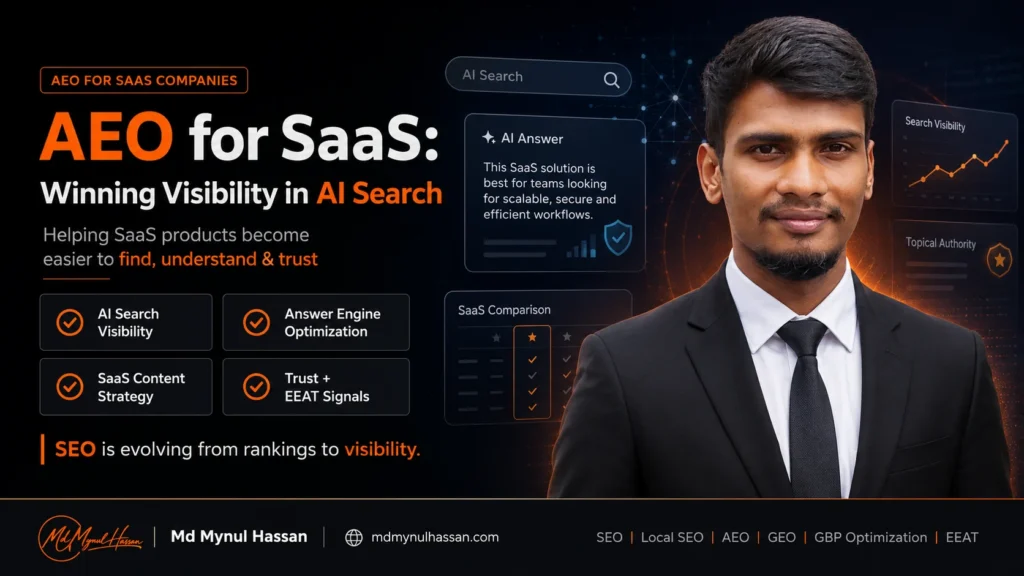
This is where Answer Engine Optimization (AEO) becomes important.
What Is AEO for SaaS Companies?
Answer Engine Optimization (AEO) is the process of creating and structuring content so that search engines, AI assistants, and answer engines can better understand a business, product, and expertise.
For SaaS companies, AEO is not simply about publishing more blog posts.
It is about creating a complete search visibility system where your website clearly explains:
- Your product purpose
- Your target audience
- Your industry expertise
- Your unique advantages
- Your solutions to customer problems
A SaaS website should not only say:
“We provide software.”
It should answer:
“We help this specific group of customers solve this specific problem through this specific solution.”
That difference creates stronger understanding for both users and AI systems.
Why AEO Matters for SaaS Businesses Today
Modern customers are researching differently.
Before buying software, they often:
- Compare multiple products
- Read reviews
- Search for alternatives
- Explore use cases
- Ask AI assistants for recommendations
This means SaaS companies need content that supports the entire customer journey.
A strong AEO strategy connects:
- SEO
- Content optimization
- Search intent
- Technical SEO
- Internal linking
- EEAT
- AI search visibility
- Topical authority
I do not look at SEO as only rankings and keywords.
I see SEO as a complete visibility system that helps businesses become:
Easier to find.
Easier to understand.
Easier to trust.
Easier to choose.
Traditional SaaS SEO vs Modern Search Visibility
Traditional SEO usually focuses on:
- Keyword rankings
- Search volume
- Backlinks
- Blog content
These are still valuable.
However, modern search requires deeper thinking.
A SaaS brand needs to build visibility around:
Product Understanding
Can search engines and AI systems understand what your product actually does?
Search Intent
Does your content answer the real questions customers have?
Trust Signals
Does your website demonstrate experience and expertise?
Topic Authority
Does your website cover your industry deeply enough?
Many SaaS websites publish random articles based only on keywords.
The problem is that content without strategy rarely builds authority.
My Approach to AEO for SaaS SEO
When I work on SEO projects, I do not start by creating more content.
First, I try to understand the foundation.
I usually analyze:
- Website structure
- Search intent
- Content gaps
- Competitor positioning
- Technical issues
- Internal linking opportunities
- Trust signals
A detailed SEO audit helps identify where a website is losing visibility and what improvements can create a stronger foundation.
1. Understanding Search Intent
One of the biggest mistakes SaaS companies make is creating content only around keywords.
A keyword alone does not explain customer needs.
For example:
“CRM software”
and
“Best CRM software for real estate agencies”
may look similar, but the user intent is completely different.
The first user may be exploring options.
The second user may already be close to making a decision.
This is why proper keyword research is important.
A good keyword strategy connects search behavior with business goals and customer needs.
2. Creating Comparison and Alternative Pages
SaaS customers compare before buying.
They search:
- Product A vs Product B
- Alternatives to Product A
- Best tools for a specific industry
- Software comparison guides
Comparison content helps customers make informed decisions.
It also helps search systems understand your product category and positioning.
Strong SaaS content often includes:
- Comparison pages
- Alternative pages
- Feature guides
- Industry pages
- Use-case pages
- Customer education content
3. Building Strong Internal Linking
Many businesses create content but fail to connect their pages properly.
Internal linking helps search engines understand:
- Which pages are important
- How topics are connected
- What expertise the website covers
A strong internal linking structure connects:
- Service pages
- Product pages
- Blog articles
- Educational resources
This is an important part of building topical authority.
4. Technical SEO Foundation
Great content cannot perform properly if search engines cannot access and understand your website.
Technical SEO helps improve areas such as:
- Website structure
- Crawling
- Indexing
- Page performance
- Internal architecture
Through my Technical SEO service, I focus on identifying technical problems that may limit search visibility and creating a cleaner foundation for growth.
Google also recommends creating helpful, reliable, people-first content as part of building better search experiences.
https://developers.google.com/search/docs/fundamentals/creating-helpful-content
5. Building EEAT for SaaS Brands
Trust is extremely important for SaaS companies.
Customers are not only buying software.
They are trusting a company with their business processes, data, and operations.
Strong EEAT signals include:
- Expert-written content
- Clear author information
- Real business information
- Helpful documentation
- Customer experiences
- Industry knowledge
I believe SEO should not create artificial trust.
It should communicate the real expertise behind a business.
My approach is based on honest recommendations, practical strategies, and improvements that make sense for the business.
Common AEO Mistakes SaaS Companies Make
Writing Only Keyword-Based Content
Some companies create articles because keywords have search volume.
But they forget to answer customer problems.
Ignoring Product Education
AI systems and users need clear explanations.
If your website does not explain your product properly, it becomes harder to understand.
Creating Thin Comparison Pages
A simple comparison table is not enough.
Customers need real insights, advantages, limitations, and practical guidance.
Neglecting Website Optimization
Content quality matters, but technical problems can prevent search engines from properly understanding important pages.
How SaaS Companies Can Prepare for AI Search
A strong AEO strategy should focus on:
Clear Product Positioning
Explain exactly what your software does and who it helps.
Helpful Content
Answer customer questions before they become customers.
Strong Website Structure
Connect related topics through effective internal linking.
Technical Foundation
Make your website easy for search engines to crawl and understand.
Trust Building
Show expertise, experience, and credibility.
My Perspective on the Future of SaaS SEO
SEO is changing, but the foundation remains the same.
Businesses that clearly communicate their value will always have an advantage.
Whether customers discover a SaaS brand through Google Search, AI assistants, or other platforms, the goal is the same:
Be understandable.
Be trustworthy.
Be useful.
I help businesses improve their search visibility through SEO, Local SEO, Google Business Profile optimization, content strategy, AEO, GEO, and EEAT-focused improvements.
For me, good SEO is not only about being found.
It is about being chosen when people find you.
Be found. Be understood. Be chosen.