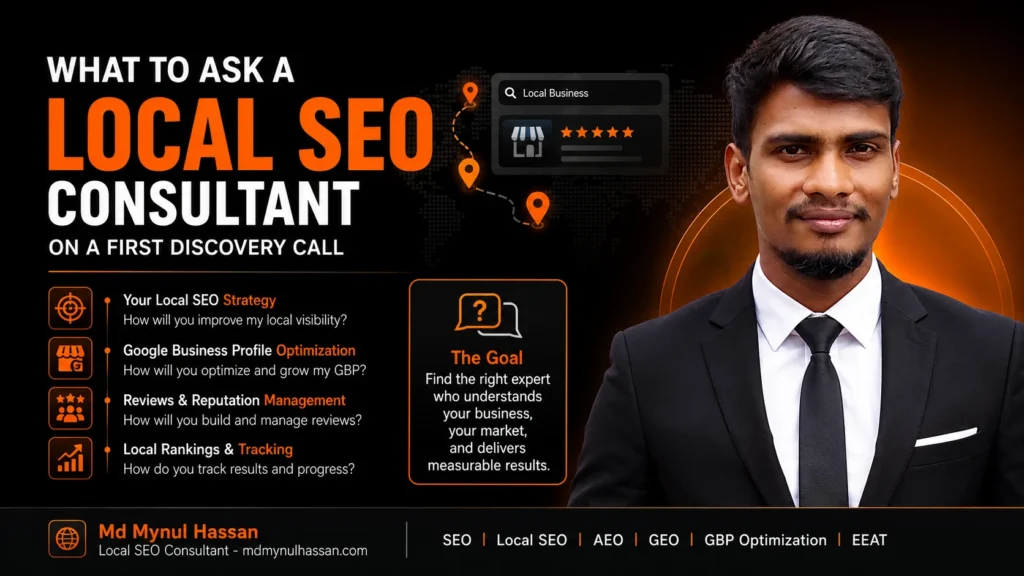
Hiring a Local SEO consultant is easier when you know what to ask before the sales conversation starts.
A good discovery call should help you understand how the consultant thinks, not simply what services they sell. You should come away with a clearer picture of your current problems, likely priorities, measurement process, responsibilities, timeline and scope.
The questions below are designed for business owners, contractors, professional-service firms, agencies and other companies considering Local SEO.
The central idea is simple: do not evaluate the consultant only by how confidently they speak. Evaluate the reasoning, evidence and accountability behind their answers.
Google itself says there are no secrets that automatically put a website first in Search. Its SEO guidance focuses on helping search engines understand content and helping users find and make decisions about a website.
What Should You Ask a Local SEO Consultant on the First Call?
Start with questions that reveal five things:
- Do they understand your business and customers?
- Do they understand Local SEO specifically?
- Can they explain what they would prioritize and why?
- Can they connect search visibility with calls, enquiries, bookings or sales?
- Can they explain what you are actually buying?
You do not need to ask every question word for word. Use the list as a framework and listen for specificity.
Questions About Experience and Business Understanding
1. How much Local SEO experience do you have?
Ask what kind of businesses the consultant has worked with and what parts of Local SEO they actually handle.
A useful answer should describe the work itself. For example, they may discuss Google Business Profile optimization, local keyword research, service-area targeting, competitor analysis, on-page SEO, technical SEO, citations, reviews, local authority and conversion tracking.
Be cautious when the answer consists mainly of vague statements such as “I have many years of experience” without explaining the type of work performed.
2. Have you worked with businesses similar to mine?
Industry experience can be useful because customer behaviour, competition and conversion paths vary.
A dentist, HVAC contractor, law firm and restaurant may all need Local SEO, but the search journey can be very different. Ask whether the consultant understands your customer, services, locations and buying process.
Relevant experience is more useful than a long list of unrelated client logos.
3. What would you want to understand about my business before creating a strategy?
This is one of the strongest questions you can ask.
A serious consultant should want to understand things such as:
- Your most important services
- Highest-value customers
- Target locations
- Service areas
- Ideal customer
- Sales process
- Seasonal patterns
- Existing marketing channels
- Current lead sources
- Main competitors
- Business goals
My own approach starts with this business context because Local SEO decisions depend on what the company actually sells, where it operates and what the customer is trying to do.
That is also why my wider SEO process connects business goals with search intent, keywords, website structure, Local SEO and conversion paths. You can review that approach on my SEO consulting and Local SEO website. Md Mynul Hassan SEO and Local SEO consulting
4. What do you see as the biggest SEO problem right now?
You are not expecting a complete strategy after a short introductory call.
You are looking for diagnostic thinking.
The consultant might say the initial problem appears to be weak service-page targeting, an underdeveloped Google Business Profile, poor local relevance, technical indexing issues, weak conversion paths, low authority, or a combination of factors.
A vague answer such as “you need more backlinks and content” tells you far less.
5. What would you prioritize first, and why?
This question tests whether the consultant can prioritize rather than simply produce a checklist.
Good SEO work involves trade-offs. One website may need technical fixes first. Another may have a healthy technical foundation but weak service pages. Another may have decent website visibility but poor local presence.
A consultant should be able to explain why one action deserves attention before another.
For a deeper example of that diagnostic approach, see my SEO audit service. SEO Audit Service
Questions About Google Business Profile and Local Search
6. How would you improve my Google Business Profile?
Ask the consultant what they would inspect before making changes.
A strong answer may include business categories, business information, services, service areas where applicable, photos and videos, reviews, profile completeness, website alignment and competitor context.
Google recommends keeping Business Profile information complete and accurate. Its local ranking documentation says local results are mainly based on relevance, distance and prominence, and that businesses cannot pay Google for a better local ranking.
The consultant should not describe GBP optimization as a magic switch that guarantees a particular Maps position.
7. How do you approach Google Maps visibility?
Ask how Maps fits into the wider Local SEO system.
A useful answer should recognize that Google Maps visibility is connected to the business’s real-world location or service-area model, relevance, website, reputation and other signals.
The consultant should also be able to explain limitations. Distance, for example, is not something a consultant can simply “optimize away.” Google explicitly includes distance in its local-ranking explanation.
8. How would you evaluate my Google Business Profile against local competitors?
This question reveals whether the consultant performs real competitive research.
You want more than “your competitors have better profiles.”
Ask what would actually be compared:
- Categories
- Services
- Review patterns
- Website relevance
- Local prominence
- Business information
- Content and media
- Location coverage
- Search-result visibility
The objective is to identify a meaningful competitive gap, not copy another business blindly.
Questions About Keywords and Competitors
9. How will you choose the local keywords we target?
Do not accept a giant spreadsheet as proof of good keyword research.
The consultant should be able to explain the relationship between keyword, intent, page and business value.
For example, “emergency plumber near me” may have a different intent from “how to fix a leaking tap.” One may support an urgent commercial landing page while the other may support educational content.
My keyword research service focuses on search intent, commercial relevance, competition, clustering, page mapping and business priorities rather than simply collecting large keyword lists. Keyword Research Service
10. How do you decide which services and locations deserve their own pages?
This is particularly important for contractors and service businesses.
A consultant should consider whether the page has a genuine purpose, enough useful information, meaningful local relevance and a distinct search intent.
Creating dozens of near-identical location pages with swapped city names is not a strategy.
Google’s spam guidance specifically warns against keyword stuffing and manipulative approaches.
11. How will you analyze my local competitors?
Ask whether they will compare your business with:
- Businesses you compete with commercially
- Businesses appearing in Google Maps
- Websites ranking organically
- Businesses dominating specific services or locations
These groups can overlap, but they are not always identical.
The point of competitor analysis is to understand why another result may be outperforming you and what useful opportunity exists.
Questions About Your Website and Technical SEO
12. What will you check on my website?
A Local SEO consultant should not treat the Google Business Profile as the entire strategy.
The website is still a core part of search visibility.
Ask whether the review will consider:
- Service pages
- Search intent
- Internal linking
- Site architecture
- Indexability
- Crawlability
- Canonicals
- Redirects
- Mobile usability
- Performance
- Structured data where relevant
- Conversion paths
Google’s technical documentation explains that important pages need to be accessible to Googlebot and contain indexable content to be eligible for indexing.
For more technical work, you can review my technical SEO service. Technical SEO Service
13. What technical issues would make you change the Local SEO plan?
This is a deeper question than simply asking whether the consultant “does technical SEO.”
A consultant should understand that technical issues can alter priorities.
For example, if important service pages are not indexable, creating five more blog posts may not be the first move.
If a WordPress website has plugin conflicts, duplicate URLs, weak internal linking or indexing problems, those issues may deserve attention before publishing more content.
My WordPress SEO service covers technical SEO, indexing, internal links, site structure, schema and practical WordPress implementation. WordPress SEO Service
Questions About Content, Citations, Reviews and Local Authority
14. What role will content play in the strategy?
A good consultant should explain what content is supposed to accomplish.
Local content can support service intent, customer education, comparisons, problem-solving, location relevance and internal linking.
But publishing articles simply to hit a monthly quota is not automatically useful.
Ask:
“Which pages do you want content to support?”
“Why does this topic matter to my customers?”
“What page should this article connect to?”
“How will you know whether the content is working?”
15. How will you handle local citations?
This is a useful question because citation work is easy to turn into meaningless volume.
Google values accurate business information. A consultant should care about correctness and relevance rather than promising hundreds of low-quality directory listings.
The better approach is usually to identify important platforms for the market, maintain consistent business information and fix meaningful inconsistencies.
16. How do you approach Google reviews?
The consultant should have a process for encouraging legitimate customer feedback, responding appropriately and monitoring reputation.
They should not offer to buy reviews.
Google states that reviews and other user contributions must reflect genuine experiences, and that incentives in exchange for reviews or changes to reviews are prohibited.
A good consultant can help you build a genuine review process. They should not manufacture reputation.
17. How do you build local links and authority?
Ask how they decide which links are relevant.
You want to hear about relevance, genuine relationships, useful publications, local organizations, industry resources and legitimate business references.
You do not want a promise such as “50 backlinks every month” without any discussion of quality.
Google’s spam policies define link spam as creating links primarily to manipulate rankings.
The right question is not “How many links will I get?”
It is “Why would these links make sense for my business?”
Questions About Reporting, KPIs and Success
18. How will you measure whether Local SEO is working?
This question matters more than asking for a guaranteed ranking.
A useful reporting model should connect search activity with business outcomes.
| SEO indicator | Business question |
|---|---|
| Keyword visibility | Are we becoming easier to find for valuable searches? |
| Organic clicks | Are relevant people visiting? |
| Google Business Profile actions | Are searchers taking useful actions? |
| Calls | Are searches generating conversations? |
| Form submissions | Are prospects contacting us? |
| Bookings | Are qualified customers taking action? |
| Qualified leads | Is visibility producing business opportunities? |
| Conversion rate | Is the website helping visitors act? |
Rankings still matter. They simply should not be the only measure.
My conversion rate optimization service looks at the step after visibility: whether visitors can understand the offer, trust the business and complete the intended action. Conversion Rate Optimization Service
19. Can I see an example of the report I will receive?
Ask for a sample with confidential information removed.
A useful report should explain:
- What changed
- What was completed
- What was learned
- What problems remain
- Which actions come next
- How the work relates to business goals
A 40-page automated export is not necessarily better than a short report that clearly explains decisions.
Questions About Timelines, Deliverables and the First 90 Days
20. What should happen in the first 30 days?
There is no universal 30-day plan because websites start from different conditions.
A sensible first month could include baseline measurement, business and competitor research, Google Business Profile review, keyword and intent research, website review, technical diagnosis and prioritized recommendations.
The exact scope should depend on what the initial evidence shows.
21. What would you expect to accomplish in the first 90 days?
Ask for priorities rather than promises.
A consultant might structure the first three months around:
Days 1-30: Diagnose, research and fix critical foundations.
Days 31-60: Implement priority website, GBP, content and local-search improvements.
Days 61-90: Expand the strongest opportunities, evaluate early data and adjust the roadmap.
Google notes that changes can take different amounts of time to appear in Search, with some changes taking hours and others taking several months. It also recommends allowing time to assess whether changes had a beneficial effect.
That makes “we will rank you in 14 days” a very different statement from “we will establish the baseline, improve the main issues and review evidence over the next few months.”
22. What exactly is included in the monthly deliverables?
Get specifics in writing.
Ask:
- How many pages are reviewed or optimized?
- Is content included?
- Is GBP work included?
- Is competitor analysis included?
- Is technical SEO included?
- Are citations included?
- Is review guidance included?
- Is reporting included?
- Who implements technical fixes?
- Who publishes content?
- What falls outside scope?
A monthly retainer should have enough definition that you know what you are paying for.
Questions About Communication, Pricing and Contracts
23. Who will actually do the work?
The salesperson may not be the person performing the work.
Ask:
“Will I work directly with you?”
“What parts are outsourced?”
“Who writes the content?”
“Who implements technical changes?”
“What happens if the person responsible for my account leaves?”
Outsourcing is not automatically bad. The important issue is whether quality and accountability remain clear.
24. How much does Local SEO cost, and what affects the price?
Ask what determines the scope instead of asking only for a monthly number.
Pricing can vary with:
- Competition
- Number of locations
- Number of services
- Website condition
- Technical complexity
- Content requirements
- GBP work
- Citation cleanup
- Authority work
- Implementation requirements
- Reporting needs
Be skeptical of pricing that is disconnected from the actual project.
A consultant should be able to explain why one business needs a different scope from another.
25. What happens if results are weaker than expected?
This may be the most revealing question on the list.
A responsible answer should involve measurement, diagnosis and adjustment.
The consultant should be willing to examine whether:
- The wrong keywords were targeted
- Search intent changed
- The competition is stronger than expected
- Technical issues remain
- Conversion problems are limiting outcomes
- The business did not complete required tasks
- Local visibility needs a different strategy
The correct response is not a new guarantee.
It is better analysis.
What Should a Good Local SEO Consultant Ask You?
The discovery call should work both ways.
A consultant who starts talking about packages before understanding your business is missing an important part of the job.
You should expect questions such as:
What are your most profitable services?
The highest-volume service is not always the service with the highest business value.
Which locations are strategically important?
The answer can be very different for a storefront, a contractor, a mobile service provider and a company with several physical locations.
Who are your best customers?
Customer type affects search intent, messaging, content and conversion paths.
Which services do you want more enquiries for?
This helps prevent the SEO strategy from becoming a race to collect traffic.
How do people currently find you?
Search may be only one part of the acquisition journey.
What happens after someone contacts you?
A website can generate leads that never become customers because the sales process is the actual bottleneck.
Who are your strongest competitors?
The consultant should be interested in both commercial competitors and search competitors.
What has already been tried?
Previous SEO work can affect the starting point and prevent duplicated effort.
Who controls the website and Google Business Profile?
Access and implementation responsibilities need to be clear before work begins.
What does success look like six to twelve months from now?
The answer creates a useful baseline for evaluating the entire SEO programme.
This business-first approach is also reflected in the structure of my own SEO process, which connects business understanding, research, prioritization, implementation and measurement. Why Choose Md Mynul Hassan: SEO Approach and Process
Local SEO Consultant Red Flags
Some warning signs are obvious. Others appear reasonable until you ask one more question.
Guaranteed #1 rankings
Google explicitly says there are no secrets that automatically rank a site first. A consultant can improve the factors they control, but cannot control Google’s final ranking outcome.
Guaranteed Google Maps positions
Local results also depend on factors such as relevance and distance. A responsible consultant should not promise a permanent position in a system they do not control.
Vague deliverables
“We’ll optimize your website every month” is not a useful scope.
Ask what will actually be done.
No meaningful reporting
If the report only shows rankings and traffic without explaining business outcomes, ask why.
Buying reviews
Google prohibits incentives for reviews and requires genuine experiences.
Manipulative link building
A large quantity of irrelevant links is not a credible substitute for relevant authority. Google explicitly identifies link spam as a prohibited manipulative practice.
Keyword stuffing
Repeating city names or target phrases everywhere does not make a strategy more sophisticated. Google’s spam documentation specifically addresses keyword stuffing.
Copied or lightly rewritten content
Google’s guidance encourages unique, helpful, people-first content rather than simply rehashing what others already published.
Instant-result promises
SEO changes do not all behave on the same timeline. Google notes that some changes can take several months to show an impact.
A Discovery Call Checklist You Can Save
Before you end the call, make sure you can answer these:
- Does the consultant understand my business?
- Have they worked with similar businesses?
- Can they explain my main Local SEO opportunities?
- Do they understand Google Business Profile strategy?
- Can they explain how they choose local keywords?
- Have they discussed competitors?
- Will they review my website and technical SEO?
- Is there a clear content strategy?
- Is citation work based on relevance and accuracy?
- Is the review strategy legitimate?
- Is local authority work clearly explained?
- Are KPIs tied to leads or customer actions?
- Can I see a reporting example?
- Are the first 30-90 days clearly described?
- Are monthly deliverables specific?
- Do I know who will perform the work?
- Do I know what I need to provide?
- Are communication expectations clear?
- Is pricing tied to scope?
- Are contract and cancellation terms clear?
- Has anyone guaranteed rankings, traffic or leads?
- Do the recommendations sound specific to my business?
- Can the consultant explain what they would not prioritize?
- Do they have a process for adjusting strategy?
- Do I understand what happens after the call?
How to Decide After the Call
Do not make the decision based only on personality or price.
Score the consultant on four areas:
| Area | What to look for |
|---|---|
| Specificity | They understand your actual business and market |
| Reasoning | They can explain why a priority matters |
| Evidence | They can show credible examples, processes or reporting |
| Accountability | They define scope, measurement, communication and responsibilities |
The best consultant is not necessarily the one who promises the most.
Often, the stronger candidate is the person who can explain what they know, what they do not know yet, what needs further investigation and what they would prioritize first.
That is also consistent with Google’s people-first guidance, which emphasizes useful, reliable, original content and discourages creating material primarily to manipulate search rankings.
Why Local SEO Should Be Evaluated as a System
Local SEO is easy to oversimplify.
A business may have a complete Google Business Profile and still have weak service pages.
A website may have strong content but weak local relevance.
A company may rank well for informational searches while generating few qualified leads.
A business may receive plenty of traffic but lose prospects because its contact process is confusing.
That is why I approach Local SEO through the relationship between:
Business goals → Search intent → Keywords → Website → Technical SEO → Google Business Profile → Content → Reviews → Local authority → Conversion
My recent work and published resources also connect Local SEO with AEO and GEO because customers increasingly discover information through search experiences beyond traditional blue links. Google’s current guidance says the same foundational SEO practices continue to apply to AI features in Search.
You can read my AEO guide for local businesses for more context on that wider visibility model. AEO for Local Businesses
For businesses evaluating whether their existing website communicates expertise and customer needs clearly, my article on customer pain points and AEO content goes deeper into using real customer questions to improve content strategy. Customer Pain Points and AEO Content
Evaluate the Consultant, Not Just the Proposal
A proposal can look polished.
A discovery call can sound convincing.
Neither guarantees a successful SEO relationship.
The better test is what happens when you ask difficult questions.
Can the consultant explain priorities?
Can they connect Local SEO to business outcomes?
Can they explain what happens in the first 30, 60 and 90 days?
Can they tell you what they need from you?
Can they show how progress will be measured?
Can they explain limitations without making the conversation sound hopeless?
That is the kind of evaluation that gives a business owner useful information before signing a contract.
If you want to evaluate my own approach, you can review my SEO process and professional positioning before starting a conversation. Why Choose Md Mynul Hassan
Find Md Mynul Hassan Online
You can also review my work and professional presence through:
LinkedIn – Md Mynul Hassan
YouTube – Md Mynul Hassan
Facebook – Md Mynul Hassan
For freelance hiring:
Upwork profile
Freelancer.com profile
Official Google Resources
For the most important claims in this article, start with Google’s own documentation:
Google Business Profile local ranking guidance
Google’s documentation should take priority over sales claims or anonymous SEO advice when you are evaluating what a consultant tells you.