Choosing a local SEO consultant for a dental practice should not start with the question, “How much do you charge?”
Start with a harder question:
Can this person explain how they would improve your practice’s visibility, why they would do it, how they would measure the work, and what they will avoid?
That distinction matters because SEO providers can look very similar during a sales call. One may have a polished website and impressive ranking screenshots, while another may have a smaller profile but a much clearer process.
Google itself recommends interviewing potential SEOs, reviewing previous work and references, asking how success will be measured, checking industry and geographic experience, and avoiding anyone who guarantees a first-place ranking.
For a dental practice, I would go one step further. I would evaluate the consultant across dental experience, local search understanding, Google Business Profile work, treatment-page strategy, technical SEO, content quality, measurement, communication, ownership and ethics.
Here is the framework I would use.
What Should a Dental Practice Look for in a Local SEO Consultant?
A good local SEO consultant for a dental practice should be able to connect the practice’s services, locations, website, Google Business Profile, search intent, content, reputation and conversion paths into one coherent strategy.
You should not hear a strategy that consists only of “more blogs,” “more backlinks” or “more keywords.”
A serious proposal should explain which treatments deserve priority, which local searches matter, whether your current pages satisfy those searches, what is happening with your Google Business Profile, what technical issues exist, how competitors are performing, and how visibility will be measured.
Google describes legitimate SEO work as including things such as content or structure review, technical advice, content development, keyword research and expertise in particular markets or geographies.
For a dental practice, the practical test is simple:
Can the consultant understand both SEO and the business behind the SEO?
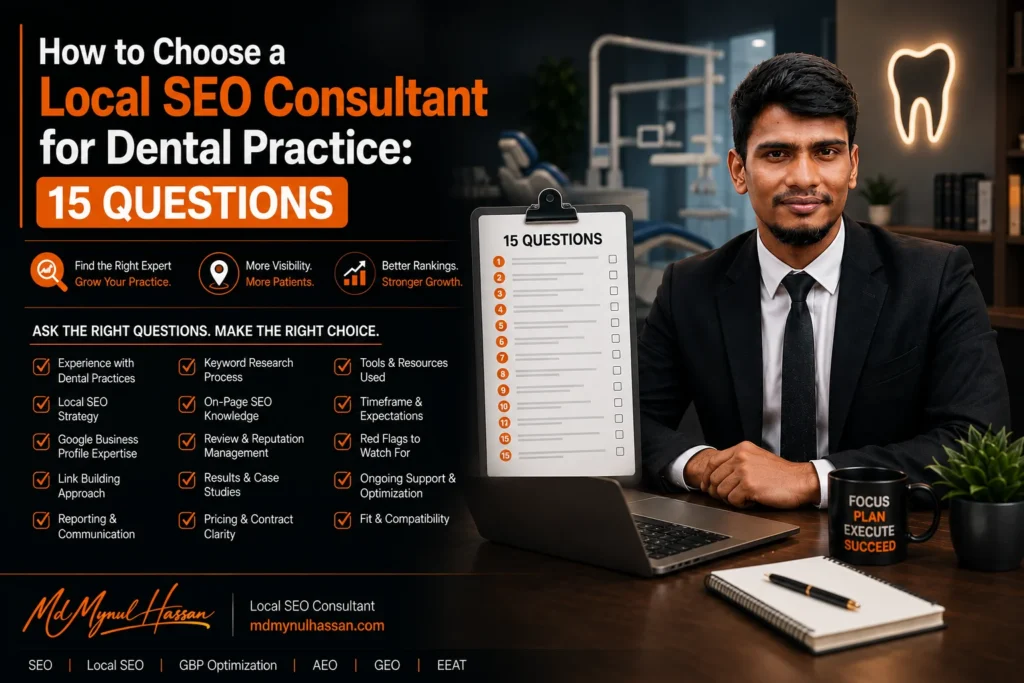
15 Questions to Ask Before Hiring a Local SEO Consultant
1. Have You Worked With Dental Practices Before?
Ask:
“Have you worked with dental practices, and can you explain what you would approach differently from a general local business?”
A good answer should go beyond saying, “Yes, I have done dental SEO.”
Listen for an understanding of treatment-based search intent, local visibility, Google Business Profile, patient questions, treatment pages, location relevance and conversion paths.
A consultant does not necessarily need to work exclusively with dentists. But they should understand why a dental practice is not identical to a plumber, restaurant or ecommerce store.
2. Can You Show Me Relevant Case Studies?
Ask for examples that resemble your situation.
Look for:
- practice type
- target market
- services or treatments
- timeframe
- starting condition
- work completed
- measurable outcomes
Be careful with screenshots showing only a few ranking positions.
A more useful case study connects search visibility with business outcomes where tracking exists.
For example, a consultant should be able to explain whether the work increased relevant organic traffic, calls, forms, enquiries or appointment opportunities.
Google also recommends asking prospective SEOs for examples of previous work and success stories, then checking references with past clients.
3. Which Treatments Would You Prioritize?
This is one of the best questions you can ask because it forces the consultant to think about your business.
Do not accept:
“We will optimize all your services.”
Ask:
“Which three treatments would you prioritize first, and why?”
A thoughtful answer should consider commercial value, search intent, competition, existing authority, current page quality, location and the practice’s ability to convert enquiries into patients.
The right answer will vary from practice to practice.
One clinic may prioritize emergency dentistry.
Another may focus on dental implants.
Another may already be strong for general dentistry but need better visibility for orthodontics or cosmetic treatments.
The consultant should be able to explain the reasoning.
4. How Would You Approach Google Business Profile?
Ask:
“What would you review in my Google Business Profile?”
The answer should cover the actual profile rather than vague claims about “ranking Maps.”
Depending on the practice, the review may include business information, categories, services, photos, website connection, reviews and overall alignment with the actual business.
Google says businesses should maintain accurate information and real-world representation on Business Profiles. It also prohibits fake engagement and incentivized reviews.
A strong consultant should be just as comfortable telling you what not to change as what to change.
5. How Will You Handle Local Keywords and Location Targeting?
Ask:
“How would you decide which location and treatment searches we should target?”
A good consultant should distinguish between:
Treatment + location
such as “dental implants [city]”
and broader local intent such as:
dentist near me
or a treatment search where Google already understands local intent.
They should also know that creating dozens of nearly identical city pages simply to capture location keywords can create poor-quality content rather than meaningful local relevance.
The goal is to build genuinely useful treatment and location relationships.
6. What Will You Fix on My Website?
Ask:
“Before creating new content, what would you inspect on my existing website?”
The answer should include relevant technical and on-page fundamentals.
Google’s SEO documentation emphasizes making content easy for search engines to crawl, index and understand, while its current Search guidance stresses useful, reliable, people-first content.
For a dental website, I would expect a consultant to consider:
- indexability
- important service and treatment pages
- page titles and headings
- internal linking
- mobile usability
- technical accessibility
- duplicate or thin pages
- structured data where appropriate
- page performance
- conversion paths
More content is not always the answer. Sometimes the existing website needs repair first.
7. Who Creates and Reviews the Content?
Ask:
“Who will write our treatment content, and how will it be reviewed?”
This matters particularly for dental practices because the subject can involve health information.
You want content that is accurate, useful and appropriate for patients, not generic pages assembled from other dental websites.
Ask to see a sample article.
Then ask:
“Why did you structure it this way?”
A capable consultant should be able to explain the search intent, page purpose, supporting questions, internal links and next action.
8. What Is Your Link and Citation Strategy?
Ask:
“Where would you try to build authority for our practice?”
You are not looking for a promise involving hundreds of directories or a fixed number of backlinks every month.
Google’s Search spam policies explicitly identify link spam as a manipulative practice, while Google’s SEO hiring guidance warns against link-popularity schemes and mass submission tactics.
A better answer should focus on relevant, legitimate sources such as professional organizations, relevant local resources, associations, partnerships, community references and appropriate industry opportunities.
Quantity is not a substitute for relevance.
9. How Do You Handle Reviews?
Ask:
“How would you improve our review process without violating Google’s policies?”
The consultant should recommend asking genuine patients for honest reviews rather than manufacturing five-star ratings.
Google allows businesses to request reviews from customers, but prohibits incentives in exchange for reviews, changes or removal of negative reviews.
Walk away from anyone recommending:
- paid reviews
- fake reviews
- review manipulation
- asking only happy patients to review
- incentives for five-star ratings
- fake reviewer accounts
A negative review is not automatically something Google will remove. Google’s guidance says only reviews violating applicable policies are eligible for removal.
10. What Will You Do in the First 30, 60 and 90 Days?
This question reveals whether the consultant actually has a process.
You do not need an exact list of 100 tasks.
You do need a logical sequence.
A reasonable framework might look like:
First 30 days: business understanding, baseline measurement, technical and local audit, keyword research and priority mapping.
Days 31 to 60: high-priority technical and on-page improvements, GBP work and treatment-page improvements.
Days 61 to 90: content expansion, internal linking, authority development, conversion improvements and measurement refinement.
The actual timeline depends on the website, competition, resources and scope.
Google’s own guidance notes that SEO changes can take different amounts of time to be reflected in Search, from hours to months, so a responsible consultant should avoid treating an arbitrary deadline as a guaranteed ranking date.
11. How Will You Measure Success?
This is probably the most important reporting question.
Do not accept:
“We will measure rankings.”
Rankings matter, but they are not the whole business outcome.
Ask what sits below the ranking report.
A stronger measurement framework can include:
Visibility → traffic → calls/forms → qualified enquiries → appointment opportunities
The exact setup depends on what the practice can track.
Google Search Console can help monitor search performance, while analytics and appropriate call or lead tracking can add conversion context. Google explicitly describes Search Console as a tool for understanding how a site performs in Google Search.
12. What Will Your Monthly Report Include?
Ask to see a sample report before signing.
The report should help answer:
What changed?
What was implemented?
What did we learn?
What should happen next?
A report filled with 200 keyword positions may look impressive but still tell the practice very little about business impact.
A useful report could include:
- major work completed
- organic visibility
- important keyword movement
- pages gaining impressions or clicks
- local visibility where tracked
- calls or enquiries where tracking exists
- technical improvements
- content published or improved
- next month’s priorities
13. What Access and Ownership Will I Keep?
Ask:
“If we stop working together, what do we still own and control?”
You should understand who owns:
- website
- domain
- Google Business Profile
- Google Analytics
- Search Console
- content
- images
- tracking systems
- listings
- accounts
- created assets
Google’s hiring guidance specifically advises practice owners and website owners to understand what an SEO changes and why. It also recommends only granting read access to Search Console when an SEO is conducting an audit at the evaluation stage.
You should know where your digital assets live before the engagement begins.
14. What Are the Contract and Exit Terms?
Ask:
“What happens if we decide to stop after three or six months?”
Clarify:
- initial term
- notice period
- renewal
- cancellation
- ownership after cancellation
- access to accounts
- content ownership
- outstanding work
- reporting access
A contract is not automatically bad because it has a term.
The problem is a contract whose terms are unclear or whose exit conditions are intentionally confusing.
15. What SEO Tactics Will You Never Use?
This is an excellent test of professional judgment.
Ask directly:
“What SEO tactics do you refuse to use?”
A responsible consultant should be comfortable rejecting practices such as fake reviews, fake locations, deceptive content, keyword stuffing, manipulative links and misleading structured data.
Google’s current Search spam documentation specifically identifies keyword stuffing and link spam as prohibited manipulative behaviors.
Google also warns that irresponsible SEO can damage a site’s presence in Search or even lead to removal from the index.
That should be enough reason to take ethics seriously during the hiring process.
Dental SEO Consultant vs Agency: Which Is Better?
There is no universal winner.
| Factor | Independent Consultant | SEO Agency |
|---|---|---|
| Direct communication | Usually higher | Often through account manager |
| Team size | Smaller | Larger |
| Flexibility | Often higher | Depends on package |
| Specialist attention | Can be very focused | May be specialized or generalized |
| Multiple disciplines | May require partners | Often available in-house |
| Best fit | Focused projects, strategy, direct expertise | Larger campaigns requiring multiple specialists |
| Main question | Who actually does the work? | Which team members actually work on the account? |
For a single-location dental practice with a focused Local SEO problem, a consultant may be a very practical choice.
For a large multi-location organization that needs SEO, paid media, creative, development, PR and multiple marketing functions, an agency may make more structural sense.
The important point is not the label.
Evaluate the actual person, process, resources and accountability behind the contract.
What a Strong Dental Local SEO Plan Should Include
Before hiring, ask whether the proposal covers the areas that actually matter to the practice.
Local Search Foundation
The consultant should understand:
- Google Business Profile
- local business information
- categories
- services
- location relevance
- reviews
- citations where relevant
- Google Maps visibility
Google’s Business Profile guidance emphasizes accurate real-world business representation and appropriate location information.
Website and Treatment Pages
Your important treatments should have clear pages where appropriate.
A treatment page should answer:
- What is the treatment?
- Who is it for?
- What problem does it address?
- What should a patient know before contacting the practice?
- Where is the service available?
- What is the appropriate next step?
Technical SEO
Your consultant should understand crawlability, indexation, redirects, canonicals, internal linking, structured data, mobile usability and performance.
My own Technical SEO service is built around these technical foundations, including crawling, indexing, architecture, structured data and internal linking.
Search Intent and Keyword Research
The objective should not be to collect thousands of keywords.
The consultant should determine:
query → intent → page → business action
My Keyword Research service follows this type of search-intent and page-mapping approach.
Measurement and Conversion
A good Local SEO campaign should eventually help answer whether visibility is leading to useful actions.
That may include calls, contact-form submissions, consultation requests or appointment enquiries, depending on the practice’s tracking setup.
Dental SEO Red Flags That Should Make You Walk Away
“We guarantee #1 on Google.”
Google explicitly says no one can guarantee a number-one ranking.
“We have a secret relationship with Google.”
Google specifically warns against SEOs making claims about special relationships with Google.
“We need hundreds of backlinks every month.”
A fixed backlink number is not automatically a useful strategy. Ask where the links come from and why they are relevant.
“We can get you hundreds of five-star reviews.”
This should be treated as a serious warning. Google prohibits fake and incentivized review activity.
“Just publish 20 blogs every month.”
Content volume without search intent, quality, relevance and conversion purpose is not a strategy.
“You only need rankings.”
For a dental practice, rankings are useful, but the business also needs relevant visibility and a path from searcher to patient enquiry.
“We will explain everything later.”
You should understand what the consultant plans to do before major changes are made.
“All our clients use the same package.”
Your practice, treatments, market, website and competitors may require a different priority order.
How to Score SEO Consultants Before You Sign
When interviewing three providers, use the same questions.
Score each provider from 1 to 5.
| Evaluation Area | Weight |
|---|---|
| Dental/local SEO knowledge | 15% |
| Relevant case studies and proof | 15% |
| Google Business Profile understanding | 10% |
| Treatment and location strategy | 10% |
| Technical SEO capability | 10% |
| Content quality and process | 10% |
| Measurement and reporting | 10% |
| Communication and transparency | 10% |
| Contract and ownership clarity | 5% |
| Ethical approach | 5% |
This makes the final decision less dependent on which salesperson gave the strongest presentation.
A consultant who scores highly across the board is usually easier to evaluate than someone who is exceptional at sales but vague about implementation.
A Simple Dental SEO Hiring Checklist
Before signing, confirm that the consultant can answer yes to the important questions below:
- Has relevant dental or healthcare experience?
- Can explain local search without relying on jargon?
- Can show relevant work or evidence?
- Can explain which treatments should come first?
- Understands Google Business Profile?
- Can identify website and technical issues?
- Has a clear content process?
- Can explain their link and citation approach?
- Follows genuine review practices?
- Has a defined 30/60/90-day plan?
- Measures more than rankings?
- Provides understandable reporting?
- Explains access and ownership?
- Has clear cancellation terms?
- Refuses manipulative SEO tactics?
- Makes no guaranteed ranking claims?
If several answers are vague, do not rush the decision.
Ask another provider.
Why I Would Start With an Audit Before a Long-Term Commitment
A long-term SEO contract should not be the first step simply because an agency has a standard package.
A better starting point can be a diagnostic review.
Google’s guidance specifically says an SEO audit should be about realistic estimates of improvement and the work involved. Google also recommends giving read access to Search Console during an evaluation rather than automatically giving write access.
That approach makes sense for dental practices because you first need to know whether the priority is:
- Google Business Profile
- technical SEO
- treatment pages
- search intent
- content
- local authority
- conversion tracking
- internal linking
- or some combination
My SEO Audit Service is structured around diagnosis, priority and actionable recommendations rather than simply forwarding an automated list of warnings.
How I Approach Local SEO for Service Businesses
My approach starts with understanding the business, then identifying what is limiting visibility, prioritizing the work and connecting search visibility with enquiries and conversions.
That is the same framework I would apply to a dental practice, with the actual priorities determined by the practice’s treatments, target locations, website, competitors and current search presence.
You can review my broader Local SEO approach and my SEO approach and process. My website explains that I work with service businesses including dentists and that my Local SEO process connects keyword research, Google Business Profile, website pages, local relevance, citations, reviews, internal links and competitor analysis.
My Professional Profiles and Marketplace Accounts
A prospective client should be able to evaluate an SEO consultant from more than a single sales page.
I keep professional profiles available so businesses can review my work and professional presence:
Google recommends checking references and previous work when evaluating an SEO, so an independent professional presence can be useful as part of your broader due diligence.
Frequently Asked Questions
How do I choose a local SEO consultant for a dental practice?
Choose a consultant based on relevant dental and Local SEO knowledge, documented work, a clear strategy, transparent reporting, ethical practices, realistic expectations and clear ownership terms. Ask the consultant to explain which treatments they would prioritize, how they would approach Google Business Profile and local search, how they would measure results and what they would do during the first 90 days.
Should I hire a dental SEO consultant or an agency?
It depends on the practice’s needs. A consultant can be a strong fit when you want direct communication and focused specialist work. An agency may be more appropriate when the practice needs multiple marketing disciplines and a larger delivery team. Evaluate the actual people and process rather than choosing based only on the word “agency” or “consultant.”
How long does dental SEO take?
There is no universal timetable. Google states that some SEO changes can be reflected within hours while others can take several months, and recommends allowing time to assess whether changes are beneficial.
How much does dental SEO cost?
The cost depends on the practice’s market, competition, number of locations, website condition, treatments, technical requirements and scope of work. A single-location practice with a relatively healthy website should not automatically receive the same scope as a multi-location dental organization.
Can an SEO consultant guarantee a #1 Google ranking?
No. Google explicitly warns that no one can guarantee a number-one ranking.
What should dental SEO reporting include?
Reporting should provide enough information to understand completed work, search visibility, important ranking movement, traffic trends, relevant page performance and lead or enquiry data where tracking is available. A useful report should explain what changed and what the next priority is.
Are Google reviews important for dental practices?
Reviews can help potential customers evaluate a business, and Google displays reviews on Business Profiles in Search and Maps. However, reviews must represent genuine experiences, and incentivized or manipulated reviews are prohibited.
What should I ask for before signing an SEO contract?
Ask for a clear scope, deliverables, reporting example, communication process, account ownership, website and profile access, contract length, cancellation terms, content ownership and an explanation of what happens if the engagement ends.
What is the biggest red flag when hiring an SEO?
For me, a guaranteed ranking promise combined with an inability to explain the actual process is one of the clearest warning signs. Google specifically warns against guaranteed first-place rankings and secret relationships with Google.
Conclusion
The best way to choose a local SEO consultant for a dental practice is to stop evaluating providers primarily by price and promises.
Evaluate how they think.
Ask them which treatments they would prioritize.
Ask how they would assess your Google Business Profile.
Ask what they would change on your website.
Ask how they measure calls and enquiries.
Ask what they will do in the first 30, 60 and 90 days.
Ask what you keep if you leave.
Then pay close attention to what they refuse to promise.
A responsible SEO consultant should be able to explain the work in plain language, connect recommendations to your practice, follow Google’s published guidance and acknowledge what SEO cannot guarantee. Google’s own hiring guidance strongly supports this type of due diligence.
For a dental practice, that is a much safer hiring framework than choosing the provider with the biggest ranking claim.