
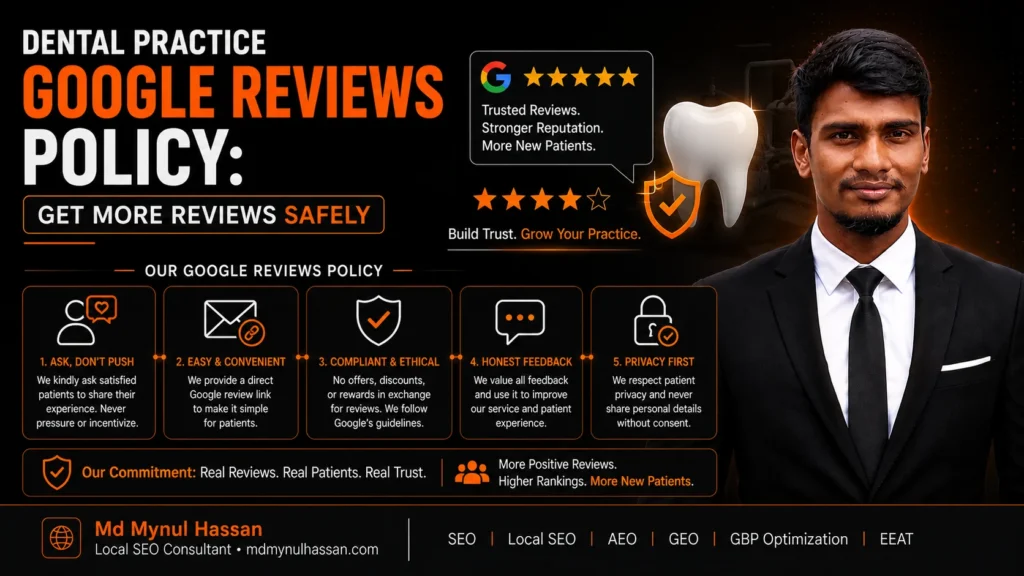
Yes. Dentists can ask patients for Google reviews.
The safest approach is straightforward: ask genuine patients for honest feedback, make the review process easy, and avoid anything that manipulates the rating or content. Google currently allows businesses to share a direct review link or QR code, but it prohibits fake engagement, incentives tied to reviews and other forms of review manipulation.
Dental practices also have a privacy concern that many generic Google-review guides overlook. A practice may follow Google’s review rules and still create a problem by publicly confirming a patient relationship or revealing unnecessary treatment information.
So the right framework is:
Get genuine reviews → don’t manipulate the outcome → protect patient information → respond professionally.
Can Dentists Ask Patients for Google Reviews?
Yes. Google explicitly tells businesses they can ask customers to leave reviews and provides tools for creating a review link or QR code. Google also recommends valuing honest and balanced reviews rather than treating only positive feedback as useful.
A good dental review request is neutral:
Thank you for visiting our practice. We value your feedback. If you’d like to share your experience on Google, you can do so here: [review link].
That is very different from:
Please give us a five-star review and mention Dr. Ahmed and our friendly hygienist.
The second message attempts to influence both the rating and the content.
Google’s review policies prohibit businesses from offering incentives, selectively soliciting positive reviews, pressuring users about ratings or content, or otherwise manipulating genuine engagement.
What Does Google’s Review Policy Actually Allow?
The easiest way to manage dental reviews is to divide common tactics into three groups.
| Tactic | Practical status | Reason |
|---|---|---|
| Ask genuine patients for an honest review | Allowed | Google explicitly supports asking for reviews |
| Send a direct Google review link | Allowed | Google provides review links |
| Use a Google review QR code | Allowed | Google provides QR-code functionality |
| Ask by SMS or email | Generally acceptable | The key issue is the request and conduct |
| Ask for honest feedback | Recommended | It does not dictate the outcome |
| Ask for five stars | Avoid | It attempts to influence the rating |
| Tell patients what to write | Avoid | It influences review content |
| Ask only patients expected to be happy | Prohibited/risky | Selective positive solicitation |
| Offer a discount for a review | Prohibited by Google | Incentivized review activity |
| Offer a gift to change/remove a review | Prohibited by Google | Review manipulation |
| Buy reviews | Prohibited | Fake engagement |
| Ask staff to post fake patient reviews | Prohibited | The review does not represent a genuine patient experience |
Google says incentives such as free or discounted goods or services in exchange for posting, changing or removing reviews are strictly prohibited.
Google can also impose Business Profile restrictions for fake or incentivized review activity. Possible consequences include temporarily preventing new reviews or ratings, unpublishing existing reviews or ratings for a period, and displaying a warning on the profile.
That is a poor trade for a dental practice.
How to Get More Dental Google Reviews Without Review Gating
Review gating usually appears when a practice creates two paths:
“Happy?” → Google
“Unhappy?” → private complaint form
That may look like a smart reputation-management trick, but it removes dissatisfied experiences from the public-review process.
Google’s current guidance specifically prohibits selectively soliciting positive reviews and discouraging or prohibiting negative reviews.
A better process is much simpler.
1. Ask Consistently
Create one basic review-request procedure for the practice.
For example:
Completed appointment → approved follow-up message → Google review link → monitoring
Don’t let individual staff members decide who “deserves” a review request based on whether the patient seemed happy.
The goal is a consistent invitation to provide honest feedback.
2. Use a Direct Google Review Link
Google lets a Business Profile owner create a direct link for customers to leave reviews.
This removes unnecessary steps.
Without a direct link, a patient may have to:
- Search the practice.
- Find the correct listing.
- Open the profile.
- Find the review area.
- Work out how to submit the review.
A direct link makes the process much easier.
3. Use a QR Code Where It Makes Sense
Google also provides a QR-code option for review requests. Google says it can be used on appropriate physical materials and notes that QR codes are currently generated through a computer browser rather than directly on a mobile device.
For a dental practice, a QR code can work well on:
- reception signage
- appropriate printed materials
- patient thank-you materials
- other legitimate practice communications
The QR code should open the review destination directly.
4. Keep the Request Neutral
Avoid rating instructions.
Use:
We’d appreciate your honest feedback about your experience with our practice.
Avoid:
Please leave us a five-star review.
Avoid coaching too.
Use:
Share whatever feedback you feel is helpful.
Avoid:
Please mention our hygienist was friendly and our waiting room was clean.
The patient should decide what to say.
5. Automate Without Selective Targeting
Automation is useful when it removes administrative work.
It becomes problematic when automation is designed to predict who will leave a positive review and send only those people to Google.
A better automation rule is:
eligible completed interaction → standard neutral request
not:
predicted happy patient → Google
That distinction keeps the process consistent and easier to audit.
Can a Dental Practice Offer an Incentive for Google Reviews?
No, not under Google’s current policy.
Google explicitly treats offering free or discounted goods or services in exchange for reviews, review changes or review removal as fake engagement and prohibits the practice.
For example:
Leave us a Google review and receive 10% off your next cleaning.
is not an appropriate Google review tactic.
The same applies when the reward is tied to changing or deleting an existing negative review.
There is a separate U.S. federal consumer-protection layer as well. The FTC’s Consumer Reviews and Testimonials Rule addresses fake reviews and incentives conditioned on reviews expressing a particular sentiment. The FTC also explains that businesses cannot simply make a five-star incentive acceptable by asking reviewers to disclose the payment.
The practical advice is simple:
Don’t build the dental practice’s Google review strategy around incentives.
Can Dentists Ask for Five-Star Reviews?
It is safer to ask for honest reviews, not five-star reviews.
A request for five stars tries to control the result before the patient writes anything.
Compare:
Better:
We value your honest feedback and would appreciate you sharing your experience on Google.
Avoid:
If you were happy with us, please leave a five-star review.
The second formulation can also become part of selective solicitation if the practice deliberately sends the request only to people it believes were satisfied.
Google’s policy emphasizes genuine experience and prohibits attempts to selectively solicit positive reviews.
Google Reviews and Patient Privacy
This is where dental practices need a second layer of thinking.
Google policy determines whether the review activity itself is acceptable. Healthcare privacy rules can determine whether the practice’s public response or communication reveals information that should not be disclosed.
HHS has taken enforcement action involving a dental practice over patient information disclosed in responses to online reviews. In the New Vision Dental matter, HHS reported a $23,000 settlement and corrective action requirements after protected health information was impermissibly disclosed in responses to online reviews.
That makes public review responses a genuine compliance concern for covered healthcare entities.
What Not to Put in a Review Request
A practice should be cautious about automatically inserting clinical details into messages.
Avoid a message such as:
Thanks for coming in for your root canal yesterday. We hope the temporary crown is feeling better. Please leave us a review…
The practice does not need to include those details simply to ask for feedback.
A more neutral request is:
Thank you for visiting our practice. We value your feedback. You can share your experience on Google here: [link].
This is also useful from an automation standpoint because the template doesn’t need to pull procedure names, diagnoses or other sensitive information from the practice-management system.
Safe vs Unsafe Examples
Safer:
Thank you for visiting our practice. We’d appreciate your honest feedback. You can share your experience on Google here: [link].
Riskier:
Thanks for trusting us with your dental implant yesterday. Please give our implant team five stars and mention Dr. Lee in your review.
The second message introduces several problems:
- rating influence
- requested content
- unnecessary clinical context
- unnecessary personalization
How Dentists Should Respond to Positive and Negative Reviews
Google lets businesses publicly respond to reviews and explains that replies are public and customers are notified when the business responds.
For healthcare practices, however, a public response should not become a public patient record.
A Safe Positive Review Response
Patient:
Great staff and a very comfortable visit.
Practice:
Thank you for taking the time to share your feedback. We appreciate your kind words about our team.
That’s enough.
There is no need to confirm a specific appointment, treatment or clinical circumstance.
A Safe Negative Review Response
Patient:
I was unhappy with how the appointment was handled.
Practice:
Thank you for sharing your concerns. We’re sorry to hear that your experience did not meet your expectations. Please contact our office directly so we can understand your concerns and discuss them privately.
The response acknowledges the concern without publishing a detailed clinical defense.
That distinction matters because healthcare privacy enforcement can apply even when a patient has already posted information publicly. HHS’s enforcement history is a strong reason to keep public replies deliberately general.
Don’t Argue With the Reviewer
A public reply is not the right place to prove that the patient was wrong.
Avoid:
You missed three appointments and failed to follow the treatment instructions, which is why your treatment took longer.
Even if the practice believes the statement is factually correct, publicly responding with patient-specific details creates a much bigger problem.
Move the conversation offline.
When Should a Dental Practice Report a Google Review?
Only when there is a genuine policy reason.
A negative review is not automatically a prohibited review.
Google explicitly says businesses should not report reviews simply because they disagree with them or dislike them. Only reviews that violate Google’s policies are eligible for removal.
For example, a practice may have grounds to report content involving:
- fake engagement
- spam
- prohibited content
- conflicts of interest
- privacy issues
- other specific policy violations
Google says reported reviews are evaluated against its content policies, and businesses can appeal certain decisions through the review management process.
So use this rule:
Bad review ≠ policy violation.
A genuine patient can leave an unfavorable review.
The appropriate response may simply be to respond professionally and improve the underlying issue.
Do Google Reviews Help Dental Local SEO?
They can contribute to a stronger local-search presence and customer trust, but they are not a guaranteed ranking shortcut.
Google says reviews can help a business stand out and provide useful information to potential customers, and reviews appear next to Business Profiles in Google Search and Maps.
For a dental practice, that means reviews operate in two related areas:
Discovery: the Business Profile appears in local search and Maps.
Decision-making: a potential patient evaluates the practice after finding it.
That distinction is important.
Don’t tell a dental client:
Get 100 more reviews and you’ll reach position one.
That is not an evidence-based promise.
A better SEO approach connects review management with the wider local search system.
Your own Local SEO service describes that broader model as connecting search intent, website relevance, Google Business Profile signals, local authority, internal links, citations, review guidance and conversion opportunities.
For a dental website, that can mean linking:
Google Business Profile → dental services → location relevance → helpful content → conversion path
rather than treating review count as the entire Local SEO strategy.
Common Dental Google Review Mistakes
Asking only happy patients
Problem: Can become selective positive solicitation.
Better approach: Use a consistent review-request process.
Offering a discount for reviews
Problem: Google prohibits incentives tied to review activity.
Better approach: Remove friction instead of paying for feedback.
Asking for five stars
Problem: The request attempts to dictate the rating.
Better approach: Ask for honest feedback.
Telling patients what to write
Problem: It interferes with independent review content.
Better approach: Let patients describe their own experience.
Asking patients to delete negative reviews
Problem: Google explicitly includes changing or removing reviews within its prohibited incentive framework.
Better approach: Resolve the underlying issue privately where appropriate and leave genuine reviews alone.
Replying to negative reviews with patient details
Problem: Privacy exposure.
Better approach: Keep the public response general and move the discussion offline. HHS enforcement involving a dental practice demonstrates why this deserves special attention.
Reporting reviews just because they are negative
Problem: Google says only policy-violating reviews qualify for removal.
Better approach: Report reviews based on a specific policy violation.
A Dental Review Workflow Your Team Can Actually Follow
Here is a practical process a small dental practice could document internally.
Step 1: Define who receives a review request
Create one objective rule based on completed, legitimate interactions.
Do not create a hidden satisfaction filter.
Step 2: Write one approved request
For example:
Thank you for visiting our practice. We value your honest feedback. If you’d like to share your experience on Google, you can use this link: [review link].
Step 3: Create the official Google review link
Use the Business Profile’s review-link functionality. Google also supports the QR-code method.
Step 4: Select the communication channel
Depending on the practice workflow, the request can be sent through an appropriate channel such as email or SMS.
Google itself notes email and WhatsApp among the channels businesses can use for review requests.
Step 5: Keep clinical information out
The default automation should be simple.
Good data fields:
First name
Practice name
Review link
Fields to treat cautiously:
Procedure
Diagnosis
Treatment details
Insurance information
Clinical notes
Step 6: Monitor new reviews
Assign responsibility.
Someone should know:
- when new reviews arrive
- who responds
- which reviews need escalation
- which complaints indicate an internal service problem
Step 7: Respond carefully
Use generic, respectful language.
Do not publish a clinical defense.
Step 8: Report only real violations
Use Google’s review-reporting process when a review actually appears to violate a policy.
Step 9: Learn from the feedback
Reviews can reveal issues involving:
- scheduling
- communication
- waiting times
- billing
- staff interaction
- explanations
- convenience
A review system becomes much more valuable when the practice uses feedback to improve patient experience.
Dental Google Review Compliance Checklist
Google policy
- Reviewers are genuine customers/patients.
- The practice requests honest feedback.
- No incentive is offered for posting a review.
- No incentive is offered for changing a review.
- No incentive is offered for deleting a negative review.
- The team does not ask only happy patients.
- The team does not request five stars.
- The team does not coach review wording.
- Patients are not pressured to leave a review.
- The practice does not buy reviews.
These checks align with Google’s current fake-engagement and review guidance.
Privacy
- Review-request templates avoid unnecessary clinical details.
- Automated messages don’t automatically reveal treatment information.
- Public review replies don’t disclose patient-specific information.
- Negative-review discussions are moved offline when appropriate.
- The practice has a privacy-review process for public responses.
Operations
- One standard review-request workflow exists.
- Staff know the approved wording.
- The Google review link is easily accessible.
- QR-code assets are current.
- New reviews are monitored.
- Review complaints are routed internally.
- Reviews are analyzed for recurring operational problems.
Dentist Schema, Organization, Person, Service and LegalService
The structured-data requirement deserves a separate clarification because dental schema and law-firm schema are different entity models.
Schema.org currently defines Dentist as a specific business/organization type within the LocalBusiness hierarchy.
For a real dental-practice website, the structured-data model should describe the actual dental business and its relationships.
A conceptual model could be:
Dental practice → Dentist
Dental practice → Organization
Dentist/organization → location → physical practice
Dental service → provider → dental organization
Dental service → areaServed → legitimate service area
Website → about → dental organization
The visible website content should support the entities being marked up.
What should not be done
Do not put LegalService on a dental practice merely because the schema type exists.
Schema.org defines LegalService as a business providing legally oriented services, such as a law firm. Its more specific types include Attorney and Notary.
That means:
Dental practice → Dentist
not:
Dental practice → LegalService
Law-Firm Schema Relationship
For your separate law-firm content, the relationship can be modeled conceptually as:
LegalService → Organization → Person/Attorney → Service → Location → WebSite
A law firm can be represented as a LegalService. An attorney can be represented as a Person/appropriate legal entity relationship, while legal services can be modeled through Service.
That is a semantic relationship.
It should not be copied onto unrelated industries.
Google’s own structured-data guidance also requires structured data to represent the actual page content and does not guarantee a particular rich result simply because markup is technically present.
Building the Review Strategy Into a Broader Local SEO System
Reviews work better as part of a connected website and Business Profile system.
Your website’s current Local SEO positioning is closely aligned with this approach. You state that local search work can connect local keywords, competitor analysis, service areas, on-page SEO, internal links, citations, Google Business Profile alignment, review guidance and performance measurement.
For a dental business, the structure could look like this:
Google Business Profile
↓
Dental service pages
↓
Location relevance
↓
Useful patient questions
↓
Internal links
↓
Review and trust signals
↓
Appointment conversion
That is a more defensible strategy than trying to make review count do all the work.
Your Google Business Profile optimization service is the closest commercial page for practices that need this part of the system reviewed.
For the broader strategy, your Local SEO service connects Google Business Profile work with website relevance, local search intent, competitors, citations and conversion opportunities.
Frequently Asked Questions
Can dentists ask patients for Google reviews?
Yes. Google explicitly allows businesses to ask customers for genuine reviews and provides review links and QR codes for that purpose. The request should not manipulate the rating or content.
Can dentists ask for five-star reviews?
It is safer to request an honest review rather than instructing patients to leave five stars. Google prohibits practices that selectively solicit positive reviews or pressure users about ratings or content.
Can a dental practice give patients a discount for a review?
No under Google’s review policy. Google prohibits incentives such as discounts or free goods/services tied to reviews, review changes or review removal.
Can dentists send Google review requests by SMS?
Yes. The communication channel is not the main problem. The request should be genuine and neutral, and the message should be designed appropriately for patient privacy.
Can a dental practice use a QR code for reviews?
Yes. Google provides a QR-code method for requesting reviews and explains how businesses can generate and share it.
Is review gating allowed for dental practices?
No. Google prohibits selectively soliciting positive reviews and discouraging or prohibiting negative feedback.
Can dentists respond to negative Google reviews?
Yes, but the response should avoid revealing patient-specific information. Publicly defending the practice with clinical details can create privacy problems.
Can a dentist confirm that a reviewer is a patient?
A practice should avoid publicly confirming a patient relationship or revealing protected information merely to defend itself in a review response. Healthcare privacy enforcement makes this an area where restraint is appropriate.
Can Google remove a negative dental review?
Only when it violates Google’s policies. Google explicitly says businesses should not report reviews simply because they disagree with or dislike them.
Do more Google reviews guarantee better local rankings?
No. Reviews can support visibility and customer decision-making, but there is no legitimate formula such as “X reviews = position one.” Google states that reviews help businesses stand out, while local search involves a broader set of signals.
How often should a dental practice ask for reviews?
Google does not prescribe a universal review-request frequency. A consistent and neutral workflow is more important than aggressive campaigns.
Should a dental practice use automated review requests?
Automation can be useful for consistency, but it should not selectively send Google requests only to patients predicted to be satisfied. The process should be based on an objective workflow rather than a sentiment filter.
Is Google review management the same as dental reputation management?
No. Review management is one part of reputation management. Reputation also includes patient experience, complaint handling, review responses, website trust signals, business information and how the practice communicates online.
Marketplace & Social Profiles
You specifically asked for these to be included naturally rather than omitted.
For direct SEO consulting or project support:
Upwork: Md Mynul Hassan on Upwork
Freelancer: Md Mynul Hassan on Freelancer.com
LinkedIn: Md Mynul Hassan on LinkedIn
For professional SEO/AEO/GEO content and updates:
YouTube: Md Mynul Hassan on YouTube
Facebook: Md Mynul Hassan on Facebook