A local SEO content strategy is a plan for creating, improving, and connecting website content so a service business can address local customers’ searches and help them choose the right service. It includes service pages, genuine location pages, problem-solving articles, customer questions, and evidence of the business’s work.
The most effective starting point is usually to make existing commercial pages useful and complete, create additional pages only where a genuine need exists, and publish supporting articles that answer questions buyers still have. A blog calendar should follow that plan, not replace it.
This guide explains what to publish first, how to identify content opportunities, how to connect pages through internal links, and how to evaluate whether the work is contributing to relevant enquiries.
What Is a Local SEO Content Strategy?
A local SEO content strategy is a structured approach to deciding which pages and articles a geographically relevant business needs, what each page should answer, and how those pages work together.
For example, an HVAC company might need a page explaining air conditioning repair, another for heat pump installation, a useful page about its genuine service area, and articles answering questions about repair costs, warning signs, and maintenance.
Each piece has a different purpose. Service pages explain the offer, location pages clarify geographic relevance, and educational content helps people understand their options before contacting the business.
A sound strategy connects four elements:
- Service: What does the business actually provide?
- Location: Where does it genuinely serve customers?
- Customer intent: What does the searcher need to know or accomplish?
- Next action: What would help the reader make an informed decision?
This is the content-planning side of Local SEO services. The objective is to build a useful website structure around real customer needs, rather than publish pages simply because a keyword tool suggests another phrase.
What Should a Service Business Publish First?
Most service businesses should evaluate their existing service pages before committing substantial resources to new blog posts. After identifying gaps in commercial coverage, they can develop useful location pages, educational content, and trust-building resources in an order that reflects customer demand and business priorities.
1. Core service pages
A service page should explain what the business does, which customers it helps, what the service includes, how the process works, and what someone should do next.
A plumber, for example, might need separate pages for emergency plumbing, drain cleaning, pipe repair, and water heater installation if those offerings represent meaningful services with distinct search intent.
Each page should explain its particular service rather than reuse the same introduction with a different keyword.
Include:
- A clear explanation of the service and the problems it addresses.
- Relevant inclusions, exclusions, limitations, or suitability information.
- The process, expected next steps, and pricing information where available.
- Genuine experience, credentials, project evidence, or customer feedback where appropriate.
- Useful answers to common buying questions.
- A relevant call to action, such as requesting an estimate or booking a consultation.
Do not create a separate page for every minor variation in wording. First determine whether the search represents a meaningfully different service or can be answered well on an existing page.
2. Location and service-area pages
A location page helps customers understand where a business operates and whether its services meet their needs in a particular area.
It should provide useful local information, not merely repeat a service description with a city name substituted.
A page for a roofing company serving a particular town might explain its actual coverage, relevant property types, typical project requirements, travel arrangements, and examples of work in that area if evidence is available.
Create a separate page when all four conditions make sense:
- The business genuinely serves the location.
- The location represents a distinct customer need or useful search opportunity.
- There is enough specific information to make the page meaningfully different.
- The page helps customers understand the service and take an appropriate next step.
If two locations have essentially the same audience, services, and information, a single well-organised service-area page may be more useful than two thin pages.
For a deeper treatment of the geographic question, use this existing service-area SEO guide.
3. Supporting blog posts and customer questions
Blog articles should answer important questions that do not belong in full on a commercial service page.
For an electrician, useful examples might include:
- What are the warning signs of an overloaded electrical circuit?
- When should an older property have its wiring inspected?
- What information should you prepare before requesting an electrical quote?
- Should you repair or replace an ageing electrical component?
The correct topic depends on the business, relevant safety considerations, customer demand, and what the company can reliably explain.
A useful article should answer the question directly, explain the reasoning, clarify important limitations, and help the reader decide what to do next. It should not stretch a small answer into a long article solely to target another keyword.
4. Trust pages, project evidence, and case studies
People evaluating a service provider often need evidence that the business can handle their problem. A website can supply that evidence through genuine customer reviews, relevant case studies, staff qualifications, project photographs, process explanations, and clearly presented experience.
A case study should explain the original problem, the investigation, the decisions made, the work completed, and the outcome that can be substantiated. Confidentiality restrictions should be respected, and unpublished or unverified results should not be presented as actual client outcomes.
This existing guide to reviews, testimonials, and case studies explains how those assets can support trust and search visibility.
How to Choose the Right Content to Publish
A local content plan becomes more manageable when every proposed page passes a consistent decision process.
Step 1: Define the business objective
Start with the services the business wants to sell, the customers it can serve, and the areas where it legitimately operates.
A company seeking more commercial roofing enquiries has different priorities from one trying to educate homeowners about roof maintenance. Both may need educational content, but the business objective determines which opportunities deserve attention first.
Record the important services, target customers, service areas, lead types, and business constraints before researching keywords.
Step 2: Research customer searches and intent
Use Google Search Console to see which queries already generate impressions and clicks. Examine the live search results for relevant service, location, problem, cost, and comparison queries. Review customer enquiries, sales conversations, and recurring questions from customer-facing staff.
Then group keywords by intent rather than treating every phrase as a separate page opportunity.
A structured local keyword research process can help distinguish commercial searches from questions that deserve educational answers.
Consider these examples:
| Search | Likely intent | Potential page |
|---|---|---|
| Emergency plumber near me | Find immediate help | Relevant service page and eligible local business information |
| Boiler repair cost | Understand likely costs | Cost guide or pricing section |
| Boiler repair versus replacement | Compare options | Detailed comparison article |
| Boiler maintenance in a particular town | Find locally relevant service information | Service or location page, depending on intent |
| How to recognise a leaking pipe | Identify a problem | Educational article that explains safe next steps |
These are examples of intent mapping, not statements that every query requires its own URL.
Step 3: Check existing pages before creating anything
Search the website for the topic and inspect the pages already receiving impressions. Determine whether an existing service page, article, FAQ, or location page already answers the question.
Choose one of four actions:
- Improve: The correct page exists but lacks useful information.
- Create: A meaningful search intent remains unanswered.
- Consolidate: Two pages overlap and would serve users better as one resource.
- Leave alone: The proposed page has weak business relevance or no clear information gap.
An SEO audit can help investigate whether weak performance comes from missing content, overlapping pages, technical problems, or another issue that should be addressed before publication.
Step 4: Evaluate the opportunity
Use a simple planning score to compare content ideas. This is an editorial prioritisation framework, not a Google ranking formula.
Give each candidate a score from zero to three for four criteria:
| Criterion | What to assess |
|---|---|
| Intent fit | Does it address a real customer need? |
| Commercial relevance | Could it help the business reach an appropriate audience or support a valuable service? |
| Content gap | Is the answer missing or materially weaker than it should be? |
| Evidence readiness | Can the business provide accurate, useful information for the page? |
Add the four scores, giving a maximum of 12.
As a practical starting rule, opportunities scoring 9 to 12 can receive high priority, scores of 6 to 8 medium priority, and scores of 0 to 5 low priority. Then consider effort, urgency, and the consequences of leaving the gap unresolved.
A high score does not automatically mean creating a new URL. An existing page may be the right place for the answer.
Step 5: Assign a clear role to every page
Record the primary intent, target page, supporting topics, internal links, evidence requirements, and intended next action for each approved idea.
For instance, a guide explaining the cost of replacing a water heater could link to an existing installation page, where readers can find service details and enquire. That is a clear connection between informational content and a commercial offering.
A content strategy should make these relationships visible before writing begins. A calendar containing only publication dates does not provide enough direction.
Which Local SEO Content Types Deserve Priority?
Different content types answer different questions. Select the format that best serves the searcher’s intent rather than forcing every topic into a blog post.
| Content type | Best use | Priority consideration |
|---|---|---|
| Main service page | Explain the primary commercial offering | Essential if service information is weak or missing |
| Dedicated service page | Address a distinct service and its buying questions | High when the service has independent demand or business value |
| Genuine location page | Explain relevant services in a real operating area | High when separate local information provides meaningful value |
| Pricing or cost guide | Explain cost drivers, estimates, and exclusions | Useful where price uncertainty affects enquiries |
| Problem-solving article | Explain symptoms, risks, causes, and appropriate next steps | Useful when customers search before choosing a provider |
| Comparison guide | Help people choose between legitimate alternatives | Useful for considered purchases |
| FAQ resource | Answer repeated questions efficiently | Suitable for related short questions, not an excuse to create thin pages |
| Case study | Demonstrate the work and explain the reasoning | Valuable when genuine evidence is available |
| Industry page | Explain specialist service requirements for a meaningful audience | Justified when the industry has distinct needs |
| Maintenance or seasonal guide | Explain recurring tasks or timely requirements | Useful when the information is relevant to the business and readership |
An industry page is not a location page, and neither should duplicate a generic service page. Each page must contribute a clear answer that belongs to its intended audience.
How to Research Local Content Ideas
The best ideas often appear where customer questions, existing service coverage, and search evidence intersect.
Start with the actual customer journey
List the questions customers ask before contacting the business, while evaluating options, and after choosing a provider. Organise them into a few useful groups.
Problem awareness: What happened? What might be causing it? Is it urgent?
Service evaluation: What does the service include? Who is qualified to provide it? What are the available options?
Buying decision: How much might it cost? What affects the estimate? What should a customer prepare? What happens after booking?
Local considerations: Is the business available in the relevant area? Are there genuine differences in access, property types, service coverage, or local requirements?
Use these questions as research starting points, then check their relevance against actual search results and business knowledge.
Compare competitor coverage without copying it
Review competing pages to understand what information readers may expect, what questions remain unanswered, and which claims require better evidence.
Look for missing explanations, unclear pricing assumptions, inadequate process information, absent local examples, and weak paths from educational content to relevant services.
Do not copy a competitor’s wording, imitate its page outline, or assume its every topic deserves a page on your website. A competitor’s content may be irrelevant to your services or may address a different search intent.
Check freshness and accuracy
Some information changes frequently, including pricing, regulations, product availability, eligibility requirements, and service details. Assign an appropriate review interval to those pages.
Do not update a publication date unless the content has genuinely been reviewed or materially improved. A date change alone does not make old information current.
An Illustrative Local Content Plan
Consider a hypothetical HVAC contractor that provides air conditioning repair, installation, and maintenance in its actual service region. The example below demonstrates how the same business could organise content by intent without publishing dozens of similar articles.
| Proposed resource | Customer need | Role in the content system |
|---|---|---|
| Air conditioning repair service page | Find a repair provider | Core commercial destination |
| Air conditioning installation page | Understand installation services | Dedicated commercial destination |
| Genuine service-area page | Confirm local availability and service details | Geographic relevance |
| Why is my air conditioner not cooling? | Understand the possible problem | Educational discovery |
| Repair versus replacement guide | Compare available options | Decision support |
| Air conditioning repair cost guide | Understand cost drivers | Commercial investigation |
| Maintenance checklist | Understand routine care | Educational support |
| Project case study | Evaluate relevant experience | Evidence and trust |
This example is a proposed content map, not a claim about an actual campaign or its performance.
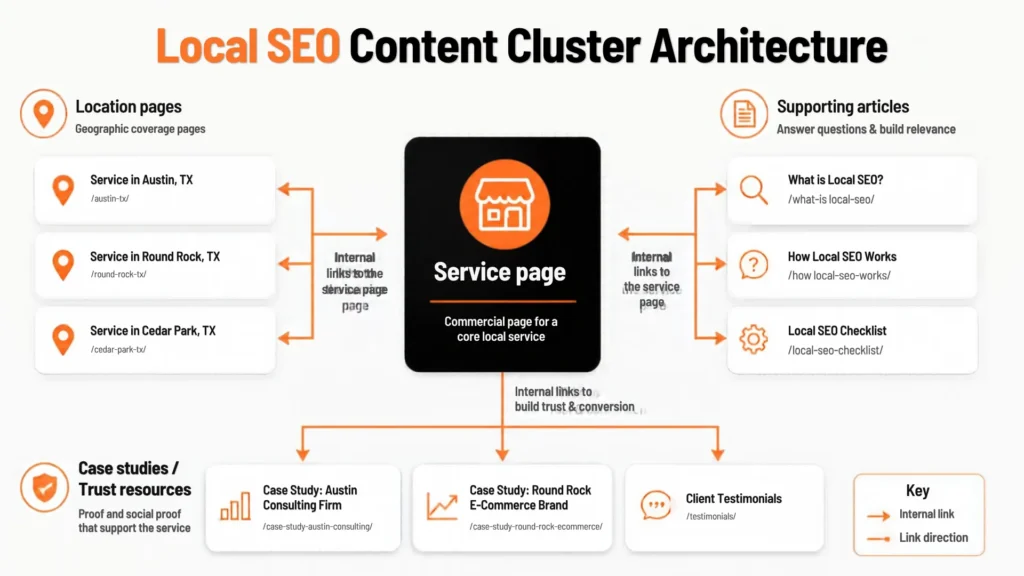
The internal links should connect the resources where the next step makes sense. A problem-solving article can link to the repair page when professional diagnosis is appropriate. The cost guide can link to installation or repair when the reader needs a relevant service. The location page should link to the services genuinely offered in that area.
A case study should connect to the work it actually documents.
The result is a smaller, clearer collection of pages where each resource performs a defined function.
How to Create Useful Local SEO Content
Once the research is complete, follow a consistent production process.
1. Write the answer before the introduction becomes long
Explain the main answer immediately. A reader asking what belongs in a local content plan should not have to work through several paragraphs of general SEO background first.
Then explain the reasons, show examples, clarify exceptions, and offer practical next steps.
2. Make every page specific to its purpose
An individual service page should provide service information, not a general essay about the importance of hiring a professional. A location page should provide useful information about the actual service area, not a repeated city-name template. A blog article should solve the question it targets.
Use on-page SEO optimisation to organise titles, headings, content, descriptive links, and other relevant page elements.
3. Support claims with genuine evidence
Use official sources for regulations and platform policies, qualified technical review where needed, and real business information for service claims.
If you cannot verify a numerical result, do not include it. If a result comes from a small set of observations, explain that context instead of describing it as an industry-wide fact.
For service businesses in sensitive industries, such as healthcare, legal services, and financial advice, the accuracy and appropriateness of claims deserve particular attention.
4. Make the content easy to scan
Use descriptive headings, concise paragraphs, ordered steps for processes, and tables when they make comparisons clearer. Answer important questions directly without repeating the same answer in several sections.
For a longer article, this guide to heading structure can help clarify how H1, H2, and H3 headings organise the content.
Write a distinctive title and meta description that represent the actual page. This SEO title tag guide covers aligning title text with search intent.
5. Give the reader a sensible next step
The next step depends on the query. A reader learning about a problem may need additional guidance. Someone comparing services may need a detailed service page. A ready buyer may need a clear way to request a quote.
Avoid inserting the same sales message after every section. The call to action should fit the information the reader has just received.
How to Connect Local Pages With Internal Links
Internal links help readers move between relevant resources and give search engines crawlable paths between related pages. Google’s documentation recommends descriptive anchor text that helps people and search engines understand the linked destination.
Use links to express actual relationships, not to increase a link count.
A practical structure looks like this:
- A supporting article links to the service page that addresses the related customer need.
- A location page links to the services genuinely offered there.
- A service page links to useful guides that explain common questions or decisions.
- A case study links to the service it documents.
- Related articles link to one another when readers are likely to benefit from both.
Avoid using the same generic anchor text across unrelated pages. Prefer descriptive phrases that fit the surrounding sentence. Also check that links resolve to the intended canonical URL and do not introduce unnecessary tracking parameters.
A link plan for a new article should be prepared during writing, not bolted on after publication.
How Website Content and Google Business Profile Work Together
Website content and Google Business Profile serve related but distinct roles. The website can explain services in depth, answer complex questions, demonstrate expertise, and guide visitors toward an enquiry. A Business Profile presents business information and supports discovery in Google Search and Maps.
Google describes local results as being based primarily on relevance, distance, and prominence. It also explains that complete, accurate Business Profile information can help its systems understand how a business matches a search. See Google’s local ranking guidance.
This does not mean a blog post can overcome distance or guarantee Maps visibility. A local content strategy should instead make the business, its services, and its genuine operating areas easier to understand.
The website and profile should describe the same business accurately. Where a service is listed on the profile, the relevant website page should explain it clearly when such a page is appropriate. Business details should remain consistent, and local claims should reflect actual operations.
A dedicated Google Business Profile optimisation service can address profile-related work alongside the wider content and website strategy.
Common Local Content Mistakes
Publishing blog posts while important service pages remain weak
Problem: The business publishes educational articles, but the relevant service pages provide little detail or no clear next step.
Why it matters: Informational content may attract readers without helping interested prospects understand the actual offering.
Better approach: Review commercial pages first, identify what they do not answer, and connect supporting articles to the relevant services.
Creating location pages by replacing city names
Problem: Many pages use the same wording, with only a town or neighbourhood changed.
Why it matters: The pages offer little distinct value and may resemble doorway-style content when created primarily to capture similar searches and funnel visitors to the same destination.
Better approach: Publish a separate location page only when the business can provide useful, specific information for that area. Consolidate weak duplicates where appropriate.
Targeting the same search intent on several pages
Problem: Multiple articles or service pages answer substantially the same question.
Why it matters: The website becomes harder to manage, internal links become less clear, and pages may compete for the same searches without a compelling reason for the duplication.
Better approach: Define one main purpose per page. Improve, consolidate, or differentiate existing resources before creating another URL.
Choosing topics by search volume alone
Problem: The content calendar prioritises high-volume terms without considering business relevance or search intent.
Why it matters: A topic may attract the wrong audience or require more investment than its potential business value justifies.
Better approach: Combine customer demand, intent, commercial relevance, content gaps, evidence readiness, and production effort.
Treating publishing frequency as the objective
Problem: The business publishes on a fixed schedule even when there is no useful topic ready.
Why it matters: Activity does not automatically improve the content system. Weak articles can add maintenance work without resolving customer questions.
Better approach: Plan a sustainable cadence that matches genuine opportunities and available expertise. Improving an important existing page can be more valuable than publishing another article.
Ignoring technical access and usability
Problem: Useful pages contain broken links, are not indexable, load poorly, or are difficult to use on mobile devices.
Why it matters: Strong writing cannot fully compensate for technical issues that make pages difficult to discover or use.
Better approach: Review important technical foundations as part of content planning. A technical SEO service can help investigate crawling, indexation, internal linking, canonicalisation, and related issues.
Publishing claims that cannot be substantiated
Problem: Content includes invented statistics, exaggerated results, unverified credentials, or generic claims of local experience.
Why it matters: Such claims undermine trust and can mislead customers.
Better approach: Use verifiable sources and real business evidence. Google’s people-first content guidance encourages original, helpful information and asks publishers to assess whether their content gives readers sufficient value.
How to Measure Local SEO Content Performance
Evaluate content using more than average ranking position or total organic sessions. The right metrics depend on what the page is supposed to accomplish.
| Measurement area | Useful indicators | What to investigate |
|---|---|---|
| Search visibility | Impressions, query coverage, average position | Whether the page is appearing for relevant searches |
| Search traffic | Organic clicks, click-through rate | Whether the title and snippet attract relevant visitors |
| Local relevance | Relevant local queries and landing-page visits | Whether visitors appear to match intended services and areas |
| Engagement | Meaningful page interactions and onward visits | Whether the content helps readers continue their research |
| Conversion | Calls, submitted forms, bookings, quote requests | Whether the page contributes to business enquiries |
| Lead quality | Qualified enquiries and service fit | Whether visitors represent the customers the business wants |
| Content health | Indexation, broken links, outdated claims | Whether the resource remains accessible and accurate |
Google Search Console can help identify queries, impressions, clicks, click-through rate, and average position. Analytics or appropriate call and lead tracking can add context about what visitors do after arriving.
Diagnose performance before changing the content
If a page receives impressions but few clicks, review query alignment, title accuracy, search-result presentation, and whether the displayed snippet makes the page’s purpose clear.
If it attracts relevant clicks but few meaningful enquiries, investigate whether the page answers the buyer’s questions, connects to an appropriate service, communicates trust, and makes the next step clear.
If a page receives little search visibility, check its intended query, existing competition, internal links, indexing status, content quality, and overlap with other pages. Low visibility alone does not prove that more words are needed.
Measure performance over suitable periods and account for seasonality, changes in demand, the baseline, and tracking limitations. A short-term movement does not establish that a content change caused the result.
For pages intended to generate leads, consider whether the conversion path works properly. Conversion rate optimisation can help investigate friction between a visitor’s needs and the action the website asks them to take.
A Practical 90-Day Implementation Plan
The following is a suggested schedule, not a promise of a particular ranking or lead outcome.
Days 1 to 30: Audit and prioritise
Inventory the existing service pages, location pages, and articles. Map their primary intents, identify overlap, check important technical issues, and research the most commercially relevant customer questions.
Select a manageable group of improvements and new topics based on the content gaps and available evidence.
Deliverable: A prioritised page map with a clear purpose for each proposed change.
Days 31 to 60: Improve and publish
Strengthen the most important commercial pages. Improve location pages where separate content is justified. Publish a small number of well-researched articles that address genuine gaps, and add contextual links between related resources.
Check titles, headings, contact details, page accessibility, and the accuracy of claims before publication.
Deliverable: Improved priority pages and relevant supporting content connected by internal links.
Days 61 to 90: Measure and refine
Review whether pages are indexed and receiving relevant impressions or clicks. Inspect query data, check the conversion path, correct problems, and improve pages where there is a clear reason to do so.
Do not assume every page needs a rewrite because it has not performed strongly within a short period. Some topics need a longer observation period, while other pages may have a clear technical or intent mismatch that can be addressed sooner.
Deliverable: A revised content plan based on actual observations and the next set of worthwhile actions.
Local SEO Content Strategy Checklist
Before publishing a page, check that the following are true:
- The page answers a clear customer question or business need.
- The search intent is appropriate for the chosen format.
- The target service and audience are genuinely relevant.
- The proposed page does not unnecessarily duplicate an existing URL.
- Any location claims reflect actual business operations.
- Important factual claims are supported or appropriately qualified.
- The title, H1, and headings clearly communicate the subject.
- Content is organised for scanning and direct answers.
- Internal links use descriptive anchor text and relevant destinations.
- The page provides an appropriate next step without excessive promotion.
- The page is accessible, indexable where intended, and usable on mobile.
- Conversion and performance measurement are considered before publication.
- The content has a sensible review plan if its facts may become outdated.
The Practical Next Step
A local SEO content strategy works best when every page has a defined purpose. Make important services clear, explain genuine service areas, answer the questions that influence buying decisions, and use internal links to help readers move naturally between information and the appropriate service.
Before commissioning more articles, identify the weakest part of the current content system. The problem may be an unanswered customer question, an incomplete service page, duplicate location content, an internal-link gap, or a technical issue. Fix the problem the evidence points to instead of defaulting to more publishing.
For readers researching AI-generated answers and modern search experiences, AEO and GEO consulting can form part of a wider strategy, but useful content, reliable information, clear business identity, and accessible website foundations remain central.
If you need help identifying the next content priorities, you can contact Md Mynul Hassan to discuss the website, its service areas, and the gaps worth addressing.
Professional Profiles and Marketplace Links
Readers can find more about my SEO work and professional background through the following profiles.
- Upwork profile
- Freelancer.com profile
- LinkedIn: Md Mynul Hassan
- YouTube: Md Mynul Hassan
- Facebook: Md Mynul Hassan
Frequently Asked Questions
How many pages does a local service business need?
There is no fixed number. A business needs enough useful pages to explain its important services, genuine service areas, customer questions, and relevant trust evidence. Start with the gaps that matter most rather than aiming for a predetermined number of URLs.
How often should a local business publish content?
Publish when there is a worthwhile topic, accurate information, and sufficient time to produce a useful resource. Some businesses may benefit from regular monthly articles, while others should prioritise improving existing service and location pages before expanding the blog.
Do blog posts help local SEO?
Blog posts can help a business address relevant informational searches, explain its expertise, and connect readers with appropriate services. They do not guarantee stronger local rankings or Maps positions, and they should not replace weak commercial pages or accurate Google Business Profile information.
Should every service and city have its own page?
No. A separate page is appropriate when the service or location represents a distinct customer need and the business can provide meaningful, accurate information. Similar topics with the same intent may belong on one stronger page rather than several near-duplicates.
Should a business update existing content or create a new page?
Update the existing page when it already serves the correct intent but needs better information, evidence, structure, or internal links. Create a new page when a meaningful search intent remains unanswered and cannot be covered well within the existing resource.
How can a business tell whether local SEO content generates leads?
Combine Google Search Console data with suitable analytics and lead tracking. Review relevant search impressions and clicks, landing-page visits, calls, form submissions, bookings, and the quality of resulting enquiries. Account for tracking gaps and other factors before attributing a business result to a particular page.