A professional website can look polished and still leave a visitor with an unanswered question:
Why should I trust this business?
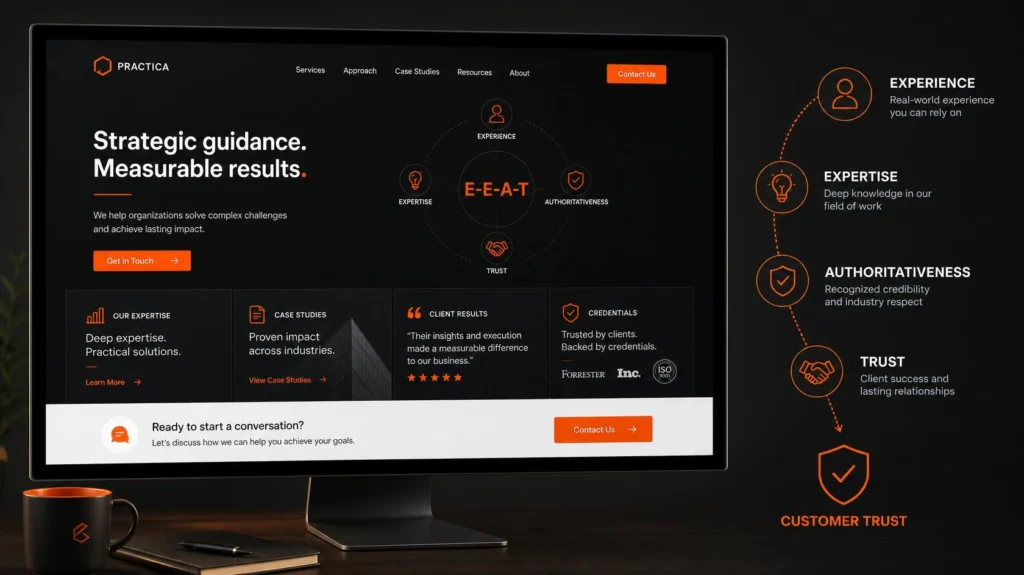
Homepage E-E-A-T addresses that question through the signals surrounding Experience, Expertise, Authoritativeness and Trustworthiness. For a professional-service website, the strongest signals are not decorative badges or a long list of marketing claims. They are clear identity, relevant expertise, genuine experience, supporting evidence, transparent business information, credible reputation, and an easy way to verify important claims.
Google says E-E-A-T is not a single ranking factor. Its systems use a mixture of signals associated with these qualities, and Google describes trust as the most important part of E-E-A-T.
That makes the homepage a useful place to make credibility easier to understand.
What Is E-E-A-T?
E-E-A-T stands for Experience, Expertise, Authoritativeness and Trustworthiness. It is a framework used in Google’s Search Quality Evaluator Guidelines to discuss the qualities that help a page and its creator appear reliable and useful.
The four concepts are related but not identical.
Experience concerns direct involvement with the subject.
Expertise concerns relevant knowledge and skill.
Authoritativeness concerns the reputation and standing of the creator, website or subject in the relevant field.
Trustworthiness concerns whether the information and business can be relied upon.
Google’s current people-first guidance encourages creators to make authorship clear, provide original and useful information, avoid unsupported claims and explain who created the content.
For a service-business homepage, think of E-E-A-T as a communication problem:
Can a stranger understand who you are, what you do, why you know the subject, what evidence supports your claims, and how to verify the business?
If the answer is yes, the homepage is doing meaningful trust work.
Does E-E-A-T Affect Google Rankings?
E-E-A-T is not a single Google ranking factor or score. Google says its automated systems use a variety of signals that can identify useful content demonstrating qualities associated with experience, expertise, authority and trust. Google also emphasizes that trust is particularly important.
This distinction matters because it changes how a business should respond.
You cannot add an “E-E-A-T score” to a homepage.
You can make the underlying evidence clearer.
For example, instead of adding a paragraph that says:
We are a leading expert you can trust.
Show who the expert is, what the person does, what experience is relevant, what work has been documented, which claims can be verified, and where a visitor can learn more.
That is a much stronger communication pattern than the word “expert” by itself.
What Should a Homepage Prove?
A strong professional-service homepage should make eight things easier to understand:
- Identity: Who is responsible for the business?
- Relevance: What does the business actually provide?
- Experience: Has the person or company genuinely done this work?
- Expertise: Why is the knowledge relevant to the customer’s problem?
- Evidence: What supports the important claims?
- Reputation: What do credible customers, organisations or external sources say?
- Accountability: Can visitors verify the business and its people?
- Action: What should a suitable visitor do next?
These do not need eight separate homepage sections.
They can be distributed naturally across the hero, services, proof sections, About introduction, case studies, testimonials, process, contact information and footer.
The useful test is not “How many trust badges are on the page?”
The useful test is:
Can the visitor connect the claim to evidence?
The 8-Part Homepage E-E-A-T Proof Stack
1. Identity: Make the Responsible Person or Business Obvious
Trust is difficult when the homepage does not make the business accountable.
A visitor should be able to identify the person, company or organisation behind the website.
For a personal consultancy, this may mean:
- Full professional name
- Clear role or specialization
- Professional photograph
- Short biography
- Link to the full About page
- Relevant professional profiles
- Clear contact route
For a company, it may mean:
- Business name
- Company description
- Leadership or team information where relevant
- Genuine location or service-area information
- Contact details
- Relevant company or professional registration details where applicable
The purpose is not to publish every piece of personal information.
The purpose is to make responsibility clear.
A useful About page for Md Mynul Hassan gives the visitor somewhere to go when a short homepage introduction is not enough.
2. Relevance: Explain Exactly What You Do and Who You Help
Expertise does not mean much if the visitor cannot determine whether it applies to their situation.
The hero section should communicate the business category, core service and audience in plain language.
Compare:
Helping brands achieve digital transformation.
with:
SEO, Local SEO, AEO and GEO consulting for businesses that need clearer search visibility.
The second version creates stronger semantic context.
The visitor can understand:
Business category → Service → Problem → Outcome
For local businesses, add genuine location context where geography changes the buying decision.
For professional firms, make the service and client type clear.
For consultants, identify the problem being solved rather than relying only on a title.
Your homepage should not force the visitor to decode what the business does through the navigation menu.
3. Experience: Show That the Work Has Actually Been Done
Experience is easiest to demonstrate through evidence.
A claim such as “experienced SEO consultant” is weak by itself.
A better structure is:
Claim → specific context → work performed → evidence
For example:
SEO consultant specializing in Local SEO, Google Business Profile optimization, technical SEO and content strategy.
Then support that positioning through:
- Documented projects
- Relevant case studies
- Project methodology
- Before-and-after evidence where genuinely available
- Screenshots or reports where permission allows
- Specific work examples
- Articles that demonstrate practical understanding
Experience should describe what is true.
Do not manufacture client work, years of experience, results or credentials just to make the homepage look stronger.
A case-study library is more useful than a generic sentence promising “proven results” without context.
4. Expertise: Demonstrate Knowledge Instead of Repeating the Word “Expert”
Expertise is demonstrated through the quality and specificity of the information.
A professional-service homepage can support expertise by explaining:
- What the business specializes in
- Which problems it handles
- How it approaches those problems
- Which services are connected
- Which situations require different approaches
- What it does not recommend
- Which evidence or sources support important claims
A strong homepage can also route visitors to deeper resources.
For example, a professional SEO site might connect its expertise to technical SEO services, on-page SEO services and keyword research services.
That creates a useful relationship between:
Person → expertise → service → supporting knowledge
The visitor does not need to believe the claim simply because the homepage says it.
The website gives them places to investigate it.
5. Evidence: Put Proof Near the Claim It Supports
One of the most useful homepage E-E-A-T principles is proof proximity.
Do not put every trust element at the bottom of the page.
Put evidence close to the decision it supports.
| Homepage claim | Useful supporting evidence |
|---|---|
| “Experienced consultant” | Relevant project history, case studies |
| “Specialist in Local SEO” | Local SEO service page, case studies, topic expertise |
| “Clients worldwide” | Genuine market examples, client locations where publishable |
| “Highly rated” | Real reviews with context |
| “Certified” | Verifiable certification information |
| “Trusted by customers” | Authentic testimonials or review sources |
| “Technical specialist” | Technical guides, service detail, practical examples |
This does not mean every claim needs a testimonial.
It means important claims should have a credible basis.
6. Reputation: Connect the Homepage to the Wider Web
A homepage is only one part of a business entity.
Potential customers may also discover the business through:
- Google Search
- Google Business Profile
- YouTube
- Industry directories
- Professional organisations
- Client reviews
- Third-party publications
- Case studies
- Marketplace profiles
For businesses with genuine local operations, Local SEO and Google Business Profile optimization can help keep the website and local presence aligned.
The important word is genuine.
Do not manufacture locations, fake profiles, fake reviews or misleading business details.
Reputation is stronger when it is independent and consistent.
7. Accountability: Make Verification Easy
Trust increases when visitors can answer:
Who wrote this?
Who owns the website?
How can I contact the business?
Where can I learn more about the person?
Can I verify important claims?
Google’s guidance specifically recommends making authorship clear and, where appropriate, providing links that help readers understand the author.
For an article, that could mean a visible byline connected to an author page.
For a service business, it may mean connecting the homepage to the About page, service pages, contact information and relevant professional profiles.
The goal is accountability, not biography overload.
8. Action: Trust Must Lead Somewhere
A visitor who trusts the business still needs to know what to do.
A homepage should make the next step clear:
- Request an audit
- Book a consultation
- Contact the business
- View a relevant service
- Review case studies
- Ask a question
- Request a quote
The CTA should fit the visitor’s stage.
Someone comparing consultants may need to see case studies before contacting you.
Someone already familiar with the business may need a simple contact route.
Trust and conversion work together when proof appears immediately before or beside an important decision.
What Trust Signals Belong on a Homepage?
There is no universal checklist because professional-service businesses have different requirements.
Useful signals can include:
Business identity: name, clear role, About link, contact details.
Expertise evidence: relevant qualifications, professional history, specialist areas, useful content.
Experience evidence: case studies, project examples, first-hand observations where genuine.
Reputation: legitimate reviews, testimonials, professional profiles, relevant recognition.
Business information: genuine location or service area, contact methods, service details.
Transparency: clear claims, accurate policies, appropriate disclosures.
Proof of work: portfolio items, examples, documented methodology, screenshots where permissible.
Content accountability: author names, dates where relevant, editorial information where appropriate.
Technical trust: usable website, accessible information, working links, consistent structured data and reasonable page experience.
Do not add all of these simply because a checklist says so.
Add the signals that reduce uncertainty for your specific buyer.
Homepage vs About Page: What Goes Where?
The homepage and About page have different jobs.
| Homepage | About page |
|---|---|
| Introduces the person or business quickly | Provides deeper background |
| Shows relevant expertise | Explains professional journey |
| Highlights the strongest proof | Provides fuller evidence |
| Clarifies services | Explains methods and specialization |
| Gives the next action | Builds deeper personal or organisational understanding |
A common mistake is writing an entire biography on the homepage.
Another is keeping the homepage anonymous and putting all credibility information on the About page.
A better structure is:
Homepage: enough proof to trust the next click.
About page: enough detail to verify the person or business.
Your About Md Mynul Hassan page provides the deeper context, while the homepage can remain focused on business positioning and customer decisions.
Testimonials, Reviews or Case Studies?
They prove different things.
| Proof type | Best for demonstrating |
|---|---|
| Testimonial | Customer opinion |
| Review | Customer experience |
| Case study | How the work was performed and what happened |
| Portfolio | Quality of output |
| Credential | Formal qualification |
| Professional profile | Identity and professional context |
| Reference/source | Support for a factual claim |
A case study is particularly useful when the buyer needs to understand how you think, not simply whether someone liked your service.
A testimonial can communicate satisfaction quickly.
A credential can establish formal qualification.
A professional profile can help connect the person across the web.
The strongest homepage often uses a small combination rather than relying on one proof type.
For more detail, see how reviews, testimonials and case studies support SEO and AEO.
Reviews also need special care. The U.S. Federal Trade Commission’s current consumer reviews rule prohibits various deceptive practices involving fake or false reviews and testimonials, including buying or selling fake reviews.
That is another reason authentic proof is more valuable than impressive-looking proof.
How Technical SEO Supports E-E-A-T
Technical SEO does not create expertise.
A schema markup block cannot turn an inexperienced business into an expert.
Technical work supports E-E-A-T by making important information accessible, understandable and connected.
A technical review should consider:
- Crawlability
- Indexability
- Internal links
- Canonical URLs
- XML sitemap quality
- Structured data
- Mobile usability
- Page performance
- Broken links
- Clear page hierarchy
A technical SEO review can identify whether important pages are actually discoverable.
On-page SEO can then improve how individual pages communicate their purpose, information and relationships.
Structured data has a narrower role.
Google says Organization structured data on a homepage can help it better understand and disambiguate an organization. Google also recommends placing appropriate organization information on the homepage or a page describing the organization.
For articles, Google says Article structured data can help it understand details such as the headline, author, image and publication information.
The principle is simple:
Visible evidence first. Structured data second.
Schema should accurately represent the visible page rather than introduce claims the page does not support.
How E-E-A-T Relates to AI Search
AI search makes clarity useful for another reason: modern search systems need to interpret information in context.
Google’s current documentation says AI Overviews and AI Mode continue to use foundational SEO practices. A page needs to be indexed and eligible to appear in normal Search with a snippet, and Google says there are no extra technical requirements or special schema required specifically for AI Overviews or AI Mode.
Google’s newer generative-AI guidance also emphasizes unique, useful, people-first content and warns against producing unnecessary pages simply to target query variations.
That has a direct connection to homepage E-E-A-T.
A business should make important facts easy to understand:
Who → Business or person
What → Services
For whom → Audience
Where → Genuine market or service area
Why credible → Experience and expertise
What proves it → Evidence
How to verify → Profiles, sources and supporting pages
What next → Relevant action
This is not an “AI hack.”
It is good information architecture.
Your AEO & GEO consulting service takes this broader approach by connecting entity clarity, content structure, expertise signals, supporting evidence and search visibility.
How to Build a Homepage E-E-A-T Section by Section
Here is a practical homepage sequence for a professional service business.
Section 1: Hero
Answer:
Who are you?
What do you do?
Who do you help?
What should the visitor do next?
Example:
SEO consultant helping service businesses improve visibility across Google Search, Google Maps and AI-driven search.
Then use a relevant CTA.
Section 2: Immediate Proof
Show one or two strong pieces of relevant evidence.
Examples:
- Years of relevant experience, when accurate
- Real review
- Recognised credential
- Client or project evidence
- Professional association
Avoid stacking ten badges.
Section 3: Core Services
List the services that matter most.
Keep each description brief and link to the deeper page.
The visitor should understand what each service actually does.
Section 4: Expertise
Explain the specialist areas and the kinds of problems you solve.
This is where useful content and service pages strengthen the homepage.
Section 5: Work or Case Studies
Show how expertise becomes real work.
Do not hide the context.
Explain:
Problem → Decision → Work → Evidence → Outcome
Do not claim an outcome that cannot be supported.
Section 6: About
Add a short human introduction with a link to the full About page.
Section 7: Testimonials or Reviews
Show only genuine feedback.
Where appropriate, provide enough context to make the proof meaningful.
Section 8: Process
Explain what happens after contact.
This reduces uncertainty.
Section 9: FAQ
Answer the questions that affect the visitor’s decision.
Do not turn the FAQ into a keyword list.
Section 10: Contact
Provide a clear next action and enough business information for the visitor to know who they are contacting.
10 Common Homepage E-E-A-T Mistakes
1. Calling Yourself an Expert Without Showing Why
Problem: The page repeatedly uses words such as expert, trusted, leading and best.
Why it fails: Claims are not evidence.
Better approach: Show relevant work, expertise, qualifications and useful information.
2. Anonymous Content
Problem: Articles have no obvious author.
Better approach: Use accurate bylines and connect them to an identifiable author or About page. Google specifically encourages clear creator information where authorship would be expected.
3. Fake or Unverifiable Reviews
Problem: Anonymous or fabricated testimonials are used as credibility shortcuts.
Better approach: Publish authentic feedback and describe the relationship appropriately.
4. Numbers Without Context
A homepage may say:
100+ projects
50+ clients
4.9 rating
Those figures should be accurate, current and understandable.
Ask:
What is being counted?
When was it measured?
What source supports it?
A number without context can create more doubt than trust.
5. Putting All Proof in the Footer
Strong evidence should appear where the visitor is deciding.
6. Copying Competitor Claims
A homepage should not say “award-winning,” “industry-leading,” “best” or similar claims simply because competitors use them.
Every claim needs its own basis.
7. Inconsistent Business Information
The website, professional profiles, local listings and other relevant sources should not create contradictory versions of the same business.
8. Hiding the Person Behind a Personal Service
Consultants, freelancers and experts are often selling knowledge.
An anonymous brand page can remove useful context.
9. Treating Schema as Proof
Schema can help search engines interpret information.
It cannot manufacture credibility.
10. Optimising for Search Systems Instead of People
Google’s guidance is explicit about prioritising people-first, helpful and reliable content rather than content produced mainly to manipulate search rankings.
How to Audit Your Homepage in 30 Minutes
You do not need a complicated tool to find many trust weaknesses.
Step 1: Read the Hero Like a Stranger
Can you identify:
- The business
- Main service
- Audience
- Location, where relevant
- Next step
If not, fix clarity before adding more proof.
Step 2: Circle Every Major Claim
Look for phrases such as:
- Experienced
- Trusted
- Specialist
- Certified
- Award-winning
- Leading
- Proven
- Hundreds of projects
- Thousands of customers
Then ask:
Where is the evidence?
Step 3: Check the Responsible Person
Can the visitor identify who created the content or provides the service?
Step 4: Check Proof Proximity
Is evidence near the decision it supports?
Step 5: Check External Consistency
Compare the homepage with:
- About page
- Service pages
- Professional profiles
- Local business profiles
- Social profiles
- Marketplace accounts
- Published case studies
Step 6: Check Contact Accountability
Does the visitor have a genuine way to contact the business?
Step 7: Check Technical Access
Review indexability, internal links, structured data, mobile usability and important page performance.
An SEO audit is useful when these questions uncover deeper structural problems rather than isolated copy issues.
Step 8: Remove Unsupported Claims
Do not leave weak claims on the page simply because they sound persuasive.
A trustworthy homepage is allowed to say less.
It just needs to make the remaining claims believable.
Homepage E-E-A-T Checklist
Use this before publishing or redesigning a professional-service homepage.
Identity
Business or professional identity is obvious
Responsible person or organisation is identifiable
About information is accessible
Contact information is genuine
Professional profiles are accurate
Experience
Relevant experience is stated accurately
Real projects or examples are available where appropriate
Case studies contain genuine information
First-hand claims are based on real involvement
Expertise
Specialization is clear
Relevant qualifications are accurate
Service explanations demonstrate subject knowledge
Supporting content reinforces expertise
Authority
External professional presence is consistent
Relevant mentions or references exist where appropriate
Reputation evidence is genuine
Business information does not conflict across important profiles
Trust
Claims are supportable
Reviews and testimonials are authentic
Policies are accurate
Business details are clear
No fake locations or misleading claims are used
Structured data matches visible information
Search and usability
One clear H1
Descriptive headings
Important pages are internally linked
Key information exists in crawlable text
Mobile experience works properly
Important pages are indexable
Page experience is acceptable
Relevant structured data is implemented correctly
Google’s current AI-search guidance reinforces several of these foundations: crawlable content, strong technical structure, useful internal links, useful textual content and structured data that matches visible content.
A Practical Example for a Professional SEO Consultant
A consultant homepage could be structured like this:
Hero
SEO consultant specializing in Local SEO, technical SEO, content strategy and AI-search visibility.
Immediate proof
Relevant experience + one authentic client statement.
Services
Local SEO, SEO audits, technical SEO, content strategy, AEO/GEO.
Expertise
Short explanations of the problems each service solves.
Case studies
Real documented examples with context.
About
Photo, professional background, relevant experience and link to the full profile.
Content
Useful articles showing how the consultant thinks about search.
External profiles
LinkedIn, professional marketplaces and relevant social channels.
For this site, the supporting ecosystem includes SEO content strategy, WordPress SEO, website speed optimization and conversion rate optimization.
The architecture matters because the homepage is not expected to prove everything by itself.
It should make the business understandable and route the visitor to deeper evidence.
Building a Trustworthy Professional Profile Beyond the Homepage
A modern professional website should also create consistency between the homepage and external profiles.
For a consultant or freelancer, that can include:
These profiles should describe the same person and core professional identity accurately.
Do not copy a giant paragraph across every platform simply for consistency.
Keep the facts consistent while adapting the wording to each platform.
That produces better entity clarity without creating repetitive content.
The Homepage E-E-A-T Decision Framework
Before adding a trust element, ask five questions:
1. What uncertainty does this element reduce?
2. What claim does it support?
3. Is the evidence genuine?
4. Can a visitor verify it if necessary?
5. Does it appear near the decision it influences?
This prevents a common homepage problem: accumulating trust signals without understanding what each one is supposed to prove.
For example, ten client logos may look impressive.
But if nobody knows what the relationship was, the logos may provide little useful context.
A short case study explaining the problem, work and outcome may provide much stronger evidence.
Evidence Before Decoration
The strongest homepage improvements often involve content and proof rather than visual decoration.
A polished design can help usability.
It cannot compensate for:
- unclear identity
- weak service positioning
- unsupported claims
- anonymous authors
- fake reviews
- inconsistent business information
- missing evidence
- difficult contact paths
Trust is built through the information itself.
That is why E-E-A-T should be treated as a website-wide communication system rather than a badge section.
Further Evidence and Official Guidance
For the underlying principles, start with Google’s current [people-first content and E-E-A-T guidance] and its current [AI features and website guidance].
For review integrity, the U.S. Federal Trade Commission’s current [consumer reviews and testimonials guidance] explains requirements surrounding deceptive reviews, testimonials and endorsements.
Final Takeaway
A strong homepage does not need to shout that a business is trustworthy.
It should make trust easier to evaluate.
Start with identity.
Make the service and audience clear.
Show genuine experience.
Demonstrate relevant expertise.
Connect important claims to evidence.
Make reputation visible without manufacturing it.
Give visitors a way to verify the business.
Then make the next action obvious.
For professional-service businesses, that creates a homepage that works as more than an introduction. It becomes the front door to the entire credibility system: the person behind the work, the services being offered, the evidence supporting them, the deeper pages explaining them, and the external presence that helps visitors investigate the business for themselves.