Opening a second med spa location changes your local SEO structure.
You are no longer optimizing one business address. You now have a brand operating in two physical markets, and Google needs to understand the difference between them.
The core setup is straightforward: the new location needs accurate business information, an eligible Google Business Profile, a dedicated location page, location-specific signals, its own review activity, consistent citations, and a tracking system that separates Location 1 from Location 2.
Google says local results are mainly influenced by relevance, distance, and prominence. Accurate and complete business information helps Google understand relevance, while reviews and websites linking to the business can contribute to prominence.
This checklist is designed for a med spa opening a second physical location in California and can be adapted to other U.S. markets.
What Changes When a Med Spa Opens a Second Location?
A second location creates a second local entity inside the same brand.
Your brand remains the same, but the physical branch has its own address, hours, phone information where appropriate, local photos, reviews, services, website URL, and local relevance.
That distinction matters.
Google’s Business Profile guidelines say businesses should create profiles for actual real-world locations and should not create more than one profile for the same location. Google also says businesses with different locations can have a profile for each location when the locations meet its eligibility requirements.
For a two-location med spa, think about SEO as two layers:
Brand layer
The parent med spa brand, overall services, reputation, main website, policies, and organization identity.
Location layer
Location 1 address, Location 1 GBP, Location 1 reviews, Location 1 page, Location 1 local links, and Location 1 performance.
Then repeat the location layer for Location 2.
The goal is not to duplicate everything twice. It is to connect both locations to the same organization while giving each real location enough unique information to stand on its own.
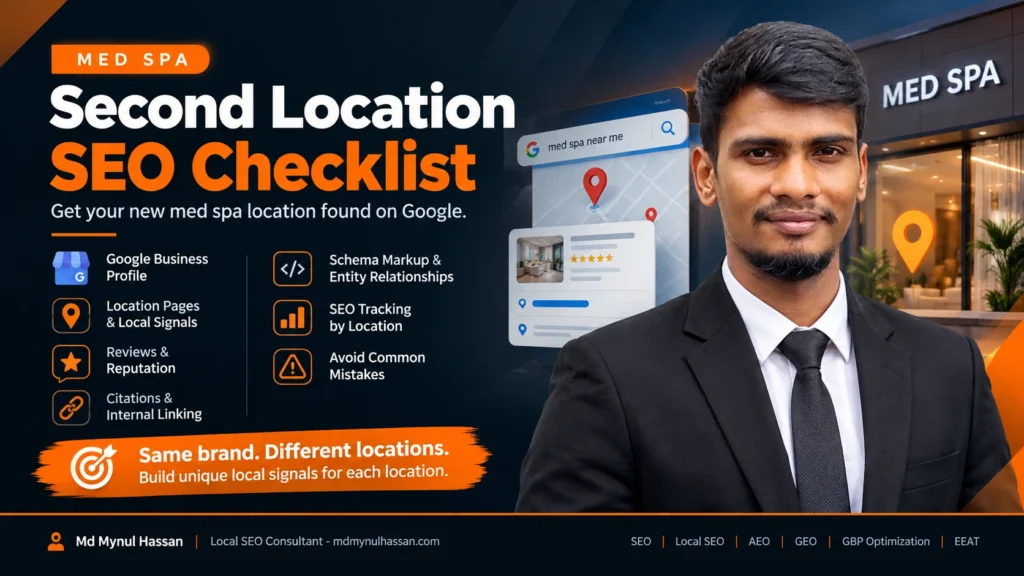
Second-Location Med Spa SEO Checklist
Use this as the launch checklist:
- Confirm the second location is a real, eligible physical location.
- Confirm the business name and local details that will be used publicly.
- Create or claim the correct Google Business Profile for the new location.
- Use the actual location address and accurate business information.
- Give the location its own website URL.
- Build a substantive location page.
- Add location-specific services and details.
- Add real photographs of the new location.
- Create a review-request process for the new location.
- Audit directory and citation information.
- Connect the new location page to relevant service pages.
- Link from the main Locations page to Location 2.
- Add location-level structured data that matches the page.
- Check canonical, indexability, sitemap, and internal links.
- Track rankings separately for each location.
- Track calls, website visits, direction requests, bookings, and leads by location.
- Review duplicate content before launch.
- Compare Location 1 and Location 2 without trying to make them identical.
- Recheck the entire local-search setup after the first 30 days.
The order matters. A second-location SEO campaign works better when the business information and technical foundation are correct before you start adding large amounts of content.
Before the New Med Spa Location Opens
1. Decide Exactly What the New Location Represents
Start with the real business setup.
Ask:
Does Location 2 have its own physical customer-facing space?
Will staff operate there?
Can customers visit during stated hours?
Will the location have permanent business signage?
Does it provide the services listed on its future profile?
Google’s guidelines emphasize real-world business locations and accurate representation. Virtual offices and addresses that do not represent an operating business are not acceptable substitutes for a real location.
This is the point where local SEO should follow the actual business rather than trying to manufacture a local presence for a keyword.
2. Map the Location’s Search Intent
Do not start by adding dozens of city names.
Build a keyword map around the services people can actually book at Location 2.
For example:
Location: Irvine, California
Core local searches:
- med spa in Irvine
- medical spa Irvine
- med spa near me
- Botox Irvine
- laser treatment Irvine
- facial treatment Irvine
Then identify which searches need:
- the location page
- a treatment page
- a service page
- an FAQ
- supporting educational content
Your keyword research service should ultimately help determine which queries belong on which page rather than turning one location page into a container for every keyword variation.
3. Build the Location Information Set
Before publishing anything, collect the real data.
At minimum:
- Official business name
- Exact address
- Suite or unit information where applicable
- Local phone number if used
- Opening hours
- Holiday hours
- Website URL
- Appointment URL
- Services offered
- Primary category
- Additional relevant categories where legitimately applicable
- Location photos
- Provider/practitioner information
- Parking or access details
- Nearby landmarks when genuinely useful
This becomes the reference document for your GBP, website, directories, schema, and internal marketing materials.
A consistent source of truth reduces accidental differences between platforms.
Create a Separate Google Business Profile for the New Location
Google’s current guidance says location information should represent the actual business, and eligible businesses with multiple locations can manage multiple profiles. Google also says businesses with multiple locations should maintain consistent names and categories where applicable.
For a second med spa location, do not treat the old GBP as if it physically moved.
Instead:
Location 1
Brand + Address 1 + Location 1 website URL + Location 1 reviews
Location 2
Brand + Address 2 + Location 2 website URL + Location 2 reviews
The exact profile setup depends on the actual business configuration and Google’s eligibility rules.
Use the Real Location Details
Do not add keywords to the business name simply because the new city has strong search demand.
Google’s current guidelines require accurate representation of the business, and its name rules generally require consistency across locations within the same country unless a documented exception applies.
That means this is risky:
Brand Name – Best Botox Med Spa Irvine
when the real-world business is simply:
Brand Name
Use the actual business name rather than trying to turn the GBP name into an SEO title.
Connect the New GBP to the Correct Page
One common second-location problem is sending both profiles to the same homepage.
Instead, where the website structure supports it:
Location 1 GBP → Location 1 page
Location 2 GBP → Location 2 page
This creates a clearer relationship between the physical branch, the local profile, and the website.
Google’s documentation says a business should provide a phone number that connects to the individual location or a website that represents that individual location.
Create a Dedicated Location Page for the Second Med Spa
A strong location page should answer a simple question:
What does this med spa location offer, where is it, who serves customers there, and how can someone book?
Avoid creating two almost-identical pages where the only change is the city name.
A better Location 2 page might include:
Location overview
Explain the specific branch and what it offers.
Address and access
Include the actual physical address, operating hours, parking information, building information, or local access details when useful.
Services available at this location
Only include treatments actually available there.
Providers or practitioners
Where publicly appropriate, identify the people providing the services and present their real credentials accurately.
Local booking information
Explain how appointments work at this branch.
Location-specific photos
Use genuine photos of the actual site rather than generic stock imagery.
Nearby context
Mention nearby districts, landmarks, parking areas, or transit information when genuinely useful to visitors.
FAQs
Answer real questions about this branch.
A useful location page gives visitors information that they could not obtain simply by replacing “Location 1” with “Location 2”.
Your on-page SEO service can support the page’s search intent, headings, metadata, internal linking, structured data, and content relevance.
Keep Brand Signals Consistent, But Make Location Signals Unique
The most useful way to think about a multi-location med spa is:
| Signal | Brand Level | Location Level |
|---|---|---|
| Brand name | Consistent | Usually consistent |
| Core brand identity | Consistent | Consistent |
| Address | Not shared as one universal value | Unique |
| Phone | May have central number | Prefer location-specific where applicable |
| Hours | Brand policy may be shared | Actual location hours |
| Reviews | Overall brand reputation | Location-specific review history |
| Photos | Brand assets | Real photos for each location |
| Services | Core service set | Only services offered there |
| URL | Main website | Dedicated location URL |
| Local links | Brand authority | Local authority per branch |
| GBP | Organization-wide management | Separate eligible location profile |
| Schema | Organization entity | Location-level LocalBusiness entity |
Google’s local guidance identifies relevance, distance, and prominence as the main local ranking areas. This is why Location 2 cannot simply inherit every local signal from Location 1. The second address is physically different, so its local context is different too.
Reviews and Reputation for the New Location
A new location usually starts with less review history than the established location.
That does not mean you should transfer, copy, or manufacture reviews.
The cleaner approach is to build a genuine review process for the new branch.
After real customer visits, provide the appropriate review-request path for that location.
Track:
- Number of new reviews
- Review recency
- Review themes
- Owner responses
- Location-specific customer feedback
Google says reviews can contribute to prominence in local search and that more reviews and positive ratings can help local ranking.
The practical lesson is not “get as many reviews as possible at any cost.”
The better lesson is:
Build a repeatable system for collecting authentic feedback from real customers at Location 2.
Your article How Reviews, Testimonials, and Case Studies Support AEO and SEO is also a natural supporting resource when discussing how customer proof can strengthen broader search visibility.
Local Citations and Directory Consistency
A second location creates another data-distribution problem.
You may now have:
- Location 1 address
- Location 2 address
- Old directory records
- New directory records
- Map platforms
- Social profiles
- Booking platforms
- Industry directories
- Local business associations
The goal is not to submit the business to every directory on the internet.
The goal is to make important business information accurate and consistent on relevant platforms.
For Location 2, create a citation checklist:
Business name: correct
Address: correct
Phone: correct
URL: correct
Hours: correct
Category: correct
Services: accurate
Location description: unique and useful
Your SEO audit service can be used to identify local-information inconsistencies alongside broader website issues.
Internal Linking Between Locations and Services
A new location page should not become an orphan page.
Create a logical internal-link structure such as:
Main Website
→ Locations
→ Location 1
→ Location 2
And:
Main Services
→ Botox
→ Laser treatments
→ Skin treatments
→ Location-specific service information where genuinely relevant
Then connect the pages contextually.
For example:
Location 2 page
→ Botox service page
Botox service page
→ Location 2 page
Location page
→ booking page
Educational blog
→ relevant treatment page
This is not about putting ten links into every paragraph.
The link should answer the reader’s next question.
Your technical SEO service covers site architecture, internal links, XML sitemaps, structured data, crawling, indexability, and related technical issues.
Med Spa Schema Markup for Multiple Locations
Structured data should help describe real entities already represented on the page.
For a med spa, Google recommends using the most specific applicable LocalBusiness subtype. Schema.org currently includes DaySpa under HealthAndBeautyBusiness, while MedicalClinic is available for businesses that genuinely fit that medical definition.
Do not choose a schema type just because the name sounds stronger.
Useful entity relationships
A multi-location med spa can conceptually be represented as:
Organization
→ operates → Location 1
→ operates → Location 2
Location 2
→ branchOf → Parent Organization
Organization
→ employee → Person
Person
→ worksFor → Organization
Organization
→ offers → Service
Service
→ areaServed → Location / Area
Schema.org supports relationships such as branchOf, employee, worksFor, location, areaServed, and sameAs, which can help describe those relationships accurately.
Example structure
Use placeholders based on actual business data:
{
  "@context": "https://schema.org",
  "@type": "DaySpa",
  "@id": "https://example.com/locations/location-2/#localbusiness",
  "name": "Example Med Spa",
  "url": "https://example.com/locations/location-2/",
  "telephone": "+1-XXX-XXX-XXXX",
  "address": {
    "@type": "PostalAddress",
    "streetAddress": "REAL STREET ADDRESS",
    "addressLocality": "REAL CITY",
    "addressRegion": "CA",
    "postalCode": "REAL ZIP",
    "addressCountry": "US"
  },
  "branchOf": {
    "@id": "https://example.com/#organization"
  }
}
If the business genuinely operates as a medical clinic, a suitable medical type may be appropriate instead. Schema.org defines MedicalClinic specifically around facilities devoted to healthcare and includes properties such as availableService and medicalSpecialty.
Do not add fake ratings, fake reviews, unsupported practitioner credentials, or locations that do not exist.
Google explicitly recommends that structured data describe the page and business accurately.
How to Track SEO Performance by Location
Do not report one combined number for a two-location business.
Separate the measurements.
| KPI | Location 1 | Location 2 |
|---|---|---|
| Organic impressions | Track separately | Track separately |
| Organic clicks | Track separately | Track separately |
| GBP calls | Track separately | Track separately |
| GBP website visits | Track separately | Track separately |
| Direction requests | Track separately | Track separately |
| Local rankings | Track separately | Track separately |
| Reviews | Track separately | Track separately |
| Leads/bookings | Track separately | Track separately |
Use location-specific keyword tracking.
For example:
Location 1
Botox Los Angeles
med spa Los Angeles
Location 2
Botox Irvine
med spa Irvine
Then monitor searches around the actual markets instead of assuming Location 1 rankings represent Location 2.
Google also provides Business Profile tools for managing multiple locations, including bulk management workflows for larger groups.
Your SEO audit and action plan can help establish the technical and search baseline before the launch.
Common Second-Location SEO Mistakes
Mistake 1: Sending both locations to the homepage
Problem:
Google and users have a less direct relationship between the branch and its website page.
Better approach:
Use a dedicated location URL where the site structure supports it.
Mistake 2: Copying Location 1 word for word
Problem:
The new page adds little unique information.
Better approach:
Keep the core brand information consistent, but add real location-specific information.
Mistake 3: Adding city names everywhere
Problem:
The copy becomes unnatural and repetitive.
Better approach:
Use geographical references where they genuinely help explain the business.
Mistake 4: Using the old location’s reviews for the new location
Problem:
Customers may not understand which branch the reviews actually describe.
Better approach:
Build authentic review activity for each location.
Mistake 5: Changing the GBP name with keywords
Problem:
The business name may no longer reflect the real-world business.
Better approach:
Follow Google’s business-name rules and keep the real-world representation accurate.
Mistake 6: Creating location pages that have no useful local information
Problem:
They become thin pages with only an address and a few generic paragraphs.
Better approach:
Answer real customer questions about that specific location.
Mistake 7: Forgetting technical SEO after launch
Problem:
The page may exist but remain poorly connected, incorrectly canonicalized, blocked, or excluded from indexing.
Better approach:
Check indexability, internal links, sitemap inclusion, canonical signals, structured data, mobile usability, and performance.
Your WordPress SEO service can be relevant when the second-location website implementation is being handled inside WordPress.
30-Day Second Location SEO Checklist
Before launch
Create the business-information master sheet.
Research location-specific commercial queries.
Plan the Location 2 URL.
Plan the internal-link structure.
Prepare unique location content.
Prepare photos.
Confirm the business’s real-world eligibility and details.
Launch week
Set up or claim the eligible Google Business Profile.
Use accurate business information.
Publish the Location 2 page.
Connect the page from the Locations hub.
Connect relevant service pages.
Add location-level structured data.
Submit or update the sitemap as appropriate.
Check indexability.
Week 2
Audit citations.
Check Google Business Profile information.
Confirm the location URL.
Review customer booking paths.
Start the authentic review-request process.
Track initial local search visibility.
Weeks 3 to 4
Review Search Console impressions and clicks.
Review GBP interactions.
Check local keyword visibility.
Look for duplicate or overlapping pages.
Check internal links.
Add useful local FAQs based on genuine customer questions.
Review conversion performance.
Use your conversion rate optimization service when the new location receives traffic but the booking journey is creating unnecessary friction.
How the Second Location Should Fit Into the Wider SEO Strategy
A second location should not become an isolated mini-website.
Your site architecture should communicate:
Brand
→ Services
→ Locations
→ Location 1
→ Location 2
→ relevant service relationships
That is where topical authority, internal linking, entity clarity, and local SEO start working together.
Your SEO content strategy service can support the content architecture by identifying which service pages, location pages, FAQs, and supporting articles deserve to exist and how they should connect.
For larger websites, technical accessibility also matters. Your website speed optimization service can be useful when the addition of location pages, booking scripts, galleries, or third-party widgets starts affecting page performance.
Frequently Asked Questions
Does each med spa location need its own Google Business Profile?
An eligible separate physical location generally needs its own Business Profile when it qualifies as a distinct location under Google’s guidelines. Google says businesses with multiple locations can have a profile for each eligible location.
Should each med spa location have its own website page?
A dedicated page is usually the clearest website structure when each location has a real address, local services, local information, and a meaningful customer experience. The page should contain useful location-specific information rather than simply replacing one city name with another.
How should reviews work for multiple med spa locations?
Build genuine review activity for each physical location. Google states that review volume and positive ratings can contribute to local prominence, but the reviews should reflect real customer experiences.
Can both med spa locations use the same phone number?
A shared phone setup may sometimes be operationally necessary, but Google says businesses should provide a phone number that connects to the individual business location or a website that represents that individual location. Use the clearest location-level contact structure that accurately reflects how customers reach each branch.
How long does it take a new location to gain local visibility?
There is no reliable universal timeline. A new location starts with a different local context from the established branch, and visibility can be affected by relevance, distance, prominence, competition, website quality, reviews, and the quality of the local business information. Google does not provide a guaranteed ranking timetable.
Should I create separate service pages for the second location?
Not automatically.
First determine whether the search intent, service, location, and customer need justify a dedicated page. A page should exist because it provides useful information, not simply because a keyword tool can generate another city combination.
What schema should a med spa use for a second location?
Use the most specific applicable LocalBusiness subtype supported by the actual business. Schema.org currently includes DaySpa under HealthAndBeautyBusiness, while MedicalClinic exists for businesses that genuinely fit that healthcare definition. The correct choice depends on what the business actually is.
How should I track SEO for two locations?
Track local rankings, GBP interactions, website clicks, calls, reviews, organic traffic, and leads separately for each location. Combining both branches into one reporting number can hide the fact that one location is much stronger or weaker than the other.
Final Takeaway
The biggest SEO mistake when opening a second med spa is treating the new branch as a copy of the old one.
A better structure is:
Same brand. Different physical location. Different local signals. Connected website architecture.
Build the second location around accurate business information, an eligible Google Business Profile, a useful location page, genuine reviews, consistent citations, logical internal links, appropriate structured data, and location-level measurement.
That gives Google clearer information about what the business is, where it operates, what services it provides, and how the second branch relates to the wider organization.
For ongoing work, Local SEO Service is the most directly relevant service page for a multi-location local search strategy, while Google Business Profile Optimization is relevant when the main challenge is profile structure and management.
Connect With Md Mynul Hassan
You can also explore my SEO work through:
Upwork
Freelancer.com
LinkedIn
YouTube
Facebook
Based in Bangladesh and working remotely with businesses in international English-speaking markets.