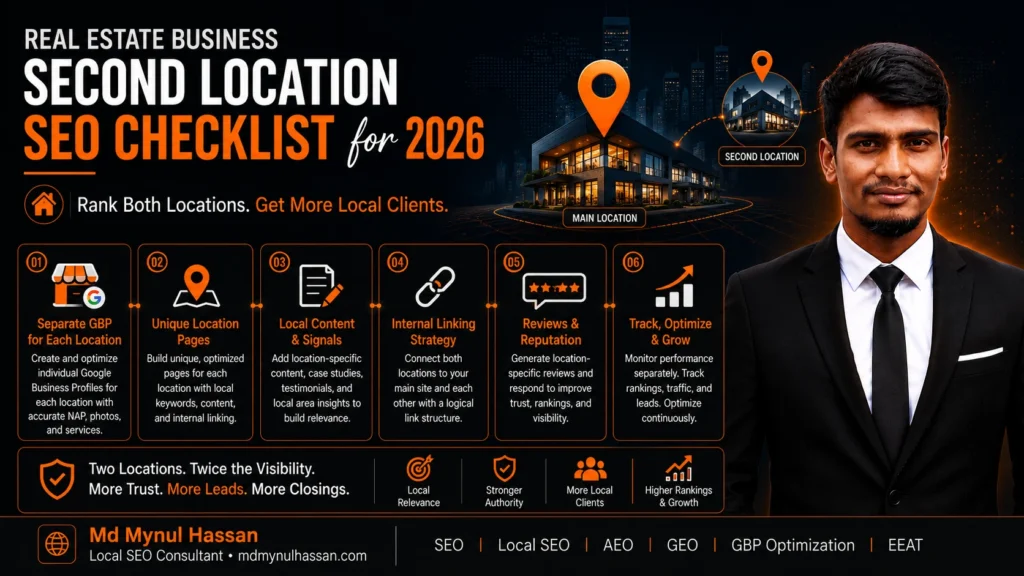
Opening a second real estate office changes your local SEO setup. You are no longer managing one business location in search. You are building a second local entity that needs its own accurate business information, local relevance, website representation, customer evidence, and measurement.
A useful real estate business second location SEO checklist starts with the physical branch, then connects Google Business Profile, the location page, service pages, reviews, citations, schema, internal links, and conversion tracking.
The biggest mistake is copying the first office and changing only the city name.
Google says local results are mainly influenced by relevance, distance, and prominence, while its Business Profile guidelines require accurate real-world representation.
A second-location strategy should therefore answer five practical questions:
- Is the new office genuinely eligible to be represented as a location?
- Does Google have a clear, accurate profile for it?
- Does your website clearly describe the branch?
- Are the new location and its services connected to the rest of the site?
- Can you measure whether the new branch is generating qualified enquiries?
Here is the checklist I would use.
What Changes When a Real Estate Agency Opens a Second Location?
A second office creates another local search context.
Your existing office may already have reviews, local mentions, links, historical relevance, branded searches, and a Google Business Profile. The new office starts with much less history.
That does not mean the new branch needs an entirely separate website. Usually, the stronger structure is one domain with clearly separated location pages and location-specific information.
For example:
Agency
→ City A Office
→ City B Office
Then connect each office to the appropriate services, agents, neighborhoods, buyer resources, seller resources, and contact paths.
Current multi-location SEO guidance similarly emphasizes dedicated location pages, location-specific information, and systems for managing multiple local markets rather than treating every branch as an isolated website.
I would also review the agency’s existing Local SEO service early in the process because the second-office project is really a multi-location local-search problem, not just a new page task.
Before Launch, Confirm the Second Office Is a Genuine Local Entity
Before worrying about keywords, confirm that the office genuinely exists and can be represented accurately.
Google’s current Business Profile guidelines say businesses should use accurate real-world locations, avoid virtual-office manipulation, and maintain appropriate representation. For service businesses with genuinely separate locations, Google allows a profile for each qualifying location when the conditions are met.
Physical address and eligibility
Check that the second office:
- exists at the stated location
- can receive customers where applicable
- uses an accurate address
- has appropriate real-world business representation
- is not simply a virtual address created to capture another city
Google specifically says a virtual office that the business does not actually operate from is not eligible as a business location.
Business name, phone and hours
Prepare the exact branch information before creating or updating profiles.
At minimum, maintain:
- real business name
- branch address
- local or directly controlled phone number
- regular customer-facing hours
- website URL representing the branch
- branch services
- staff information where useful
- photos of the real office
Google also advises using the actual business name rather than stuffing location or service keywords into the name.
This is one area where my Google Business Profile optimization service is directly relevant because the goal is accurate profile structure rather than adding keywords to every field.
Set Up the Second Google Business Profile Correctly
A second physical location does not automatically mean you should create another profile. The question is whether it is a genuine, eligible business location.
For a qualifying second office, the branch should have information that represents that actual location. Google says businesses with different qualifying locations may have separate profiles, and each profile should represent its genuine business location.
Use the real business identity
Do not create:
ABC Realty – Best Realtor Downtown
when the real-world business name is simply:
ABC Realty
Google explicitly prohibits unnecessary business-name information such as service terms and location information added solely for search manipulation.
Choose the correct category
Google recommends using as few categories as necessary and selecting categories that accurately represent the core business. Categories should describe the business rather than act as keyword fields.
For a real estate organization, verify the current available category set in the Business Profile interface instead of copying a category from an old SEO article.
Keep branch data aligned
The branch page, GBP, citations, footer information, contact page, and other authoritative references should tell the same basic story.
That means the second office should not have one phone number on Google, another on the website, and a third on a directory.
Consistency is useful because it reduces ambiguity about which information belongs to which location.
Build a Dedicated Location Page for the New Office
A second location should normally have its own useful website representation.
A practical structure could be:
Main site
→ /locations/
→ /locations/city-a/
→ /locations/city-b/
The exact structure can differ, but the principle is the same: each branch needs a clear URL that explains that branch.
Current real estate SEO guidance strongly emphasizes location and neighborhood pages, but also warns against thin pages that simply swap a city name into the same template.
What the second-location page should contain
A useful branch page might include:
- official office name
- full address
- phone
- office hours
- map or directions
- services provided from that office
- agents or staff genuinely associated with it
- areas the office actually serves
- current local property context where appropriate
- recent listings or useful property resources
- local buyer or seller information
- branch-specific FAQs
- genuine photographs
- clear enquiry or appointment path
The point is not to make the page long.
The point is to make it useful.
A buyer looking for a real estate office in City B should be able to understand where the office is, what it offers, who works there, what areas it serves, and how to contact it without opening another five pages.
How to make the page genuinely different
Do not publish:
Real Estate Agency in City A
and
Real Estate Agency in City B
with 90 percent of the text identical.
Instead, write about things that are actually different:
City B office team
City B neighborhoods served
City B buyer and seller services
City B property types
City B market resources
City B contact information
City B local FAQs
City B branch photography
This also aligns with Google’s people-first guidance, which encourages original, useful information and warns against content created mainly to capture search traffic.
For broader content architecture, connect the branch work with your Content Strategy & SEO Content Writing Service rather than treating the location page as a standalone copywriting exercise.
Connect the Branch Page to the Rest of the Website
A location page should not sit alone.
Think of the website as a relationship system:
Homepage
→ Locations
→ City B Office
Then:
City B Office
→ Buy Property
→ Sell Property
→ Property Valuation
→ Neighborhood Guides
→ Featured Listings
→ Agents
→ Contact
This creates useful paths for both users and search engines.
Your service pages should also link into the branch page where the relationship makes sense.
For example, a page about selling homes can link to:
Sell Your Home in City B
rather than forcing every service page to link to every branch.
That is the type of internal linking I recommend on my On-Page SEO service, where the purpose is to connect page intent rather than simply increase the number of links.
Build Location Relevance Without Creating Doorway Pages
Opening another office often creates a temptation to publish dozens of location pages:
Realtor in City B
Realtor near City B
Best Realtor City B
Cheap Realtor City B
Realtor City B downtown
Realtor City B east
Realtor City B west
That can become a pile of pages with little independent value.
A better approach is to create pages around genuine differences in search intent.
For example:
- City B office
- City B buyer services
- City B seller services
- Neighborhood guide for Neighborhood X
- Neighborhood guide for Neighborhood Y
- Property type guide for City B
The page should exist because the user needs a distinct resource, not because a keyword tool produced another variation.
That principle is consistent with Google’s people-first guidance and with current real estate SEO recommendations that warn against thin, templated location content.
For keyword mapping before publishing, your Keyword Research Service is relevant because the goal should be keyword-to-page mapping, not keyword accumulation.
Reviews, Citations and Local Authority for the New Branch
A new office has one obvious disadvantage: it may have little location-specific proof.
That is why branch reputation work should begin early.
Reviews
Reviews should be genuine and tied to real customer experiences.
Do not ask existing customers to pretend they used the new office when they did not.
A simple process is:
Customer interaction
→ appropriate review request
→ genuine branch-specific experience
→ response from the business
Do not attempt to transfer or fabricate reputation between locations.
Citations
Review major local and industry directories and update the branch information accurately.
Prioritize relevance rather than creating hundreds of low-quality listings.
Check:
- business name
- branch address
- phone
- URL
- category
- hours
- branch description
For larger cleanup projects, a Local SEO audit can identify inconsistencies before they spread across more platforms.
Local mentions and links
The second branch can also earn local relevance through legitimate relationships.
Examples include:
- local property associations
- community organizations
- chambers of commerce
- local publications
- property events
- sponsorships
- neighborhood resources
- local professional partners
The objective is not “get 50 backlinks.”
The objective is to build legitimate evidence that the business operates in that market.
Implement Real Estate Schema Correctly
Structured data should describe the business that actually exists on the page.
Google’s Local Business documentation recommends using the most specific appropriate LocalBusiness subtype and making sure structured data reflects visible content.
Schema.org currently defines RealEstateAgent as a subtype of LocalBusiness, which makes it far more appropriate for this topic than LegalService.
RealEstateAgent
Use RealEstateAgent to represent a genuine real estate business or branch where appropriate.
Example relationship:
RealEstateAgent
→ has address → PostalAddress
→ has location → Place
→ offers → Service
→ has employee/member → Person
→ has website → WebSite
Schema.org’s current definition supports real-estate-agent-specific business representation and inherits many organization and location properties.
Organization
Use Organization when you need to describe the wider agency entity.
For example:
ABC Realty
owns or operates:
ABC Realty City A Office
ABC Realty City B Office
Google’s Organization documentation explicitly supports multiple addresses where the organization genuinely operates in multiple locations.
Person
A branch may have named agents or brokers.
Those people should be represented as Person entities when the page genuinely describes them.
The relationship should be clear:
Agency → has employee/member → Agent Name
Do not turn every salesperson into a separate fake business entity.
This is particularly important because Google separately recognizes individual practitioners, including real estate agents, under Business Profile policy. The policy says a real estate agent can qualify as an individual practitioner when the conditions are met.
Service
A branch may offer services such as:
- residential sales
- buyer representation
- seller representation
- property valuation
- rental services
- commercial property services
Schema.org’s Service type supports relationships such as provider and areaServed.
For example:
Service
→ provider → RealEstateAgent
→ areaServed → City B
Place
A physical branch has a location.
You can represent the branch location using address information and, where appropriate, geographic coordinates.
Schema.org defines Place as a physically fixed entity, while geo can describe its geographical coordinates.
WebSite and WebPage relationships
Your website should represent the relationship between:
WebSite
→ publisher/operator → agency
and:
WebPage
→ about → branch
The location page should describe the actual office rather than pretending to be an independent organization.
Why LegalService is not appropriate
LegalService is specifically a Schema.org type for legal businesses such as law firms.
So for this real estate article:
Use: RealEstateAgent, Organization, Person, Service, Place, WebSite, WebPage
Do not use: LegalService
This is an important example of entity SEO done correctly. Schema is not a list of attractive labels. The type must match the entity being described.
For broader structured-data implementation, the Technical SEO service can support the technical side of schema, indexing, canonicalization, sitemaps, and internal architecture.
Technical SEO Checklist for the Second Location
Before publishing the branch, check the technical foundation.
Indexing and crawlability
Confirm:
- branch page is indexable
- canonical points to itself when appropriate
- no accidental
noindex - internal links point to the correct URL
- XML sitemap includes the new page
- robots.txt is not blocking important resources
- page loads correctly on mobile
- page returns a proper HTTP status
- old URLs are not accidentally redirected to the wrong branch
Internal architecture
The new branch should be reachable from useful areas of the website.
Do not bury it five or six levels deep.
This connects directly with the principles covered in my Technical SEO service and WordPress SEO service, particularly around internal links, sitemaps, architecture, indexation and structured data.
Performance
A branch page full of maps, property images, scripts, embedded widgets and galleries can become heavy.
Compress images, review scripts, and test the page rather than assuming a new location page is technically harmless.
The Website Speed Optimization service is especially relevant when map embeds, large property images and third-party tools affect mobile performance.
Track the New Location Separately
A second office should have separate measurement.
You need to know whether the branch creates visibility and whether that visibility produces business.
| KPI | Why it matters |
|---|---|
| Organic impressions | Shows search visibility growth |
| Organic clicks | Measures visits from search |
| GBP interactions | Indicates local profile engagement |
| Calls | Strong local lead signal |
| Direction requests | Useful for physical-office demand where available |
| Contact forms | Tracks website enquiries |
| Appointment requests | Measures stronger commercial intent |
| Qualified leads | Moves measurement closer to business value |
| Branch conversion rate | Compares location performance |
| Branded searches | Can indicate growing awareness |
Use Search Console for search visibility and GA4 or a suitable analytics setup for website behavior.
For conversion work, the Conversion Rate Optimization service can support the next stage because ranking the branch is only useful when visitors can actually contact the office.
Common Second-Location SEO Mistakes
Mistake 1: Creating a virtual office
Why it happens:
The agency wants visibility in a new city before the office is truly operating.
Consequence:
Policy risk and misleading local information.
Better approach:
Launch the location only when the business can accurately represent the physical operation.
Mistake 2: Adding the city to the business name
Why it happens:
Someone assumes the city keyword will make the GBP rank better.
Consequence:
The profile stops reflecting the real-world business name.
Better approach:
Keep the real business name and use address, category, services and other appropriate fields for location context.
Mistake 3: Copying the first branch page
Why it happens:
It is faster.
Consequence:
The second page provides little additional value.
Better approach:
Build branch-specific information, staff, services, local context, photos and FAQs.
Mistake 4: Creating dozens of city pages
Why it happens:
Keyword expansion is mistaken for local SEO strategy.
Consequence:
The site becomes repetitive and difficult to maintain.
Better approach:
Create pages only when there is a genuine user need and enough unique information.
Mistake 5: Forgetting internal links
Why it happens:
The branch page is published as an isolated landing page.
Consequence:
The site architecture fails to explain how the branch relates to services and other resources.
Better approach:
Connect branch pages with relevant service pages, guides and commercial paths.
Mistake 6: Treating schema as decoration
Why it happens:
An SEO plugin makes it easy to add types.
Consequence:
The markup may describe the wrong entity.
Better approach:
Use structured data that matches visible content and the actual organization. Google explicitly says structured data does not guarantee a special search appearance.
Mistake 7: Measuring rankings but not leads
Why it happens:
Rankings are easy to report.
Consequence:
You cannot tell whether the second office is producing business.
Better approach:
Track branch-level calls, forms, bookings and qualified enquiries.
30-Day Second Location Local SEO Launch Checklist
Week 1: Business and Google setup
- Confirm genuine physical location
- Confirm signage and customer access where applicable
- Confirm business name
- Confirm branch phone
- Confirm hours
- Confirm services
- Create or claim the appropriate Google Business Profile
- Verify the profile
- Select accurate categories
- Upload real office photographs
- Review profile information for consistency
Week 2: Website architecture
- Create the location page
- Add address and contact information
- Add branch-specific services
- Add branch-specific staff where appropriate
- Add useful local information
- Add unique FAQs
- Add internal links from relevant pages
- Add the page to the sitemap
- Check canonical and indexing settings
- Test mobile usability
For deeper site architecture work, the SEO-friendly web design service is relevant because multi-location growth is much easier when location architecture is planned before pages multiply.
Week 3: Local authority and trust
- Audit major citations
- Update branch information
- Build legitimate local mentions
- Create a genuine review-request process
- Respond to branch reviews
- Publish useful local resources
- Connect branch content to relevant commercial pages
Week 4: Measurement and refinement
- Verify Search Console indexing
- Monitor branch page impressions
- Track form submissions
- Track phone enquiries
- Review GBP performance
- Compare branch and original-office conversion paths
- Fix inconsistent information
- Review internal-link coverage
- Recheck schema
- Document the next 60 to 90 days of local content opportunities
What a Simple Two-Location Real Estate Website Can Look Like
A useful architecture might be:
Home
→ Locations
→ City A Office
→ City B Office
Services
→ Buying
→ Selling
→ Property Valuation
→ Commercial Real Estate
Resources
→ City A Neighborhood Guides
→ City B Neighborhood Guides
→ Buyer Guides
→ Seller Guides
People
→ Agent A
→ Agent B
→ Agent C
Each important page should have a reason to exist.
The branch page explains the branch.
The service page explains the service.
The neighborhood guide explains the neighborhood.
The agent page explains the person.
That separation reduces the temptation to make one page rank for everything.
This is also consistent with the way I structure my own SEO work. My Why Choose Md Mynul Hassan page explains the broader approach of connecting search intent, content, technical SEO, local visibility, entity consistency, trust, and conversion rather than treating them as separate activities.
My Recommended Priority Order
For a second real estate location, I would normally prioritize the work in this sequence:
1. Genuine location eligibility
Make sure the branch exists and is accurately represented.
2. Google Business Profile
Get the local entity and business information correct.
3. Branch location page
Give the new office a strong, unique website representation.
4. Internal architecture
Connect the branch to services, people and relevant local content.
5. Citations and reviews
Build consistent external information and genuine customer evidence.
6. Structured data
Describe the business, branch, people, services and location correctly.
7. Measurement
Track visibility and actual enquiries.
8. Local authority
Develop legitimate local relationships and relevant mentions over time.
That order matters. There is little value in spending heavily on backlinks while the address, website page and Google Business Profile are still inconsistent.
For businesses that need the problem diagnosed before implementation, my SEO Audit service can be the logical first step.
Work With Md Mynul Hassan on Multi-Location SEO
I focus on Local SEO, Google Business Profile optimization, technical SEO, keyword research, content, AEO and GEO. My broader approach is to connect the website, local business information, search intent, content, internal links and conversion paths instead of treating the second office as one isolated SEO task.
The site’s Local SEO service, Google Business Profile optimization service, Keyword Research service, and AEO & GEO consulting service can support different parts of that process depending on the project’s needs.
Find Md Mynul Hassan Online
You can also connect or review my professional profiles:
Upwork profile
Freelancer profile
LinkedIn
YouTube
Facebook
My About Md Mynul Hassan page also explains my background across WordPress, SEO, Local SEO, Google Business Profile optimization, technical SEO, content, AEO and GEO.
The next practical move for an agency opening a second office is simple: verify the branch, build its local entity properly, then make the website, Google profile, reviews, schema and measurement tell the same story.
A second location should feel like a real part of the business online, not a city keyword added to the first office.