A few years ago, when a business owner asked me about SEO, the question was usually simple:
“How can I rank higher on Google?”
That question still matters.
But after working on practical SEO strategies for the last two years, I have noticed another question becoming increasingly important:
“How do I know if my business is actually becoming more visible in AI search?”
That is a different measurement problem.
A business can rank well in traditional search and still be difficult for an AI system to understand.
It can publish hundreds of pages but rarely appear when customers ask relevant questions.
It can be mentioned by an AI platform but receive almost no qualified traffic.
And it can receive AI-driven visibility without knowing whether that visibility is contributing to actual enquiries, leads or sales.
This is why I believe AEO should not be measured exactly like traditional SEO.
AEO needs its own measurement framework.
The goal is not simply to count how many times an AI mentions your brand.
The real goal is to understand whether your business is becoming:
Easier to find.
Easier to understand.
Easier to trust.
Easier to choose.
That is the approach I use when I think about modern search visibility.
What Is AEO and Why Does Measurement Matter?
Answer Engine Optimization, or AEO, focuses on making information easier for answer engines and AI-powered search systems to understand, retrieve and use when responding to relevant questions.
But AEO does not replace SEO.
In my work, I see AEO as part of a wider search visibility system that connects:
- Traditional SEO
- Search intent
- Content structure
- Topical authority
- Internal linking
- Local SEO
- Google Business Profile
- Google Maps visibility
- EEAT
- Entity consistency
- Technical SEO
- AI search visibility
This is also how I position my AEO & GEO consulting service: not as a shortcut for AI rankings, but as a way to make a business, its expertise and its information easier for modern search systems to understand.
Why Traditional SEO Metrics Are Not Enough
Traditional SEO gives us useful measurements such as:
- Keyword rankings
- Organic impressions
- Organic clicks
- Organic traffic
- Backlinks
- Conversions
I still use these metrics.
But AI search introduces another layer of visibility.
Someone might ask an AI system:
“What are the best ways for a local service business to improve Google Maps visibility?”
The person may receive an answer that mentions several businesses, websites or sources.
They might never click a traditional search result.
They might see your brand, remember it, search for it later and eventually become a customer.
That means the customer journey can happen across several search environments.
AEO measurement needs to account for that journey.
The 7 AEO KPIs I Would Track
I don’t believe in creating a dashboard with dozens of metrics simply because a tool can generate them.
I prefer a smaller number of measurements that help answer real business questions.
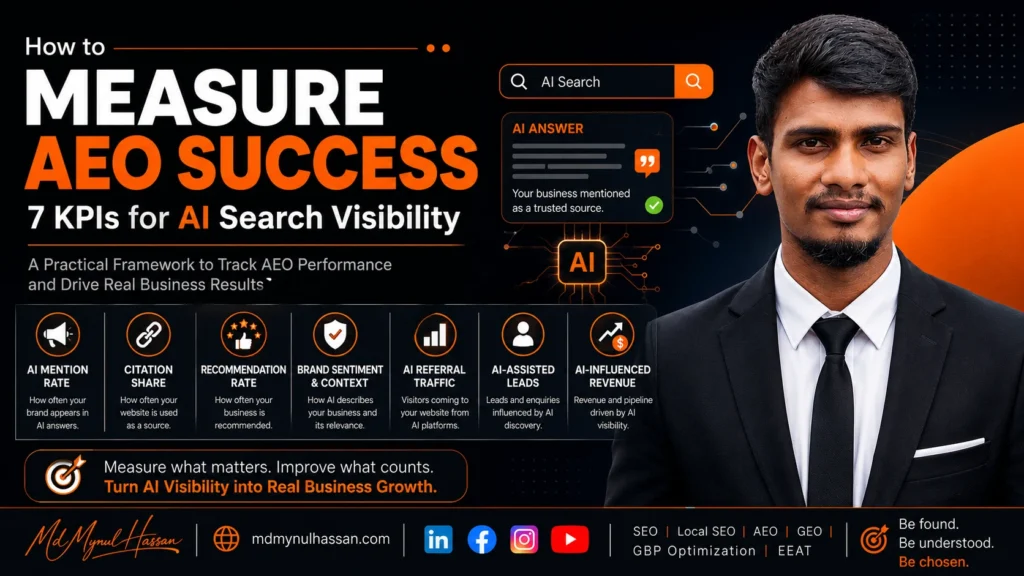
Here are the seven AEO KPIs I would start with.
1. AI Brand Mention Rate
The first question is straightforward:
How often does my business appear when customers ask relevant questions?
Create a list of questions your potential customers are actually likely to ask.
For example, if you are a local SEO consultant, your questions might include:
- Who can help a small business with Local SEO?
- How can a service business improve Google Maps visibility?
- What should a local business do before hiring an SEO consultant?
- How can a business improve its AI search visibility?
- What is the difference between AEO and traditional SEO?
Then test those questions consistently.
Record:
- Was your business mentioned?
- Was it recommended?
- Which competitors appeared?
- What information was used to describe your business?
- Was the information accurate?
Over time, you can calculate an internal AI brand mention rate.
A simple formula
AI Mention Rate = Relevant prompts where your brand appears ÷ Total relevant prompts tested × 100
This is not a universal industry-standard score.
I would use it as an internal benchmark.
2. AI Citation Share
A mention and a citation are not exactly the same thing.
If an AI system mentions your business, that tells you something about visibility.
If your website is repeatedly cited as a source for relevant information, that gives you another useful signal.
I would therefore monitor:
- How often your website is cited
- Which pages are cited
- Which topics generate citations
- Which competitors are cited
- Whether the cited page actually supports the answer
What I would look for
If competitors consistently appear as sources while your website is rarely cited, I would investigate:
- Content depth
- Topical authority
- Original information
- Expertise signals
- Internal linking
- Entity clarity
- External references
- Content usefulness
This is one reason I don’t recommend creating content simply because a keyword has search volume.
A useful page needs to provide information worth understanding and referencing.
3. AI Recommendation Rate
There is an important difference between being mentioned and being recommended.
Imagine someone asks:
“Who should I hire for Local SEO?”
An AI system might mention several companies without actually recommending any of them.
For commercial queries, recommendation visibility can therefore be a useful KPI.
Track:
- How often your brand is recommended
- What type of questions trigger recommendations
- What competitors are recommended
- Why the recommendation appears
- Whether the recommendation matches your actual positioning
This is particularly relevant for service businesses.
A law firm, dentist, agency, contractor or consultant does not simply want to be “mentioned.”
They want to be considered.
That is where AEO starts connecting with buyer intent.
4. AI Brand Sentiment and Context
This is one of the measurements I think businesses often overlook.
Suppose your business appears in AI answers 30 times.
That sounds positive.
But what does the AI actually say about you?
Is your business described as:
- Experienced?
- Local?
- Specialized?
- Affordable?
- Professional?
- Relevant?
- Trustworthy?
- Suitable for a particular type of customer?
Or is the information:
- Outdated?
- Incomplete?
- Incorrect?
- Too generic?
- Confused with another business?
This is where EEAT becomes important.
Your goal should not simply be to increase mentions.
You want the information surrounding your brand to accurately communicate your expertise and positioning.
Why Brand Context Matters
From my experience, many businesses have a website but do not clearly communicate:
- What they do
- Who they help
- Where they operate
- What they specialize in
- Why customers should trust them
That creates a clarity problem.
And clarity matters to both people and search systems.
This is why my broader SEO approach focuses on making businesses easier to understand before trying to make them more visible.
5. AI Referral Traffic
The next KPI moves from visibility to website activity.
If an AI platform sends users to your website, measure it.
Look at:
- Sessions
- Users
- Landing pages
- Engagement
- Returning visitors
- Contact form submissions
- Calls
- Quote requests
- Other conversion events
But there is an important warning here:
Don’t assume that low AI referral traffic means AEO is failing.
AI visibility can influence people without generating an immediate click.
Someone may discover your business through an AI answer and later search your brand directly.
So I treat AI referral traffic as an important metric, but not the entire measurement system.
6. AI-Assisted Leads and Conversions
This is where AEO becomes much more connected to business performance.
The question changes from:
“Did AI mention my business?”
to:
“Did AI-driven discovery contribute to a real business opportunity?”
For a service business, that could mean:
- Contact form submissions
- Phone calls
- Consultation requests
- Quote requests
- Bookings
- Qualified leads
For an ecommerce business, it could include:
- Product visits
- Add-to-cart activity
- Purchases
- Revenue
For B2B businesses, it might include:
- Demo requests
- Sales-qualified leads
- Pipeline opportunities
The exact KPI depends on the business model.
That is why I don’t believe every business should use exactly the same AEO dashboard.
7. AI-Influenced Revenue
The final measurement is the one most business owners ultimately care about:
Did the visibility contribute to revenue?
For some businesses, this can be difficult to measure perfectly.
A customer might:
- See your brand in an AI answer.
- Search your brand on Google.
- Visit your website.
- Read your reviews.
- Return later.
- Contact you.
- Become a customer.
Which channel gets the credit?
That is not always easy to determine.
So I believe in honest attribution.
If your data cannot prove that AEO generated a specific amount of revenue, don’t invent a number.
Instead, report what the data actually supports.
For example:
“AI-assisted discovery contributed to qualified enquiries during the measurement period.”
That is more trustworthy than creating artificial precision.
A Practical AEO KPI Dashboard
If I were building an AEO measurement dashboard for a business today, I would start with these metrics:
| KPI | What it measures |
|---|---|
| AI Mention Rate | How frequently your brand appears in relevant AI answers |
| AI Citation Share | How frequently your website is used as a source |
| Recommendation Rate | How often your business is recommended |
| Brand Sentiment | How AI systems describe your business |
| AI Referral Traffic | Website visits from AI platforms |
| AI-Assisted Leads | Leads connected to AI-driven discovery |
| AI-Influenced Revenue | Revenue or pipeline influenced by AI visibility |
Then I would place these alongside traditional SEO and Local SEO data.
For example:
- Organic impressions
- Organic clicks
- Keyword visibility
- Branded searches
- Google Business Profile performance
- Google Maps visibility
- Local rankings
- Website conversions
- Review growth
- Service-page performance
That gives you a much more complete picture.
How I Would Measure AEO for a Local Business
This is where AEO becomes especially interesting.
Imagine a local home-service company.
It already has:
- A website
- A Google Business Profile
- Several service pages
- Customer reviews
- Social profiles
But it is not generating enough enquiries.
I would not immediately tell the business to publish 50 more AI-focused articles.
I would first investigate the foundation.
Step 1: Check the Business Information
Is the business clearly described?
Does the website explain:
- Services
- Service areas
- Business type
- Experience
- Contact information
- Customer problems
- Reasons to choose the business
Step 2: Check Local Search Signals
I would review the Google Business Profile, website and broader local signals together.
My Local SEO service focuses on this wider local visibility system rather than treating Google Maps as an isolated ranking exercise.
I would also look at Google Business Profile Optimization because the profile is an important part of how a local business presents itself in Google’s local ecosystem.
Step 3: Check Search Intent
A business may have plenty of content but still answer the wrong questions.
This is something I see frequently.
A company wants to rank for a broad keyword.
But the customer is actually asking a much more specific question.
That is why I use Keyword Research to understand the relationship between:
keyword → intent → question → page → business action
Step 4: Check Content and Topical Authority
Does the website answer the questions customers actually ask?
Are related topics connected?
Do service pages support informational content?
Are important pages internally linked?
Does the website demonstrate first-hand knowledge?
My Content Strategy & SEO Content Writing Service is built around this type of search-intent and topical approach.
Step 5: Check Technical SEO
A great answer cannot help much if search engines cannot properly access or understand the website.
I would check:
- Indexability
- Crawlability
- Canonicals
- Internal links
- Structured data
- Site architecture
- Page performance
- Mobile experience
For deeper technical issues, my Technical SEO service and SEO Audit service are relevant parts of the wider process.
AEO Measurement Should Connect With EEAT
I don’t see EEAT as something you add to a page at the end.
It should be visible throughout the business’s online presence.
For example, a strong service page can demonstrate:
Experience
Explain what the business actually does and what problems it has experience solving.
Expertise
Show knowledge rather than simply repeating generic information.
Authoritativeness
Build connections between the business, its services, content and credible external signals.
Trust
Make the business information accurate, transparent and easy to verify.
For me, this is much more useful than simply adding an “EEAT section” to every article.
AEO and Internal Linking: An Overlooked Measurement Factor
One thing I often see when reviewing websites is that the content exists, but the pages are not connected properly.
A business may have:
- A service page
- Five blog posts
- An FAQ page
- A location page
- A case study
But each page behaves like an isolated island.
That makes it harder to communicate topical relationships.
A stronger internal-linking structure can connect:
Pillar page → service page → supporting article → FAQ → conversion page
For example, an article about measuring AEO success can naturally connect to:
- AEO & GEO consulting
- SEO audit
- Content strategy
- Keyword research
- Technical SEO
- Local SEO
- Google Business Profile optimization
This is not about adding links for the sake of adding links.
Each link should help the reader understand the next relevant topic.
That is how I approach On-Page SEO and internal linking.
Common AEO Measurement Mistakes
Measuring Only Keyword Rankings
Rankings remain useful.
But they don’t tell you everything about AI-driven visibility.
Counting AI Mentions Without Context
More mentions do not automatically mean better visibility.
The context matters.
Ignoring Citations
If competitors are consistently cited as sources while your business is not, investigate why.
Measuring Traffic Without Business Outcomes
Traffic is useful only when you understand what it contributes to the business.
Creating Too Many KPIs
A dashboard should help you make decisions.
It should not become another source of confusion.
Checking AI Visibility Only Once
AI-generated results can change.
Your content changes.
Competitors change.
Search behavior changes.
AEO measurement should therefore be continuous.
My Approach to Measuring AEO Success
After two years of practical SEO work, my approach is fairly simple.
I don’t start with:
“How can we make AI mention this business?”
I start with:
“Why should an AI system, search engine or customer trust this business as a useful answer?”
Then I work backwards.
I look at:
- Search intent
- Website structure
- Service pages
- Content quality
- Topical authority
- Internal linking
- Technical SEO
- Local SEO
- Google Business Profile
- Google Maps visibility
- Reviews
- Entity consistency
- EEAT
- Brand information
- Conversion paths
This is why I don’t treat AEO as a separate replacement for SEO.
I see it as part of a broader search visibility system.
My SEO Audit Service is designed around identifying what is actually limiting visibility and prioritizing what should be improved first.
A Simple 90-Day AEO Measurement Plan
You don’t need an enormous dashboard to get started.
You need a baseline.
Month 1: Measure the Baseline
Create a list of important customer questions.
Record:
- AI mentions
- Recommendations
- Citations
- Competitor visibility
- Brand context
- Referral traffic
- Existing leads
At the same time, review your traditional SEO and Local SEO foundation.
Month 2: Improve the Foundation
Work on the gaps.
That might include:
- Improving service pages
- Answering real customer questions
- Strengthening topical coverage
- Improving internal linking
- Adding genuine expertise
- Improving entity consistency
- Strengthening local relevance
- Improving Google Business Profile information
- Creating useful, citation-worthy content
If you use WordPress, technical implementation can also become part of the process. My WordPress SEO service focuses on connecting the technical website foundation with SEO visibility.
Month 3: Measure Again
Use the same questions you used during your baseline.
Then compare:
- AI mentions
- Citations
- Recommendations
- Brand context
- Referral traffic
- Leads
- Traditional search visibility
Don’t change the entire strategy because one AI answer changed.
Look for patterns.
The Bigger Lesson I Have Learned
The biggest lesson for me is that visibility and business value are not the same thing.
A business can rank well and receive poor leads.
It can receive traffic without conversions.
It can have a Google Business Profile without strong Maps visibility.
It can publish hundreds of articles without building topical authority.
And now, it can appear in AI answers without generating meaningful business opportunities.
That is why I believe modern SEO measurement needs to become broader.
We should ask:
Can people find the business?
Can search engines understand it?
Can AI systems understand it?
Can customers trust it?
Can they find enough evidence to choose it?
And ultimately:
Does that visibility contribute to a real business outcome?
That is how I measure AEO success.
Not by chasing an AI score.
Not by collecting mentions simply to make a report look impressive.
But by understanding whether a business is becoming:
Easier to find.
Easier to understand.
Easier to trust.
Easier to choose.
If your business is trying to understand how SEO, AEO, GEO, Local SEO and AI search can work together, you can contact me about your search visibility.
I work with businesses that want practical SEO recommendations, clearer priorities and a search strategy connected to real business goals.
Be found. Be understood. Be chosen.
— Md Mynul Hassan
SEO, AEO, GEO & Brand Visibility Specialist