A few years ago, most businesses asking me about SEO had a fairly straightforward question:
“How can I rank higher on Google?”
That question still matters.
But while working on SEO, Local SEO, Google Business Profile optimization, content strategy and AI search visibility over the last two years, I have noticed another question becoming increasingly important:
“When people ask an AI system about businesses like mine, will my brand be understood, mentioned and supported by reliable sources?”
That is a different kind of search visibility problem.
It is not only about rankings anymore.
People can discover a business through Google Search, Google Maps, social platforms, reviews, industry websites, directories, LinkedIn, marketplaces and increasingly through AI-powered search and answer experiences.
This means a business needs more than a website with keywords.
It needs a clear and consistent presence across the web.
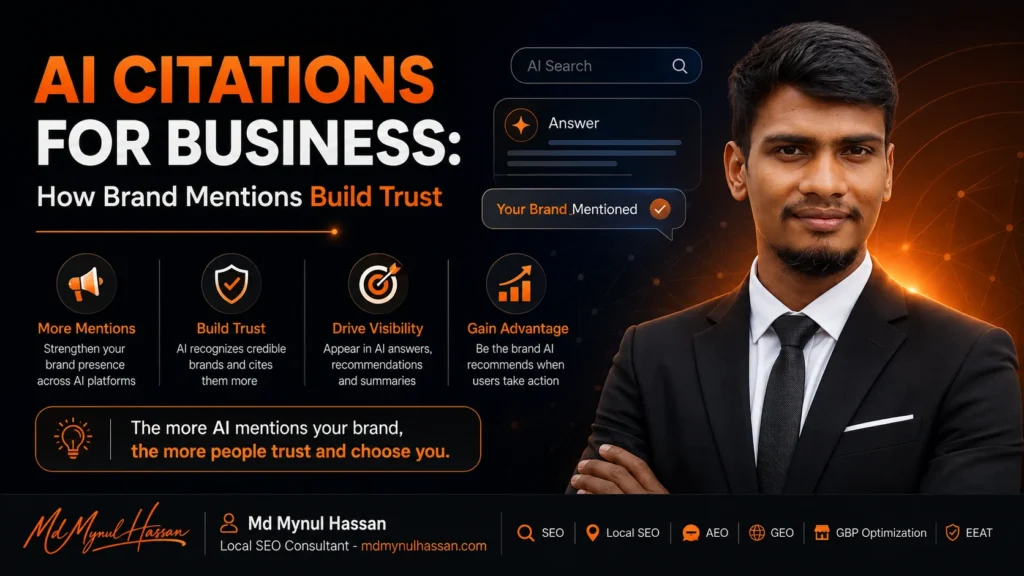
That is where AI citations, brand mentions, digital PR, reviews, content, SEO, AEO, GEO and EEAT start to connect.
What is an AI citation for a business?
An AI citation is a reference to a source used by an AI-powered search or answer system when it provides information to a user.
The source might be a business website, industry publication, review platform, directory, professional profile or another relevant website.
For a business owner, the important part is not simply getting a citation.
The bigger question is:
What information is available about your business that an AI system can understand and use?
For example, imagine someone asks:
“Who are some reliable Local SEO consultants for service businesses?”
An AI system may need to understand different businesses, their services, locations, expertise, reputation and other available information before generating an answer.
If your business information is clear on your website but inconsistent or almost nonexistent elsewhere, the overall picture may be incomplete.
That does not mean you can force an AI system to mention your business.
You cannot guarantee that.
But you can make your digital presence clearer, more useful and better supported by relevant information.
Google’s current guidance for generative AI search also emphasizes the importance of valuable, unique, people-first content and strong SEO foundations rather than trying to find a special shortcut for AI visibility.
Why AI mentions are becoming part of brand visibility
Traditional search and AI search are different experiences, but they share an important foundation.
Both need information they can understand.
A search engine needs to understand what a page is about.
An AI system needs to understand information well enough to retrieve, connect or summarize it.
That is why I do not see AI search as a replacement for SEO.
I see it as another environment where good SEO fundamentals can become useful.
My own [AEO and GEO consulting service] can help businesses connect traditional SEO foundations with AI search visibility, content structure, entity consistency and brand signals.
The goal is not to chase an AI mention.
The goal is to make the business easier to understand.
AI citations are not the same as backlinks
This is an important distinction.
A backlink is a link from one website to another.
An AI citation is a source reference used within an AI-generated answer or search experience.
They can overlap, but they are not the same thing.
A business should not assume:
“If I get more backlinks, AI will automatically recommend me.”
That is too simplistic.
At the same time, I would not ignore backlinks, mentions or digital PR.
Relevant third-party references can contribute to the broader information environment around a business.
For example, a local business might have:
- A well-structured website
- A complete Google Business Profile
- Genuine customer reviews
- Relevant local directory listings
- Industry mentions
- Useful educational content
- Professional profiles
- Media coverage
- Links from relevant websites
- Consistent business information
None of these should be treated as a magic ranking signal.
But together, they can help create a clearer digital identity.
That is the part I find more interesting.
Why brand mentions can influence buyer trust
Imagine that someone is looking for an SEO consultant.
They find your website.
Then they search your name.
They look at your LinkedIn profile.
They check reviews.
They look at your professional profiles.
They read your articles.
They may search for your business on Google.
They may ask an AI system about your services.
The buyer is not necessarily making the decision from one webpage.
They are building a picture.
That picture is influenced by the information they can find about you.
This is why I believe brand mentions are becoming more important in modern search visibility.
Not because every mention creates a ranking benefit.
But because people increasingly research businesses across multiple platforms before contacting them.
From my experience, clarity comes before visibility
One thing I often see when reviewing websites is that the business owner knows exactly what the company does, but the website does not explain it clearly.
The owner may understand the services.
The team may have years of experience.
Customers may be happy.
But the website might have vague headings, thin service pages, weak internal links and little explanation of who the business actually helps.
That creates a problem.
If people struggle to understand the business, search systems can also have less useful context.
This is one reason my approach starts with the business itself.
On my [About page], I explain how my background in WordPress and website development helped shape the way I approach SEO today. I do not look at SEO as a collection of isolated tasks. I connect website structure, search intent, content, Local SEO, authority, branding and AI-search readiness.
That same principle applies to AI citations.
Before worrying about mentions, make sure there is something clear to understand.
What information should a business make clear?
Start with the basics.
Your website should make it obvious:
What you do
Explain your main products or services in plain language.
Do not make people interpret clever marketing statements to figure out what you actually sell.
Who you help
A business serving homeowners has different search needs from a B2B SaaS company.
Make your audience clear.
Where you operate
For local businesses, location is especially important.
Your website, service pages and Google Business Profile should communicate your genuine service area accurately.
This is one reason [Local SEO] matters beyond simply ranking in the local pack.
What problems you solve
Customers usually search because they have a problem.
A good website connects the service with that problem.
Why people should trust you
Show relevant experience, expertise, reviews, qualifications, processes, examples and other genuine evidence where appropriate.
Do not invent proof.
Do not create fake testimonials.
Do not claim results you cannot support.
Your Google Business Profile still matters
AI search does not make Google Business Profile optimization irrelevant.
For businesses that depend on local customers, the Google Business Profile remains an important part of the overall local search presence.
When I work on [Google Business Profile optimization], I look at the relationship between the profile, website, services, locations, reviews, categories and other local signals.
The profile should represent the real business accurately.
Your website should support the same understanding.
Your business name, services, location and other important information should not tell completely different stories across different platforms.
That consistency is useful for customers first.
It can also make the business easier for search systems to interpret.
Reviews are part of the trust picture
Reviews are not simply something to collect because an SEO checklist says so.
They are customer evidence.
A potential customer may read reviews before visiting your website.
They may compare your business with competitors.
They may look at the language customers use to describe your service.
They may also encounter those reviews while researching your brand through search.
This is why I prefer genuine reviews over artificial reputation-building.
Do good work.
Make it easy for satisfied customers to leave honest feedback.
Respond professionally.
And make sure your business information remains consistent.
That is a much healthier long-term approach.
Digital PR can support AI search visibility
This is where digital PR becomes particularly interesting.
Suppose an industry publication mentions your company because you contributed expert commentary to an article.
Or a local publication covers your business.
Or a relevant professional website interviews you.
Or a respected industry website references one of your original resources.
Those mentions can help establish a broader presence around the brand.
Again, I would not reduce this to:
“Get PR links and AI will rank you.”
That is not how I approach it.
The better question is:
“Where would it make sense for this business to be mentioned?”
That could be an industry publication, local news site, professional association, relevant directory, podcast, interview, expert article or partner website.
Relevance matters.
Context matters.
Quality matters.
And the mention should be earned for a legitimate reason.
Do not build AI visibility by creating low-value content
This is one of the biggest mistakes I would avoid.
A business discovers AI search.
Then it decides to publish 100 generic articles.
Most articles say the same things competitors already say.
The headings are slightly different.
The examples are generic.
There is no first-hand experience.
There are no useful insights.
The website becomes larger, but not necessarily better.
That is not the direction I recommend.
Google’s current guidance says generative AI can be useful during research and content development, but generating many pages without adding value can fall under scaled content abuse. Google’s guidance also emphasizes creating useful, reliable content with original value rather than simply recycling information already available online.
For that reason, I would rather see a business publish ten genuinely useful resources than hundreds of pages created only because a keyword tool suggested them.
What makes content useful for AI search?
From my perspective, useful content has context.
It answers the actual question.
It explains the subject clearly.
It adds something beyond what is already obvious.
It reflects real expertise when expertise is relevant.
It gives the reader a reason to trust the information.
For example, if I write about Local SEO, I should not simply define Local SEO.
I can explain what I look for when reviewing a local business website.
I can explain why a Google Business Profile may be underperforming.
I can discuss how service pages and local targeting connect.
I can explain mistakes I regularly see.
That gives the content a point of view.
Google’s generative AI guidance specifically highlights first-hand experience and a unique point of view as characteristics of valuable content.
That is much closer to how I believe professional content should be created.
Build topical authority instead of isolated articles
Another area I focus on is topical authority.
If you want your business to become known for a subject, one article is rarely enough.
For example, my website covers related areas such as:
- Local SEO
- Google Business Profile optimization
- Technical SEO
- Keyword research
- On-page SEO
- SEO audits
- SEO content strategy
- AEO
- GEO
- WordPress SEO
- Website performance
These topics connect.
A business reading one article about AI search may need information about AEO.
Someone learning about AEO may need information about technical SEO.
Someone working on Local SEO may need Google Business Profile optimization.
Someone improving content may need keyword research and search intent.
That is why [keyword research] and [SEO content strategy] should not be treated as completely separate activities.
The content should form a useful network.
Internal linking helps connect the information
I take internal linking seriously because it is useful for both users and search engines.
A good internal link answers the natural next question.
For example:
If I discuss technical foundations, I can link to my [Technical SEO service].
If I discuss website problems, I can link to my [SEO Audit service].
If I discuss content planning, I can link to my [SEO Content Writing service].
If I discuss WordPress websites, I can link to my [WordPress SEO service].
If I discuss ecommerce brands, I can link to my [Ecommerce SEO service].
The purpose is not to put a link in every paragraph.
The purpose is to help readers move naturally from one useful resource to another.
Google’s SEO guidance recommends organizing sites logically and using descriptive links so users and search engines can better understand how pages relate to one another.
What I would check before trying to improve AI visibility
If a business asked me to improve its AI search visibility, I would not start by trying to force citations.
I would start with an audit.
Website foundation
I would check:
- Crawlability
- Indexing
- Important page accessibility
- Site structure
- Canonicals
- Internal links
- Page speed
- Mobile usability
- Structured data where relevant
My [Technical SEO service] covers this type of foundation.
Search intent
I would ask:
Are the pages actually targeting the searches that matter to the business?
A page can rank for something and still attract the wrong audience.
That is why I also look at keyword research, search intent and the relationship between informational content and commercial pages.
My [SEO Audit service] and [Keyword Research service] are built around this kind of practical diagnosis.
Content quality
I would check whether the content:
- Answers real questions
- Shows expertise
- Adds original value
- Matches search intent
- Uses clear structure
- Avoids unnecessary repetition
- Connects to relevant services
- Provides a useful next step
Entity and brand consistency
I would compare important business information across:
- Website
- Google Business Profile
- Professional profiles
- Relevant directories
- Social profiles
- Industry platforms
- Marketplace profiles
The goal is not to make every profile identical.
The goal is to make sure the important facts about the business are accurate and consistent.
Common AI citation mistakes businesses should avoid
Trying to manipulate AI recommendations
There is no responsible shortcut where you simply insert your business name everywhere and expect AI systems to recommend you.
Build genuine visibility instead.
Creating fake mentions
Fake reviews, fake articles, fake profiles and manufactured reputation signals are not a sustainable strategy.
Publishing hundreds of generic articles
More pages do not automatically mean more authority.
Ignoring traditional SEO
Technical SEO, search intent, internal linking, useful content and website accessibility still matter.
Google’s current generative AI guidance explicitly states that existing SEO best practices remain foundational for visibility in generative AI features.
Focusing only on citations
A citation is not the final business outcome.
The customer still needs to trust the company, understand the service and know what to do next.
How I approach AI citations and brand visibility
My approach is fairly simple.
I start with the real business.
I want to understand what it sells, who it helps, where it operates, what customers search for and what makes the business different.
Then I look at the existing search visibility.
I review the website.
I review important pages.
I look at search intent.
I check technical foundations.
I look at Local SEO when location matters.
I review the Google Business Profile when the business depends on local search.
I look at content and topical coverage.
I review internal linking.
I compare competitors.
Then I look at the broader brand presence.
Where is the business mentioned?
Where is it missing?
Is the information consistent?
Are there genuine opportunities for authority and digital PR?
Are there useful questions the business can answer better than competitors?
That gives me a much more useful picture than simply asking whether a business appears in an AI answer.
What businesses should do now
If you want to prepare your business for AI search, I would start with these steps:
- Make your business and services clear.
- Build strong service pages around real search intent.
- Improve your technical SEO foundation.
- Strengthen your Google Business Profile if you serve a local market.
- Publish useful content based on genuine customer questions.
- Build topical authority around the subjects you want to be known for.
- Connect related pages with useful internal links.
- Keep business information accurate across relevant platforms.
- Earn relevant brand mentions and digital PR opportunities.
- Build genuine reviews and customer trust.
- Show real expertise instead of generic claims.
- Measure visibility and business outcomes instead of chasing one metric.
The real goal is not to be mentioned by AI
This is probably the most important point I would leave you with.
If your only goal is:
“I want ChatGPT to mention my business.”
You are looking at the problem too narrowly.
The better goal is:
“I want my business to have such a clear, useful and trustworthy digital presence that search systems and customers can understand what I do and why I am relevant.”
That is a much stronger foundation.
AI search will continue to change.
The platforms will change.
The interfaces will change.
The way people ask questions will change.
But businesses will still need to communicate clearly.
They will still need useful websites.
They will still need genuine expertise.
They will still need customer trust.
They will still need relevant visibility.
That is why I do not think the future of SEO is about abandoning SEO.
It is about connecting SEO with the wider search and brand ecosystem.
Final thoughts
After two years of working on practical SEO strategies, one thing has become increasingly clear to me:
Visibility without clarity is not enough.
A business can have a website and still be difficult to understand.
It can have a Google Business Profile and still have weak local visibility.
It can publish content and still have no topical authority.
It can rank for keywords and still attract the wrong visitors.
And it can have expertise that nobody can see because that expertise is not communicated clearly online.
AI search makes this problem more noticeable.
People are no longer discovering information only by clicking through search results.
They are asking questions and expecting useful answers.
That means businesses need to think beyond rankings.
Build useful information.
Build real expertise.
Build consistent brand signals.
Earn relevant mentions.
Strengthen your website.
Answer customer questions.
Support your local presence.
And make the business easy to understand wherever people discover it.
I believe that is where AI citations become meaningful.
Not as a shortcut.
Not as a guaranteed ranking signal.
But as one part of a wider digital presence that helps a business become easier to find, easier to understand, easier to trust and ultimately easier to choose.
Be found. Be understood. Be chosen.
If you want to discuss your website’s SEO, Local SEO, Google Business Profile, AEO, GEO or AI search visibility, you can contact me and tell me what you are currently struggling with.
You can also learn more about my SEO services, AEO and GEO consulting, Local SEO service or SEO Audit service.
Find Md Mynul Hassan online
You can also verify and follow my professional work through my Facebook, LinkedIn profile, Upwork profile, Fiverr profile, and Freelancer profile.
For businesses looking at AI search specifically, I also recommend reading Google’s guide to optimizing for generative AI features in Google Search. It reinforces an important point behind my own approach: strong SEO fundamentals and genuinely useful content remain important even as search experiences evolve.