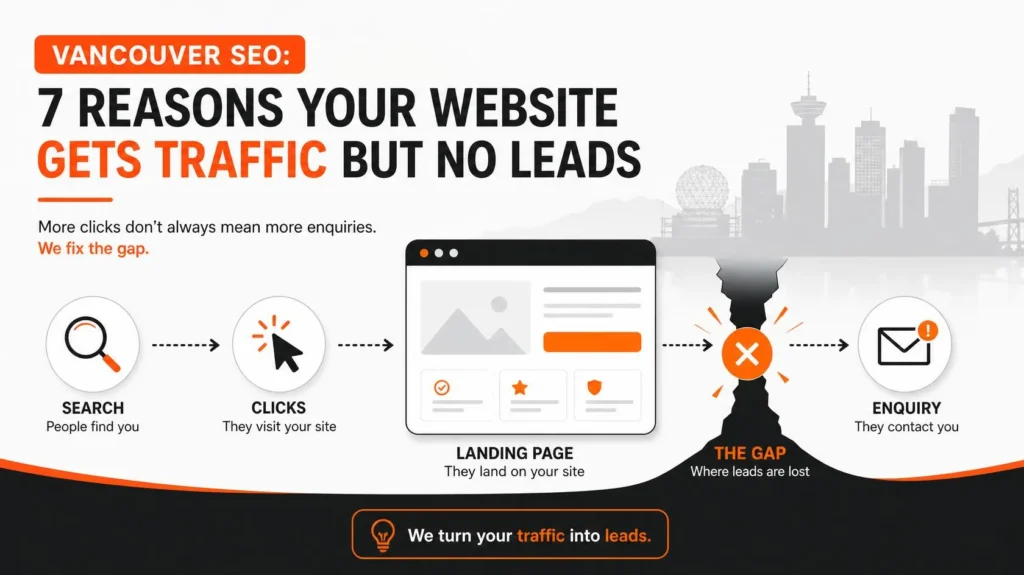
Getting website traffic but very few enquiries is a frustrating problem for a business. More clicks do not necessarily mean more potential customers. Visitors may be searching for the wrong thing, landing on a page that does not answer their needs, struggling to understand your offer, or leaving before they contact you.
For businesses serving Vancouver, British Columbia, the right next step is to diagnose where the search-to-enquiry journey breaks down before investing in more content, additional SEO services, or another monthly package.
The most useful checks are search intent, landing-page relevance, service clarity, local visibility, technical usability, trust, and conversion tracking. Once you identify the weak point, you can invest in work that addresses it directly.
1. Are You Attracting the Right Search Traffic?
The first question is not how many people visit your website. It is whether they are looking for something your business actually provides.
A page might attract impressions and clicks for broad informational searches while the business needs enquiries from people ready to compare providers or request a service.
For example, a company offering commercial cleaning in Vancouver may receive visits from people searching for cleaning tips, employment opportunities, or household cleaning advice. Those searches can be relevant to the wider topic without being relevant to the company’s commercial offer.
Review Google Search Console to understand which queries generate impressions and clicks, which pages receive them, and whether the search terms match the services you sell.
Separate the queries into three groups:
- Research queries: People looking for explanations, definitions, or instructions.
- Comparison queries: People evaluating providers, approaches, or costs.
- Service queries: People looking for a specific service or a provider who can help.
Each group may deserve a different page and next step.
If your website targets broad phrases without mapping them to customer intent, a keyword strategy review can help identify which searches belong to existing pages and which opportunities deserve separate content. My keyword research service focuses on intent, commercial relevance, clustering, and page mapping rather than simply producing a list of keywords.
2. Does the Landing Page Match What the Searcher Wants?
Even relevant traffic can fail to convert when the destination page does not meet the visitor’s expectations.
Imagine someone searches for a technical SEO consultant because important pages are not being indexed. They arrive at a generic page describing every SEO service, but cannot find a clear explanation of technical diagnostics, implementation responsibilities, or the next step.
The visitor has a reason to leave.
A landing page should quickly answer:
- What service is offered?
- Who is it for?
- Which problem does it address?
- What does the work include?
- What should the visitor do next?
Compare the promise made by the search result with the information on the page. If the title attracts people looking for an SEO audit, the destination should make the audit’s scope and purpose clear.
For existing pages, the answer may be to improve the content, headings, internal links, and calls to action rather than publish another URL. My on-page SEO service focuses on aligning page content with search intent and making important information easier to understand.
3. Can Visitors Understand Your Offer Without Guessing?
A visitor should not have to work out what happens after contacting your business.
Vague descriptions such as “innovative growth solutions” or “complete digital transformation” may sound polished, but they do not explain the service, process, deliverables, or intended customer.
Replace general statements with concrete information.
For example, a service page could explain that an initial SEO review examines important pages, search intent, indexing, technical issues, content gaps, and conversion paths. It should then clarify what the business receives and whether implementation is included.
You can also explain the next step directly. A potential client may need to submit a website, describe their services, identify a target market, or explain the main search problem.
Keep the action consistent with the decision the visitor needs to make. Someone who is still diagnosing a problem may respond better to a clearly described audit than an immediate request to commit to a long-term engagement.
My SEO audit service is relevant when a business needs to identify what is limiting organic visibility and which improvements deserve priority. The point is to establish the problem before prescribing the work.
4. Are Local Search and Your Website Telling the Same Story?
A business that serves Vancouver customers may need to evaluate both its website and its local search presence.
Check whether the website clearly communicates its services, legitimate service areas, contact details, and the customers it supports. Where the business is eligible for a Google Business Profile, review whether its profile information accurately represents the real business.
A profile and website should reinforce one another. If the profile describes one set of services while the website emphasizes something else, potential customers may not get a consistent picture of the offer.
For eligible businesses, useful review areas include:
- Accurate business information and categories.
- Relevant services and service details.
- Consistency between the profile and website.
- Appropriate local landing pages.
- A clear route from discovery to enquiry.
- Genuine customer reviews and accurate responses.
Google explains that local results are influenced by relevance, distance, and prominence. A consultant cannot control all of these factors or promise a particular Maps position. See Google’s guidance on improving local ranking.
For businesses that rely on local discovery, my Local SEO service and Google Business Profile optimization service address related but distinct parts of local search visibility.
Geographic targeting also needs care. Adding Vancouver to a page does not establish a genuine local presence or make a remote business eligible for a Google Business Profile in that city. The service model and business information must remain accurate.
5. Could Technical Problems Be Interrupting the Customer Journey?
Technical SEO problems are not always the cause of poor lead generation, but they are worth investigating when the evidence points that way.
Check for issues such as:
- Important service pages that cannot be indexed correctly.
- Broken links or unexpected redirects.
- Forms that fail to submit.
- Contact buttons that are difficult to use on mobile.
- Slow or unstable pages.
- Navigation that makes key services difficult to find.
- Technical errors that prevent visitors from reaching the intended destination.
Start by checking the pages that matter commercially. A problem affecting the main service page or enquiry form is generally more urgent than a minor warning on an unimportant archive URL.
Use Google Search Console to inspect indexing and search performance. Test the enquiry process yourself on desktop and mobile. Confirm that forms submit correctly, confirmation messages appear, and enquiries reach the intended recipient.
My technical SEO service can support investigations involving crawlability, indexing, redirects, website structure, and other technical issues. For performance-related concerns, the website speed optimization service is a more relevant destination.
A technical audit should prioritise actual problems rather than treat every tool warning as equally important.
6. Does the Website Give People Enough Reason to Trust the Business?
Search visibility can bring visitors to a page, but the page still needs to help them assess the business.
Potential customers may look for clear service descriptions, relevant experience, transparent processes, accurate contact information, and evidence that supports important claims.
Avoid unsupported statements such as “Vancouver’s number-one SEO consultant” or guaranteed lead growth. Unless independently verifiable evidence supports a claim, it should not appear as fact.
A stronger approach is to explain the work, show what a client can expect, and make the basis of important claims clear. Case studies should identify the actual project, the work completed, the measurement period, and the available results.
The same principle applies to remote service delivery. Businesses should understand where their consultant is based, how communication works, what is included, and which tasks the consultant will implement directly.
I’m Md Mynul Hassan, an SEO, Local SEO, AEO and GEO specialist based in Dinajpur, Bangladesh, working remotely with businesses internationally. My professional approach centres on diagnosing search problems, explaining priorities, and connecting relevant SEO work to business goals. Whether that makes me a good fit for a Vancouver business depends on its needs, scope, budget, and expectations.
7. Are You Measuring Enquiries or Only Clicks?
Search Console clicks, website sessions, form submissions, phone calls, qualified leads, and sales measure different things. They should not be treated as interchangeable.
Search Console helps you understand how your pages perform in Google Search. Analytics and CRM data can help you understand what visitors do after arriving and whether they become meaningful prospects.
A practical measurement setup should distinguish between:
| Metric | What it helps you understand |
|---|---|
| Search impressions | How often a page appears in Google Search |
| Organic clicks | How many clicks Google Search sends to the site |
| Click-through rate | The share of impressions that result in clicks |
| Landing-page engagement | What visitors do after arriving |
| Form submissions and tracked calls | Whether visitors take an intended action |
| Qualified enquiries | Whether those actions represent genuine opportunities |
| Sales or booked work | Whether enquiries progress toward a business outcome |
Do not assume that every enquiry is qualified or that every increase in clicks should create the same increase in revenue.
Check whether conversion tracking is working before judging an SEO campaign. If form submissions are not recorded, phone enquiries are missing from reporting, or duplicate events inflate the numbers, the business may make decisions from misleading data.
My conversion rate optimization service focuses on the journey from visitor to action. This can be relevant when the website already attracts suitable visitors but the offer, page experience, or contact path needs investigation.
A Practical Diagnostic: What Should You Fix First?
Use the following framework to connect a visible symptom with the next investigation.
| What you notice | What to investigate first | Possible next step |
|---|---|---|
| Many clicks but few relevant enquiries | Search queries and audience intent | Refine keyword targeting and page purpose |
| Visitors land on the wrong service page | Query-to-page mapping | Improve the existing landing page |
| Local searches bring limited opportunities | Profile eligibility, local relevance and service-page alignment | Review Local SEO and business information |
| Important service pages are hard to find | Indexing, navigation and internal links | Correct technical or structural problems |
| Visitors reach the page but do not contact you | Offer clarity, trust and calls to action | Improve the page and conversion journey |
| Enquiries are reported inconsistently | Analytics events, forms, calls and CRM records | Fix measurement before judging performance |
This is a diagnostic framework, not a claim that the same cause explains every business’s results. Your website data should determine which path deserves attention.
Example: A Vancouver Service Business With Relevant Clicks but Few Enquiries
Consider an illustrative Vancouver home-services company that receives visits for several service-related searches but gets few quote requests.
Before recommending more blog posts, an SEO consultant should check whether the queries match the company’s actual services, whether visitors land on the right service pages, whether the business clearly explains its service area, and whether the quote form works on mobile.
If the traffic is irrelevant, keyword targeting may need attention. If visitors are relevant but cannot understand the offer, page improvements may be more useful. If they submit enquiries but tracking misses them, fixing measurement comes first.
This is an example of how the framework works, not a real client case study or a claim about Vancouver market performance.
Common SEO Mistakes That Can Waste Your Budget
Avoid these mistakes when trying to turn organic search into business opportunities:
- Publishing more content before diagnosing the problem. New articles will not automatically fix poor targeting, unclear offers, or broken forms.
- Optimizing for rankings without checking lead quality. A higher position for an irrelevant term may produce little commercial value.
- Creating near-identical city pages. Geographic pages should serve distinct needs and provide useful information, not simply replace one city name with another.
- Treating every technical warning as urgent. Prioritize issues by their effect on important pages and user journeys.
- Making unsupported performance claims. Use evidence and explain the limitations of the data.
- Buying an ongoing SEO package without a defined scope. Establish deliverables, responsibilities, reporting, and the purpose of the work before committing.
- Ignoring the conversion path. Visibility matters, but visitors also need a clear way to understand the offer and contact the business.
Google’s guidance on creating helpful, reliable, people-first content reinforces the importance of content that provides genuine value rather than being created primarily to attract search traffic.
The Pre-Investment Checklist for Vancouver Businesses
Before spending more on SEO, confirm the following:
- I know which search queries attract visitors to my key pages.
- The queries match the services or products I actually provide.
- Important landing pages clearly explain the offer and intended customer.
- Visitors can find the next step without unnecessary friction.
- Local business information is accurate and appropriate to the real service model.
- Important pages are accessible and indexable.
- Forms, calls, and enquiry tracking work correctly.
- Reports distinguish traffic from qualified leads and sales opportunities.
- The proposed SEO work addresses a diagnosed problem rather than a generic list of monthly tasks.
You do not need every answer before seeking specialist help. The checklist simply helps frame the problem and makes it easier to evaluate a proposal.
When Is It Worth Working With an SEO Consultant?
Consider specialist support when you cannot confidently identify why important pages are underperforming, when technical and content issues overlap, or when search traffic does not translate into the enquiries your business needs.
The right scope might be a focused audit, technical fixes, Local SEO, page optimization, content strategy, or conversion work. It should reflect the evidence rather than a predetermined package.
My approach as an independent SEO consultant connects search intent, technical SEO, Local SEO, content, website structure, AEO and GEO considerations, and conversion paths where they are relevant to the business objective. I work remotely and do not claim a Vancouver office or local client experience that has not been verified.
You can review my SEO services and professional approach before discussing a specific website or search problem.
The sensible first step is to identify the bottleneck, understand the work required, and agree on how progress will be measured. That gives you a more useful basis for deciding whether an SEO consultant is a good fit than rankings or promises alone.
Connect With Md Mynul Hassan
Website: mdmynulhassan.com
LinkedIn: Md Mynul Hassan
Facebook: Md Mynul Hassan SEO
YouTube: Md Mynul Hassan
Upwork: Hire Md Mynul Hassan
Freelancer.com: Md Mynul Hassan’s Freelancer profile
Based in Bangladesh, working remotely with businesses worldwide.