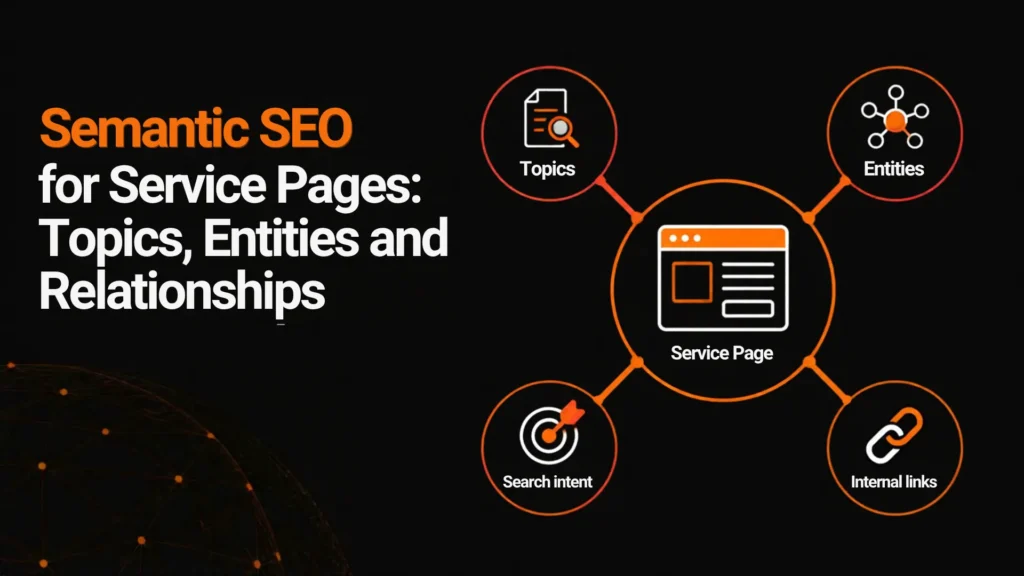
Semantic SEO helps you organize website content around meaning, search intent, entities, and the relationships between concepts rather than relying on repeated keyword phrases. For service businesses, this means building pages that explain what a service is, who it helps, which problems it solves, and how it relates to other services and resources on the website.
A semantically clear service page connects its target query to useful explanations, relevant supporting topics, credible evidence, and a clear next step. The result is a better-organized resource for visitors and a page whose purpose is easier for search systems to interpret.
This guide explains how semantic SEO works, how to map entities and topics, and how to apply the approach to real service pages without keyword stuffing or creating unnecessary URLs.
What Is Semantic SEO?
Semantic SEO is an approach to search optimization that focuses on the meaning, context, and relationships expressed in website content. It considers search intent, entities, attributes, terminology, and supporting information alongside traditional on-page elements such as titles, headings, and internal links.
For example, a page about on-page SEO should explain relevant concepts such as search intent, title tags, content structure, internal linking, and page relevance where they apply. Merely repeating the phrase “on-page SEO service” does not explain the work or help a potential customer evaluate the service.
Semantic SEO does not require every related term to appear on one page. It requires the right information to appear in the right context, with a clear distinction between the subjects a page covers and those that deserve separate resources.
Why Does Semantic SEO Matter for Service Pages?
A service page has two connected jobs: explain an offering to potential customers and provide a clear representation of the page’s subject.
Consider a business offering website speed optimization. A useful page might explain Core Web Vitals, loading performance, image optimization, JavaScript overhead, and the diagnostic process. It should connect these topics to the actual service rather than list technical terms without explaining their relevance.
A visitor should be able to answer four questions:
- What does this business offer?
- Is the service relevant to my problem?
- What does the work involve?
- What should I do next if I need help?
The same clarity supports search optimization. Google’s guidance on helpful, reliable, people-first content emphasizes usefulness, accuracy, originality, and satisfying the visitor’s needs.
How Does Semantic SEO Work?
Semantic SEO works by connecting a search query to its intended meaning, the relevant subject matter, and the page that best satisfies the user’s need.
A practical workflow follows six stages:
- Understand the search intent. Determine whether the visitor wants information, a comparison, a solution, or a service provider.
- Define the page’s primary subject. Establish exactly what the page offers or explains.
- Identify relevant entities. List the services, processes, concepts, audiences, and problems needed to explain that subject.
- Map relationships. Connect each concept to the main topic with a clear explanation.
- Organize supporting content. Decide which information belongs on the page and which requires a separate guide.
- Connect related resources. Use contextual internal links to help visitors navigate the wider website.
These steps are a content-planning framework, not a documented Google ranking formula. Their value is that they help prevent pages from becoming disconnected collections of keywords.
Semantic SEO vs. Traditional Keyword Optimization
| Aspect | Keyword-focused approach | Semantic SEO approach |
|---|---|---|
| Primary focus | Target search phrases | Search intent, meaning, and context |
| Content planning | Assign keywords to pages | Assign intent and topics to pages |
| Related terms | Add variations where relevant | Explain concepts and relationships where useful |
| Page architecture | Often planned around individual keywords | Planned around distinct user needs and connected topics |
| Internal links | May be added during final optimization | Planned around useful relationships between pages |
| Evaluation | Keyword positions and traffic | Relevance, visibility, content usefulness, and business outcomes |
Keyword research remains important. Semantic SEO builds on it rather than replacing it. Search queries help reveal what people want, while entity and intent analysis helps determine how a page should answer them.
Entities, Attributes and Relationships Explained
An entity is a distinct, identifiable thing or concept. Depending on the context, it may be a person, business, service, product, place, organization, or technical concept.
Three elements are especially useful when planning semantic content.
Entity: The subject being discussed.
Attribute: A characteristic or property associated with that subject.
Relationship: The connection between two entities or concepts.
For example:
| Entity | Attribute or relationship | Example |
|---|---|---|
| SEO consultant | Provides | SEO consulting |
| On-page SEO | Includes | Content and heading optimization |
| Service page | Targets | A specific customer need |
| Internal link | Connects | Related website pages |
| Search intent | Helps determine | Appropriate content format |
This framework makes content planning more precise. Instead of asking only whether a page contains the right keywords, ask whether it explains the important characteristics of the subject and how those characteristics relate to the visitor’s problem.
How Do Entities Improve SEO Content?
Entities help organize information around recognizable subjects and their meaningful attributes. A page that clearly explains a service, its intended audience, its methods, and its limitations provides more useful context than a page built around repeated phrases.
For example, a keyword list might contain “technical SEO,” “crawlability,” “indexing,” “canonical tags,” and “XML sitemap.” An entity-based content plan asks which of those concepts are necessary to explain the service, how they relate, and whether the reader needs an introductory explanation or a deeper technical guide.
Not every related entity must be mentioned. Relevance depends on the page’s purpose and the user’s needs.
How to Apply Semantic SEO to Service Pages
A practical semantic SEO strategy starts with the existing page, not a blank document. Review what the page currently offers, what visitors expect, which topics it covers, and where it overlaps with other URLs.
Step 1: Define the Page’s Purpose and Search Intent
Write a one-sentence description of the page’s purpose.
For example:
“This page helps business owners understand and evaluate a professional on-page SEO service.”
Next, review the current search results for the target query. Examine the page types, recurring questions, service details, comparisons, and supporting information. Search results are useful evidence of the information landscape, but they do not establish a universal formula for ranking.
If the query primarily serves people seeking a service provider, a service page should remain the primary destination. An educational article may support that page, but it should not duplicate the same commercial purpose.
Use keyword research and search intent analysis to organize queries by meaning and page purpose rather than assigning every phrase a separate URL.
Step 2: Build an Entity Map
List the main subject, its important attributes, related concepts, customer problems, and possible evidence.
For a local SEO service page, the map might look like this:
| Category | Relevant information |
|---|---|
| Main entity | Local SEO service |
| Audience | Businesses serving defined geographic markets |
| Services | Local keyword research, website optimization, profile optimization |
| Problems | Weak local relevance, inconsistent business details, poorly structured pages |
| Processes | Competitor research, page auditing, prioritization, performance monitoring |
| Outcomes to measure | Relevant search visibility, qualified visits, calls, and enquiries |
This map is a planning tool. It does not mean every item needs a dedicated heading or that every business should offer every listed service.
Step 3: Group Keywords by Meaning and Intent
Collect the main query, close variants, related concepts, question-based searches, and commercial terms. Then group them according to the need they represent.
For example, “what is on-page SEO?” and “how does on-page SEO work?” may belong in an educational guide. “On-page SEO consultant” may have a stronger commercial intent and belong on a service page.
Use a keyword map to record:
- Primary keyword and intended URL.
- Secondary topics that support the same intent.
- Important questions that deserve direct answers.
- Queries that require a separate resource.
- Existing pages that may already satisfy the need.
Do not create separate pages merely because two keywords have different wording. When they represent the same need, one well-structured page may be the better choice.
Step 4: Build a Topical Map
A topical map connects the main subject to supporting topics and commercial resources.
For an SEO consultancy, a sensible structure could include:
- Core service pages: on-page SEO, keyword research, technical SEO, and SEO audits.
- Supporting educational guides: semantic SEO, search intent, entity mapping, internal linking, and content optimization.
- Specialist resources: WordPress SEO, local SEO, and AI-search optimization where relevant.
The relationships should be logical rather than based solely on the number of pages.
A pillar page provides the broader explanation. A cluster page explores one distinct subtopic in greater depth. The service page explains the commercial offering and helps readers decide whether they need assistance.
For instance, this semantic SEO guide can support the On-Page SEO Service page. A more detailed guide about keyword grouping can support the Keyword Research Service page.
Step 5: Write Headings That Explain the Subject
Headings should help readers understand the content that follows.
Weak heading: “Important SEO Factors”
More useful heading: “How Search Intent Shapes a Service Page”
The second heading establishes a specific relationship between search intent and service-page planning.
Use one clear H1 for the page’s main subject, H2s for major sections, and H3s for meaningful subsections. A heading should earn its place by organizing useful information, not merely providing another opportunity to insert a keyword.
Step 6: Strengthen Contextual Internal Links
Internal links connect related pages and help visitors discover useful next steps. Google explains that crawlable links and descriptive anchor text help it discover pages and understand their destinations in its link best practices documentation.
A useful internal link explains why the destination matters.
For example, a paragraph about website architecture can link to the Technical SEO Service page when the reader needs help with crawlability, indexing, or technical site structure.
A paragraph about improving search visibility through clearer content can link to the SEO Content Writing Service page.
Use links where the relationship helps the reader. Avoid repeating the same exact-match anchor in every section, and do not force unrelated service pages into the article.
Step 7: Use Structured Data Where Appropriate
Structured data gives supported information a machine-readable representation. Depending on the page, appropriate types may include Article, BreadcrumbList, Person, Organization, or other types that accurately describe visible content.
For an educational article, Article or BlogPosting markup may be appropriate. BreadcrumbList can represent the page’s position in the website hierarchy.
Google’s structured data guidelines require markup to represent the page’s actual content and comply with relevant policies.
Schema markup does not replace useful content, correct page architecture, or crawlable internal links. Adding more schema types does not guarantee better rankings or enhanced search appearances.
Step 8: Review the Page Against Related URLs
Before publishing, compare the proposed article with existing service pages and blog posts.
Ask:
- Does another page already answer the same primary question?
- Does the proposed page have a distinct purpose?
- Is the new article educational while the service page remains commercial?
- Would merging overlapping content make the website clearer?
- Do existing pages need links to this new resource?
If two pages compete for the same intent, differentiate their purposes or consider consolidation where appropriate. Do not assume that publishing another URL automatically creates another search opportunity.
A Practical Semantic SEO Example
Consider a fictional company that offers residential plumbing services. It wants a service page that explains its drain-cleaning offering.
A weak page might repeat “professional drain cleaning service” in several headings while providing little information about the service itself.
A more useful page would explain:
- The drain problems the service addresses.
- The symptoms that may indicate a blockage.
- What an inspection or cleaning appointment typically involves.
- When a more serious plumbing issue may require further diagnosis.
- Which services are included and which require separate work.
- The service area, where genuinely relevant.
- How customers can request an appointment.
The supporting entity map might connect the plumbing business to drain cleaning, common blockage symptoms, inspection, cleaning methods, service limitations, and booking.
The website could then link to separate resources about recurring drain blockages or emergency plumbing if those pages serve distinct questions.
This example is illustrative, not a real client case study. The important principle is to explain the actual service and its relationships rather than adding technical terms without context.
Common Semantic SEO Mistakes
1. Treating Every Related Keyword as a Separate Page
Problem: Similar pages target the same intent and repeat much of the same information.
Better approach: Group related queries by intent, compare existing URLs, and create a new page only when it serves a distinct need.
2. Adding Entities Without Explaining Them
Problem: A page mentions tools, concepts, or processes without explaining their relevance.
Better approach: Include an entity only when it helps define the service, answer a question, support a claim, or guide a decision.
3. Confusing Topical Breadth With Content Length
Problem: The article becomes longer but does not answer the reader’s questions more effectively.
Better approach: Add meaningful examples, limitations, evidence, and practical steps. Remove sections that repeat existing explanations.
4. Overusing Exact-Match Anchor Text
Problem: Links read unnaturally and provide poor context.
Better approach: Use concise, descriptive anchor text that explains the destination naturally.
5. Treating Schema as a Shortcut
Problem: Structured data is expected to compensate for unclear content or guarantee a rich result.
Better approach: Fix the visible page first, then implement accurate markup supported by its content.
6. Confusing Semantic SEO With AI-Search Guarantees
Problem: A website owner expects entity coverage or short answer blocks to guarantee AI citations.
Better approach: Make the information accurate, useful, attributable, and easy to understand. Measure actual visibility where data is available, and acknowledge that search and answer systems control their own selection processes.
How to Measure Semantic SEO Results
Semantic SEO does not have one universal score. Evaluate the page using several indicators and interpret them in the context of the website’s goals.
| Metric | What to examine | Important limitation |
|---|---|---|
| Relevant impressions | Whether the page appears for queries related to its intended topic | Impressions do not prove that users find the page useful |
| Clicks and click-through rate | Whether relevant searches lead visitors to the page | CTR varies with position, query, and SERP layout |
| Query coverage | Whether relevant query groups appear in Search Console | More queries are not automatically better |
| Conversions | Qualified enquiries, bookings, or other intended actions | Conversion changes may have multiple causes |
| Indexing and canonical status | Whether the intended URL is eligible and selected appropriately | Indexing does not guarantee ranking |
| Internal link discovery | Whether important pages have contextual, crawlable links | Link count alone does not measure quality |
Use Google Search Console to review query and page performance. Compare periods carefully, allow for reporting delays, and annotate significant site changes where practical.
For service pages, connect search visibility with business outcomes. A page that attracts fewer but more relevant visitors may be more useful than a page that attracts broad, unrelated traffic.
Semantic SEO Audit Checklist
Use this checklist when reviewing a service page or planning a new resource.
The page has one clear primary purpose.
The primary search intent matches the page type.
The title and H1 describe the actual subject.
The opening section answers the main question directly.
Supporting entities are relevant and clearly explained.
Important attributes and relationships are explicit.
Headings organize the information logically.
Examples clarify how the subject works in practice.
Claims are supported, qualified, or removed where necessary.
The content is distinct from other pages targeting similar intent.
Internal links use descriptive anchors and relevant destinations.
Structured data matches visible content.
The page works on mobile and is accessible to users.
Performance and conversion metrics can be reviewed.
The next step is clear without overwhelming the reader.
Prioritize the issues that affect usefulness, intent alignment, accuracy, and discoverability. Do not treat the checklist as a scoring system that predicts rankings.
Frequently Asked Questions
What is semantic SEO in simple terms?
Semantic SEO organizes content around meaning, context, and relationships between topics rather than relying only on exact keyword matches. It helps a page explain its subject clearly, address the reader’s intent, and connect naturally to relevant supporting resources.
Is semantic SEO different from entity SEO?
Yes, although they overlap. Semantic SEO is the broader approach to meaning and context. Entity SEO focuses on identifying and accurately representing entities, their attributes, and their relationships within that broader context.
Does semantic SEO replace keyword research?
No. Keyword research helps reveal what people search for and the intent behind their queries. Semantic SEO uses that information to organize topics, choose appropriate pages, explain related concepts, and avoid unnecessary duplication.
Does schema markup improve semantic SEO?
Structured data can provide machine-readable information about supported page content. It is one part of a wider approach that includes clear writing, useful page structure, relevant internal links, and technical accessibility. Correct markup does not guarantee higher rankings.
Can semantic SEO improve AI-search visibility?
Clear, accurate, well-structured content may be easier for search and answer systems to interpret. However, semantic SEO techniques do not guarantee that a page will be cited or selected by an AI-generated answer. Monitor available visibility data and focus on genuine information quality.
How do I know whether a topic needs a separate page?
Create a separate page when the topic has a distinct user intent, purpose, audience, or depth requirement that cannot be served effectively within the existing resource. If the information supports the same question and page purpose, it may belong as a section instead.
How often should I update a semantic SEO article?
Update it when the underlying information, user needs, website architecture, or supporting resources change. Review performance and factual accuracy periodically, but avoid superficial edits made only to change a publication date.
Conclusion
Semantic SEO is most useful when it changes how you plan and explain website content. Start with the visitor’s question, define the page’s purpose, map the entities that genuinely help explain the subject, and connect related resources through contextual links.
For service businesses, the practical priority is to make each offering understandable and distinct while ensuring supporting guides serve their own purpose. Begin with one important page, audit its intent and relationships, and use the findings to improve the wider site architecture.
If your next step is improving the relevance and structure of existing pages, explore the On-Page SEO Service and Keyword Research Service to see how page optimization and intent-led keyword planning fit into that work.
About the Author
Md Mynul Hassan is an SEO, AEO, GEO, and brand visibility specialist based in Bangladesh. His work focuses on search intent, on-page optimization, local SEO, keyword research, and improving how businesses communicate their services across search experiences.
Explore his Upwork profile, Freelancer.com profile, and LinkedIn. You can also follow his YouTube channel and Facebook profile for professional updates and SEO content.