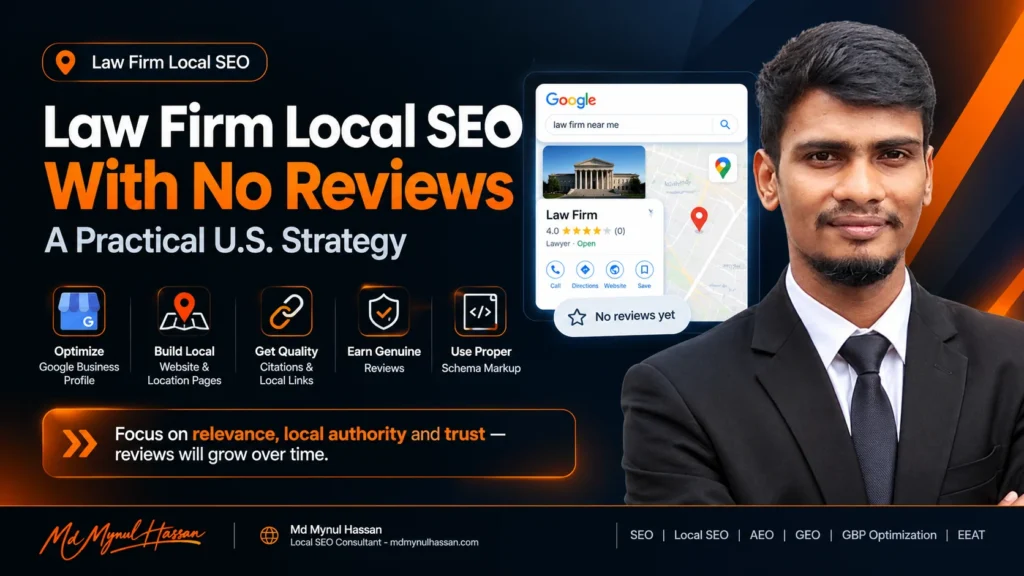
A law firm does not need a large Google review history before it starts Local SEO.
A firm with zero or only a few reviews is at a disadvantage in some local searches, because Google says reviews can contribute to prominence. But Google also says local results are mainly influenced by relevance, distance, and prominence. That means a law firm can work on many important local-search signals before it has built a substantial review profile.
The right approach is not to wait for reviews.
It is to build the foundation that tells Google and prospective clients exactly what the firm does, where it operates, which legal services it provides, and why the business is a legitimate local entity. Reviews should then be built naturally alongside that foundation.
This guide explains how to do that without fake reviews, fake locations, keyword stuffing, or unrealistic ranking promises.
Can a Law Firm Rank on Google With No Reviews?
Yes. A law firm can build local visibility without having a large number of Google reviews, although a weak review profile can make competition harder.
Google does not describe reviews as the only local ranking factor. Its published guidance groups local results around relevance, distance, and prominence, and specifically says reviews can contribute to prominence. So the absence of reviews should be treated as one weakness within the firm’s local-search profile, not as a reason to postpone all SEO work.
Think about a new law firm with:
A legitimate office
A verified Google Business Profile
A real phone number
Clear opening hours
A professional website
Specific practice areas
Attorney information
Useful service pages
Accurate location information
No or very few Google reviews
That firm already has significant work available.
The priority is to strengthen everything that can legitimately be improved while the review profile develops.
What Google Actually Uses for Local Rankings
Google’s current documentation identifies three main areas:
| Factor | What it means for a law firm |
|---|---|
| Relevance | How closely the firm matches what the searcher is looking for |
| Distance | How close the business is to the searcher or location used by Google |
| Prominence | How well-known the business appears from available information |
Google also says that more reviews and positive ratings can help local ranking through prominence.
Relevance
Suppose someone searches:
“family lawyer in Austin”
A page that clearly explains the firm’s family-law services, jurisdiction, location and consultation process communicates more useful information than a generic homepage that simply says:
Experienced legal professionals helping clients with their legal needs.
The second sentence may sound professional, but it does not clearly communicate the firm’s practice focus.
Local SEO starts with relevance.
That means the firm should make its practice areas understandable through its Google Business Profile and website.
Distance
Distance is fundamentally geographic.
A law firm cannot optimize its way out of every proximity disadvantage. A firm located across a large metropolitan area will not necessarily rank equally well for every neighborhood simply because it has strong content.
That is why a legitimate local SEO strategy starts with the firm’s real-world office location.
Google’s Business Profile policies also require businesses to represent themselves accurately. A business must qualify for a Business Profile and, for eligible businesses, customer interaction generally needs to occur in person during stated hours.
Prominence
Prominence is where the review problem becomes more relevant.
A law firm with 200 genuine reviews may have a stronger reputation signal than a firm with two reviews.
But prominence is broader than review count.
Google’s own explanation also mentions information such as websites linking to a business and reviews when discussing prominence.
That gives a no-review law firm a useful strategy:
Strengthen relevance and legitimate prominence while the review profile is still developing.
What to Do First When a Law Firm Has Almost No Reviews
Don’t begin by buying reviews.
Don’t create fake profiles.
Don’t add cities to the business name.
Don’t create dozens of city pages.
Start with the foundation.
1. Confirm Google Business Profile eligibility
Before optimization, make sure the firm genuinely qualifies for a Google Business Profile.
Google states that eligible businesses must make in-person contact with customers during stated hours, subject to its specific exceptions and guidelines.
This matters for legal practices that operate in unusual arrangements.
A real office where clients can meet the firm is different from a virtual office used only to create a local listing.
Get the business model right first.
2. Verify and complete the profile
Once eligibility is established, review:
Business name
Address
Phone number
Website
Hours
Primary category
Additional categories where appropriate
Services
Photos
Appointment/contact path
Business description
Google says businesses with complete and accurate Business Profile information are more likely to appear in relevant local searches.
For a new law firm, completeness is especially valuable because the business has less historical reputation to rely on.
A focused law firm local SEO audit can help identify whether the biggest weakness is the profile, website, technical setup, search intent, citations, or something else.
3. Make the physical office clear
The firm’s website should make the real location easy to understand.
Include the actual:
Street address
City
State
ZIP code
Phone
Business hours
Directions
Office information
Consultation/contact method
Google’s address guidance states that businesses should use a complete, accurate address and that service-area businesses should not display an address when they do not serve customers at that location.
For Local SEO, the website and GBP should tell the same story.
4. Clarify the actual legal services
A law firm’s services should not be buried beneath vague copy.
For example, a firm might genuinely provide:
Family law
Divorce representation
Child custody
Personal injury
Employment law
Estate planning
Immigration law
Criminal defense
Business law
The exact list depends on the firm.
The important part is accuracy.
A firm should not publish a page simply because the keyword appears attractive.
Each important practice area deserves a useful destination that explains:
What the service covers
Who it is for
Relevant legal issues
Jurisdiction
What the firm actually handles
What a prospective client can expect
How to contact the firm
This is where local keyword research strategy becomes useful.
The objective is not to create a giant keyword list.
It is to determine which searches represent genuine client needs and which pages should answer them.
Build the Website Around Real Legal Search Intent
A law firm’s website should support local search from several directions.
Practice-area pages
A firm should normally have dedicated, useful pages for its important services.
Instead of:
/services/
being expected to rank for everything, consider stronger destinations such as:
Family Law
Divorce Lawyer
Child Custody
Personal Injury
Estate Planning
Immigration
Business Law
The exact architecture should reflect the firm’s actual practice.
A page should not exist merely because a keyword was found.
It should exist because the search represents a meaningful user need.
Location pages
Location pages can support genuine local intent, but the firm should avoid creating a large set of near-duplicate city pages.
A page targeting a specific city should provide something useful about that market.
For example:
Office location
Jurisdiction
Courthouse or local legal context where genuinely relevant
Services provided
Local consultation information
Directions
Attorneys serving that market
Useful local information
A page that changes only the city name is not a strong information-gain strategy.
Attorney pages
Attorney profiles are important for both users and entity clarity.
A useful attorney profile can include:
Name
Professional role
Practice areas
Jurisdictions
Education
Professional memberships
Bar admissions where appropriate
Publications
Speaking or professional activity
Contact/firm relationship
Only publish credentials and professional information that the firm can verify.
Internal linking
Practice-area pages should not exist in isolation.
A related article about custody could link to the firm’s family-law service.
A page about estate planning questions could link to estate-planning services.
A city page can link to the relevant practice areas.
An attorney biography can link to the services handled by that attorney.
Your on-page SEO for service pages approach already emphasizes the relationship between search intent, content, internal links, relevance and conversions.
Build Local Authority Without Buying Reviews
A law firm with few reviews still needs evidence that it is a real, active business.
That evidence can include:
Accurate directory listings
Professional associations
Local business organizations
Relevant local publications
Legal directories
Community involvement
Real partnerships
Relevant local links
Useful resources published by the firm
The goal is not to collect hundreds of weak directory links.
It is to build a consistent, legitimate representation of the firm across relevant sources.
This is also why technical foundations matter. Your technical SEO foundation work can address crawlability, indexing, canonicalization, sitemaps, site architecture, structured data and internal linking.
Citations are support, not a magic ranking button
Citations can help maintain consistent business information across important sources.
Check for:
Business-name consistency
Address consistency
Phone consistency
Website consistency
Old addresses
Old telephone numbers
Incorrect opening hours
A law firm should prefer relevant and trustworthy directories rather than publishing its information everywhere possible.
How to Get Genuine Google Reviews for a Law Firm
Once the foundation is correct, build reviews as part of normal client follow-up.
Google’s policy permits businesses to ask for genuine reviews, but it prohibits fake engagement, paid reviews and incentives in exchange for reviews. It also prohibits discouraging negative reviews or selectively soliciting positive reviews.
That makes the process simple.
A neutral request might say:
Thank you for working with our firm. If you would like to share your experience, you can leave an honest Google review using this link.
That is enough.
The firm does not need to tell a client:
“Please give us five stars.”
It also should not dictate the language of the review.
Don’t ask clients to insert:
“best divorce lawyer in [city]”
“best personal injury firm”
“top-rated attorney”
or another keyword phrase.
The client should describe their genuine experience.
What a law firm should not do
Do not buy reviews.
Do not create fake client accounts.
Do not ask employees to pose as clients.
Do not pay customers for five-star reviews.
Do not offer discounts for positive reviews.
Do not prevent unhappy clients from leaving feedback.
Do not ask only happy clients to review Google while deliberately directing unhappy clients elsewhere.
Google explicitly identifies these types of review manipulation as prohibited.
Because legal advertising and client-communication rules vary by jurisdiction, the firm’s review and testimonial workflow should also be checked against the applicable bar or professional rules.
How Many Google Reviews Does a Law Firm Need?
There is no Google-published number of reviews that guarantees a particular local ranking.
Google says reviews can contribute to prominence, but local results also depend on relevance and distance.
That makes “How many reviews do I need?” the wrong first question.
A better question is:
How strong is the firm’s overall local-search foundation compared with the competitors serving the same market?
A new firm might compete in a lower-competition market with very few reviews.
A firm operating in a competitive major city may face competitors with extensive review histories.
The benchmark is therefore competitive, not universal.
Do not build a strategy around an artificial number such as 10, 25 or 100 reviews.
Build an honest process that produces genuine reviews consistently.
Law Firm Local SEO and Schema Markup
Schema should help describe the firm’s real entities and relationships.
It should not be treated as a ranking shortcut.
Schema.org currently defines LegalService as a business providing legally oriented services such as law firms. LegalService sits within the Schema.org hierarchy under Organization and LocalBusiness.
LegalService
For the law firm itself, the current Schema.org type to consider is:
LegalService
It can represent the firm’s legal-service business entity.
Useful properties can include:
nameurltelephoneaddressgeoopeningHours or relevant opening-hours propertiesareaServedlocationemployeemakesOffer
Schema.org specifically defines areaServed as the geographic area where the service or offered item is provided.
Organization
LegalService is already within the Organization hierarchy, so a law firm normally does not need a duplicate generic Organization node describing exactly the same entity simply for the sake of having both types.
However, if the business has a genuinely separate parent organization or legal structure that should be represented, an Organization node can be appropriate.
Google recommends using the most specific Organization subtype that matches the organization.
Person for individual attorneys
This is where current implementation should differ from older law-firm schema guides.
Schema.org’s current release marks Attorney as deprecated and states that LegalService is more inclusive and less ambiguous.
So an individual lawyer should generally be represented as:
Person
rather than using a new Attorney node as the primary type.
The relationship can be expressed with properties such as:
worksFor
or from the firm side:
employee
Schema.org’s Person documentation includes worksFor, while LegalService inherits Organization properties that include employee relationships.
Service
A practice area can also be represented as:
Service
For example:
Divorce representation
Estate planning
Immigration legal services
Personal injury representation
Schema.org defines Service as something provided by an organization and supports relationships such as provider, serviceType and areaServed.
The relationship becomes:
Law Firm → provides → Service
rather than simply placing a keyword inside the schema.
Location
If the firm has a genuine physical office, the firm’s LegalService entity can be related to a Place or PostalAddress.
This helps establish:
Law Firm → located at → Office
For multiple genuine offices, each physical location should be represented accurately rather than creating fictional locations.
WebSite
Your website can be represented separately as:
WebSite
Schema.org defines WebSite as a set of related web pages and other items served from the same web domain.
The relationship becomes:
Law Firm → url → WebSite
and:
WebSite → contains → WebPage
WebPage
Individual pages can use appropriate WebPage-related markup where useful.
A service page can describe a Service.
An attorney biography can describe a Person.
A location page can describe a specific location.
An article can describe the article itself.
Google recommends that structured data accurately describe the page and that markup be validated before deployment.
A practical law-firm schema graph
Conceptually, the graph can look like this:
Law Firm
  │
  ├── type → LegalService
  │
  ├── location → Physical Office
  │
  ├── employee → Attorney Person
  │                     │
  │                     └── worksFor → Law Firm
  │
  ├── makesOffer → Service
  │
  └── url → WebSite
                    │
                    ├── WebPage
                    ├── Service Page
                    ├── Attorney Page
                    ├── Location Page
                    └── Article
That is more useful than creating an oversized schema block containing unrelated properties.
I have also published a separate law firm schema markup guide that goes deeper into this relationship model.
What About Organization + LegalService + Person + Service All Together?
You can think of the markup as a connected graph rather than five unrelated schema blocks.
For example:
{
  "@context": "https://schema.org",
  "@graph": [
    {
      "@type": "LegalService",
      "@id": "https://example.com/#law-firm",
      "name": "Example Law Firm",
      "url": "https://example.com/",
      "telephone": "+1-000-000-0000",
      "address": {
        "@type": "PostalAddress",
        "streetAddress": "123 Main Street",
        "addressLocality": "Austin",
        "addressRegion": "TX",
        "postalCode": "00000",
        "addressCountry": "US"
      },
      "employee": {
        "@id": "https://example.com/attorneys/jane-smith/#person"
      },
      "makesOffer": {
        "@id": "https://example.com/services/family-law/#service"
      }
    },
    {
      "@type": "Person",
      "@id": "https://example.com/attorneys/jane-smith/#person",
      "name": "Jane Smith",
      "jobTitle": "Attorney",
      "worksFor": {
        "@id": "https://example.com/#law-firm"
      }
    },
    {
      "@type": "Service",
      "@id": "https://example.com/services/family-law/#service",
      "name": "Family Law Services",
      "serviceType": "Family Law",
      "provider": {
        "@id": "https://example.com/#law-firm"
      },
      "areaServed": {
        "@type": "City",
        "name": "Austin"
      }
    },
    {
      "@type": "WebSite",
      "@id": "https://example.com/#website",
      "url": "https://example.com/",
      "name": "Example Law Firm"
    }
  ]
}
This is an illustrative model, not code to publish unchanged.
Replace every entity, URL, address, person, service, jurisdiction and property with real visible information.
Google’s structured-data documentation emphasizes accurate, relevant markup and validation rather than adding markup simply to increase its size.
30/60/90-Day Law Firm Local SEO Plan With Almost No Reviews
First 30 days: Fix the foundation
Start with:
GBP eligibility
GBP verification
Business name
Address
Phone
Hours
Primary category
Services
Website connection
Practice-area mapping
Local keyword research
Website location information
Technical indexing
Core service pages
Internal links
Do not make the review count your only KPI.
At this stage, your goal is to make the business understandable and technically sound.
Days 31 to 60: Build relevance and authority
Strengthen:
Practice-area pages
Location page where genuinely justified
Attorney profiles
Local citations
Professional references
Relevant local links
Content around client questions
Internal linking
Structured data
Your SEO content strategy should connect informational content to important commercial pages.
Don’t publish random legal articles merely because a keyword has search volume.
Days 61 to 90: Build reputation and measurement
Continue:
Genuine review requests
GBP monitoring
Local visibility tracking
Search Console analysis
Call tracking
Consultation enquiries
Content refinement
Internal-link improvements
Competitor comparisons
Google says businesses cannot pay for better local rankings and that local ranking depends on its relevance, distance and prominence system.
So the goal should be improving the firm’s actual local-search foundation, not searching for a shortcut.
How Long Does Local SEO Take for a Law Firm?
There is no universal date.
Google explains that SEO changes can take from hours to several months to be reflected in Search, so a law firm should evaluate progress over time rather than expecting an instant ranking change. Your own current Local SEO timeline guide uses a planning range rather than a guarantee.
For a law firm starting with very little review history, the timeline can be affected by:
Market competition
Location
Practice area
Domain age and authority
Website quality
GBP condition
Existing citations
Local links
Content quality
Technical problems
Review acquisition
Conversion experience
A better reporting model is:
Month 1: foundation
Months 2 to 3: relevance and visibility signals
Months 3 to 6: stronger local and organic movement may emerge
Months 6+: measure whether visibility is producing business opportunities
Those are planning stages, not ranking promises.
How to Measure Law Firm Local SEO
Do not report only:
“Keyword moved from position 18 to position 11.”
That can be useful, but it isn’t the final business outcome.
Track:
Local search visibility
Map Pack presence
Local rankings
Non-branded searches
Practice-area searches
City + practice searches
Google Business Profile activity
Website clicks
Phone calls
Directions where applicable
Messages or appointment actions where available
Website activity
Organic clicks
Landing-page traffic
Practice-area visibility
Engagement
Contact-page activity
Business outcomes
Phone enquiries
Consultation requests
Completed forms
Qualified leads
Consultations booked
Cases attributable to organic/local search where tracking permits
If the firm receives traffic but very few enquiries, conversion rate optimization for lead generation becomes relevant.
That is a different problem from ranking.
Common Law Firm Local SEO Mistakes When Reviews Are Low
Mistake 1: Waiting for reviews before starting SEO
Problem: Months pass while the website and GBP remain weak.
Better approach: Improve the complete local foundation while building genuine reviews.
Mistake 2: Buying reviews
Problem: Google prohibits paid or incentivized review activity.
Better approach: Ask real clients neutrally for honest feedback.
Mistake 3: Keyword stuffing the business name
Problem: The official business name becomes inaccurate.
Better approach: Use the real-world name and place service information in the appropriate fields.
Mistake 4: Creating fake city offices
Problem: The website starts communicating locations where the firm does not genuinely operate.
Better approach: Build local pages around real offices and genuine markets.
Mistake 5: Creating dozens of duplicate city pages
Problem: Every page says essentially the same thing except for the city name.
Better approach: Create a location page only when there is enough genuine, useful information to justify it.
Mistake 6: Using old Attorney schema recommendations
Problem: Schema.org currently marks Attorney as deprecated.
Better approach: Use LegalService for the legal-service business and Person for individual attorneys, connected through relationships such as worksFor and employee.
Mistake 7: Publishing content with no connection to services
Problem: Traffic increases without strengthening commercial relevance.
Better approach: Build content around actual client questions and connect it to relevant practice-area pages.
Mistake 8: Measuring rankings but not enquiries
Problem: The firm reports visibility but cannot determine whether Local SEO helps generate business.
Better approach: Connect rankings, GBP actions, organic traffic, calls and consultations.
Law Firm Local SEO Checklist With Almost No Reviews
Google Business Profile
☐ Business is eligible
☐ Profile verified
☐ Real business name
☐ Accurate address
☐ Accurate phone
☐ Correct hours
☐ Appropriate primary category
☐ Relevant services
☐ Website connected
☐ Contact/consultation path clear
☐ Current photos
☐ Business information matches website
Website
☐ Clear practice areas
☐ Strong service pages
☐ Genuine location information
☐ Attorney profiles
☐ Clear contact information
☐ Mobile-friendly experience
☐ Strong internal linking
☐ Indexable pages
☐ Correct canonical setup
☐ XML sitemap working
☐ Appropriate structured data
☐ Clear calls to action
Local Authority
☐ Accurate citations
☐ Relevant legal directories
☐ Professional associations where appropriate
☐ Local references
☐ Genuine local links
☐ No spam directory campaign
☐ No fabricated locations
Reviews
☐ Genuine review process
☐ Neutral review request
☐ No incentives
☐ No bought reviews
☐ No fake accounts
☐ No selective positive-only solicitation
☐ Responses handled professionally
Google explicitly prohibits fake engagement and incentivized reviews.
Measurement
☐ Search Console
☐ GBP performance
☐ Local rankings
☐ Organic clicks
☐ Calls
☐ Consultation enquiries
☐ Qualified leads
☐ Conversion tracking
☐ Competitive monitoring
Frequently Asked Questions
Can a law firm rank on Google with no reviews?
Yes. Google says local search is mainly influenced by relevance, distance and prominence. Reviews can contribute to prominence, but they are not the only local-search signal. A law firm should improve its GBP, website relevance, physical-location signals, local authority and technical foundation while building genuine reviews.
How many Google reviews does a law firm need?
There is no universal Google-published review count that guarantees a local ranking. The firm’s competitive environment matters more than an arbitrary target number. Build genuine reviews consistently while strengthening the rest of the Local SEO foundation.
Are Google reviews important for law firms?
Yes. Google states that reviews can contribute to prominence, which is one part of its local-ranking system. Reviews also influence how prospective clients evaluate a law firm before contacting it.
Can a new law firm do Local SEO before it gets its first review?
Yes. The firm can verify and complete its Google Business Profile, create useful practice-area pages, establish accurate location information, improve technical SEO, build legitimate local references and prepare a genuine review process before receiving a large review count.
Should a law firm buy Google reviews?
No. Google prohibits paid reviews and incentives tied to review publication, as well as several forms of fake engagement and rating manipulation.
Should a law firm create a page for every nearby city?
Not automatically. A city page should have a genuine business reason and useful, distinct information. Changing the city name on the same template is not a strong Local SEO strategy.
What schema should a law firm use?
A law firm can use LegalService to represent the legal-service business, Person for individual attorneys, Service for actual legal services, appropriate location entities, and WebSite/WebPage for the site and its pages. Use relationships such as employee, worksFor, provider, location, and url to connect the entities. Schema.org currently marks Attorney as deprecated.
Does schema markup guarantee better rankings?
No. Structured data helps search engines understand the content and entities on a page, but Google does not guarantee that structured data will produce a particular search appearance.
Is Local SEO different from regular law firm SEO?
Yes. Traditional SEO focuses heavily on organic website visibility, while Local SEO adds geographic relevance, Google Business Profile, local search visibility, real-world location signals and reputation. The two should support each other rather than being treated as isolated campaigns.
How long does law firm Local SEO take?
There is no universal timeline. Competition, location, website condition, GBP quality, authority, content and review development all affect progress. A law firm should evaluate changes over several months rather than expecting a guaranteed ranking date.
Conclusion
A law firm with almost no Google reviews should not conclude that Local SEO has to wait.
Reviews matter, but they are one part of a wider local-search system.
The stronger starting strategy is:
Eligibility → GBP → Location → Practice Areas → Website → Internal Links → Local Authority → Genuine Reviews → Measurement
The firm should become easier to understand before trying to become more popular.
That means accurate business information, clear legal services, real location signals, useful practice-area pages, legitimate local references, a professional attorney presence, appropriate schema and a genuine review process.
This is also why Local SEO should not be reduced to “get more reviews.”
The real objective is to make the law firm found, understood, trusted and chosen.
Readers who want to explore the wider methodology can review the AEO for local businesses, technical SEO foundation, and reviews and case studies for search visibility resources.
The site also includes a relevant immigration law firm Local SEO case study. That project should be treated as a separate case study, not as evidence that every no-review law firm will achieve the same outcome.
About Md Mynul Hassan
Md Mynul Hassan is a Local SEO Specialist and SEO, AEO, GEO & AI Search Visibility Specialist focused on Google Business Profile optimization, local search visibility, service businesses and local SEO strategies.
His broader work connects Local SEO, Google Business Profile optimization, technical SEO, content strategy, internal linking, AEO and GEO rather than treating rankings as an isolated objective. His website describes work with businesses across international English-speaking markets.
You can explore his marketplace and professional profiles:
Upwork: https://www.upwork.com/freelancers/mdmynulhassan
Freelancer.com: https://www.freelancer.com.bd/u/mdmynulhassan
LinkedIn: http://www.linkedin.com/in/aeo-geo-seo-specialist
YouTube: https://www.youtube.com/@mdmynulhassan17
Facebook: https://web.facebook.com/mdmynulhassan.seo