
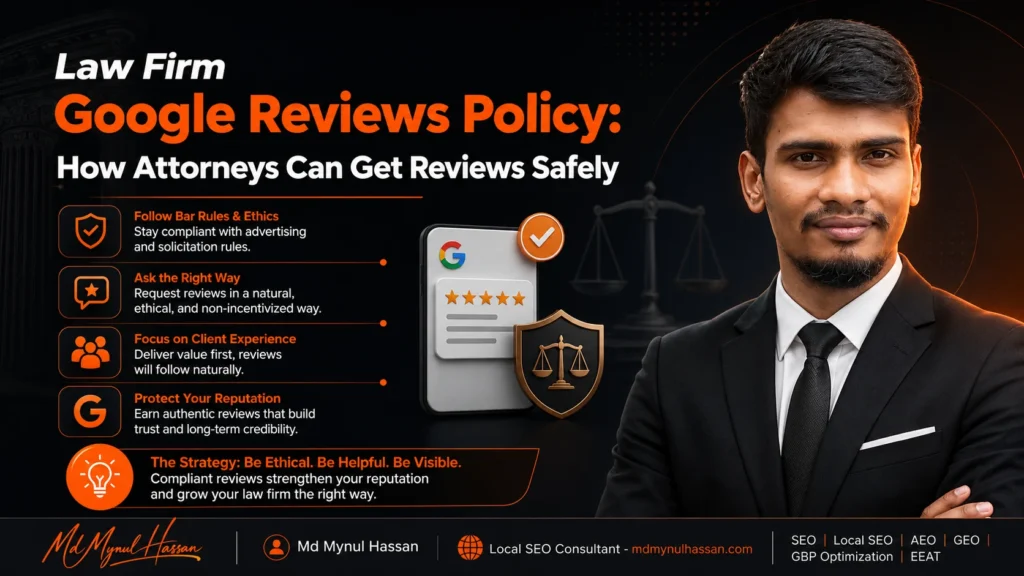
Yes. Attorneys and law firms can ask clients for genuine Google reviews, but the request needs to stay neutral and must comply with both Google’s review policies and the professional-conduct rules that apply to the lawyer or firm.
Google permits businesses to request reviews through a direct review link or QR code. At the same time, Google prohibits fake engagement, paid or incentivized reviews, selective solicitation of positive reviews, conflicts of interest, and attempts to control what customers write.
For lawyers, there is another layer. Attorney advertising and confidentiality rules can restrict how reviews are requested, presented, and answered. The ABA Model Rules provide an important framework, but they are not automatically binding law in every jurisdiction. A law firm should check the rules and ethics opinions applicable to its state, province, country, or other governing authority.
The safest approach is straightforward: ask eligible clients for honest feedback, make the process easy, do not influence the rating or wording, and protect client confidentiality.
Can Attorneys Ask Clients for Google Reviews?
Yes. Google explicitly allows businesses to remind customers to leave reviews and provides tools for creating a review link or QR code.
The important distinction is between asking for an honest review and trying to manufacture a positive review.
A compliant request gives the client the choice to participate, choose the rating, and write whatever accurately reflects the experience.
For example:
“If you have a moment, we would appreciate an honest Google review about your experience with our firm.”
That is very different from:
“If you were happy with our service, please leave us a five-star review and mention how we handled your case.”
The first request leaves the outcome to the client. The second attempts to influence both who reviews and what the review says.
Google’s current policy specifically prohibits discouraging negative reviews or selectively soliciting positive reviews.
Google’s Rules for Law Firm Google Reviews
The same Google review rules that apply to other businesses apply to law firms using Google Business Profile.
Reviews must represent a genuine experience
A Google review should come from someone with an actual experience with the business. Google prohibits fake engagement and content that does not represent a genuine experience.
For a law firm, that means the review should come from someone who genuinely interacted with the firm or received its services.
Do not pay for reviews
Google prohibits reviews or ratings that are paid for directly or indirectly.
That includes offering:
- Cash
- Gift cards
- Discounts
- Free services
- Free goods
- Other incentives
in exchange for a review, review change, or removal of a negative review.
This is particularly important for attorneys because professional-conduct rules may create an additional problem.
ABA Model Rule 7.2 states that a lawyer generally cannot give anything of value to a person for recommending the lawyer’s services, subject to specified exceptions.
So a discount-for-review campaign can create two separate compliance concerns.
Do not selectively ask only happy clients
A firm should not decide that satisfied clients receive a Google review link while dissatisfied clients are quietly excluded.
Google expressly prohibits discouraging or prohibiting negative reviews and selectively soliciting positive reviews.
A better system is to establish a neutral eligibility rule and apply it consistently.
For example:
“Every eligible client receives the same neutral review invitation after the appropriate client relationship or matter milestone.”
The exact timing should be reviewed against the firm’s professional-conduct requirements.
Do not ask for a specific star rating
A request such as “Please leave us five stars” is unnecessary and moves the request away from neutral feedback.
The better approach is simply to ask for an honest review and let the client choose the rating.
Do not tell clients what to write
Avoid asking clients to include:
- A particular keyword
- The attorney’s name
- A specific practice area
- A particular case result
- A settlement amount
- “Best lawyer”
- “Best law firm”
- A specific five-star phrase
The client should control the substance of the review.
Google states that businesses may encourage genuine reviews without attempting to influence the rating or content.
Google Policy and Attorney Ethics Are Two Different Compliance Tests
This distinction is one of the most important parts of a law firm review strategy.
Google’s question is:
Does this review activity represent genuine, unbiased engagement?
The attorney-ethics question is:
Does the lawyer’s conduct comply with the professional rules governing advertising, recommendations, confidentiality, and communications?
The ABA Model Rule framework includes rules addressing lawyer communications and confidentiality. Model Rule 7.1 prohibits false or misleading communications about a lawyer or the lawyer’s services.
Model Rule 1.6 separately addresses confidentiality and generally prohibits lawyers from revealing information relating to a client’s representation without appropriate authorization or another applicable exception.
These are model rules, not a universal substitute for local legal advice. Individual jurisdictions can adopt different language, interpretations, exceptions, and additional requirements.
That means a law firm’s Google review policy should be checked against the applicable bar or professional-conduct rules before implementation.
How Attorneys Can Build More Genuine Google Reviews
A compliant review strategy does not need complicated tactics.
It needs a reliable process.
1. Create a neutral review request
The request should ask for an honest review without suggesting the rating or content.
A simple message might be:
“Thank you for working with our firm. If you would like to share your experience, you can leave an honest Google review here: [Google review link].”
The firm is asking for feedback, not manufacturing a particular outcome.
2. Make the review process easy
Google provides businesses with a direct review link and QR-code option. The link can be shared through email, messaging, or other appropriate client communications, while a QR code can make the process easier during suitable in-person interactions.
Do not send clients through five pages of navigation before they can find the review form.
Reduce friction while keeping the decision completely voluntary.
3. Use a consistent eligibility process
Create an internal policy defining when a client becomes eligible for a review request.
For example, the firm might establish a process around a suitable completed matter or client-service milestone.
The key is consistency.
Do not create an internal list called “clients most likely to give five stars.” That creates the exact selective-solicitation problem a compliant system should avoid.
4. Keep the request separate from financial incentives
Do not connect the review request with:
- Fee reductions
- Refunds
- Credits
- Gift cards
- Discounts
- Payment arrangements
Google prohibits incentives for reviews.
Attorney ethics requirements may add further restrictions.
5. Give clients control over their words
The firm can make the process easy. It should not write the review for the client.
Do not send:
“Please mention that Attorney Smith won your case and was extremely responsive.”
Instead, ask for an honest account of the client’s experience.
6. Monitor and respond professionally
Once reviews arrive, review them regularly.
Google allows verified businesses to reply to customer reviews, and its guidance recommends professional, relevant responses.
For lawyers, however, the response requires additional caution because public communication can implicate confidentiality.
That is where legal review matters more than generic reputation-management advice.
What Attorneys Should Never Do
A law firm Google review policy should explicitly prohibit the following:
| Practice | Why it is risky |
|---|---|
| Buy Google reviews | Violates Google’s fake-engagement policy |
| Offer discounts for reviews | Incentivized engagement is prohibited |
| Give gifts for reviews | Same Google policy problem |
| Ask only happy clients | Selective solicitation can manipulate ratings |
| Request five-star reviews | Attempts to influence the rating |
| Script review wording | Attempts to influence content |
| Ask for specific keywords | Content manipulation |
| Create fake reviews | Not a genuine client experience |
| Ask conflicted people to review | Conflict-of-interest concern |
| Review competitors | Google prohibits competitor reputation attacks |
| Pressure clients to review immediately | Undermines voluntary participation |
| Reveal confidential case details | May violate professional confidentiality duties |
Google specifically identifies paid reviews, multiple-account manipulation, conflicts of interest, competitor attacks, incentives, selective solicitation, and attempts to influence review content as prohibited or restricted behavior.
How Lawyers Should Respond to Negative Google Reviews
This is where law firms need to be more careful than many ordinary businesses.
A negative review can be frustrating. A lawyer may know that the review leaves out important facts or presents the matter inaccurately.
That does not automatically mean those facts can be disclosed publicly.
ABA guidance discussing Formal Opinion 496 states that lawyers may not disclose information relating to a client’s representation in response to a negative online review merely because the review is inaccurate or unfair.
The ABA’s current Model Rule 1.6 commentary also states that public criticism, such as a negative online review, is not itself a “controversy” that automatically permits disclosure under the rule’s self-defense provision.
A safer response is often brief and neutral.
For example:
“Thank you for sharing your concerns. Because of our professional obligations, we cannot discuss the details of client matters publicly. Please contact our office directly if you would like to discuss your concerns.”
Even this type of response should be reviewed against the firm’s jurisdiction and circumstances.
Do not publicly disclose:
- Case strategy
- Settlement information
- Confidential communications
- Personal client information
- Internal correspondence
- Details of the representation
- Facts that could identify a client or matter
The ABA’s recent guidance continues to emphasize that confidentiality can remain applicable even when a client publicly discusses the matter.
If a review appears to violate Google’s policies, the firm can report it through Google’s review-reporting process rather than trying to win the argument publicly.
A Practical Law Firm Google Review Compliance Checklist
Before launching a review campaign, ask:
Is every review based on a genuine client experience?
Are we avoiding payment or incentives?
Are we avoiding review gating?
Are eligible clients receiving a neutral opportunity to review?
Are we avoiding requests for five-star ratings?
Are we avoiding instructions about what clients should write?
Are we avoiding requests for specific keywords?
Are we avoiding reviews from employees or conflicted individuals?
Are we avoiding reviews of competitors?
Is the Google review link easy to access?
Is our request language appropriate for our jurisdiction?
Have we considered whether the timing could pressure a current client?
Do staff know not to discuss confidential matters publicly?
Does someone responsible for the firm’s ethics compliance review the workflow?
Do we have a process for reporting policy-violating reviews?
If several answers are “no,” fix the process before increasing review volume.
How Reviews Fit Into Law Firm Local SEO
Reviews should be treated as one component of a broader local-search system.
A law firm’s Google Business Profile should accurately represent the firm, while the website should clearly explain its practice areas, service locations, attorneys, contact options, and relevant expertise.
My Google Business Profile Optimization Service focuses on the relationship between profile information, local relevance, services, reviews, website alignment, and Google Maps visibility.
For firms that depend heavily on local searches, Local SEO services can connect the Google Business Profile with service pages, location relevance, competitor analysis, internal links, citations, and local search intent.
The website itself also matters. Strong reviews cannot compensate for a confusing service page, poor conversion path, weak technical foundation, or unclear practice-area information.
That is why On-Page SEO can be useful for aligning practice-area pages with search intent and improving the path from search result to enquiry.
Likewise, Keyword Research can help identify the practice-area and location searches that prospective clients actually use, while an SEO Audit can identify technical, content, local, and conversion issues that may be limiting visibility.
For firms publishing educational legal content, a structured SEO Content Writing and Content Strategy service can help connect informational topics with relevant commercial pages.
And where technical problems are involved, Technical SEO can address crawlability, indexing, internal linking, structured data, redirects, and related foundations.
The same information also needs to be understandable beyond traditional search. My AEO and GEO consulting focuses on clear entities, useful answers, structured information, and brand visibility across modern search experiences.
Reviews Are a Reputation System, Not a Numbers Game
A law firm’s goal should not be to manufacture the largest possible review count.
The better objective is a consistent stream of genuine client feedback supported by a process that respects both Google and professional obligations.
That means:
- Ask eligible clients consistently.
- Keep the request neutral.
- Make the Google review easy to access.
- Never pay or incentivize reviews.
- Never filter for positive sentiment.
- Never script the client’s words.
- Monitor reviews regularly.
- Respond carefully.
- Protect confidentiality.
- Review the process against applicable local ethics rules.
Google itself recommends requesting genuine reviews through links or QR codes and valuing honest and balanced feedback.
That approach is much more defensible than chasing a particular star rating.
Connect With Md Mynul Hassan
I help service businesses improve Google Search, Google Maps, Local SEO, Google Business Profile visibility, AEO, GEO, and broader brand visibility.
For law firms that need help reviewing their Google Business Profile, local search structure, review strategy, or website-to-GBP alignment, you can explore the relevant services or connect through my professional profiles:
Frequently Asked Questions
Can lawyers ask clients for Google reviews?
Yes. Google permits businesses to request genuine reviews through tools such as direct review links and QR codes. Attorneys should make the request neutral and ensure it complies with applicable professional-conduct rules in their jurisdiction.
Can a law firm offer a discount for a Google review?
No. Google prohibits offering incentives such as discounts, free goods, or services in exchange for reviews or changes to reviews. Attorney professional-conduct rules may create additional restrictions.
Can a lawyer ask for a five-star review?
A safer approach is not to request a particular star rating. Ask for an honest review and allow the client to choose the rating independently. Google’s policy prohibits attempts to influence the rating or content of reviews.
Is review gating allowed for law firms?
No. Google prohibits discouraging negative reviews or selectively soliciting positive reviews. A law firm should not send review requests only to clients it expects to be satisfied.
Can attorneys use a Google review QR code?
Yes. Google provides a review-link and QR-code feature that businesses can use to make it easier for customers to leave reviews.
Can lawyers respond to negative Google reviews?
They can respond, but attorney confidentiality obligations make public responses more complicated than ordinary business review replies. ABA guidance warns that lawyers should not disclose information relating to a client’s representation simply to defend themselves against a negative online review.
Can a lawyer say that a negative reviewer was never a client?
Potentially, but only when the statement is accurate and making it publicly would not reveal protected information. The specific circumstances and jurisdiction matter, so attorneys should exercise caution and consider applicable ethics guidance.
What happens if Google detects fake law firm reviews?
Google may remove violating reviews and can impose restrictions on a Business Profile, including temporarily preventing new reviews, unpublishing existing reviews, or displaying a warning about removed fake reviews.
How many Google reviews does a law firm need?
There is no universal number that guarantees strong local visibility. A more useful benchmark is to examine the genuine review profile of relevant competitors in the firm’s market while paying attention to review quality, recency, relevance, and the overall strength of the firm’s local presence.
Conclusion
The safest law firm review strategy is not to chase five-star reviews.
It is to build a repeatable system that makes it easy for genuine clients to share honest experiences without being paid, filtered, pressured, or coached.
Google allows businesses to request genuine reviews. It does not allow businesses to manipulate the review process.
For attorneys, the analysis goes one step further. Professional-conduct requirements, especially confidentiality and rules governing lawyer communications, can affect how reviews are requested, displayed, and answered. ABA guidance makes clear that a negative online review does not automatically give a lawyer permission to disclose information about the client’s representation.
So the practical rule is simple:
Ask honestly. Do not manipulate. Protect confidentiality. Check your jurisdiction’s rules.
That gives a law firm a review strategy that is much easier to defend and much more useful for long-term local search visibility.