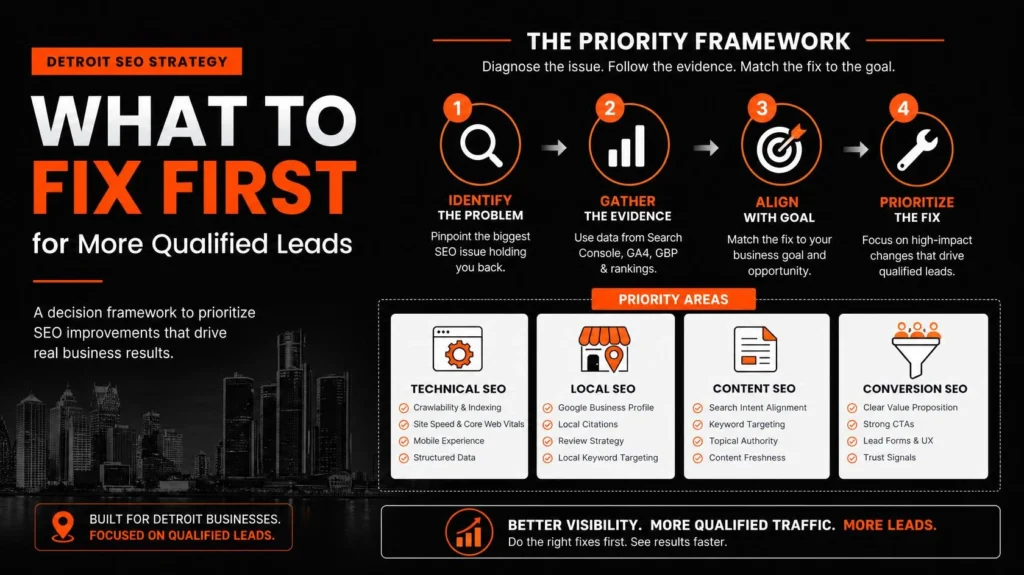
A Detroit business that is struggling to get enquiries from Google does not necessarily need more blog posts, more backlinks, or another package of SEO tasks. It needs to identify where its search journey is breaking down.
If Google cannot index important pages, technical work may be the priority. If customers are looking for a nearby service, Local SEO may deserve more attention. If relevant visitors reach the website but do not enquire, content clarity and conversion paths may be the bigger problem.
The right SEO strategy starts with the business goal, the searcher’s intent and the evidence available, then selects the work most likely to address the problem. This guide explains how to make that decision for businesses serving Detroit and the wider Metro Detroit market.
1. Diagnose the Search Problem Before Choosing an SEO Service
Start with what you can observe. A weak result from SEO can have different causes, and treating every problem as a keyword problem wastes time.
| What you observe | What to investigate first | Possible priority |
|---|---|---|
| Important pages are not indexed | Indexing status, canonical tags, crawl access, redirects and page quality | Technical SEO |
| Relevant pages receive few impressions | Search intent, query targeting, page relevance and content gaps | Keyword research and on-page SEO |
| Local customers struggle to discover the business | Business eligibility, profile accuracy, local relevance and competition | Local SEO |
| Visitors arrive but rarely contact the business | Offer clarity, trust, page usability, forms and calls to action | Conversion optimization |
| Buyers cannot find specific products or capabilities | Site architecture, product/category pages and detailed service information | B2B or ecommerce SEO |
| Content is published but does not support commercial pages | Topic ownership, internal links and content planning | SEO content strategy |
These are diagnostic starting points, not guaranteed explanations. For example, low impressions can result from demand, competition, indexing, relevance or other factors. Confirm the cause before choosing a solution.
A focused SEO audit helps bring the evidence together so that the next step is based on the website’s actual condition.
2. Choose the SEO Strategy That Fits Your Business Model
Detroit is not one uniform market. The region includes automotive and mobility businesses, advanced manufacturing, professional services, logistics, digital technology and financial services. Each type of business can have a different route from search discovery to a commercial decision. The Detroit Regional Partnership’s industry overview provides context for these sectors.
Local service businesses: focus on service intent and genuine local relevance
A contractor, clinic, repair business or other local service provider may depend on people searching for a specific service in a particular area.
The website should explain what the business does, which services it provides and how customers can take the next step. If the business is eligible for a Google Business Profile, the profile and website should communicate accurate, consistent information.
Google says local results are influenced mainly by relevance, distance and prominence. A consultant cannot remove the distance factor or guarantee a particular map position. The practical objective is to improve the factors the business can legitimately influence. Google’s official local-ranking guidance explains these factors.
For an eligible business, Local SEO services and Google Business Profile optimization may be relevant. The appropriate scope depends on the business’s real location, service model and current visibility.
Manufacturers and B2B suppliers: make capabilities discoverable
A manufacturer or industrial supplier often needs to help a technical or procurement-focused buyer determine whether the company can meet a particular requirement.
A generic company overview may not answer those questions. Buyers may need to understand available processes, product categories, materials, applications, tolerances or other capabilities relevant to the business.
The website should publish accurate information about the capabilities the company can substantiate. Important capability pages should be accessible, internally linked and written using terminology its customers understand.
The objective is not to manufacture thousands of low-value technical keyword pages. It is to make genuine capabilities easier to discover and evaluate.
This work can involve keyword research, technical SEO and a more focused SEO content strategy.
Professional firms: make services and expertise clear
Professional services businesses may need to explain complex services, distinguish related offerings and help potential clients understand whether the firm is suitable for their needs.
The content should answer substantive questions rather than produce a separate page for every close keyword variation. Each important service page needs a clear purpose, useful supporting information and a logical enquiry route.
On-page SEO can support this by improving search intent alignment, page structure, internal links and the clarity of the information.
Ecommerce businesses: investigate category and product discovery
For an online store, the problem may sit in category architecture, product content, crawlable navigation, duplicate URLs, filters or the way key pages connect.
A local-service SEO checklist cannot cover every ecommerce requirement. Product and category pages need to serve commercial searches while helping customers understand the available options.
In this situation, evaluate an Ecommerce SEO strategy instead of assuming that adding local keywords to the homepage will solve the problem.
3. Does Your Detroit Business Need Local SEO, Technical SEO or Both?
Local SEO and technical SEO address different aspects of search performance. They can work together, but neither automatically replaces the other.
| Situation | What to investigate |
|---|---|
| Customers cannot find an eligible business for relevant local searches | Profile accuracy, categories, real service coverage, website relevance and local competition |
| Search engines struggle to discover or index important pages | Crawling, indexing, redirects, canonicalization, sitemap quality and internal links |
| The site is indexed but attracts the wrong searchers | Keyword targeting, search intent, page relevance and content |
| Relevant organic visitors do not convert | Landing-page messaging, calls to action, contact friction and conversion tracking |
| A business wants visibility beyond traditional search results | Clear entity information, useful content, crawlability and appropriate AEO/GEO work |
For example, a business may have a well-maintained profile but poorly structured service pages. Another may have good organic content but technical problems preventing important pages from appearing as expected.
Do not pay for the same generic checklist every month. Determine which work is necessary, what evidence supports it and how the completed work will be reviewed.
A website speed optimization service may be useful where performance issues are substantiated. It should not be prescribed merely because speed sounds important.
4. Build Pages Around Search Intent, Not Just Detroit and Its Suburbs
Adding geographic wording is not the same as creating a useful local-search strategy.
A business serving Detroit, Dearborn, Troy, Royal Oak, Southfield and Novi should investigate whether its customers have distinct service needs in those areas before creating separate landing pages.
Use this decision process:
Review existing pages. Determine whether a current service page already answers the intended query.
Group queries by purpose. Separate service searches, location-based searches, comparisons and informational questions.
Check actual demand and results. Use country- and location-relevant keyword data and examine the current SERP.
Decide whether another page is justified. Publish a new page only when it meets a distinct need and can offer substantial independent value.
Connect relevant pages. Use contextual internal links and an understandable site hierarchy.
If one page already serves the relevant intent, improve it rather than creating a second URL that repeats substantially the same information.
This is particularly important for businesses targeting multiple nearby cities. Geographic proximity alone is not a reason to create another page, and a remotely delivered service should not pretend to have an office or staff in the target city.
5. Make AI Search Visibility Part of a Clear Search Strategy
AEO and GEO can support the wider search strategy when a business wants its information to be easier to understand and discover in answer-oriented systems. They should not replace basic SEO work or become a reason to publish repetitive AI-focused content.
Start with the fundamentals:
Explain the business, its services and its capabilities clearly.
Keep important pages accessible and useful.
Use headings that communicate the actual subject.
Connect related pages through relevant internal links.
Support important factual claims with credible evidence.
Publish original information where the business can substantiate it.
Avoid unsupported claims about locations, expertise, customer outcomes or rankings.
A company that is difficult to understand on its own website should not begin by buying promises of AI citations. First make sure that its services, pages and supporting evidence are clear.
When the scope genuinely includes this work, AEO and GEO consulting can form part of the wider plan. No one can guarantee that a particular AI system will cite a page or mention a brand.
6. A Practical SEO Prioritization Plan
Once the business has identified the problem, organize the work so the highest-priority issues are not buried beneath minor tasks.
Stage 1: Establish a baseline
Review the website’s important URLs, relevant search queries, organic clicks, impressions, indexing status and existing conversion tracking. Use Google Search Console for search-performance data and the appropriate analytics or CRM system for business outcomes.
Keep impressions, clicks and qualified leads separate. Each measures a different point in the customer journey.
Stage 2: Map search intent to existing pages
Identify which URLs should serve core commercial queries, which pages support those services and which questions deserve independent informational content.
Keyword research can help organize search opportunities by intent and prevent closely related pages from unnecessarily competing with one another.
Stage 3: Fix the highest-impact problems first
If important pages cannot be indexed, address the underlying issue before expanding the content library. If pages are discoverable but poorly aligned with customer needs, prioritize intent, content and on-page improvements.
Do not apply every possible SEO tactic in the same order to every website.
Stage 4: Improve the visitor’s path to action
Make sure a visitor can understand the service, assess whether it fits their needs and complete the intended action without unnecessary friction. Where evidence indicates conversion problems, review the page and its conversion rate optimization opportunities.
Stage 5: Measure and revise
Review the data after implementation. Identify what changed, what has not improved and whether the original diagnosis was correct. Use findings to revise priorities rather than automatically repeating the previous month’s tasks.
This is a prioritization process, not a promise of results within a fixed period.
7. Common SEO Decisions That Waste Time and Resources
Publishing a new page for every suburb. This can multiply repetitive content without providing a distinct reason for each URL. Investigate demand, page ownership and local value first.
Focusing only on rankings. A ranking report alone cannot tell you whether the business receives relevant traffic, qualified enquiries or sales.
Treating all technical warnings as equally important. An audit should help determine which issues affect important pages and which can wait.
Writing content without a business connection. An article should serve a clear audience need and connect naturally with relevant service pages.
Assuming AI optimization is a separate shortcut. Clear, accessible information and trustworthy evidence remain important when a business is trying to communicate its expertise.
Accepting unsupported local claims. A consultant should not invent an address, local clients or city-specific project results to strengthen the appearance of local relevance.
Changing every page at once. Uncontrolled changes can make it difficult to determine which intervention contributed to a change in performance. Prioritize work and preserve a useful baseline.
8. Can a Remote SEO Consultant Support a Detroit Business?
Yes. Many research, audit, strategy, content-planning and technical consulting activities can be delivered remotely. The engagement should define what the consultant will investigate, which recommendations are included, who implements the work and how progress is measured.
I am Md Mynul Hassan, based in Dinajpur, Bangladesh, and working with businesses remotely. I do not claim a Detroit office or Detroit-specific project results that have not been verified.
The appropriate next step depends on the problem. A business that needs diagnosis can start with an SEO audit; a site with implementation issues may need WordPress SEO support; and a business whose key concern is local visibility may need a focused Local SEO plan.
For a different perspective on applying local-search strategy to an actual business context, see the published immigration law firm local-visibility case study. That project concerns Leicester, not Detroit, so it should be viewed as an example from another market rather than evidence of Detroit client experience.
About Md Mynul Hassan
Md Mynul Hassan works across SEO, Local SEO, Google Business Profile optimization, technical SEO, content strategy, AEO and GEO. His approach connects search intent, website structure, service relevance and conversion priorities.
You can read more about his SEO approach or explore the relevant services for your own business.
For professional updates and educational content, connect with him on LinkedIn, Facebook and YouTube.
His freelance profiles are available on Upwork and Freelancer.com.
To discuss a project, use the contact page.
FAQ
These are suggested questions for the article. Confirm the actual search results before labelling any as verified PAA.
How do I know what SEO work my business needs first?
Start with evidence from your website and search performance. Check whether important pages are indexed, whether relevant queries generate impressions and clicks, whether local discovery works as expected, and whether visitors complete meaningful actions. The findings should determine the priority, not a predetermined package.
Does every Detroit business need Local SEO?
No. A business relying on customers who search for nearby services may benefit from Local SEO. A national ecommerce business or a B2B supplier selling across several regions may need a different emphasis, although aspects of Local SEO can still be relevant depending on the business model.
Should I create SEO pages for Detroit, Dearborn, Troy and Novi?
Only when each proposed page has a distinct purpose, substantiated demand or a defensible strategic rationale, and useful content that differs meaningfully from existing pages. Do not create multiple city URLs just because the business serves those areas.
What should an SEO consultant investigate first?
The consultant should understand the business model, current website, target searches, existing performance, relevant competitors and the desired commercial outcome. They should then explain the problem, the proposed work, the implementation responsibilities and the way progress will be measured.
Can a remote SEO consultant work with a Detroit company?
Yes. Search research, technical reviews, content planning and many consulting tasks can be delivered remotely. The business should confirm the consultant’s relevant capabilities, agreed scope, communication process and measurement plan rather than assume an office in Detroit is necessary.
Does AEO or GEO replace traditional SEO?
No. Answer-oriented and generative search work should complement useful content, technical accessibility, clear business information and the website’s wider SEO strategy. No service can guarantee that a particular AI platform will cite a company.