A Google Business Profile for a chiropractic clinic or physical therapy practice should make the clinic easy for Google and potential patients to understand. That means accurate business information, the most appropriate category, relevant services, useful photos, genuine reviews, correct location data, and a clear connection between the profile and the clinic website.
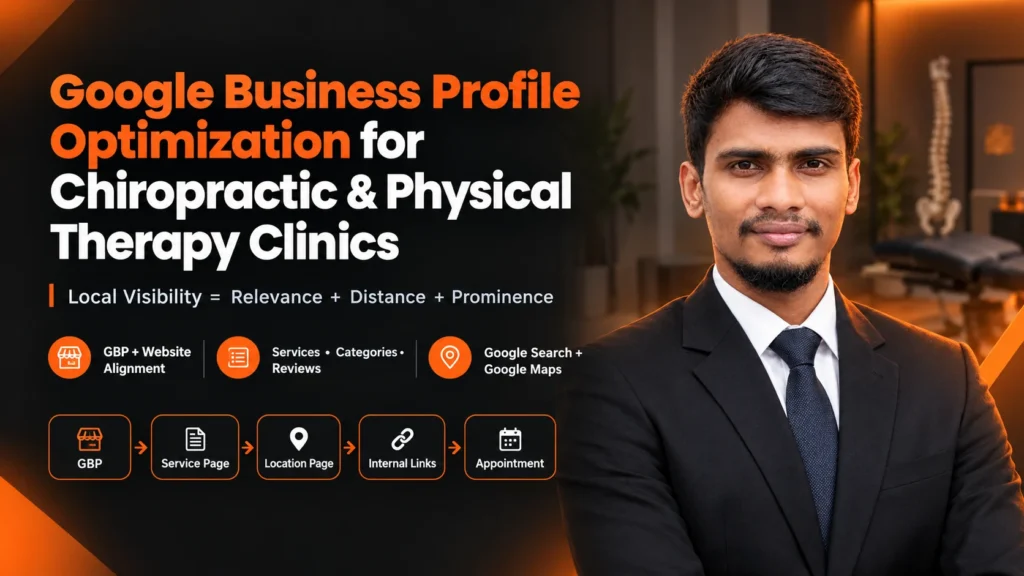
Google says local results are mainly influenced by relevance, distance and prominence. Complete and accurate business information helps Google understand how a business relates to a search.
For a healthcare practice, the work should go beyond filling every field. The profile needs to accurately represent the real clinic, its location, its services and the patient journey.
The most useful way to approach this is:
GBP relevance + real-world location + prominence + website alignment + trust + conversion
What Is a Google Business Profile for a Chiropractic or Physical Therapy Clinic?
A Google Business Profile is the business listing that represents an eligible clinic in Google Search and Google Maps. For chiropractic and physical therapy practices, it can display information such as the clinic name, category, address, hours, services, photos, reviews, website and other customer-facing details.
For a clinic, the goal is not to insert the phrase “chiropractor” or “physical therapy” into every field. The goal is to create an accurate, consistent entity that Google can associate with relevant local searches.
That makes GBP part of a wider local SEO system, not a standalone profile-editing task.
For the website side, the clinic can support this work through a broader Local SEO strategy and, where appropriate, dedicated Google Business Profile optimization.
How Google Local Results Work for Clinics
Google states that local results are mainly based on three broad factors:
| Factor | What it means | What a clinic can do |
|---|---|---|
| Relevance | How well the business matches the search | Improve categories, services, information and website relevance |
| Distance | How far the business is from the searcher | You cannot rewrite the clinic’s physical location |
| Prominence | How well-known or established the business is | Build genuine reputation, reviews, links and broader visibility |
Relevance
Relevance answers a simple question:
Does this clinic actually match what the person searched for?
A chiropractic practice should clearly communicate that it is a chiropractic practice. A physical therapy clinic should accurately represent physical therapy as its core service where that is the actual business.
Categories, services, business information and the linked website all contribute to the context Google can use.
Distance
Distance is different.
A clinic in downtown Chicago cannot optimize its GBP into physically being closer to someone searching from a distant suburb.
Google explicitly includes distance in local ranking. That means clinic owners should stop looking for ways to “optimize away” geographic reality. Instead, improve the factors they can control, especially relevance and prominence.
Prominence
Prominence concerns how well-known the business is. Google says factors such as links and reviews can contribute to this understanding, and more reviews and positive ratings can help local ranking.
This is why GBP optimization should not end inside Google. Your website, local references, reviews and broader web presence matter too.
10 Areas to Optimize on a Chiropractic or Physical Therapy GBP
1. Use the Real-World Business Name
Your business name should reflect the name customers actually see in the real world.
Do not turn the business name into a keyword string such as:
“Best Chiropractor Dallas | Back Pain Chiropractor | Sports Chiropractic”
Google says the name should reflect the real-world business name used consistently on signage, stationery and other branding. Unnecessary information in the name is not permitted and can create profile quality problems.
A better approach is to keep the actual clinic name in the business-name field and use categories, services, website content and relevant pages to communicate what the clinic does.
2. Choose the Most Specific Primary Category
Google says the primary category should be the category that best represents the main business. You can also select additional categories when they genuinely apply.
For a dedicated chiropractic practice, Chiropractor is the logical primary category when that category is available in the clinic’s market and accurately describes the business.
For a physical therapy practice, Google category naming can vary by country and account context. Categories such as Physical therapist or Physical therapy clinic may appear. The correct rule is to select the most specific accurate category currently offered in the GBP interface, rather than choosing a broader category simply because it sounds familiar.
Do not select secondary categories only because they contain a keyword you want to rank for.
Ask:
Does this category describe a real part of the business?
If the answer is no, don’t add it.
3. Build a Useful Service List
Google allows eligible businesses to display services directly on their Business Profile. Services can be grouped into categories and can include descriptions and prices where applicable.
For a chiropractic clinic, services might include offerings such as:
- Chiropractic adjustment
- Spinal adjustment
- Sports chiropractic care
- Soft tissue therapy
- Injury rehabilitation
- Posture-focused care
For a physical therapy clinic, examples could include:
- Orthopedic physical therapy
- Sports rehabilitation
- Post-surgical rehabilitation
- Balance and mobility therapy
- Manual therapy
- Neurological rehabilitation
Only add services the clinic actually provides.
A useful service entry should correspond with a real patient-facing offering. Where there is a dedicated website page for that service, the website should reinforce the same terminology.
This is where a structured keyword research strategy can help identify how patients search for services without turning the profile into a keyword dump.
4. Write the Business Description for Clarity
The description should explain:
- what the clinic is
- who it serves
- its primary services
- where it operates
- useful differentiating context
Google says the business description should contain useful information about services and the business’s mission or history, while avoiding irrelevant or promotional material. Links should not be placed in the description field.
For example:
“A chiropractic clinic providing spinal care, sports-focused chiropractic services and rehabilitation support for patients in Austin and surrounding communities.”
That communicates the entity clearly.
A description such as:
“Best chiropractor near me, top chiropractor, cheap chiropractor, chiropractor Austin, back pain chiropractor…”
communicates less and reads like keyword stuffing.
5. Keep Address and Service Area Accurate
For a clinic where patients visit a physical location, the real clinic address should be represented accurately.
Google’s business representation guidance says storefront businesses can display their address, while service-area businesses need a different setup. A service-area business should not use a virtual office as though it were a staffed storefront.
For clinics, this matters because geography is a real local-ranking constraint.
Do not create fake locations for neighborhoods you want to target.
Do not add service areas that the clinic does not genuinely serve.
If the practice serves patients from nearby communities, reflect that truthfully through the profile, website, service-area information where appropriate, local content and location pages.
6. Keep Hours and Appointment Information Current
Incorrect hours are a conversion problem before they become an SEO problem.
A patient who sees an open clinic in Google but arrives to find it closed has no reason to trust the listing again.
Keep:
- regular hours
- holiday or special hours
- phone number
- website
- appointment information
current and consistent.
Google’s profile system is designed to show business details such as location, hours, phone and website to customers through Search and Maps.
7. Add Real Clinic Photos
Photos should answer questions a prospective patient actually has.
Useful images include:
- exterior entrance
- reception
- treatment rooms
- equipment
- waiting area
- practitioner headshots
- team photos
- accessible entrances
- branded clinic signage
For a chiropractor, a clear treatment environment can reduce uncertainty.
For a PT clinic, images of rehabilitation spaces and equipment can help explain the environment before the first visit.
Use original imagery whenever possible. Avoid generic stock photography that makes the profile look interchangeable with dozens of other clinics.
Google’s profile policies apply to submitted photos and videos, and businesses remain responsible for complying with applicable laws and platform requirements.
8. Build a Genuine Review Process
Reviews serve two roles.
They affect how potential patients evaluate the clinic, and Google states that review-related prominence signals can contribute to local ranking.
Google also provides businesses with a direct review link or QR-code workflow for requesting genuine reviews.
The important word is genuine.
Do not offer discounts or gifts in exchange for reviews. Do not selectively request only positive feedback. Google explicitly prohibits incentivized or manipulated reviews.
For healthcare practices, review responses need another layer of caution.
A clinic should not publicly confirm that a reviewer is a patient or disclose patient-specific information merely because the reviewer included it first. The AMA’s current guidance specifically warns physicians and practices to maintain patient privacy when responding publicly to online reviews.
A safe style is:
“Thank you for sharing your feedback. Our team takes concerns about communication and care seriously. Please contact our office directly so we can discuss the matter privately.”
That keeps the response general.
9. Connect GBP to the Right Website Page
One of the most common strategic mistakes is sending every local profile and local searcher to the homepage.
A clinic should consider what page best continues the search journey.
For example:
Google search → GBP → chiropractic service page
or
Google search → GBP → location page → service page
A chiropractor searching for “sports chiropractor in Austin” should not land on a generic page that never discusses sports-focused chiropractic services.
Likewise, a physical therapy clinic targeting “post-surgical physical therapy Chicago” should have a useful service page that actually explains that service.
This is where on-page SEO and technical SEO connect with local optimization.
10. Keep the Profile Accurate Over Time
GBP optimization is not a one-time form-filling exercise.
Check the profile when:
- the clinic changes hours
- a phone number changes
- a practitioner joins or leaves
- services change
- the clinic relocates
- new services are introduced
- appointment processes change
- Google suggests edits
- customer-submitted information becomes inaccurate
Google notes that profile information can be compiled from business owners, users, publicly available web content, licensed third-party data and other sources.
That makes consistency across the web more important than trying to “perfect” one profile in isolation.
How Do Chiropractors Rank Higher on Google Maps?
Chiropractors do not rank higher in Google Maps because of one magic GBP field.
Google says local ranking is mainly influenced by relevance, distance and prominence.
A practical chiropractic local SEO system therefore looks like:
Accurate GBP
→ correct category
→ relevant services
→ accurate business information
→ genuine reviews
→ strong website relevance
→ useful local pages
→ internal links
→ legitimate local authority
The key distinction is between what you can improve and what you cannot control.
You can improve relevance and prominence.
You cannot move the clinic closer to a searcher.
You also cannot pay Google for a better local ranking. Google explicitly states that there is no way to request or pay for a better local ranking.
What Category Should a Chiropractor Use on Google Business Profile?
For a genuine chiropractic clinic, Chiropractor is the appropriate primary category when that category is available and accurately describes the clinic.
Google recommends choosing a specific category that represents the core business rather than stacking broad categories. You can add additional categories when they accurately describe real business activities.
For example:
Primary: Chiropractor
Possible secondary categories should only be added when they reflect genuine services or business types.
Do not add categories solely because a competitor uses them.
Do not use a medical category to suggest services the clinic does not actually provide.
What Category Should a Physical Therapist Use on Google Business Profile?
A physical therapy clinic should choose the most accurate, specific category currently available in its GBP interface.
The category wording can vary by market and language, so practices should use the category Google actually provides for their region rather than forcing a US term into a UK, Australian, Canadian or Irish listing.
For a dedicated physical therapy business, a physical therapy-specific category is generally more appropriate than a vague wellness or general medical category when that specific option is available.
The same principle applies:
Choose the category that describes the actual business, not the keyword you wish to target.
How Do I Add Chiropractic or Physical Therapy Services to Google Business Profile?
Google’s current workflow allows eligible businesses to add services, group them by category and add descriptions.
A practical workflow is:
- Open the verified Business Profile.
- Select the service-editing area.
- Review the services already suggested by Google.
- Add only services the clinic genuinely offers.
- Group related services logically.
- Add concise, patient-friendly descriptions where useful.
- Cross-check the same services against relevant website pages.
- Review the profile again after changes are published.
The strongest relationship is not:
GBP service → keyword
It is:
GBP service → actual clinic offering → website service page → patient intent
How Important Are Reviews for Chiropractor Google Maps Visibility?
Reviews matter for both reputation and local search.
Google says reviews and positive ratings can contribute to prominence in local results.
But review strategy should focus on authentic patient feedback, not review manipulation.
Google prohibits offering incentives for reviews and also prohibits selectively discouraging negative reviews.
A sensible review process might be:
Completed appointment → normal follow-up → genuine review request → optional review link → professional response
The goal is not to manufacture a perfect rating.
The goal is to create a trustworthy body of feedback that reflects the real customer experience.
For healthcare practices, responses should also protect patient privacy. Publicly acknowledging someone’s patient relationship can create privacy issues even when the reviewer has identified themselves.
Do Google Business Profile Posts Help Local Rankings?
Do not treat Google Business Profile posts as a direct ranking hack.
Google’s official local-ranking documentation identifies relevance, distance and prominence as the main factors. It does not say that publishing a certain number of posts directly moves a profile upward.
Posts can still be useful.
They can help communicate timely information, explain services, highlight educational resources and give a profile more customer-facing context. Google allows businesses to publish relevant updates and other content subject to its policies.
For a chiropractic clinic, a useful post might explain:
“What to expect at your first chiropractic consultation”
For a PT clinic:
“What happens during an initial physical therapy evaluation?”
That is useful to the patient whether or not it creates a ranking benefit.
How Important Is Location Distance for Chiropractor Google Maps Rankings?
Distance is a real constraint.
Google defines distance as how far each business is from the searcher, using known location information when available.
That means a clinic should not build a strategy around the assumption that it can rank equally across an entire metropolitan area with profile edits alone.
Instead, build geographic relevance honestly.
For example:
Clinic in Boston
→ Boston service page
→ accurate clinic address
→ relevant nearby-area content
→ legitimate citations
→ strong GBP
→ useful service pages
What you should not build is:
Boston clinic
→ 25 near-identical location pages
→ fake offices
→ unsupported service-area claims
Distance cannot be optimized away.
How Can Physical Therapy Clinics Get More Local Visibility on Google?
Physical therapy clinics usually need the same local foundation as other location-based practices, but the service structure can become more detailed.
A PT clinic may need to communicate:
- core physical therapy
- specific rehabilitation programs
- conditions treated
- specialty areas
- practitioner information
- appointment process
- clinic location
- insurance or payment information where appropriate
- accessible facilities
- real patient-facing information
The website should reinforce the GBP rather than contradict it.
Google explains that business information can be drawn from the official website and other public sources, so consistency helps create a clearer representation of the business.
A focused SEO content strategy can help determine which services deserve their own pages and which topics should remain supporting content.
How GBP and Your Clinic Website Should Work Together
Think of your local search presence as one connected system:
Google Business Profile
↕
Clinic website
↕
Service pages
↕
Location pages
↕
Internal links
↕
Reviews and other external references
Service Pages
If the GBP lists “sports chiropractic care,” your website should have a useful page that actually explains the service when that service is important enough to deserve a dedicated page.
Location Pages
A physical therapy clinic serving multiple genuine locations should use useful location pages that explain the actual clinic, services and local context.
Do not create a location page solely because a keyword tool says “physical therapy + city” has search volume.
Internal Links
Internal links help Google and users understand which pages are related.
A useful architecture could be:
Local SEO hub
→ chiropractic service page
→ physical therapy service page
→ Boston location page
→ sports rehabilitation page
→ appointment page
A broader SEO audit can identify whether the current site actually provides those relationships.
Local Business Information
Keep the core business identity consistent:
Name + address + phone + website + location
Do not create five different versions of the business identity across important pages.
Structured Data
Structured data can help search engines understand page content and business information.
Google’s Local Business documentation recommends using the most specific LocalBusiness subtype that fits the business.
Schema.org also defines MedicalClinic as a type of local medical organization and Service as a way to describe a service provided by an organization.
For a clinic website, the structure can conceptually look like:
MedicalClinic
→ name
→ address
→ telephone
→ URL
→ opening hours
→ available services
Service
→ service name
→ provider
→ area served
→ service page URL
Person
→ practitioner or author
→ name
→ professional role
→ profile URL
This should always match visible, accurate information.
Google recommends validating structured data and making sure the page is crawlable and accessible.
A Practical Optimization Example
Example A: Chiropractic Clinic
Imagine a fictional chiropractic practice:
Example: “River North Chiropractic”
The real clinic name is used in the business-name field.
Primary category: Chiropractor
Services:
- Chiropractic adjustment
- Sports chiropractic care
- Soft tissue therapy
Website architecture:
Home
→ Chiropractic Services
→ Sports Chiropractic
→ River North Location
→ Contact
Internal relationships:
GBP
→ website
→ core service page
→ location page
The important point is consistency.
The profile does not need to repeat the same phrase in every field. The profile, website and real-world business should all communicate the same underlying entity.
Example B: Physical Therapy Clinic
Imagine a fictional clinic:
Example: “Harbor Physical Therapy”
Primary category: the most accurate physical therapy-specific option available in the clinic’s market
Services:
- Orthopedic physical therapy
- Sports rehabilitation
- Post-operative rehabilitation
Website architecture:
Home
→ Physical Therapy
→ Sports Rehabilitation
→ Post-Surgical Rehab
→ Clinic Location
→ Appointment
Again, the profile provides discovery.
The website supplies depth.
The local page supplies location context.
The service pages answer patient questions.
The reviews provide authentic reputation evidence.
Multi-Location Chiropractic and Physical Therapy GBP Strategy
Multi-location practices need a stricter structure.
Google says there should be only one Business Profile for each business, while legitimate multiple locations can be managed separately. Duplicate profiles for the same business can create problems and may not appear in Search or Maps.
For larger businesses, Google supports bulk management for businesses with 10 or more locations, subject to eligibility and quality guidelines.
A clean multi-location model is:
Brand
→ Location A GBP
→ Location A page
→ Location B GBP
→ Location B page
→ Location C GBP
→ Location C page
Each genuine location should have its own accurate identity and useful local information.
What should not happen:
One physical clinic
→ Chicago GBP
→ Dallas GBP
→ Houston GBP
→ Phoenix GBP
simply because those cities have search demand.
Artificial location creation is not a local SEO shortcut.
9 Common GBP Mistakes Clinics Should Avoid
Keyword-stuffing the business name
Use the real-world name.
Choosing a broad category for the wrong reason
Use the most accurate specific category available.
Adding services that are not actually offered
GBP should describe the real clinic.
Creating fake service areas
Geographic targeting should reflect actual service delivery.
Buying or incentivizing reviews
Google prohibits incentivized reviews.
Publicly revealing patient information in review responses
Healthcare reputation management must protect privacy.
Creating duplicate profiles for one clinic
Google states one profile per business.
Sending every searcher to the homepage
Match important local intents to useful service and location pages.
Treating GBP as separate from SEO
Local visibility works better as a connected system.
How to Measure Local Visibility and Patient-Action Signals
A clinic should measure more than rankings.
A practical measurement model is:
| Area | Useful question |
|---|---|
| Visibility | Are important local queries generating impressions or visibility? |
| GBP activity | Are searchers taking meaningful actions from the profile? |
| Website | Are visitors reaching relevant service and location pages? |
| Conversion | Are calls, inquiries or appointment actions increasing? |
| Reputation | Is genuine review activity being maintained? |
| Coverage | Are target services and real locations properly represented? |
Use the Business Profile data available in the account alongside Google Search Console and website analytics.
This makes the reporting more useful than saying:
“Your map ranking moved from 8 to 5.”
A clinic owner needs to know what changed in the actual customer journey.
For example:
Search visibility
→ GBP impression
→ website visit
→ service page
→ appointment inquiry
That is a much more meaningful chain.
A focused conversion rate optimization service can help when local visibility exists but the patient journey is weak.
30-Point Chiropractic and Physical Therapy GBP Checklist
Business identity
- Real clinic name used
- Address accurate
- Phone accurate
- Website accurate
- Hours accurate
- Special hours checked
Categories
- Primary category matches the real business
- Secondary categories are genuinely relevant
- No category stuffing
Services
- Core services listed
- Service groupings logical
- Descriptions useful
- Website service pages align
Local relevance
- Physical location accurate
- Service area truthful where applicable
- Local website context consistent
- Location pages useful and unique
Reputation
- Genuine review requests
- No review incentives
- Review responses are professional
- Healthcare privacy protected
Media
- Exterior photo
- Interior photo
- Treatment or rehabilitation area
- Team or practitioner imagery
- Accessibility or useful facility imagery
Website connection
- GBP links to the most useful page
- Internal links connect service and location pages
- Structured data matches visible information
- Profile and website information are reviewed regularly
A technical SEO audit is useful when the local strategy looks correct but search engines still struggle to discover, crawl or interpret important service or location pages.
How a Local SEO Specialist Can Support GBP and Website Alignment
GBP optimization becomes more valuable when it is connected to the rest of the site’s search architecture.
A clinic may need help with:
- local keyword research
- category analysis
- service mapping
- GBP optimization
- local landing pages
- internal linking
- technical SEO
- content strategy
- structured data
- competitor analysis
- conversion paths
- measurement
That is the difference between editing a profile and building a local search system.
My broader Local SEO work connects Google Business Profile, Google Maps visibility, local relevance, website structure, reviews, internal links and conversion paths. My AEO and GEO consulting can also support clearer entities, structured information and direct-answer content for broader search visibility.
I also document the relationship between local visibility and trust in healthcare-related work. For example, my Local SEO case study for a mental health practice illustrates how sensitive healthcare-related businesses require careful attention to trust, local relevance and conversion rather than keyword repetition alone.
For clinics using WordPress, WordPress SEO support can also be relevant when GBP work needs to connect with page structure, schema, internal links and technical configuration.
Two authoritative references worth keeping nearby
Google’s guidance on improving local ranking explains relevance, distance and prominence and is the strongest starting point for GBP ranking questions.
Schema.org Service provides the underlying vocabulary for describing services and their relationships to organizations and geographic areas.
Connect With Md Mynul Hassan
For clinics researching local SEO, Google Business Profile optimization or broader search visibility, you can also find my professional work on:
These profiles are useful for businesses that want to understand the consultant behind the strategy rather than evaluating a service page alone.
Frequently Asked Questions
How often should a chiropractor update a Google Business Profile?
A chiropractor should update the profile whenever business information, services, hours, location details or other customer-facing information changes. Ongoing maintenance is more important than changing fields on an arbitrary schedule.
Can a chiropractic clinic have multiple Google Business Profiles?
Yes, when there are legitimate eligible business locations. A single business should not create duplicate profiles simply to target different keywords, services or areas. Google says each business should have one profile, while legitimate multiple locations can be managed separately.
Do Google Business Profile posts directly improve chiropractor rankings?
Google’s official local-ranking documentation does not identify post frequency as one of the three main local ranking factors. Posts can still provide useful customer-facing updates, but they should not be treated as a guaranteed ranking lever.
Is distance more important than relevance?
Distance is one of Google’s named local-ranking factors, alongside relevance and prominence. A clinic cannot change its real-world distance, so practical optimization should focus heavily on the factors the business can influence.
Should a PT clinic use “Physical Therapist” or “Physical Therapy Clinic”?
Use the most accurate physical-therapy-specific category currently available in the clinic’s Google Business Profile interface. Category wording can vary by country, language and market, so the exact label should be checked in the live account.
Should chiropractors add every related healthcare category?
No. Google recommends using the fewest categories needed to accurately describe the overall business. Add secondary categories only when they genuinely represent the clinic.
Can a healthcare practice respond to a negative Google review?
Yes, but the response must be handled carefully. Healthcare providers should avoid disclosing or confirming patient-specific information in public responses, even when the reviewer has disclosed personal information first.
What is more important, GBP optimization or the clinic website?
They solve different parts of the same local-search system. GBP helps establish the clinic’s local business presence, while the website provides deeper information about services, locations, practitioners, expertise and conversion paths. Treating them as connected assets is more useful than asking which one should replace the other. Google also notes that information from a business’s website can contribute to how profile information is compiled.
Can schema markup guarantee Google Maps rankings?
No. Schema is a way to provide structured information about a page or entity. It does not remove distance constraints, create legitimate reviews or guarantee a local ranking. Google recommends accurate, valid structured data that matches visible content.
What should I optimize first on a chiropractic or physical therapy GBP?
Start with the clinic’s real-world identity, primary category, core services, address, hours, phone number and website, then work on reviews, media, website alignment and broader local authority. This order fixes foundational accuracy before moving into supporting optimization.