Choosing an SEO consultant in Los Angeles starts with identifying the problem you need to solve. A local service business may need better Google Maps visibility, while an ecommerce company may need technical improvements, stronger category pages, or a content strategy that attracts buyers.
The right provider should explain what they would improve, why it matters, how the work will be implemented, and how progress will be measured. A prominent website or a long list of services is not enough.
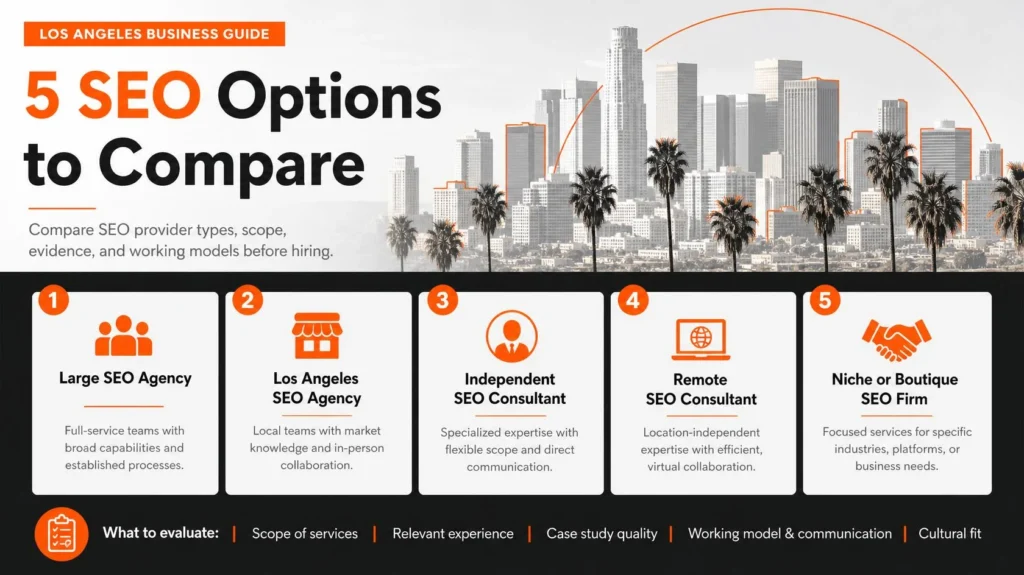
This guide compares five SEO provider options with different working models: a remote consultant, an individual consultant targeting Los Angeles, and agencies advertising SEO services for the market. The order is not a quality ranking, and the inclusion of a provider is not an independent endorsement.
What this comparison can tell you
The shortlist is based on publicly available provider pages reviewed on October 18, 2026. The comparison considers stated service focus, working model, available information, and questions that a buyer should investigate before making a decision.
Public website claims are not the same as independently verified results. Before hiring anyone, request relevant evidence, confirm the proposed scope, and make sure the provider can work within your budget and implementation requirements.
Five SEO consultant and agency options for Los Angeles businesses
1. Md Mynul Hassan: a remote SEO consulting option
Website: mdmynulhassan.com
Md Mynul Hassan provides SEO and Local SEO consulting from Dinajpur, Bangladesh, working remotely with businesses in international markets. His published service offering includes Local SEO, technical SEO, keyword research, on-page optimization, SEO auditing, Google Business Profile optimization, and SEO content strategy. He also offers AEO and GEO consulting for businesses working on the clarity of their information and visibility across modern search experiences.
The potential fit is a business that is comfortable with remote collaboration and wants connected research, practical recommendations, and implementation support rather than requiring a consultant to visit its Los Angeles office.
Before hiring, confirm how the work will be delivered, what tasks are included, who will implement website changes, how communication will work across time zones, and which outcomes will be measured. Ask for examples relevant to your own industry and market.
Important limitation: the reviewed website pages did not establish a Los Angeles-specific client history or a Los Angeles case study. This option should therefore be evaluated as remote consulting, not as a locally established LA agency.
You can review Md Mynul Hassan’s professional background and SEO approach and process to understand his stated scope and working principles. His published case studies provide additional material to assess, but should not be interpreted as proof of Los Angeles results.
2. John Akande: an individual consultant targeting Los Angeles
John Akande presents himself as an SEO consultant serving Los Angeles businesses, with an emphasis on technical SEO, site architecture, and conversion-focused work. His published page also displays project and client-result claims.
This option may be worth evaluating if you prefer direct contact with an individual consultant and want to discuss technical website work alongside lead generation.
During due diligence, ask which parts of the displayed case studies were completed by the consultant, how revenue or lead attribution was calculated, whether the results are relevant to your business model, and whether a recent reference is available. Treat published outcomes as provider claims until the underlying evidence has been checked.
3. Metrix Digital: connected technical, local, and ecommerce SEO
Metrix Digital describes itself as a Los Angeles SEO agency and presents technical SEO, site architecture, content, local-search signals, and ecommerce optimization as related components of an organic-growth program.
That mix may suit a company whose search problems span several areas. For instance, publishing more content will not resolve an indexing problem that prevents important pages from being discovered, and technical fixes alone may not give an ecommerce category page a clear reason to rank for a competitive commercial query.
Ask the team how it diagnoses issues, who implements fixes, how editorial work is approved, and how it reports the impact of different activities.
4. LA SEO Service: an enterprise and ecommerce-focused provider
LA SEO Service advertises enterprise and ecommerce SEO alongside lead-generation, local, international, and other search-related services. Its website publishes an address in Los Angeles.
This option is worth comparing if your business has a large product catalogue, multiple search requirements, or needs a broader delivery team. An agency’s advertised breadth, however, does not establish that every service is equally strong.
Before engaging the provider, request a proposed scope for your platform and business model. Ecommerce owners should ask specifically about category and product-page strategy, crawl and indexation controls, faceted navigation, redirects, product information, and how organic-search work connects to conversion measurement.
5. CRTE Agency: an LA-focused agency with published pricing
CRTE Agency describes its Los Angeles SEO services as a combination of technical SEO, Local SEO, and content work for service businesses, multi-location operators, ecommerce businesses, and catalogue sites.
At the time of this research, its public page listed an investment range of $1,500–$6,000 per month and a 90-day minimum term. These are the provider’s published terms, not a verified market-wide average. Confirm the current proposal directly before comparing it with other quotes.
Ask which technical changes, pages or editorial assets are included, what falls outside the retainer, whether implementation is included, and how priorities change when the initial audit finds more issues than expected.
How to choose the right SEO provider
Use the following process before signing a contract.
1. Match the provider to the problem
Start with the business outcome rather than a generic request for more rankings.
A local professional practice may need clearer service pages, accurate business information, and a stronger local-search strategy.
A service company may need more qualified enquiries from the pages that describe its most profitable services.
An ecommerce company may need improved crawlability, product and category pages, and clearer conversion paths.
A company selling nationally may need broader non-local keyword targeting, technical improvements, and a more connected content strategy.
A focused SEO audit service can help establish which problems actually deserve attention first.
2. Ask for evidence you can check
Request a relevant example showing the initial condition, work completed, timeframe, and outcome. For numerical claims, ask what was measured, the source of the data, and how much of the outcome can reasonably be attributed to the SEO work.
Look for evidence that resembles your situation. A case involving a multi-location retailer is not necessarily a useful proxy for a small professional practice.
3. Understand the audit and implementation process
A useful audit should identify problems, explain why they matter, and prioritise corrective actions. Depending on the site, the work may include crawling and indexing, redirects and canonical tags, site structure, performance, content relevance, internal links, and structured data.
A technical SEO review is relevant when the questions concern discoverability, rendering, indexing, or site architecture. It should result in decisions about what to fix, not merely a report full of warnings.
4. Check keyword and page ownership
Your provider should explain which pages will target which topics and why. A keyword spreadsheet without page ownership can lead to several similar pages competing to satisfy the same search intent.
Good keyword research connects queries to the business, the searcher’s need, the page that should own the query, and the value of serving that audience.
For an LA business, this means investigating whether a direct service page, a supporting guide, or an existing page update is the right choice before commissioning another URL.
5. Compare scope, reporting, and accountability
| What to compare | Question to ask |
|---|---|
| Research | What will you investigate before recommending changes? |
| Deliverables | What exactly will I receive each month? |
| Implementation | Who makes the approved website changes? |
| Reporting | Will reports cover meaningful queries, pages, enquiries, and conversions where measurable? |
| Communication | Who is responsible for the project and how often will we review it? |
| Contract | What are the minimum term, cancellation terms, and extra costs? |
| Evidence | Can you substantiate the results and references relevant to this proposal? |
Compare providers against the same requirements. A low-cost audit and a retainer that includes technical implementation and ongoing content are different products.
6. Evaluate local-search capabilities when they matter
For a business that serves customers within a genuine geographic area, ask how the provider will approach the website’s local relevance, service pages, and business information.
A suitable Google Business Profile optimization service should work with accurate, eligible business information. Google’s Business Profile guidelines explain that a virtual office cannot be presented as a business location unless the relevant staffing and operating requirements are met. Merely adding Los Angeles to a website does not create eligibility for a local profile there.
On-site work matters too. On-page SEO should connect a page’s purpose, content, metadata, and internal links with the search intent it serves.
7. Check content and ecommerce capabilities when relevant
An ongoing content plan should explain which audience questions deserve pages, how those pages support existing services, and how each resource provides value beyond repeating the same information.
A structured SEO content strategy is more useful than commissioning articles simply to increase the number of URLs.
For online stores, compare providers’ experience with the platform and product catalogue. A dedicated ecommerce SEO service should be evaluated against the store’s actual technical and commercial requirements.
If AI-search visibility is part of the brief, ask how the provider will improve clarity, useful answers, entity consistency, and supporting evidence through AEO and GEO consulting. No provider can guarantee a particular AI citation or search placement.
Does an LA business need Local SEO or broader SEO?
It depends on how the business acquires customers.
A business whose customers search for services in particular areas may need Local SEO alongside improvements to its main service pages. A company serving customers nationally or selling products online may need a broader organic-search strategy. Many businesses need a combination of both.
Start with the way customers find and choose your services. Then assign the work to the page or channel that can best support that journey.
How should Los Angeles and nearby-area targeting be handled?
Do not assume that Downtown LA, Pasadena, Glendale, Burbank, Santa Monica, and Long Beach each require a separate page. Research whether the business genuinely serves each area, whether buyers have a distinct need, how current search results differ, and whether a separate page would provide substantial additional value.
A useful location page should offer real location-specific information rather than a city name swapped into an otherwise identical template. Google’s spam policies on doorway abuse warn against creating similar pages for multiple locations that funnel users toward the same destination.
Review how to build local landing pages without doorway-page duplication before scaling geographic pages. If two pages already compete for the same intent, address the keyword cannibalization problem rather than automatically creating another URL.
Common mistakes when hiring an SEO consultant
Choosing based on a ranking promise. Ask for a realistic plan, measurable work, and transparent reporting instead.
Comparing prices without comparing scope. Confirm deliverables, implementation, contract terms, and additional costs.
Accepting unexplained case-study numbers. Check baselines, data sources, attribution, and relevance to your business.
Assuming an agency is always better than a consultant. Choose based on the skills and capacity the project actually needs.
Publishing a page for every nearby city. Establish a clear purpose and distinct value before assigning a new URL.
Confusing website targeting with local presence. Keep geographic claims and business profile information accurate.
Treating AI visibility as a guaranteed deliverable. Ask what work can actually be completed and how progress will be assessed.
A practical checklist before you hire
Use this list during a discovery call or proposal review.
Review my work and connect with Md Mynul Hassan
For businesses considering remote SEO consulting, these profiles provide additional ways to review my professional background, published content, and service offering.
Professional profiles: LinkedIn, Facebook, and YouTube.
Freelance marketplaces: Upwork profile and Freelancer.com profile.
I am based in Bangladesh and work remotely with businesses. For an LA company considering this model, the next step is to discuss the website, target market, business priorities, and the work that needs to be delivered. The fit should be judged on the agreed scope, evidence, communication, and implementation requirements, rather than an assumption of local presence.
The best hiring decision is the provider who can explain what your business needs, substantiate relevant claims, and turn a clearly defined scope into measurable work. Compare the options on those criteria before deciding.
FAQ
These questions are suggested from the search journey, not verified PAA. Add this FAQ block after the hiring checklist and before the article’s closing CTA. It complements the article instead of repeating the full selection framework.
How much does an SEO consultant cost in Los Angeles?
SEO consulting costs depend on the provider, scope, competition, site condition, and whether implementation is included. For example, CRTE Agency publicly listed $1,500–$6,000 per month during this research. That is one provider’s advertised range, not a market-wide average. Request itemised proposals before comparing prices.
Should I hire an SEO consultant or an SEO agency?
A consultant may suit a business that needs direct strategic expertise or focused specialist work. An agency may be more suitable when a project requires several specialists or a larger delivery team. Compare the actual skills, implementation capacity, communication, scope, and accountability rather than relying on company size alone.
Can a remote SEO consultant help a Los Angeles business?
Yes. A remote consultant can conduct research, review a website, plan content, evaluate technical issues, and collaborate with a business online. The fit depends on relevant expertise, communication, implementation access, and evidence. Remote consulting should not be confused with having a physical Los Angeles office or local client history.
What should an SEO audit include?
The scope depends on the website, but a suitable audit may review crawling, indexing, redirects, canonical URLs, site structure, page relevance, content, internal links, performance, and structured data. For a local business, it may also review geographic targeting and Google Business Profile alignment where appropriate. The audit should prioritise actionable findings.
How long does SEO take to produce results?
There is no universal timeline. Results depend on the site’s starting condition, competition, the work required, implementation speed, and the searches being targeted. Ask a consultant to separate initial diagnostic work, implementation milestones, early performance indicators, and longer-term outcomes. Be cautious of guarantees tied to a fixed date.
Does every Los Angeles suburb need a separate SEO landing page?
No. A separate page needs a distinct search purpose and meaningful value for people in that area. If the copy only changes the suburb name and funnels visitors toward the same service, it risks becoming a doorway page. Review search demand, existing URL ownership, and local relevance first.
How can I check whether an SEO provider’s case studies are credible?
Ask for the timeframe, baseline, source of the reported data, work completed, and an explanation of how the outcome was attributed. Check whether the result relates to the same kind of business and search market. A numerical claim on a provider’s website is a reason to ask questions, not automatic proof of performance.