A business can have a good service, experienced people, satisfied customers, and years of knowledge behind it.
But if none of that experience is visible online, a potential customer may never know.
This is something I have noticed repeatedly while working on SEO over the last two years.
Many businesses focus heavily on rankings, keywords, service pages, Google Business Profile optimization, or publishing more content. Those things matter. But there is another part of search visibility that is often overlooked:
Proof.
What can a potential customer see that shows the business has real experience?
What can they read that explains how the business has helped people?
What evidence supports the claims being made on the website?
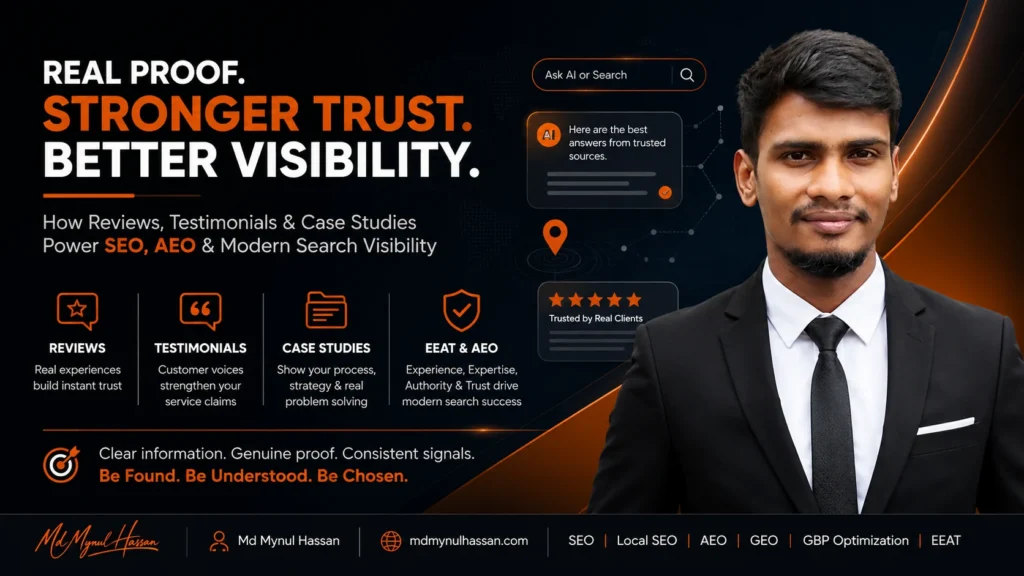
Reviews, testimonials, and case studies can help answer those questions.
I do not see them as decoration for a website. I see them as part of a broader trust and visibility system.
That becomes particularly important as search becomes more conversational and people increasingly use Google, AI-powered search, and answer engines to research businesses before making a decision.
Why trust has become an important part of search visibility
When someone searches for a service, finding a business is only the first step.
The next question is usually much more important:
Can I trust this business?
Consider someone searching for a local SEO consultant.
They may find several consultants offering similar services. Many websites will have similar service descriptions:
“Local SEO.”
“Google Business Profile optimization.”
“Keyword research.”
“SEO audits.”
“AEO and GEO.”
The service names alone do not tell the buyer very much.
They want to understand the person behind the service.
Have they actually worked on these problems?
Do previous clients describe their work positively?
Can they explain their approach?
Have they documented real projects?
Do they understand the difference between a technical issue, a content problem, a local visibility problem, and a conversion problem?
This is why my own approach to SEO goes beyond rankings.
I focus on helping businesses become easier to find, easier to understand, easier to trust, and easier to choose. That is also how I structure my own website, connecting services, practical content, client feedback, case studies, and information about how I approach SEO. My SEO consulting website
For me, this is where SEO and trust start to overlap.
Reviews are more than star ratings
Reviews are one of the simplest forms of customer evidence.
But the value of a review is not only the number of stars.
The words matter too.
A review such as:
“Great service.”
is positive, but it tells a potential customer very little.
Compare that with a genuine review that explains what the client needed, what was done, what they found useful, or how the experience helped them.
That second type of review gives context.
On my own website, I have received feedback mentioning areas such as keyword research, clustering, search intent, communication, professionalism, and SEO strategy. Those details are useful because they give potential clients a better understanding of the type of work I actually do.
I do not believe businesses should try to manufacture reviews around keywords.
A genuine customer should be allowed to describe their experience naturally.
The objective is not to turn a review into SEO copy.
The objective is to make real customer experience visible.
What makes a review useful?
When I look at reviews from a search visibility perspective, I find specific experiences more useful than generic praise.
A useful review may naturally explain:
- What problem the customer had
- What service they received
- What part of the work helped
- How the communication was
- What they appreciated about the process
- What type of project was involved
That creates context for the reader.
It also gives the business owner something much more valuable than a collection of five-star ratings.
It gives them evidence that explains why someone trusted them.
Testimonials help connect your service claims with real experiences
There is a difference between a review and a testimonial, even though the two can overlap.
A testimonial is often presented directly on a business website as part of the buying journey.
For example, if I explain that my approach to keyword research goes beyond producing a list of search terms, a testimonial discussing keyword clustering, search intent, topic clusters, or long-tail opportunities can give that claim more context.
This is one reason I include client feedback on my own website.
My keyword research service is not positioned simply as a keyword-list service. My approach is to connect search data with pages, content, internal linking, commercial opportunities, and broader topical authority. That distinction becomes easier to understand when real client feedback supports the type of work being described.
The same principle applies to Local SEO.
If a business offers Local SEO services, relevant testimonials can help visitors understand the type of local search problems the consultant works on.
The important word is relevant.
A testimonial should not be forced into a page simply because it contains a keyword.
It should help the reader make a decision.
Case studies show how you think, not just what you achieved
This is where case studies become especially valuable.
A review may take a few sentences.
A case study can explain the entire problem-solving process.
That difference matters.
When I look at a case study, I want to understand:
What was the original problem?
What did the business already have?
What was missing?
What did the SEO audit reveal?
Which issues mattered most?
Why were certain changes prioritized?
What was actually implemented?
What happened afterward?
And perhaps most importantly:
What can another business learn from the project?
That is much more useful than simply displaying a large traffic-growth number.
A good case study should explain the reasoning
One thing I try to avoid in SEO case studies is presenting SEO as a collection of random tasks.
For example:
- Keyword research completed
- On-page SEO completed
- Backlinks built
- Content published
- GBP optimized
That tells me what happened.
It does not tell me why.
A stronger case study connects the decisions.
For example:
The business was targeting valuable local services, but important service pages did not clearly match local search intent.
So the service structure was reviewed.
Then keyword research was connected with customer intent.
The important pages were strengthened.
Supporting content was developed where it made sense.
Internal links connected informational content with commercial pages.
The Google Business Profile and website were reviewed together.
Trust signals were considered as part of the customer journey.
That is the kind of story I find useful because it explains the SEO thinking behind the work.
My own case studies reflect this approach
My website currently includes SEO case studies covering different types of projects, including an ecommerce SEO project and a Local SEO project.
The purpose of these case studies is not simply to say, “I do SEO.”
They show how I approach problems.
For example, my Local SEO case-study framework connects website structure, service pages, Google Business Profile, local relevance, reviews, internal linking, content, technical SEO, and authority rather than treating Local SEO as only GBP optimization and citations.
There is also an important lesson here about honesty.
The HVAC case study currently published on my website clearly states that its performance figures are example figures and should be replaced with verified client data before being presented publicly as an actual client result.
I think that distinction matters.
I would rather explain what was actually done and what can genuinely be supported than publish impressive numbers simply because they make a case study look better.
This is where EEAT becomes practical
EEAT is often discussed as if it were another SEO checklist.
I see it differently.
If you want to demonstrate experience, expertise, authoritativeness, and trustworthiness, your website should give people reasons to believe you.
Experience comes from showing the work
Do not only say:
“I am experienced in SEO.”
Explain what you have actually worked on.
Talk about problems you have encountered.
Explain what you noticed.
Show how you approach an SEO audit.
Discuss the decisions you make when keyword data conflicts with business priorities.
Explain what you look for when reviewing a Google Business Profile.
That is much stronger than simply repeating the word “experience.”
I have been focused on practical SEO work for the last two years, with a web-development background going back to 2020. That combination influences how I approach SEO because I can look at both the strategy and the implementation behind a recommendation.
Expertise comes from explaining why
Anyone can publish a checklist.
Expertise becomes more visible when you explain the reasoning behind the checklist.
For example, I do not recommend creating more blog posts simply because a website has not published anything recently.
First I want to know:
What are customers searching for?
Which topics are commercially relevant?
Which pages already exist?
Where are the content gaps?
Is the problem actually content?
Could the existing pages be improved instead?
How should the pages connect through internal linking?
That is why my SEO content strategy and content writing approach is connected with search intent, topical coverage, internal linking, and the wider business objective.
Authority develops through consistency
Authority is not created by adding “expert” to your job title.
It develops through consistent evidence.
Your website should communicate the same basic identity across your important online profiles.
Your services should make sense.
Your content should demonstrate knowledge.
Your case studies should be honest.
Your reviews should be genuine.
Your professional profiles should reinforce who you are and what you do.
This is also why I keep my own professional identity consistent around SEO, Local SEO, AEO, GEO, Google Business Profile optimization, and search visibility.
Trust depends on honesty
This is probably the part of EEAT I care about most.
Do not invent results.
Do not create fake testimonials.
Do not publish a case study using numbers you cannot verify.
Do not promise that a business will reach a specific Google position.
Do not imply that adding schema will automatically make an AI system recommend you.
If you cannot publish confidential client information, explain what you can responsibly share.
That is better for long-term trust.
Google’s own guidance emphasizes accuracy, quality, relevance, originality, and adding value for users rather than producing content simply to manipulate search rankings.
What does this have to do with AEO?
AEO, or Answer Engine Optimization, is often described as optimizing content so that answer engines can understand and use it.
That is part of it.
But I think there is a deeper issue.
Before an answer engine can confidently understand your business, there needs to be enough clear information about the business in the first place.
Who are you?
What do you offer?
Who do you help?
Where do you work?
What problems do you solve?
What experience do you have?
What evidence supports your expertise?
Are your business details consistent?
Are other people talking about your business?
Does your website clearly explain your services?
Does your content answer the questions customers actually ask?
These are not entirely new SEO questions.
They are becoming more important because search itself is becoming more conversational.
My current AEO and GEO consulting service focuses on areas such as customer-question research, entity consistency, brand-information clarity, content structure, author and expertise signals, topic coverage, structured data review, citation-worthy content opportunities, website accessibility, third-party profile consistency, and AI-result testing.
That reflects how I think about AEO.
I do not want to create content that only tries to “sound like AI answers.”
I want to make the underlying business information clearer and more useful.
Reviews can become part of that wider information system
Think about the questions a potential customer might ask an answer engine:
“Who is a good local SEO consultant for a service business?”
“Does this consultant have experience with Google Business Profile optimization?”
“What do clients say about this SEO consultant?”
“Does he work with international businesses?”
“What services does Md Mynul Hassan provide?”
“Does he have experience with ecommerce SEO?”
A single service page cannot answer all of those questions effectively.
The wider web presence matters.
Your website matters.
Your service pages matter.
Your author information matters.
Your reviews matter.
Your case studies matter.
Your professional profiles matter.
Your content matters.
The consistency between those sources matters too.
That is why I see AEO as part of a broader search visibility system, not as a completely separate replacement for SEO.
Local businesses have another layer of trust
For local and service businesses, the relationship between website content, reviews, and Google Business Profile becomes even more important.
Someone may discover a business through Google Search.
Another person may discover it through Google Maps.
Someone else may find the website first.
Another potential customer may search the business name after seeing a recommendation.
These are different discovery paths, but the customer eventually asks similar questions:
Is this the right business?
Can I trust them?
Do they provide the service I need?
Do they operate in my area?
What do other customers say?
How can I contact them?
This is why I do not treat Google Business Profile optimization as a completely separate task from website SEO.
The profile, website, services, local information, reviews, and customer journey should support the same business identity.
My current Local SEO approach starts by understanding the business and then looking for the gaps across website structure, service targeting, GBP, local signals, technical SEO, content, competitors, and conversion paths.
Review schema is not a shortcut to trust
There is another area where I think businesses need to be careful.
Structured data can help search engines understand content.
But structured data does not create trust by itself.
If a business has no genuine customer evidence, adding review schema does not solve that problem.
And if the markup does not follow Google’s requirements, it may not qualify for a search feature.
Google explains that structured data can help search engines understand page content and make eligible pages available for certain rich-result features. It also provides specific requirements for review-related markup.
So my order of thinking is:
Create genuine evidence first.
Present it clearly.
Then use appropriate technical markup when the content qualifies.
Not the other way around.
The biggest mistake I see: treating proof as decoration
A lot of websites have a testimonial section because every modern business website seems to have one.
But ask yourself:
Why is that testimonial there?
What question does it answer?
What uncertainty does it reduce?
What part of the buying decision does it support?
The same applies to case studies.
A case study should not exist simply because “case studies are good for SEO.”
It should help someone understand your experience and your way of solving problems.
A testimonial should not exist just to fill a design section.
It should provide genuine customer perspective.
A review should not exist because you want another keyword.
It should represent an actual customer experience.
That difference may sound small, but it changes the quality of the entire website.
How I would use reviews, testimonials, and case studies together
If I were building a trust-focused search visibility strategy for a service business, I would think about the three assets differently.
Reviews
Use genuine reviews to show what real customers experienced.
Keep them authentic.
Do not rewrite them into artificial SEO copy.
Testimonials
Use relevant testimonials close to important decision points.
If someone is reading about a service, give them evidence from customers who experienced that type of service when possible.
Case studies
Use case studies to explain the deeper story.
Show the problem, investigation, strategy, implementation, and lessons.
Do not hide the limitations of what can be publicly shared.
Connect them through internal linking
This is where internal linking becomes useful.
A blog post about local search can naturally connect to a Local SEO service.
An article about technical problems can lead to an SEO audit service.
A discussion about keyword strategy can lead to keyword research.
An AEO article can lead to AEO and GEO consulting.
A case study can link back to the service that was actually involved.
That is useful internal linking because every link has a reason.
I do not believe a blog post should contain ten internal links simply because there are ten pages available.
The next page should make sense for the reader.
What I focus on when reviewing a business website
When I review a website, I do not begin by asking how many testimonials I can add.
I first try to understand the business.
Who is the customer?
What does the business actually sell?
Which services matter most?
Where does it operate?
What searches are commercially valuable?
What pages already exist?
What do competitors communicate better?
Where are the trust gaps?
Then I look at the technical and content foundation.
Is the site crawlable?
Are important pages indexed?
Are the service pages clear?
Does the content match search intent?
Is the internal linking logical?
Does the Google Business Profile align with the website?
Are local signals strong enough?
Does the content demonstrate genuine experience?
Are there real customer reviews?
Are there useful case studies?
Can a visitor quickly understand what to do next?
That is consistent with the approach I use across my SEO consulting work: understand the business, identify what is holding it back, prioritize the work, and connect visibility with actual business opportunities.
What businesses should do now
You do not need hundreds of reviews.
You do not need twenty case studies.
You do not need to publish a testimonial on every page.
Start with the evidence you genuinely have.
Review your existing customer feedback.
Look for specific experiences that help explain your work.
Create a small number of useful case studies from projects you can responsibly discuss.
Explain your own experience in your content.
Connect relevant services, case studies, and educational articles through natural internal links.
Make your business information consistent across important profiles.
And keep the underlying SEO foundation healthy.
Google’s current guidance for AI search continues to point businesses toward strong SEO fundamentals, useful content, clear structure, and content created for people.
That is important because I do not think the future of search requires businesses to choose between SEO and AEO.
The fundamentals still matter.
The difference is that we now need to think more carefully about whether our online presence is understandable and trustworthy enough for both people and newer search experiences.
My view after two years of practical SEO work
After working on SEO for the last two years, one thing has become clearer to me.
A website is not just a collection of pages targeting keywords.
It is a representation of the business.
Its service pages explain what the business does.
Its content explains what the business knows.
Its case studies demonstrate experience.
Its reviews show how customers experienced the business.
Its technical structure helps search engines access and understand the information.
Its internal links connect the important pieces.
Its Google Business Profile supports local discovery.
Its external mentions and professional profiles contribute to the wider picture.
And its conversion paths help turn visibility into actual business opportunities.
That is why I do not treat SEO as a checklist.
I look at the whole system.
Reviews, testimonials, and case studies are only one part of that system, but they are an important part because they answer a question that rankings alone cannot answer:
Why should someone trust you?
And in a search environment where people increasingly compare businesses through traditional search, Maps, reviews, and AI-generated answers, I believe that question will become even more important.
Final thoughts
You can optimize a page for a keyword.
You can improve its headings.
You can build internal links.
You can improve technical SEO.
You can optimize a Google Business Profile.
All of those things can matter.
But when a real person discovers your business, they still want evidence.
They want to know that you understand their problem.
They want to know that you have done this work before.
They want to know what other customers experienced.
They want to understand how you approach the work.
And they want to feel that the person behind the website is being honest with them.
That is where reviews, testimonials, and case studies become more than marketing assets.
They become part of the evidence behind your online identity.
For me, modern SEO is not simply about getting a business seen.
It is about making the business clear enough to understand, credible enough to trust, and useful enough to choose.
Be found. Be understood. Be chosen.