Many businesses already have a website. Some have invested in SEO. Local businesses may also have a Google Business Profile, reviews, service pages and years of real experience.
Yet there is a new question I hear more often now:
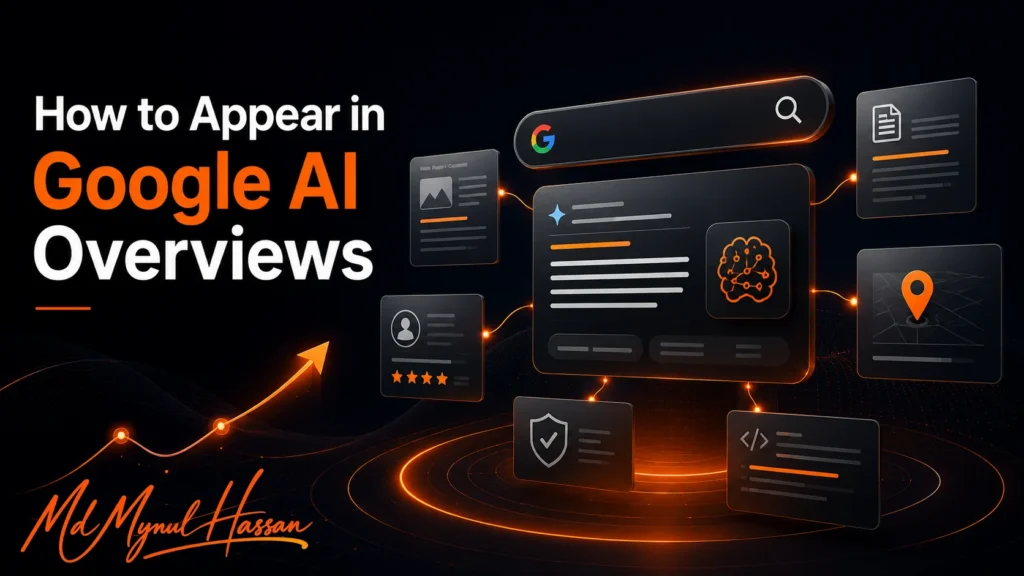
How can my business appear in Google AI Overviews?
It is easy to assume that AI search requires a completely different type of SEO.
From my experience working on practical SEO strategies over the last two years, I see it differently.
The businesses that are best prepared for AI search are usually not the ones chasing every new AI optimization trick. They are the businesses that make it easy for Google and real customers to understand:
- what they do,
- who they help,
- where they operate,
- what expertise they have,
- which questions they can answer,
- and why their information deserves trust.
That is why I look at AI Overview optimization as part of a wider search visibility system.
Traditional SEO still matters. But today I also think about AEO, GEO, search intent, entities, topical authority, EEAT, Google Business Profile, internal linking and content clarity as connected parts of that system.
Google’s own current guidance supports this approach. Google says its normal SEO best practices remain relevant to AI Overviews and AI Mode, and there is no separate technical requirement that guarantees inclusion.
So the goal is not to find an AI Overview shortcut.
The goal is to build information that Google can find, understand, retrieve and confidently connect with a user’s question.
Quick Answer: How Can a Business Appear in Google AI Overviews?
To improve your chances of appearing in Google AI Overviews, make sure your important pages are crawlable and indexed, satisfy real search intent, provide original and expert-led information, cover topics deeply, use strong internal linking, demonstrate trustworthy business and author signals, maintain accurate local information where relevant and provide a good user experience.
For Google specifically, you do not need a special AI Overview schema, an llms.txt file or a completely different writing style designed only for AI systems. Google recommends continuing to build strong SEO foundations and useful, original content.
No legitimate SEO professional can guarantee that a page will appear in an AI Overview. Google itself states that meeting its requirements does not guarantee crawling, indexing or serving.
What we can do is build a much stronger foundation for eligibility, relevance and trust.
What Are Google AI Overviews?
Google AI Overviews are AI-generated responses that can appear within Google Search for queries where Google’s systems determine that an AI-generated summary could help the user understand the topic.
These responses can include links to websites that support different parts of the answer.
That last point matters.
AI Overviews do not mean the web has disappeared. Google continues to retrieve information from its Search index and connect users with relevant websites. Google’s documentation explains that its generative Search systems use techniques including retrieval-augmented generation, or RAG, to retrieve relevant and current pages from its Search index.
Google may also use what it calls query fan-out.
Instead of looking only at one exact phrase, the system can generate several related searches to gather information needed to answer a broader question.
This has important implications for SEO.
A page does not need to repeat every possible keyword variation.
It needs to demonstrate genuine relevance to the topic and answer the user’s needs clearly.
Why Google AI Overview Visibility Matters for Businesses
AI search is no longer a small experiment.
In June 2026, Google reported that AI Overviews had more than 2.5 billion monthly active users, while AI Mode had surpassed one billion monthly users.
That does not mean every search produces an AI Overview.
It does mean that AI-supported discovery is becoming a significant part of how people use Google.
People can now ask longer and more specific questions instead of relying only on short keyword searches.
For example, instead of:
local SEO service
someone might search:
What should a small service business fix first if it has a website and Google Business Profile but still gets very few local leads?
That question involves several ideas:
- Local SEO
- Google Business Profile
- website optimization
- search intent
- local visibility
- conversion
- trust
- service pages
A business with useful information across these connected subjects has a stronger knowledge footprint than a business with one thin page repeating “local SEO service” twenty times.
This is why modern SEO requires more than keyword placement.
How Google Chooses Information for AI Overviews
There is no public checklist that says:
“Complete these ten steps and Google will cite your page.”
Google’s systems are more complex than that.
But Google has now published enough official information for us to understand the foundation.
Your Page Needs to Be Eligible for Google Search
Before thinking about AI Overview visibility, ask a simpler question:
Can Google properly access and index this page?
Google says a page must be indexed and eligible to appear in normal Google Search with a snippet before it can be eligible as a supporting link in its generative AI features.
This is why I would start with technical SEO before chasing GEO tactics.
If you are unsure whether technical problems are limiting your site, my SEO Audit Service is designed to identify crawlability, indexation, content, internal linking and other visibility issues before deeper optimization begins.
For more technical implementation work, see my Technical SEO Service.
Google Can Expand the Original Query
Query fan-out means Google may retrieve information related to multiple subtopics around the original question.
Imagine someone asks:
“How can I improve local visibility for my dental clinic?”
Related information could involve:
- dental Local SEO,
- Google Maps visibility,
- Google Business Profile categories,
- reviews,
- local landing pages,
- service information,
- location relevance,
- website authority,
- trust,
- and patient questions.
This is one reason I focus on topic coverage and connected expertise rather than building every page around one exact-match keyword.
1. Fix the SEO Foundation Before Trying to Optimize for AI
One thing I often see when reviewing websites is that people want advanced strategies before fixing basic problems.
They ask about AI Overviews while their website has:
- pages Google cannot easily discover,
- weak internal linking,
- duplicate pages,
- unclear canonical signals,
- poor mobile performance,
- slow pages,
- thin service pages,
- incorrect redirects,
- weak title tags,
- or important content buried inside confusing page structures.
AI search does not make those problems disappear.
Google explicitly says that its existing technical SEO practices continue to matter for generative AI search.
What I Would Check First
I would review:
- Crawlability
- Indexability
- XML sitemap
- Robots directives
- Canonicals
- Internal linking
- Page speed
- Mobile usability
- Duplicate content
- JavaScript accessibility where relevant
- Search Console indexing information
- Important content visibility
If the foundation is weak, start with a proper SEO audit rather than trying to add “AI optimization” on top of technical problems.
2. Understand Search Intent Before Writing More Content
Keywords are still useful.
But I do not treat keyword research as a list of phrases to place into an article.
The more important question is:
What is the person actually trying to understand, compare, solve or buy?
For this article, the main keyword is:
how to appear in Google AI Overviews
But the real intent includes questions such as:
- How does Google select AI Overview sources?
- Does normal SEO still matter?
- Does GEO help?
- Does AEO help?
- Do I need schema?
- Do I need llms.txt?
- Does EEAT matter?
- How should content be written?
- Can local businesses appear?
- How can I measure AI Overview visibility?
A useful page should address that wider intent naturally.
If you need help identifying commercial, informational and buyer-intent opportunities before creating pages, see my Keyword Research Service.
3. Create Information That Adds Something Original
This is one of the areas where I believe many websites will struggle.
There is already a huge amount of generic content online.
Anyone can publish:
“10 SEO tips.”
“What is Local SEO?”
“Why is content important?”
Google’s 2026 guidance specifically recommends creating valuable, unique and non-commodity content. It also encourages publishers to bring first-hand experience and unique perspectives rather than simply recycling information already available elsewhere.
That is where EEAT and real experience become practical.
Generic Content
A generic paragraph might say:
SEO audits help identify problems on your website.
That is technically correct.
But it adds very little.
Experience-Led Content
A stronger version could explain:
When I review a service-business website, I usually do not start by looking for the largest number of tool errors. I first check whether Google can understand the core services, whether the pages match search intent, whether important pages are internally connected and whether the business provides enough trust information for someone to feel confident contacting it.
Now the reader gets actual thinking.
That is much harder to replace with generic information.
If your site needs this kind of expert-led content structure, my Content Strategy & SEO Writing Service focuses on useful search-intent coverage rather than publishing filler.
4. Write for People First, but Make Answers Easy to Extract
AEO is useful when it encourages us to make answers clearer.
For example, a user asks:
What is Google AI Overview optimization?
Instead of hiding the answer beneath five paragraphs of introduction, provide it clearly.
Direct Answer
Google AI Overview optimization is the process of improving a website’s technical accessibility, content usefulness, topical relevance, trust signals and overall search visibility so its information has a stronger chance of being retrieved and referenced within Google’s generative Search experiences.
Then expand.
This helps:
- readers,
- traditional search,
- featured-snippet style results,
- answer engines,
- AI systems,
- and voice-style queries.
But I would not turn every article into hundreds of tiny disconnected answer blocks.
Google specifically says there is no requirement to artificially “chunk” content into tiny pieces for its AI systems.
The better goal is clarity.
My AEO & GEO Consulting approach connects this answer-focused structure with normal SEO rather than treating it as a separate trick.
5. Build Topical Authority Around Your Real Expertise
One article rarely establishes a complete subject.
If a business wants stronger visibility around a topic, I normally think in terms of a connected topic ecosystem.
Suppose your main service is Local SEO.
A strong supporting content system might address:
- what Local SEO is,
- Google Business Profile optimization,
- Google Maps visibility,
- local keyword research,
- reviews,
- local citations,
- service-area businesses,
- location pages,
- local landing pages,
- local competitor analysis,
- local schema,
- local content,
- conversion from Maps traffic,
- and AI search for local businesses.
Each page should have its own useful purpose.
The goal is not to publish fifty near-identical pages.
Google warns that creating large quantities of content around every possible query variation purely to manipulate search or generative responses can conflict with its spam policies.
Topical authority comes from depth, useful relationships and expertise, not page count.
For businesses focused on geographic visibility, my Local SEO Service connects website relevance, local search signals and Google Maps visibility rather than treating them as separate tasks.
6. Strengthen Internal Linking
Internal linking is one of the most practical ways to show how your expertise connects.
If I mention technical indexing problems in this article, it makes sense to link to my Technical SEO Service.
When discussing identifying search opportunities, I can naturally point to Keyword Research.
When discussing page-level optimization, On-Page SEO is the logical next resource.
When discussing AI search specifically, AEO & GEO Consulting is the deeper commercial page.
That creates a clear relationship:
AI Search → SEO → Technical Foundation → Search Intent → Content → AEO/GEO → Conversion
Good Internal Links Should Help the Reader
Do not add an internal link because an SEO tool tells you that a page needs seven links.
Ask:
If someone is reading this paragraph, what would genuinely help them next?
That usually produces better anchor text and better linking decisions.
7. Make EEAT Visible Instead of Simply Claiming Expertise
EEAT stands for:
- Experience
- Expertise
- Authoritativeness
- Trustworthiness
But I do not believe EEAT should be approached by writing:
“We are experts. Trust us.”
That proves very little.
Show Experience
Explain what you have learned through actual work.
Share:
- what you usually check,
- what mistakes you repeatedly notice,
- how you prioritize,
- what you disagree with,
- and how you approach difficult decisions.
Show Expertise
Go deeper than definitions.
Explain why something matters and how different factors connect.
Build Authoritativeness
Create a consistent body of useful information around subjects you genuinely work with.
Connect related pages.
Make your professional positioning clear.
Build Trust
This is the most important part for me.
Do not invent:
- case studies,
- rankings,
- traffic percentages,
- revenue,
- awards,
- certifications,
- partnerships,
- or client results.
If something cannot be proven, do not use it as proof.
A trustworthy website should also make it easy to understand:
- who wrote the content,
- who provides the service,
- how to contact the business,
- what the business actually offers,
- where claims come from,
- and when information was last reviewed.
My approach is simple:
Do not try to look authoritative. Build information that demonstrates why you should be trusted.
8. Optimize Your Google Business Profile for Local AI Search
This point is especially important for local businesses.
Google’s current generative Search guidance says AI responses can include information about local businesses and specifically mentions Google Business Profile as a way to help business information appear across Google experiences.
This means your website should not be the only source of clear business information.
Your Google Business Profile should accurately reflect:
- business name,
- primary category,
- relevant secondary categories,
- services,
- address or service area,
- hours,
- website,
- phone details,
- photos,
- business description,
- and other applicable profile information.
If a customer sees one message on your website and another on your Business Profile, you create unnecessary confusion.
When I work on a Google Business Profile, I try to connect it with the wider Local SEO strategy rather than optimizing the profile in isolation.
For more detail, see my Google Business Profile Optimization Service.
9. Use Structured Data Properly – But Ignore “AI Schema” Hype
Structured data can help Google understand specific types of information and can make pages eligible for supported Search features.
It is still useful.
But there is an important distinction.
Google does not require special structured data for AI Overviews or AI Mode.
Google’s 2026 AI optimization guidance explicitly states that there is no special schema.org markup businesses need to add for generative AI Search.
So I would not add invented markup such as:
- AIOverview schema,
- GEO schema,
- AI citation schema,
- special ChatGPT schema,
- or random properties that are not valid.
Use legitimate structured data that accurately matches visible content.
Depending on the page, that could include:
- Article
- Person
- Organization
- LocalBusiness
- Product
- BreadcrumbList
- Service-related entity information where supported and appropriate
Structured data should support a clear website.
It cannot rescue weak content.
10. Do You Need an LLMS.txt File for Google AI Overviews?
For Google Search, the current answer is straightforward:
No.
Google says it does not use llms.txt as a special visibility or ranking mechanism for Google Search, including its generative AI features.
You may decide to create one for another platform that uses it.
But I would not tell a business:
“Add llms.txt and you will rank in AI Overviews.”
Google’s own guidance does not support that claim.
This is a good example of why I prefer official documentation and practical testing over following every new SEO trend.
11. Do Not Rewrite Your Entire Website “For AI”
Another mistake I expect to see more often is businesses rewriting natural content into strange AI-oriented language.
For example:
Question. Answer. Entity. Product. Location. Fact. Citation.
That is not automatically better content.
Google says publishers do not need to write in a special format purely for its generative AI systems. Its systems can understand synonyms and broader meaning without exact keyword repetition.
Write clearly.
Use natural language.
Answer important questions.
Structure long pages properly.
Use headings where they help.
But do not sacrifice human readability because someone sold you an “AI-readable content formula.”
12. Improve On-Page SEO and Content Structure
A strong page should make its main topic obvious.
I normally check:
- Title tag
- H1
- opening paragraph
- H2/H3 structure
- primary topic coverage
- related entities
- search intent
- internal links
- external references where useful
- image relevance
- alt text
- author information
- supporting evidence
- CTA placement
- readability
- mobile presentation
This is where traditional On-Page SEO still plays an important role.
Does Heading Structure Affect AI Overview Visibility?
There is no rule saying that you must use every heading from H1 to H6.
A good structure might be:
- H1 — Main page topic
- H2 — Major sections
- H3 — Subsections
- H4 — Deeper supporting sections
- H5/H6 — Only where content actually requires deeper nesting
The purpose is clarity, not creating heading levels for an SEO checklist.
Google’s guidance encourages content to be organized into readable sections and headings for users.
13. Add Relevant Images and Video Where They Improve the Page
Modern search is not purely text.
Google’s current generative AI guidance specifically recommends using relevant, high-quality images and video when they genuinely improve the content.
For this article, I would consider adding:
- A screenshot showing an example Google AI Overview
- A diagram explaining query fan-out
- A visual showing my modern search visibility system
- A checklist graphic for AI Overview readiness
- A screenshot of the Search Console Generative AI report if available on the property
Each image should have:
- a descriptive filename,
- relevant alt text,
- appropriate dimensions,
- sensible compression,
- and useful surrounding text.
If site performance is weak, image-heavy pages can create another problem. In that situation, Website Speed Optimization should be considered alongside content improvements.
14. Understand the Relationship Between SEO, AEO and GEO
I do not treat these as three competing strategies.
SEO
SEO creates the foundation for organic discovery.
It includes:
- crawling,
- indexing,
- technical health,
- keywords,
- search intent,
- content,
- internal links,
- authority,
- and user experience.
AEO
Answer Engine Optimization focuses more closely on making information understandable and useful for direct-answer experiences.
For me, that means:
- clear questions,
- concise answers,
- definitions,
- comparisons,
- structured explanations,
- and complete intent coverage.
GEO
Generative Engine Optimization focuses on visibility inside generative search and AI-assisted discovery.
That can influence how we think about:
- entities,
- topical relationships,
- unique information,
- citations,
- trust,
- author identity,
- expert perspectives,
- and answer completeness.
Google itself says AEO and GEO are terms used in the industry, but from Google’s perspective, optimization for its generative Search experiences is still part of SEO.
That is why my AEO & GEO Consulting connects AI visibility with SEO foundations rather than replacing them.
15. Create Topic Clusters Instead of Isolated Blog Posts
If you want topical authority around AI search, one article should support other useful pages.
For example:
Pillar Topic
AI Search Visibility
Supporting Topics
- What is AEO?
- What is GEO?
- AEO vs GEO vs SEO
- How Google AI Overviews work
- How to optimize content for AI search
- EEAT and AI search
- Structured data for AI search
- Local SEO and AI Overviews
- Google Business Profile and AI Search
- Ecommerce SEO for AI search
- Search intent in generative search
- How to measure AI search visibility
- AI content vs expert content
- Topical authority for AI search
Then connect those resources logically.
This is how a website starts becoming a useful knowledge source around a subject rather than a collection of unrelated posts.
16. Build Stronger Entity Signals
Modern search is increasingly about understanding things and their relationships, not only matching strings of text.
Your website should make important entities clear.
For my own professional presence, those relationships could include:
Md Mynul Hassan → SEO → Local SEO → Google Business Profile → AEO → GEO → search visibility → technical SEO → content strategy
For a dentist:
Business → Dentist → Location → Treatments → Doctor → Qualifications → Reviews → Contact information
For an ecommerce business:
Brand → Product category → Individual products → Features → Specifications → Reviews → Shipping → Returns
The goal is not to stuff entity names.
It is to explain the real relationships clearly across your content and website architecture.
17. Keep Your Business Information Consistent
This is especially important for Local SEO and trust.
Your:
- name,
- services,
- address,
- contact information,
- location,
- author identity,
- professional positioning,
- and business description
should not contradict each other across important pages and platforms.
Consistency helps users understand the business.
For local businesses, this should extend to the website and Google Business Profile.
For broader brands, it can include major professional profiles and authoritative third-party references where appropriate.
18. Support Important Claims With Reliable Sources
I do not think every sentence needs an external citation.
But important factual claims should be supported when a reliable primary source exists.
For this article, the strongest external authority is Google’s own documentation.
Useful official resources include:
- Google’s guide to optimizing for generative AI Search
- Google’s AI features and your website documentation
- Google Search Console Generative AI performance report
- Google Search Essentials
I prefer primary documentation for claims about how Google Search works.
19. Improve Page Experience After You Win the Click
Getting mentioned by AI search is not the final objective.
A person still needs a reason to:
- click,
- stay,
- understand,
- trust,
- contact,
- subscribe,
- book,
- or buy.
That means SEO should connect with user experience and conversion.
Ask:
If someone lands on this page from an AI Overview, what happens next?
Can they understand the business?
Can they find related information?
Is the CTA clear?
Does the website look trustworthy?
Does it work properly on mobile?
Does it load quickly?
Is the next step obvious?
For businesses receiving traffic but struggling to turn visitors into enquiries, Conversion Rate Optimization becomes part of the wider growth strategy.
20. Measure AI Search Visibility in Google Search Console
AI visibility should not remain pure guesswork.
Google introduced a dedicated Generative AI performance report within Search Console in 2026. The report includes impressions from AI Overviews and AI Mode and can show performance by page, country, device and date. Google is rolling the feature out progressively, so not every property necessarily has access yet.
What I Would Monitor
If the report is available, I would look at:
- pages receiving AI impressions,
- changes over time,
- countries,
- device distribution,
- which topics are receiving visibility,
- and whether pages receiving AI visibility support business goals.
Then I would compare those findings with normal Search Console information.
The question is not only:
“Did AI show my page?”
It is also:
“Is Google increasingly understanding my website as relevant to the subjects that matter to my business?”
My Practical AI Overview Optimization Process
When I approach this type of visibility problem, I would not begin by installing an “AI SEO plugin.”
I would work through the site systematically.
Stage 1: Understand the Business
First, I need clarity around:
- core services,
- target customers,
- locations,
- commercial goals,
- strongest areas of experience,
- existing content,
- and current visibility.
Stage 2: Audit Search Visibility
Next, I would review:
- indexing,
- technical SEO,
- content,
- keyword targeting,
- search intent,
- internal links,
- topical gaps,
- local signals,
- author information,
- and trust.
A professional SEO Audit Service is useful here because fixing the wrong problem wastes time.
Stage 3: Map Topics and Search Intent
Then I would identify:
- primary commercial topics,
- informational questions,
- supporting subtopics,
- search-intent gaps,
- answer opportunities,
- and internal-link relationships.
This is where Keyword Research becomes strategic rather than simply collecting search volume.
Stage 4: Improve Core Pages
Page-Level SEO Checks
I would improve:
- titles,
- headings,
- introductions,
- service explanations,
- answer clarity,
- internal links,
- trust information,
- supporting evidence,
- and CTAs.
Answer Extraction Check
For important questions, I ask:
Can someone understand the answer quickly without losing the context needed to trust it?
Example: Service-Business Answer Block
Question: Can Local SEO help a service business appear in AI search?
Answer: Local SEO can strengthen the business information, geographic relevance, website content and Google Business Profile signals that support visibility across Google’s search ecosystem. However, there is no guaranteed method for appearing in an AI Overview.
The answer is clear.
The supporting explanation can then go deeper.
Stage 5: Build Supporting Content
I would publish content only when it fills a real gap.
Not because:
“we need four blogs this month.”
I want every article to strengthen:
- an important topic,
- a real search intent,
- an internal-link relationship,
- a commercial service,
- or the site’s overall expertise.
Stage 6: Strengthen Trust and Entity Clarity
I would make sure the site clearly communicates:
- who is responsible for the content,
- who provides the service,
- what experience exists,
- what the business actually offers,
- and how users can verify or contact the business.
Stage 7: Measure and Improve
SEO is not complete when a page is published.
I would monitor:
- impressions,
- clicks,
- indexing,
- query visibility,
- AI Search impressions where available,
- conversions,
- and engagement with important pages.
Then improve based on evidence.
Common AI Overview SEO Mistakes I Would Avoid
1. Publishing Hundreds of AI-Generated Articles
Using AI does not automatically make content bad.
But producing large amounts of generic content without original value is not a sustainable search strategy.
Google’s guidance says AI-assisted content still needs to meet its normal Search quality and spam policies.
2. Chasing Every Long-Tail Variation
You do not need separate pages for:
- how to rank AI Overview,
- ranking AI Overview,
- appear AI Overview,
- get into Google AI Overview,
- AI Overview ranking SEO,
- Google AI result ranking
when one strong page can satisfy the underlying intent.
3. Adding Fake Experience
Never invent:
“After helping 500 businesses…”
unless you actually have that proof.
4. Buying Fake Mentions
Google specifically warns against pursuing inauthentic mentions purely to influence generative Search visibility.
5. Believing AI Search Has Replaced SEO
Google’s current documentation says the opposite: core SEO systems continue to underpin generative Search.
6. Ignoring Local Search
Local businesses should not abandon Google Maps or Google Business Profile while chasing AI citations.
7. Ignoring Conversion
An AI Overview mention that produces no trust, enquiry or business value is not the complete goal.
Example: Local Service Business
Imagine a plumbing company wants visibility for:
“Who should I call if my water heater keeps losing pressure?”
A weak website may contain:
We are the best plumbers in London. Call today.
A useful website could explain:
- common causes,
- warning signs,
- when the issue is urgent,
- what the homeowner can safely check,
- when a professional is required,
- what the repair process usually involves,
- which areas the company serves,
- and the company’s relevant experience.
It could then link to:
- water heater repair service,
- emergency plumbing,
- service areas,
- FAQ,
- reviews,
- and contact information.
That content gives both the user and search systems substantially more context.
Example: Ecommerce Business
Suppose someone searches:
“Which running shoe is better for a beginner with wide feet who walks more than they run?”
A product page containing only:
- product title,
- manufacturer description,
- SKU,
- and price
provides limited original value.
A stronger ecommerce content system could include:
- real measurements,
- fit information,
- comparison with alternatives,
- who the product is suitable for,
- who should avoid it,
- photographs,
- FAQs,
- material information,
- testing or experience where available,
- and links to relevant categories.
For ecommerce websites, that broader approach connects naturally with Ecommerce SEO.
Example: B2B or Professional Service Business
A B2B company should think beyond:
“digital transformation services.”
Potential customers may ask:
- What does the service actually include?
- Who needs it?
- How is implementation handled?
- What risks should management understand?
- What systems are involved?
- What does success look like?
- What should a buyer ask before hiring a provider?
- How does the approach differ by company size?
Answering those questions can create much stronger commercial authority than publishing only high-level thought leadership.
AI Overview Readiness Checklist
Before I would consider a website well prepared for modern Google Search, I would check the following:
- Is the important content crawlable?
- Are the important pages indexed?
- Does each page satisfy a clear search intent?
- Does the page answer important questions directly?
- Does the content provide original information or experience?
- Is the business entity clear?
- Is the author clear where appropriate?
- Are related topics covered?
- Are related pages internally linked?
- Are service pages strong enough?
- Is Google Business Profile accurate where relevant?
- Are local signals consistent?
- Are claims honest?
- Are important facts supported?
- Is structured data valid and accurate?
- Is the website mobile friendly?
- Is the page reasonably fast?
- Are images useful and optimized?
- Is the CTA appropriate?
- Can users easily contact or verify the business?
- Is Search Console configured?
- Is AI visibility being monitored where the report is available?
If several of these are weak, I would fix the foundation before worrying about advanced GEO terminology.
Frequently Asked Questions About Google AI Overviews
Can I Pay Google to Appear in an Organic AI Overview?
Organic inclusion in AI-generated Search responses should not be confused with buying an organic ranking or citation. Businesses should focus on normal search eligibility, useful information, relevance and trust rather than expecting payment to guarantee an organic AI source placement.
Can SEO Help Me Appear in Google AI Overviews?
Yes, SEO is the foundation.
Google states that its generative AI Search features rely on its core Search systems, so technical SEO, crawlability, indexing, helpful content and overall Search quality remain important.
Is GEO Different From SEO?
GEO is a useful industry term for thinking specifically about visibility in generative search systems.
However, Google says that from its perspective, optimizing for its generative Search experience remains part of SEO.
Is AEO Important for Google AI Overviews?
AEO can be useful because it encourages clear answers, good information architecture and stronger coverage of user questions.
But it should complement strong SEO rather than replace it.
Do I Need Special Schema for Google AI Overviews?
No.
Google says there is no special structured-data requirement for generative AI Search.
Use legitimate structured data when it accurately represents the page and supports eligible Google Search features.
Does Google Use LLMS.txt for AI Overviews?
According to Google’s current documentation, Google Search does not use llms.txt as a special mechanism for rankings or visibility in its generative Search features.
Does EEAT Help With AI Search Visibility?
Google’s systems are designed to surface useful and reliable information, and Google continues to emphasize helpful, reliable, expert-led and people-first content.
From a practical SEO perspective, strong experience, expertise, authority and trust signals make content more useful and credible whether a visitor discovers it through traditional Search or an AI-supported result.
Can a Local Business Appear in Google AI Overviews?
Local-business information can be used within Google’s generative Search experiences where relevant, and Google’s current guidance specifically recommends keeping Google Business Profile information accurate.
Local businesses should therefore connect their website SEO, Local SEO and Google Business Profile optimization.
Can AI-Generated Content Appear in Google Search?
Google focuses on content quality rather than simply whether AI was used to help create it.
However, generating large amounts of content without adding value can conflict with Google’s spam policies.
The important question is whether the finished content provides real value, originality and usefulness.
How Long Does It Take to Appear in Google AI Overviews?
There is no guaranteed timeframe.
A page first needs to be discoverable, crawlable and eligible for Search, but even meeting Google’s requirements does not guarantee inclusion in an AI Overview.
How Can I Track Whether My Website Appears in AI Overviews?
Google has begun rolling out a dedicated Generative AI performance report in Search Console. It can show AI-related impressions and information by page, country, device and date.
Availability may vary while Google continues the rollout.
Final Thoughts: AI Search Optimization Is Really About Clarity, Usefulness and Trust
Google AI Overviews have changed the search experience.
But I do not think businesses should respond by abandoning everything they already know about good SEO.
The fundamentals still matter.
Your website needs to be technically accessible.
Your pages need clear search intent.
Your content needs depth.
Your information needs to be useful.
Your expertise needs to be visible.
Your internal links need to connect related subjects.
Your business information needs to be accurate.
Your Google Business Profile needs attention if Local SEO matters.
Your claims need to be honest.
And your content needs to give people a reason to trust you after they find you.
That is also why I do not separate SEO, Local SEO, Google Business Profile optimization, AEO, GEO, content, technical SEO, topical authority, EEAT and conversion into completely isolated strategies.
They work better when they support one another.
If your website already exists but is not generating enough visibility, traffic, trust or enquiries, the answer may not be to publish more content immediately.
First find out what is actually missing.
You can start with my SEO Audit Service, explore my AEO & GEO Consulting, or visit Md Mynul Hassan to learn more about my approach to modern search visibility.
My goal is not to promise that I can force Google to cite a website.
My goal is to build a stronger visibility foundation so the business becomes:
easier to find, easier to understand, easier to trust and easier to choose.
Be found. Be understood. Be chosen.
— Md Mynul Hassan
SEO, AEO, GEO and Brand Visibility Specialist